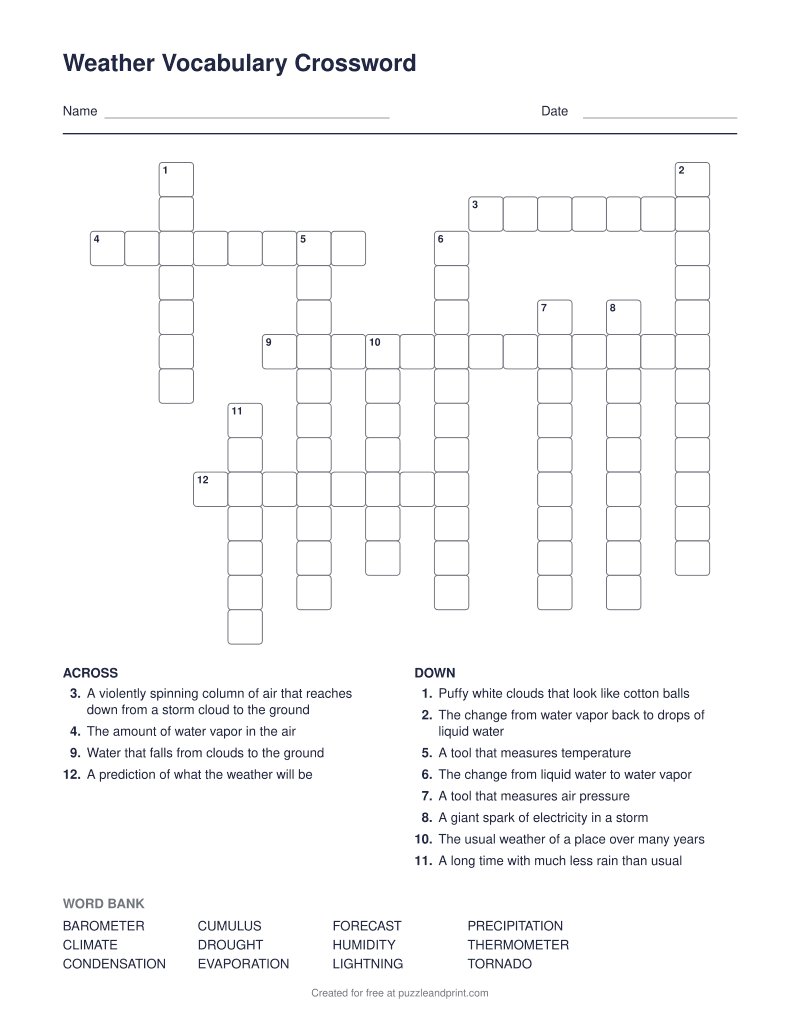
What a crossword from this maker looks like
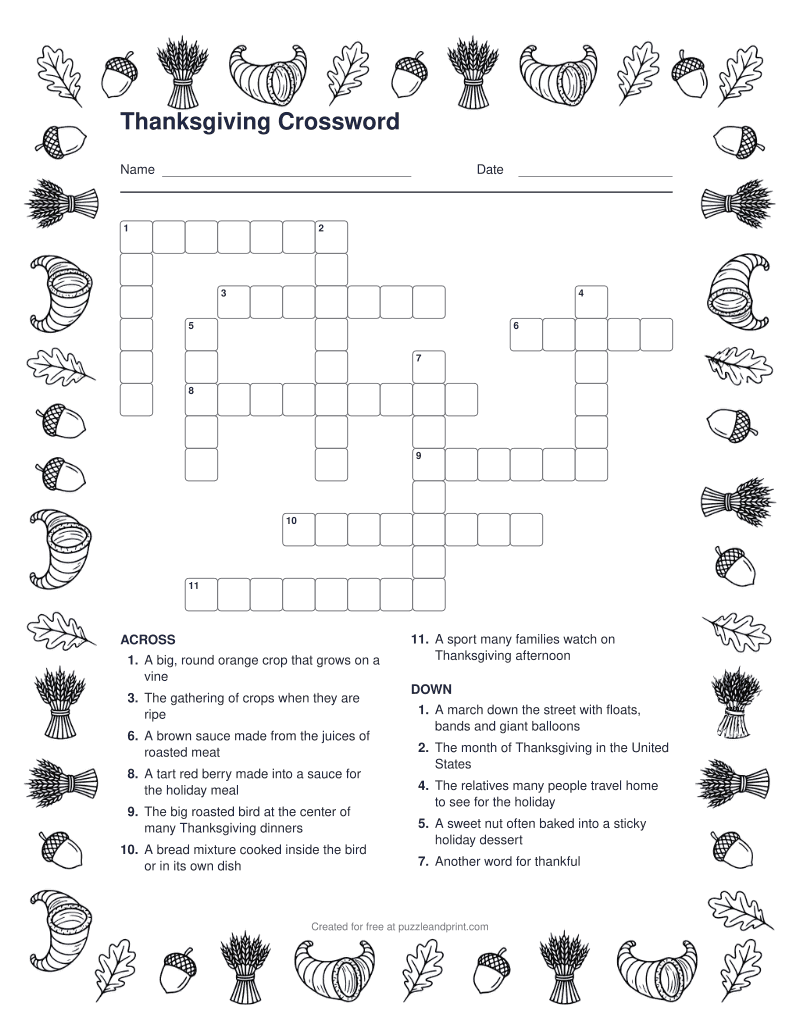
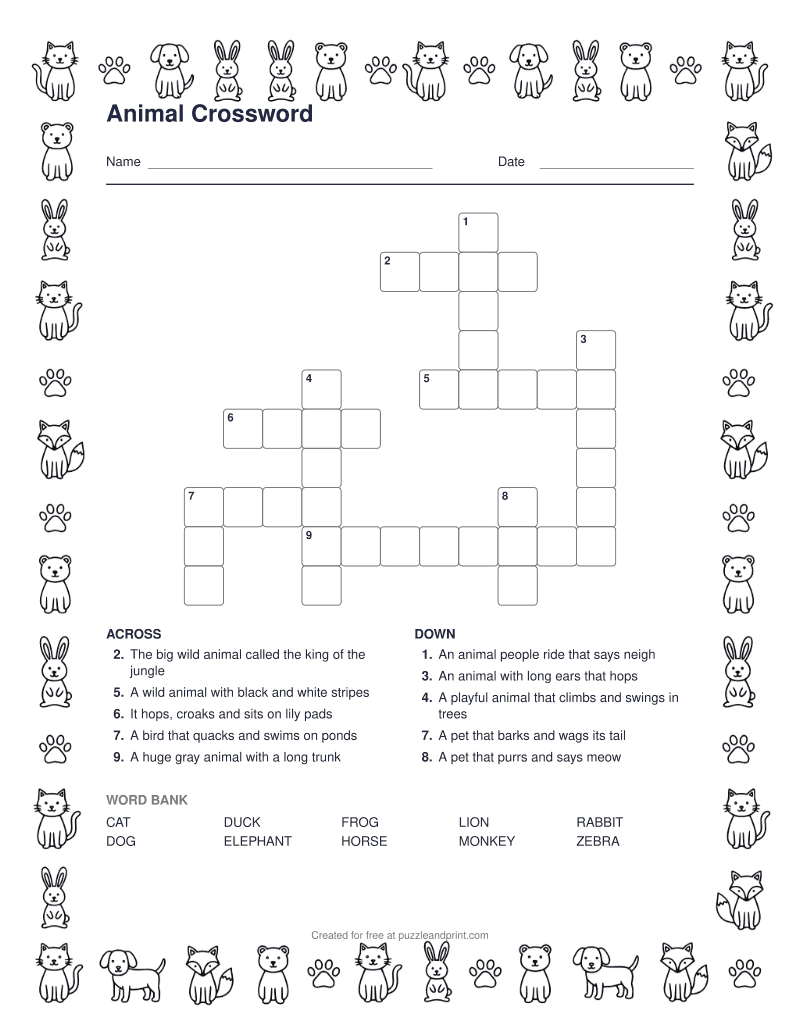
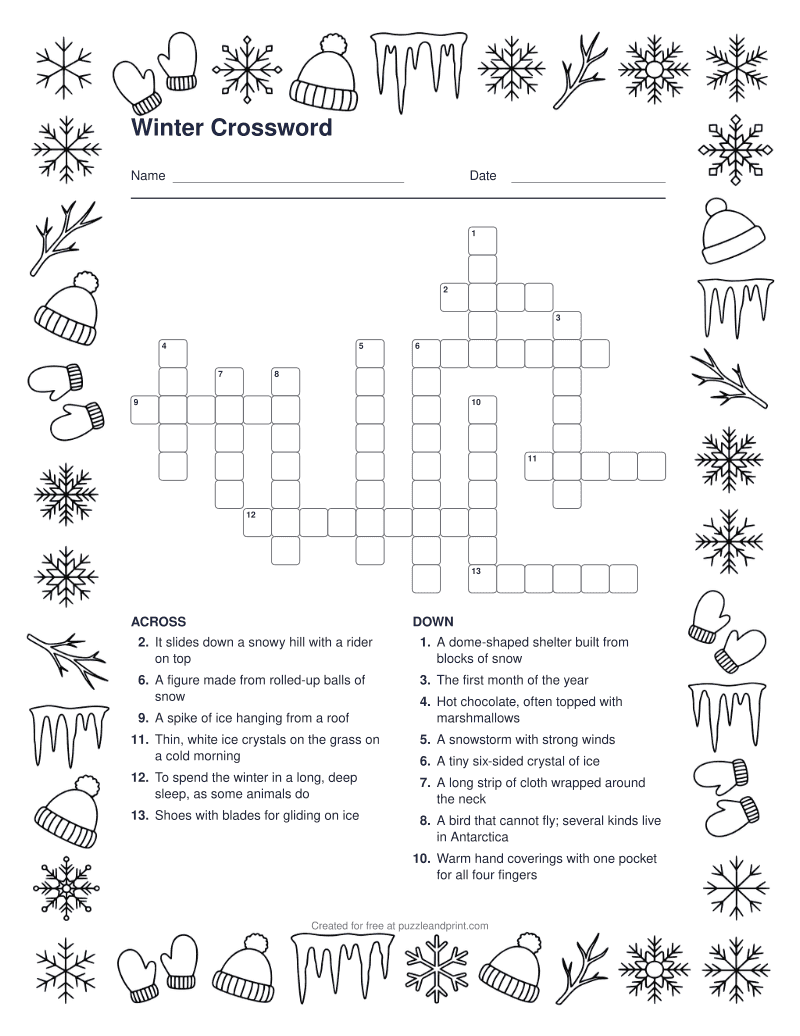
A title, a line for a name and a date, then the grid. Only the squares an answer passes through are drawn, each numbered where an answer starts, and the rest of the page stays white rather than filling with black squares. Under the grid the clues are set in two columns, Across first and then Down, each with its number.
Two options change the sheet. List the answers adds a word bank under the clues, the answers in alphabetical order, which turns a hard crossword into one a younger class can finish. Large print sets the clues at 14 point rather than 10, stepping down to no less than 12 only when a long list would not otherwise fit, and draws squares at least 0.44 inch across; it prints without a border, and when the clues and the bigger grid will not share a page, the clues get a page of their own.
The answer key is a separate page and always plain, whatever border the puzzle wears: the filled grid, then every answer listed by number under Across and Down, so the answers can be read out to a class. Ask for up to five versions and each one fits the same clues into a grid of its own, with its own key. A short list fits together in only a few ways, so when two versions come out the same, a note beside the settings says so.
Pasting a vocabulary list from a spreadsheet or Quizlet
Choose Write my own and put one answer and its clue on each line, as harvest = the gathering of ripe crops. An equals sign, a colon or a spaced dash all work as the divider, and whichever comes first on the line is the one used, so a definition with a colon of its own stays whole.
Two columns copied from a spreadsheet arrive with a tab between them, and that works too, as does a Quizlet set exported with its default settings, which put a tab between each term and its definition and a new line between cards. A header row reading Term and Definition, or Word and Clue, is recognized and skipped.
A worked example: a weather unit typed as evaporation = the change from liquid water to water vapor, then condensation, precipitation and the rest in the same way, is the Weather vocabulary sheet in the ready-made set on this page. Definitions can run to 120 characters. A longer one is named in a warning and left out, rather than printed in small type.
Answers lose their spaces, accents and punctuation in the grid, as in any crossword, so crème brûlée fills eleven squares as CREMEBRULEE. A clue whose answer was typed as two or more words gains a note such as (2 words) at its end, so the solver knows to look for the break.
Crossword or criss-cross: which one to print
Both start from the same kind of grid, built by the same engine on this site. A crossword hands the solver a clue for each answer and hides the answers; a criss-cross hands over the list of answers and hides only where each one goes. The criss-cross maker needs nothing but a word list, which suits a spelling list early in the week. This maker needs a clue for every word, which suits a vocabulary list at the end of a unit, when the meanings are what is being checked.
The word bank option sits between the two. A crossword with its answers listed underneath asks for the meanings but supplies the words and their spelling, which is about the right step for a class meeting crosswords for the first time.
How every grid is checked before it prints
Every answer crosses at least one other, and no two answers ever lie side by side or run on end to end, so the only words on the page are the ones with clues: there is no stray two-letter fragment for a solver to puzzle over. The numbers follow the newspaper convention, left to right along each row and then down the page, and an across answer and a down answer that start in the same square share one number.
Every change to the maker has to pass a separate check that builds more than a thousand crosswords from the clue sets and from deliberately awkward lists, and confirms each of those rules along with one more: every clue printed belongs to the answer in its squares. It also confirms that each line of clue text fits its column at the size it prints.
An answer that shares no usable letter with the rest of the grid cannot be placed. From a typed list it is named in a warning beside the settings, and from a theme it is swapped for another clue from the same set, so a theme sheet always prints the number of clues asked for.
Who the ready-made clues are written for
Each theme gives its ages in the picker: animals for ages 6 to 8; Thanksgiving, Halloween and winter for 8 to 12; Christmas for 8 to 11; the weather words for grades 3 to 5; and a Christmas trivia set for teenagers and adults that draws on A Christmas Carol, The Nutcracker and old carols.
Each of the 170 clues was written for its set and checked against its answer, for accuracy and for the ages the set names. Where a clue is about folklore it says so, with "said to", "in stories" or "storybook", so it reads as true to every child in the room. And no clue names another answer from its own set, so one clue never gives away a second.