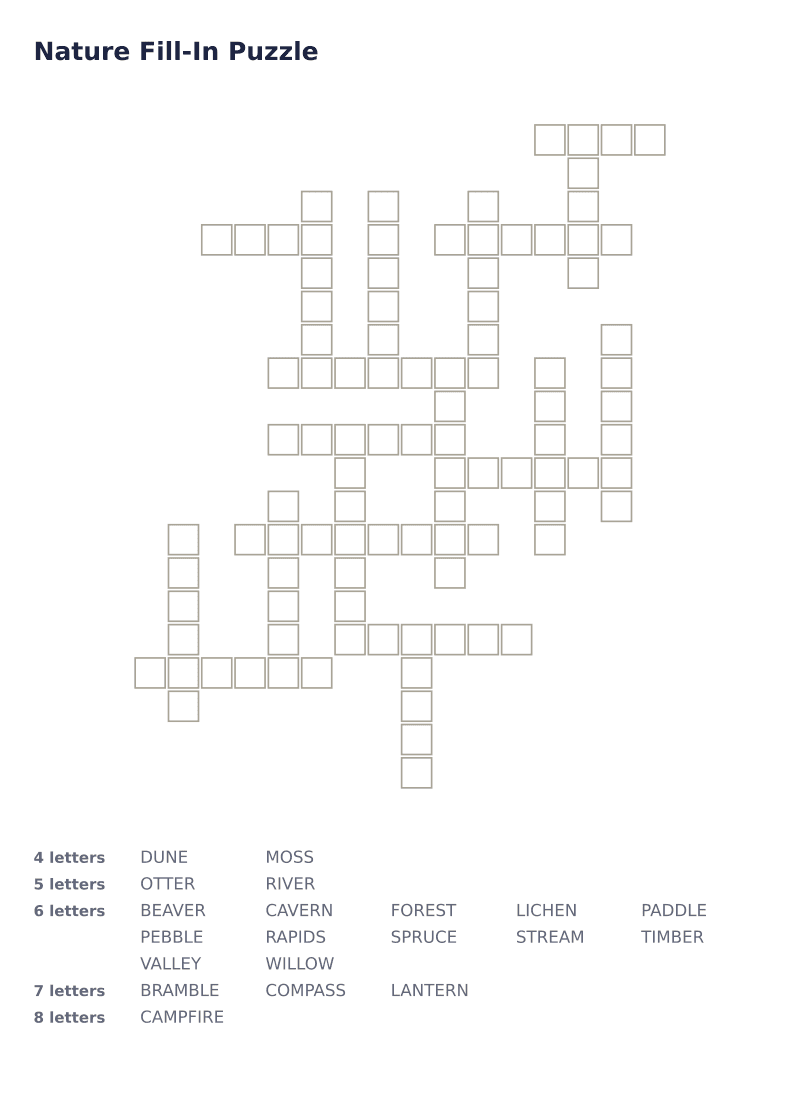
A fill-in hands you every answer and keeps back only where each one goes. The grid is a scatter of empty squares with nothing printed in them, and the twenty words that fill it are listed underneath by length, under 4 letters, 5 letters and on up. There is nothing to know and nothing to look up: the whole puzzle is fitting each word into a run of its own length so that every letter agrees with the word crossing it.
Grouping by length sounds as if it gives the game away, and on a list where every word was a different length it would. These four lists were picked so that it does not. Each has exactly one word whose length no other word shares, which is the way in, and then a crowd: eight seven-letter words on the weather and bird grids, eight five-letter words on the food grid, and twelve six-letter words on the nature grid. Telling the crowd apart is the work, and the crossing letters are the only help.
Every grid here was solved the slow way, by a program trying every word in every run, and each has exactly one way to be filled. A fill-in needs that checking more than most puzzles do, since two words of one length can sometimes trade places with every crossing still agreeing. Each can also be finished from its way in without a guess: from that first word on, there is always a run that only one word still fits, or a word with only one run left for it.
The maker above builds the same kind of grid from any of the 36 word lists or from words you type, four to twenty of them, printed with no numbers and the list grouped by length. It counts the solutions of every grid it draws and tries up to twelve arrangements to find one with a single answer, and says so on the form when none of them has one. Typed words stay on your device. For clues to solve instead, the crossword maker builds the same kind of grid with a clue for each answer.
Where to start on each of the four fill-in grids
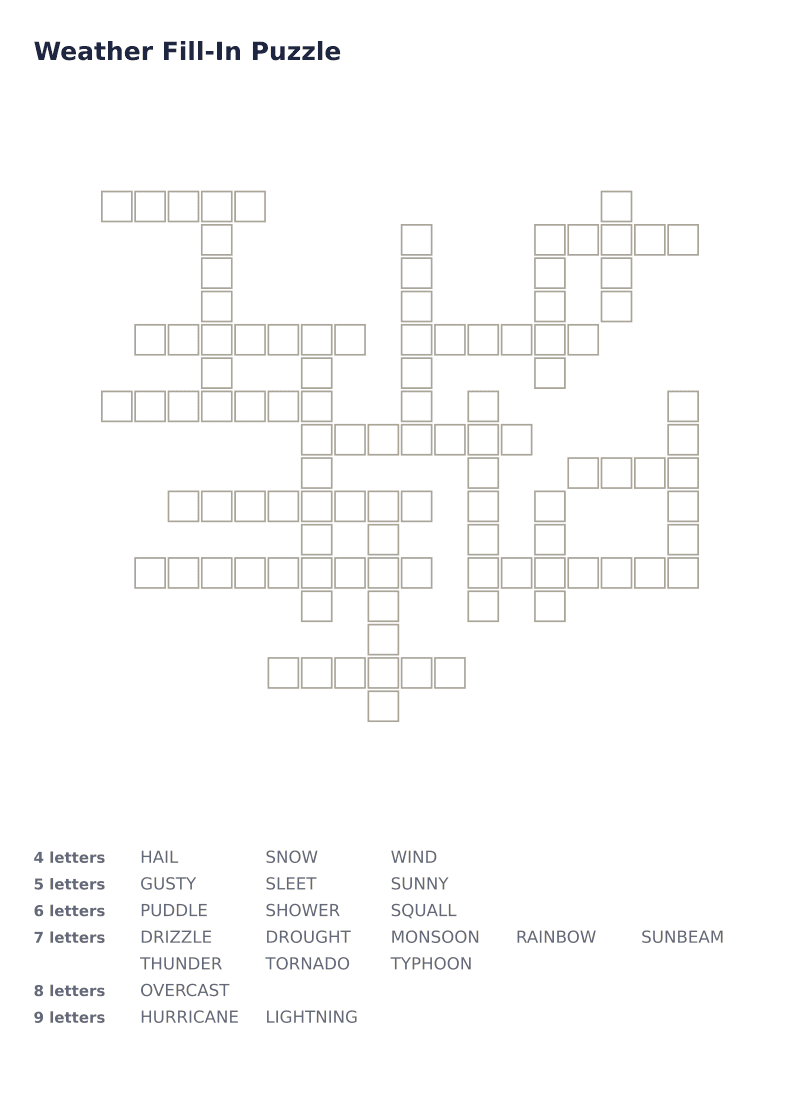
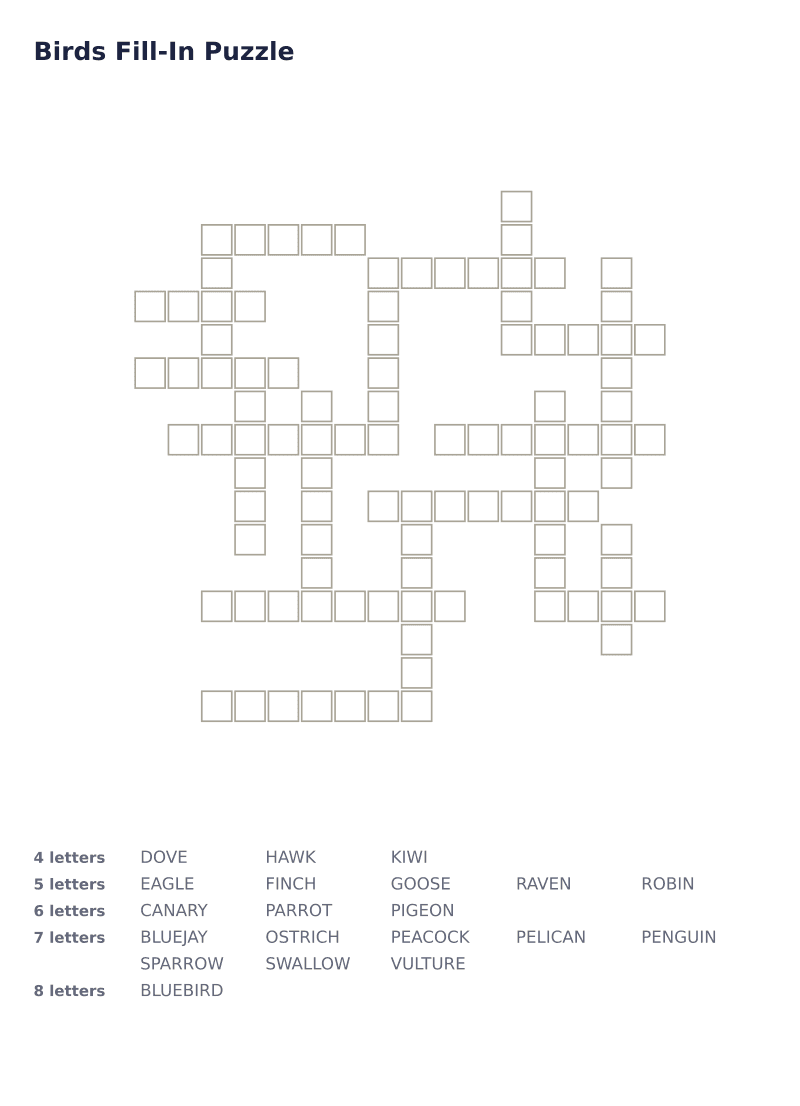
Start each grid with its one word of a length no other word on the list shares, because there is only one run of squares it can go in. On the weather grid that is OVERCAST, the only eight-letter word, which crosses HURRICANE at its C and SUNBEAM at its S. SUNBEAM is then the only seven-letter word on that list beginning with S, and HURRICANE the only nine-letter word with a C, so three words are in before anything has to be tested. The bird grid opens on BLUEBIRD, its only eight, which puts a letter into VULTURE and into SPARROW.
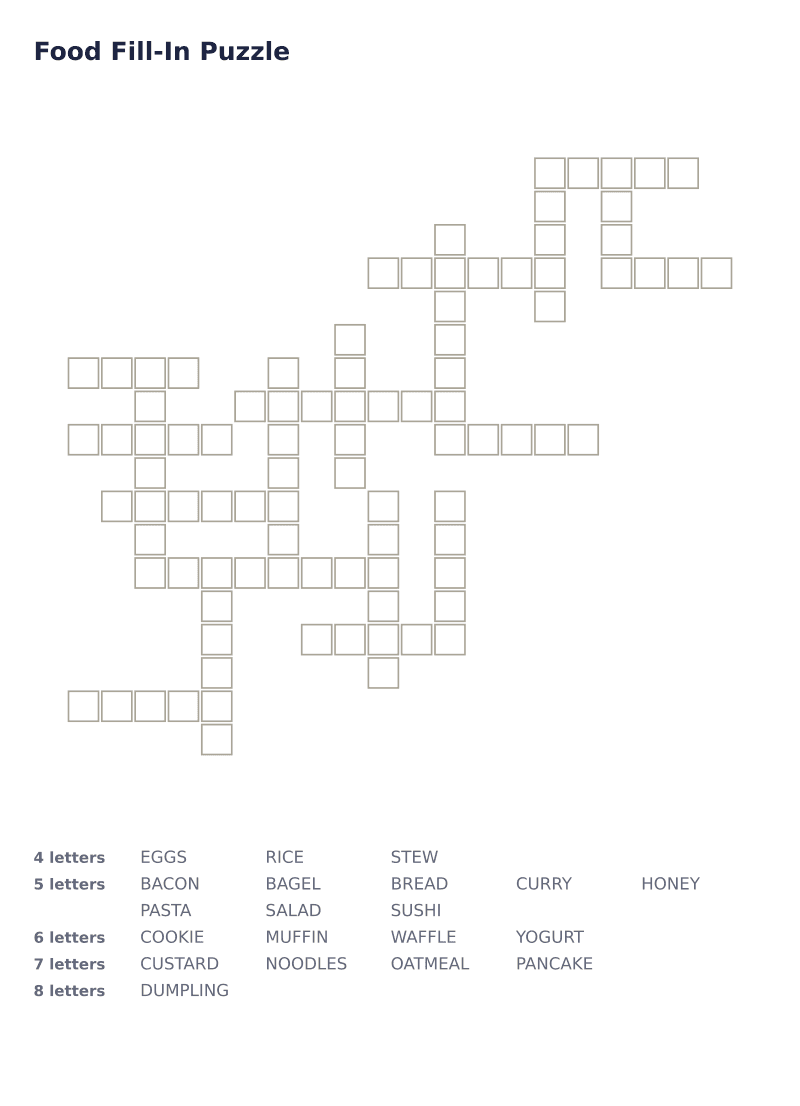
The food grid opens on DUMPLING, again the only eight, and it does more work than any other first word here: it crosses CUSTARD at the D, MUFFIN at the M, OATMEAL at the L and YOGURT at the G, so one word fixes a letter in four others. The nature grid opens on CAMPFIRE, which crosses LANTERN at the R, COMPASS at the P and RAPIDS at the A. Of the three seven-letter words only COMPASS has a P, so that run is settled at once. The A is less help to RAPIDS, since CAVERN, PADDLE and VALLEY also have an A second, and RAPIDS is one of the last words that grid gives up.
Why the crowded length is the hard part of a fill-in
On every grid one length holds a large share of the list, and that group is where a fill-in takes its time. The nature grid is the extreme case: twelve of its twenty words have six letters, from BEAVER to WILLOW, and one letter in place does not narrow a run much. The run VALLEY goes in crosses OTTER at an E and PADDLE at an A, and either letter alone still fits four of the twelve. Even so, nine of the twelve can be written in with only one of their letters in place; the rest of the work is keeping track of which six-letter words are already used.
A word that crosses only one other is pinned by that single letter, so it comes out only once that letter is in, and sometimes that is early: on the weather grid SQUALL, the only six-letter word there with an A, is settled as soon as SUNBEAM gives it one. The nature grid has seven words like that, MOSS, DUNE, RIVER, STREAM, CAVERN, PEBBLE and WILLOW, four of them in the crowded six-letter group. The food grid has seven too, BACON, HONEY, PASTA, SALAD and SUSHI among its five-letter words, with RICE and STEW. On the bird grid ROBIN, DOVE, HAWK and SWALLOW each hang off one word.