Bingo, card 1
PROJECTGLOBELUNCHBOXSCISSORSPOSTERDESKRECESSGLUESTAPLERMAPLIBRARYPENCILFREECLOCKNUMBERSMARKERWHITEBOARDSPELLINGSHARPENERBULLETINWRITINGLOCKERPAINTINGCHAIRNOTEBOOK
Created for free at puzzleandprint.com
Eighteen patterns to call, in black and white, as a two-page chart and as signs to hold up for the room.
Last updated
Save this to PinterestFour sheets to run the game with, all in black and white. The chart and the signs hold the same eighteen patterns.
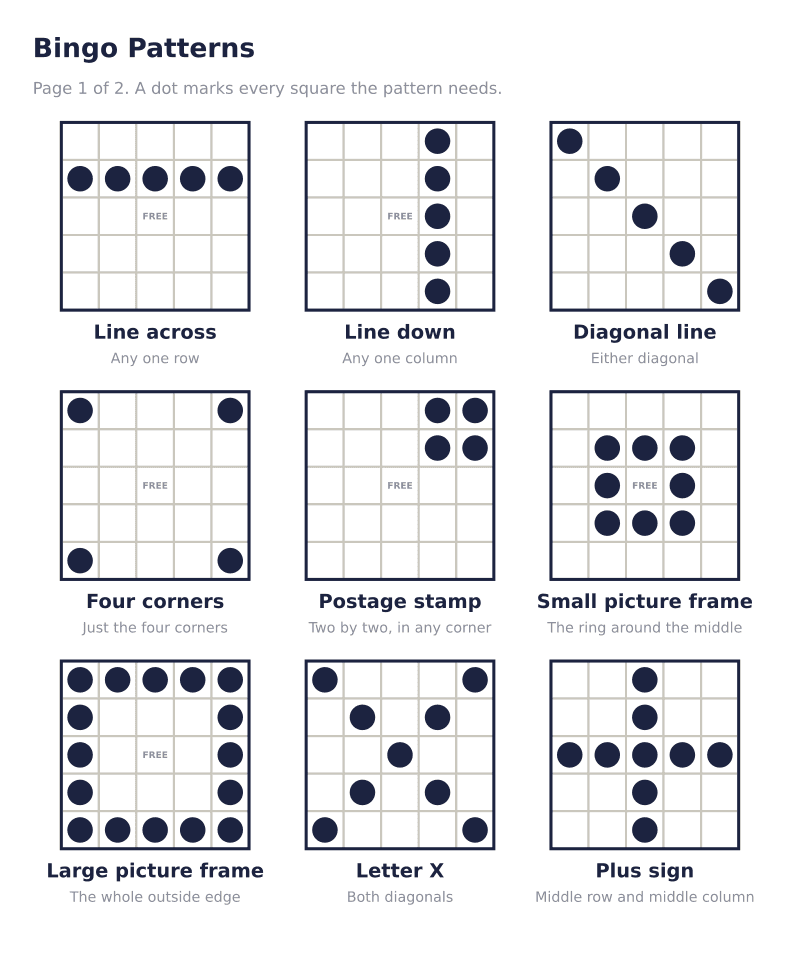 Bingo patterns chart2 pages · 18 patterns, nine to a pageDownload PDF ↓
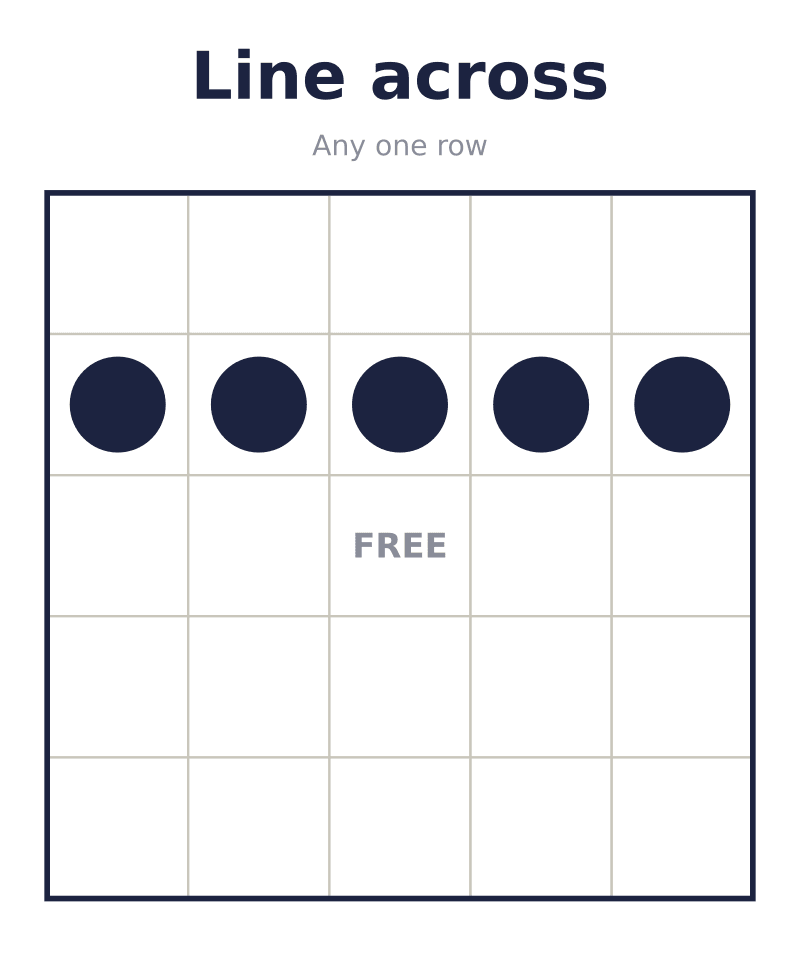 Bingo pattern signs18 pages · one pattern a pageDownload PDF ↓
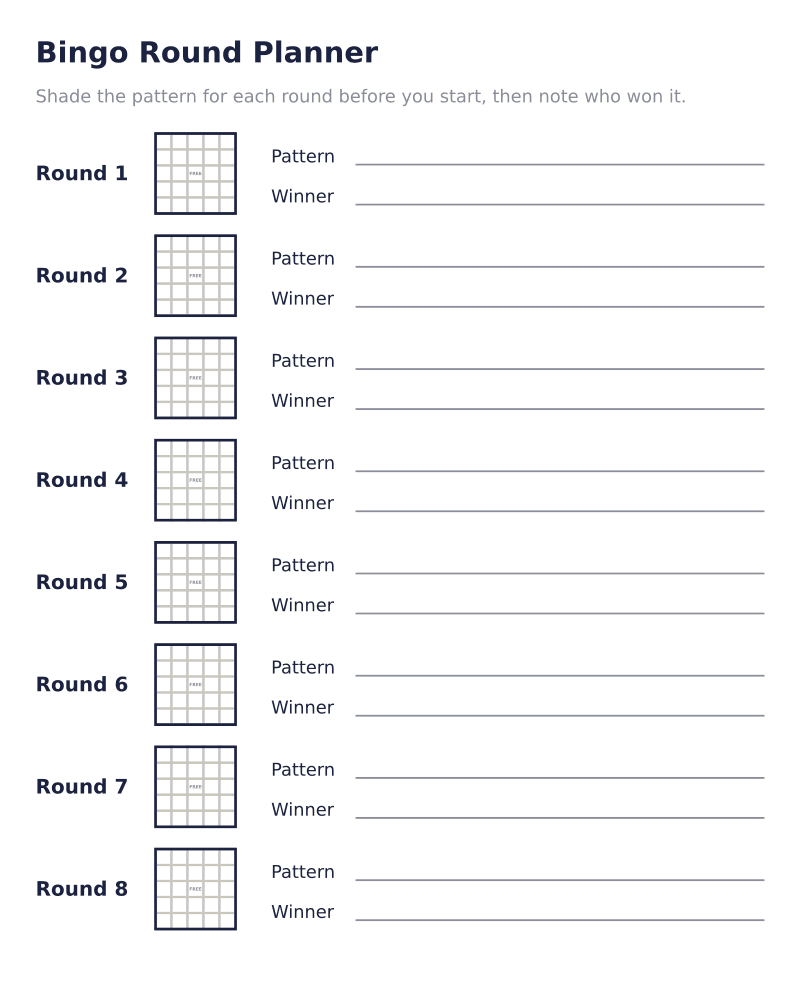 Bingo round planner1 page · 8 rounds to planDownload PDF ↓
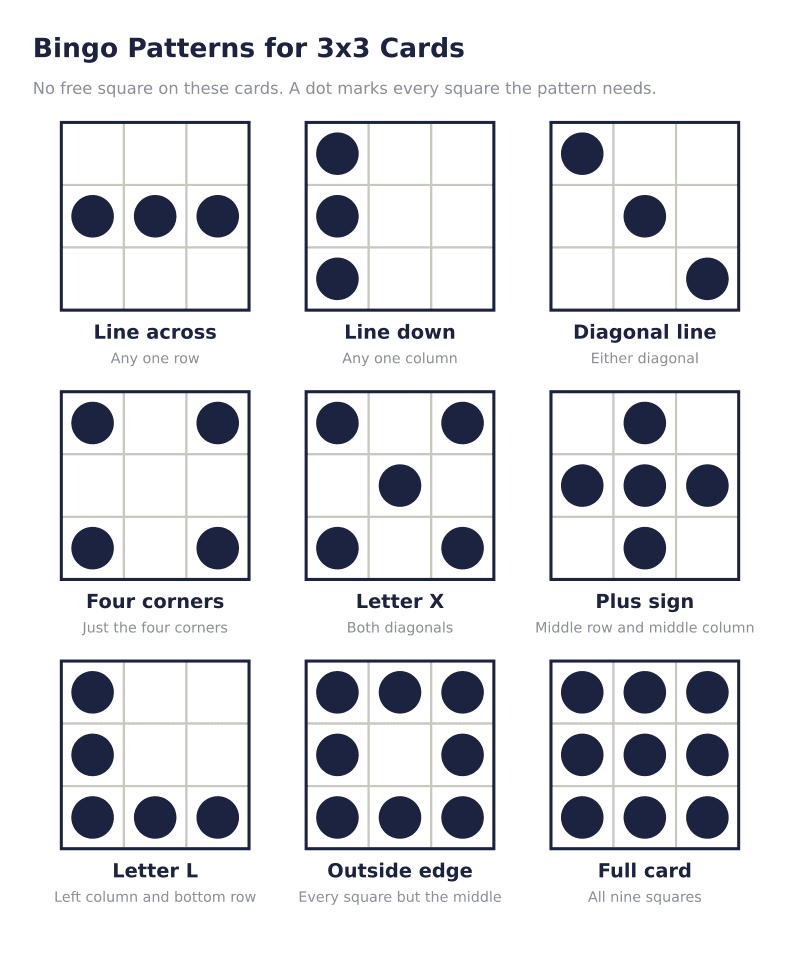 Bingo patterns for 3x3 cards1 page · 9 patternsDownload PDF ↓
Every sheet here is free to print as often as you like. If one saved you time, the tip jar is on Ko-fi.
Bingo, card 1
Created for free at puzzleandprint.com
Bingo, call list
Check off each word as you call it. 40 words in play.
Created for free at puzzleandprint.com
A bingo pattern is the shape a card has to complete to win a round. The plain game is won by any single line, and calling a pattern instead, four corners, the letter X or a blackout, makes a round shorter or longer without printing a single new card. It is also a simple way to break a tie: two players who finished a line on the same call can play on to a pattern to decide it.
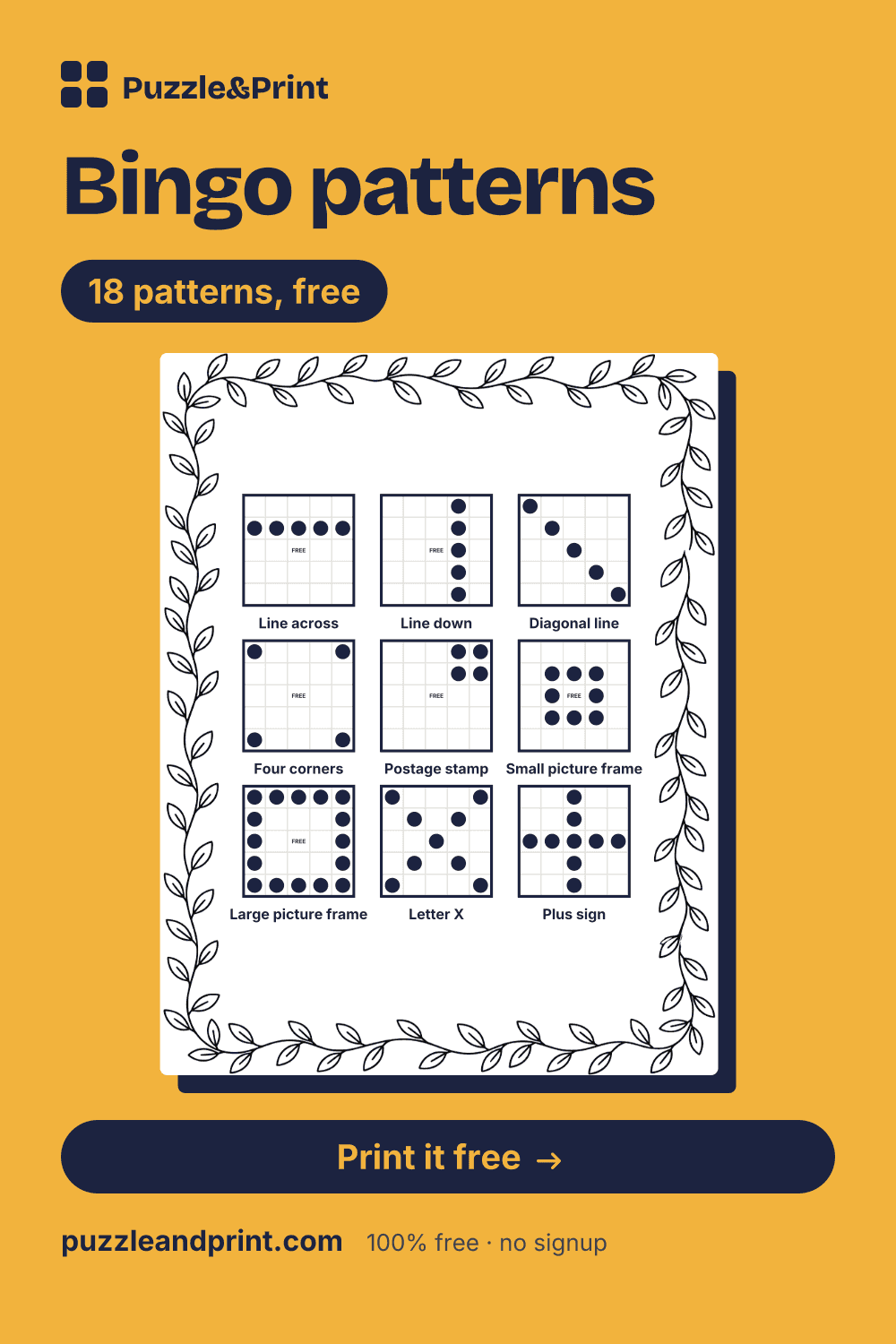
The chart is two pages of nine patterns each. The first page holds the ones most games use: a line across, a line down, a diagonal, four corners, the postage stamp, the small and large picture frames, the letter X and the plus sign. The second has two lines, the letters T, L, H, U and Z, the diamond, the pyramid and the blackout. Each is drawn on a 5 × 5 card with a round dot in every square it needs, and the word free in the middle when the pattern leaves the middle square out.
The same eighteen patterns come again as hold-up signs, one to a page, with the pattern nearly seven inches across and its name in large type above it, so the back of a room can see what is being played. The round planner has eight empty cards to shade a pattern on, with a line for its name and one for who won the round. The last sheet has nine patterns drawn for the 3 × 3 card, which has no free square.
Called cards from the maker on this page have a free center on the 5 × 5, as do the 5 × 5 cards in every ready-made called set on the site, and the chart assumes it: a dot in the middle of the X or the plus is a square that is already marked. Patterns work on cards of your own words exactly as they do on the ready-made sets, since the shape is the same whatever the squares hold.
Announce the pattern before the first word, hold up its sign, and leave the sign where the room can see it for the whole round. Say whether the pattern can sit anywhere: a line can be any row, column or diagonal, and a postage stamp is often allowed in any of the four corners, while a letter is played the way the chart draws it, the right way up. Say too that the free square counts as marked, which matters for every pattern that runs through the middle of the card.
When a player calls bingo, check the card against the pattern before anything else: read the squares that make up the pattern aloud and find each one on the call list. Plan a session from short patterns to long ones, a single line or four corners first and a picture frame or a blackout last, so the longest round comes when the room is settled and the last game keeps everyone playing to the end.
What decides how long a pattern takes is how many squares it needs besides the free middle. Played with the thirty cards of the whole-class set on the classroom bingo page, each holding 24 of its 40 words, any single line is won after about 12 calls on average. A postage stamp in any corner takes about 13, a line counted across only, down only or on a diagonal only about 14 or 15, four corners about 17 and two lines about 19.
The middle of the chart is a plateau. The plus sign, the letters X and T, the small picture frame, the diamond and the pyramid each need eight squares besides the free one, and each takes about 26 or 27 calls. The letter L needs nine and takes about 28; the letters H, U and Z need twelve or thirteen and take 31 or 32; the large picture frame needs all sixteen squares of the edge and takes about 34. A blackout needs 24 and takes 36 or 37 of the 40 calls, and with thirty cards about two games in five end with more than one card filling on the same call, so agree on a tiebreak first.
Yes. The free space is marked from the first call, so a pattern that runs through the middle of a 5 × 5 needs one square fewer than it shows. Eight of the eighteen patterns on the chart use the middle: the diagonal, the plus sign, the letters X, T, H and Z, the pyramid and the blackout. Every other pattern has the word free printed in its middle square, so nobody looks for a dot that is not there.
Blackout, where every square on the card has to be marked. Played with the thirty cards of the whole-class set on the classroom bingo page, which draw on 40 words, the first card fills after 36 or 37 calls, nearly the whole list, against about 12 for a single line. Of the shapes, the large picture frame takes longest, at about 34 calls, because all sixteen squares around the edge have to come up.
A block of four squares in a corner of the card, two across and two down, like a stamp on an envelope. The chart draws it in the top right corner, where a stamp goes, but it is often allowed in any of the four corners, so say which before the round starts. Played in any corner on the thirty-card classroom set, it is the quickest pattern on the chart after a single line in any direction, at about 13 calls.
New printables when they go up, mostly seasonal, a few times a year.