Valentine's Day Criss-Cross
- AFFECTION
- CUPID
- DEAREST
- DOILY
- FONDNESS
- FRIEND
- LOVE
- POEM
- RIBBON
- SINCERE
- SMITTEN
- TREASURE
Created for free at puzzleandprint.com
Four Valentine’s Day criss-cross grids, from ten words built around KINDNESS to twenty on a full page, 62 words to fit in all, forty of them different, each with its answer key on its own page.
Last updated
Save this to PinterestValentine's Day Criss-Cross
Created for free at puzzleandprint.com
Valentine's Day Criss-Cross, Answer Key
Created for free at puzzleandprint.com
Four grids from ten words to twenty. Every one is a two-page PDF, the puzzle, then the answer key on its own page.
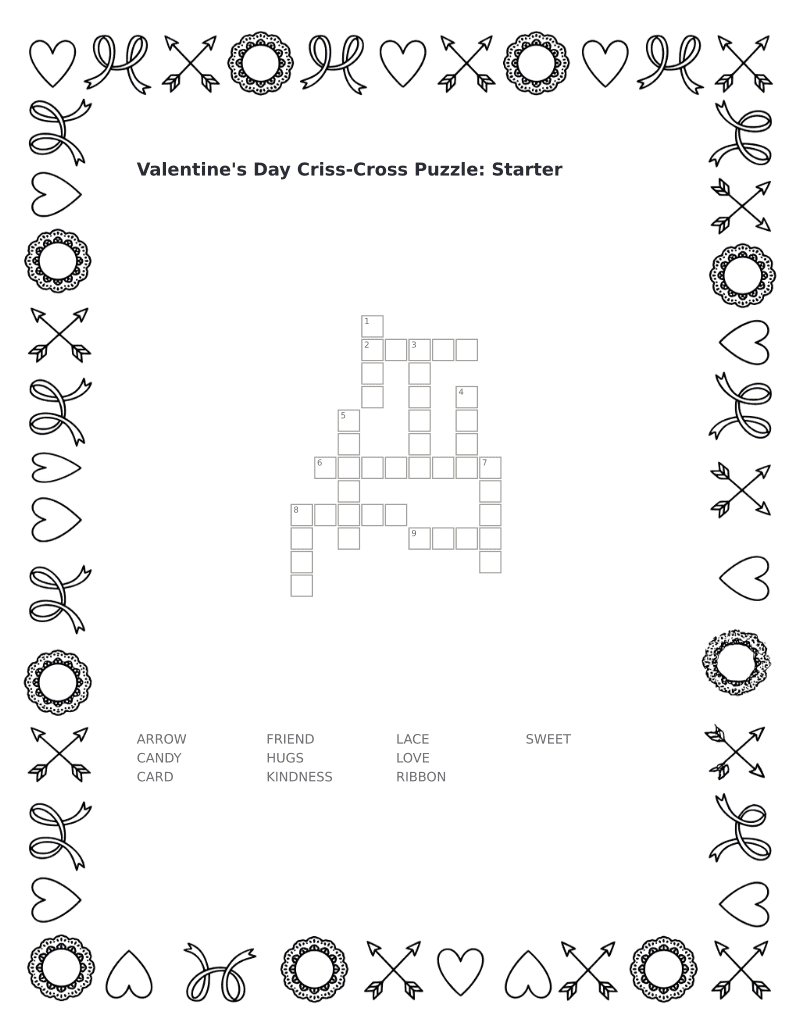 Valentine's Day criss-cross puzzle, starter10 words · small gridDownload PDF ↓
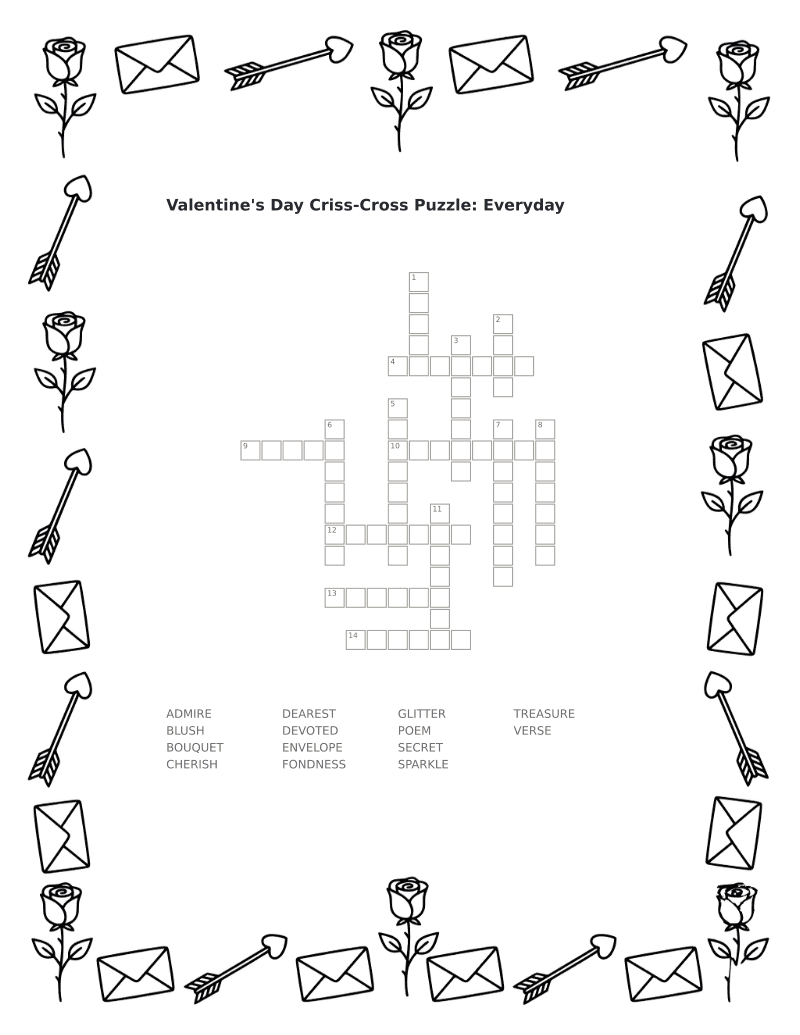 Valentine's Day criss-cross puzzle, everyday14 words · medium gridDownload PDF ↓
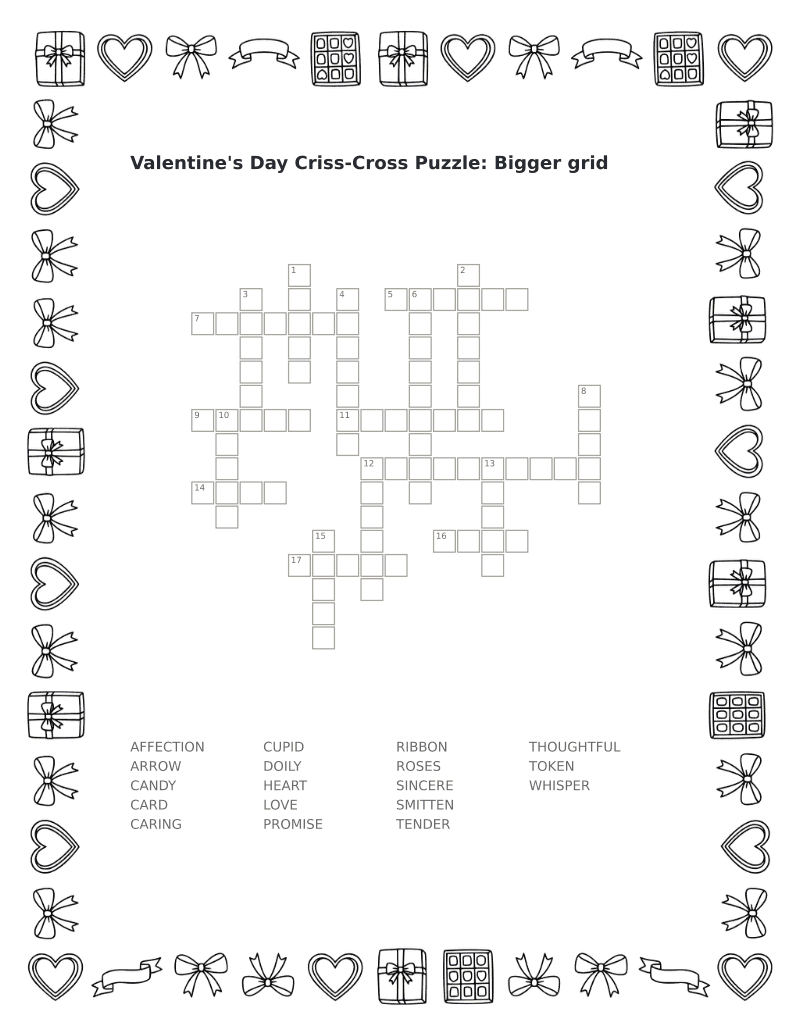 Valentine's Day criss-cross puzzle, bigger grid18 words · large gridDownload PDF ↓
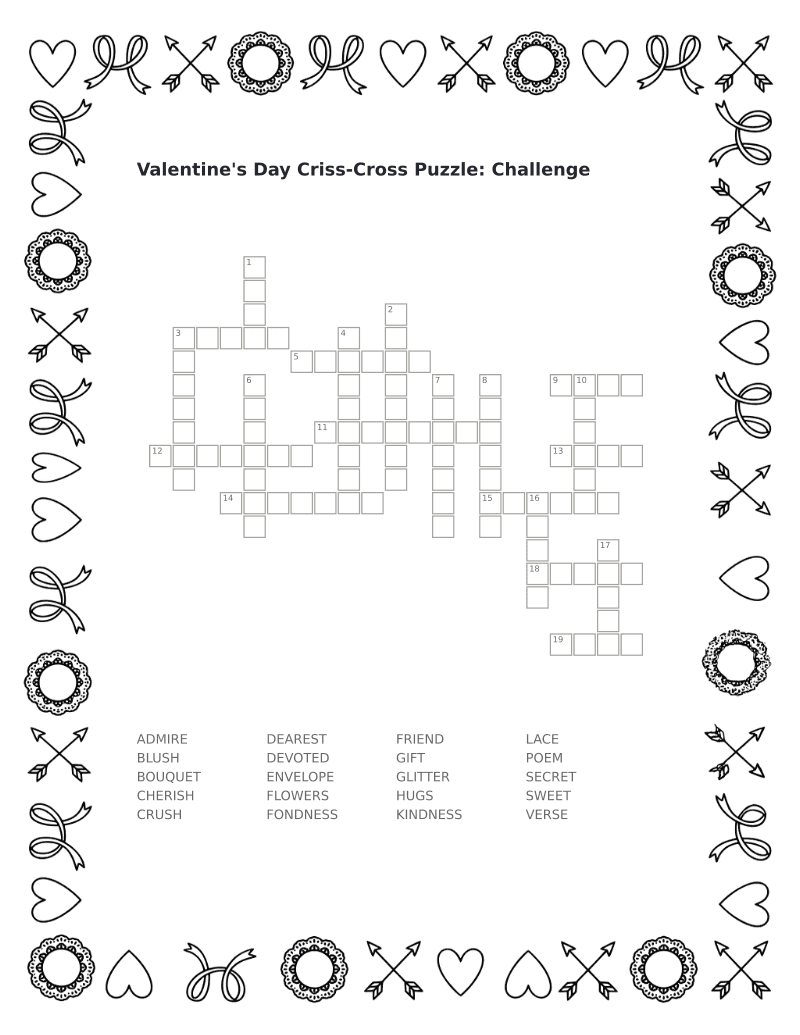 Valentine's Day criss-cross puzzle, challenge20 words · full pageDownload PDF ↓
Every sheet here is free to print as often as you like. If one saved you time, the tip jar is on Ko-fi.
A Valentine’s Day criss-cross is a quiet sheet for a noisy day. The word bank is printed under the grid, so there is nothing to look up and no clue to puzzle over, only where each word goes, and it suits the table where finished cards are drying or a child who has handed out every valentine and needs something to do until the party starts.
The four grids hold ten, fourteen, eighteen and twenty words, joined at 9, 13, 18 and 20 crossings, and they grow from a starter twelve squares tall and nine across to a challenge seventeen tall and twenty-one across, the widest grid the maker will make. Each puzzle page wears a Valentine’s frame, and each answer key prints plain on the page after it, to save ink.
The grid is a good check on the spellings children read on cards far more often than they write. ENVELOPE is crossed four times on both the everyday sheet and the challenge, and on each a word runs through its final E, DEAREST on the everyday sheet and CHERISH on the challenge, so a child who writes envelop, the verb, is left with an empty square that the other word needs. The puzzle points at the mistake before any adult has to.
The maker on this page interlocks a list of your own, four to twenty words of three letters or more. That is room for the first names of a reading group, and a criss-cross every child in the group can find themselves in is a reasonable thing to slip into a valentine bag. If a name will not link to the others, the maker says which, and whatever you type stays on your device rather than going into the page address.
Begin with KINDNESS. It is the only eight-letter word on the starter, so there is exactly one run of squares it can go in, across the middle of the grid, and four of the other nine words cross it: FRIEND at its I, RIBBON at its second N, HUGS ending on its first S and SWEET starting on its last. Once KINDNESS is written in, each of those four has a letter to start from, and the grid fills outward from the middle.
Save the four-letter words for last. LOVE, CARD, LACE and HUGS each touch only one other word, so their length is nearly all there is to go on, and with four runs of four squares on the grid a child who places them early is guessing. Left until the longer words are in, each run already shows one of its letters: the run for CARD is the only one starting with C, because CANDY gives it, and the run for HUGS the only one ending in S. LACE then takes the run with the A from ARROW, and LOVE the one ending on the second E of SWEET.
The everyday sheet and the challenge are close relatives. Twelve of the fourteen everyday words come back on the challenge, from ADMIRE and BOUQUET to POEM and VERSE, and only TREASURE and SPARKLE stay behind. The challenge also takes five words from the starter, LACE, SWEET, FRIEND, KINDNESS and HUGS, so a child who has done the first two sheets meets just three new words on the full page: GIFT, CRUSH and FLOWERS. What makes the challenge hard is the size of the interlock rather than the spellings.
The bigger grid is the odd one out. Thirteen of its eighteen words are on no other sheet, among them THOUGHTFUL and AFFECTION, the two longest words on the list, and WHISPER, PROMISE and SMITTEN; its other five, LOVE, CARD, RIBBON, CANDY and ARROW, come from the starter. That makes it the sheet for a child who has done all the others and wants new words, and a reasonable second sheet for a younger one, who will find five familiar words among the new.
KINDNESS and FONDNESS are the trap on the Valentine’s challenge. Both have eight letters, both run down the grid two columns apart, and they differ only in their first two letters, KI and FO: the other six, NDNESS, are the same in both. Counting squares cannot separate them, and nor can ENVELOPE, which runs across through the N of one and the E of the other, because those letters sit in the same place in each word.
FRIEND settles it. It runs across both of them above ENVELOPE, and the square it shares with the left-hand word is its I, which only KINDNESS has, while the square it shares with the right-hand word is its N, the first N of FONDNESS. Once FRIEND is in, the two long words go in without any guessing, and ENVELOPE, the third eight-letter word on the sheet, has two letters given. The upper middle of the grid, where those four meet, is the place to start the sheet.
Bigger than four extra words suggests. The everyday sheet has fourteen words and thirteen crossings against the starter’s ten and nine, and its words are longer: nine of the fourteen have seven or eight letters, from DEAREST and BOUQUET to FONDNESS and TREASURE, where the starter has only KINDNESS. A child who raced through the starter should expect to slow down on the second sheet.
Yes. Its ten words are the card-table ones: LOVE, CARD, RIBBON, CANDY, ARROW, LACE, SWEET, FRIEND, KINDNESS and HUGS. The words closer to romance are on the later grids, BLUSH and DEVOTED on the everyday sheet and the challenge, SMITTEN and AFFECTION on the bigger grid, and CRUSH on the challenge alone.
THOUGHTFUL. At ten letters it is the longest word on the Valentine’s list and the only one that long on the sheet, so it has exactly one run of squares, and four words cross it: AFFECTION at its O, DOILY at its final L, TENDER from its first T and HEART from its second H. With THOUGHTFUL written in, each of those four has a letter to start from.
New printables when they go up, mostly seasonal, a few times a year.