Addition flash cards, facts to 10
Page 1 of 9. Fold down the dashed line, printed side out, then cut along the solid lines.
Created for free at puzzleandprint.com
Facts to 10 and to 20, plus the doubles and the facts that cross ten.
Last updated
Save this to PinterestAddition flash cards, facts to 10
Page 1 of 9. Fold down the dashed line, printed side out, then cut along the solid lines.
Created for free at puzzleandprint.com
4 sets, each one PDF. Under each: how many cards, how the backs print, and how much paper it takes.
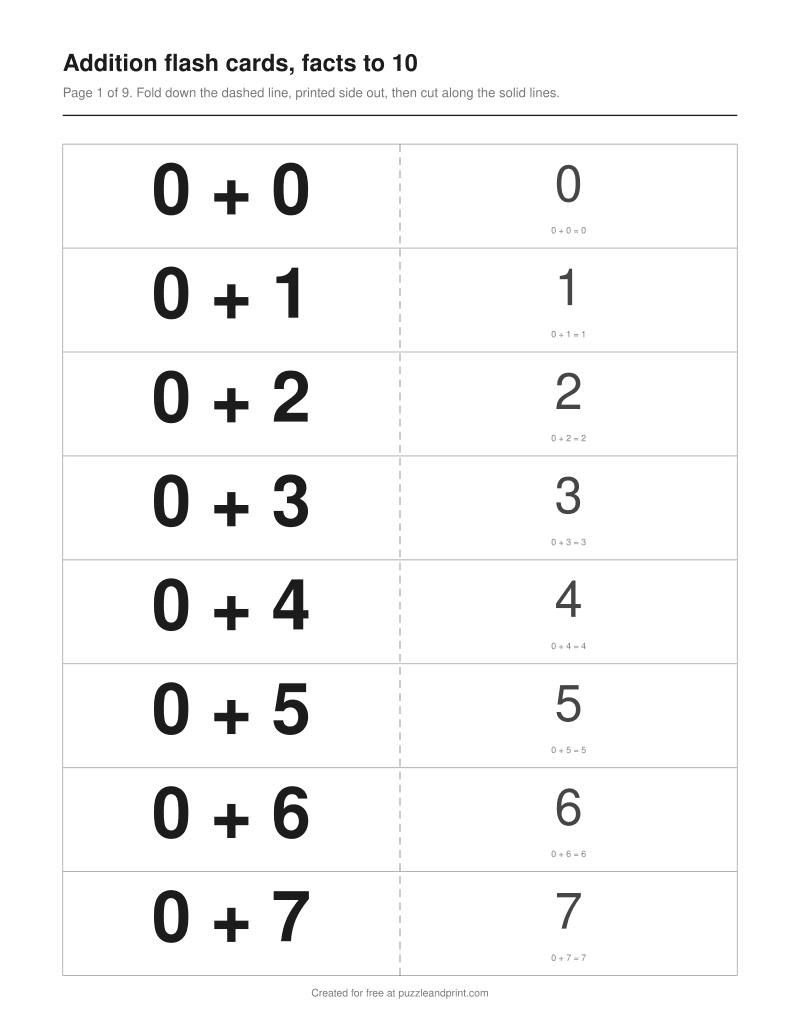 Addition flash cards, facts to 1066 cards · fold-over, 8 a page · 9 pagesDownload PDF ↓
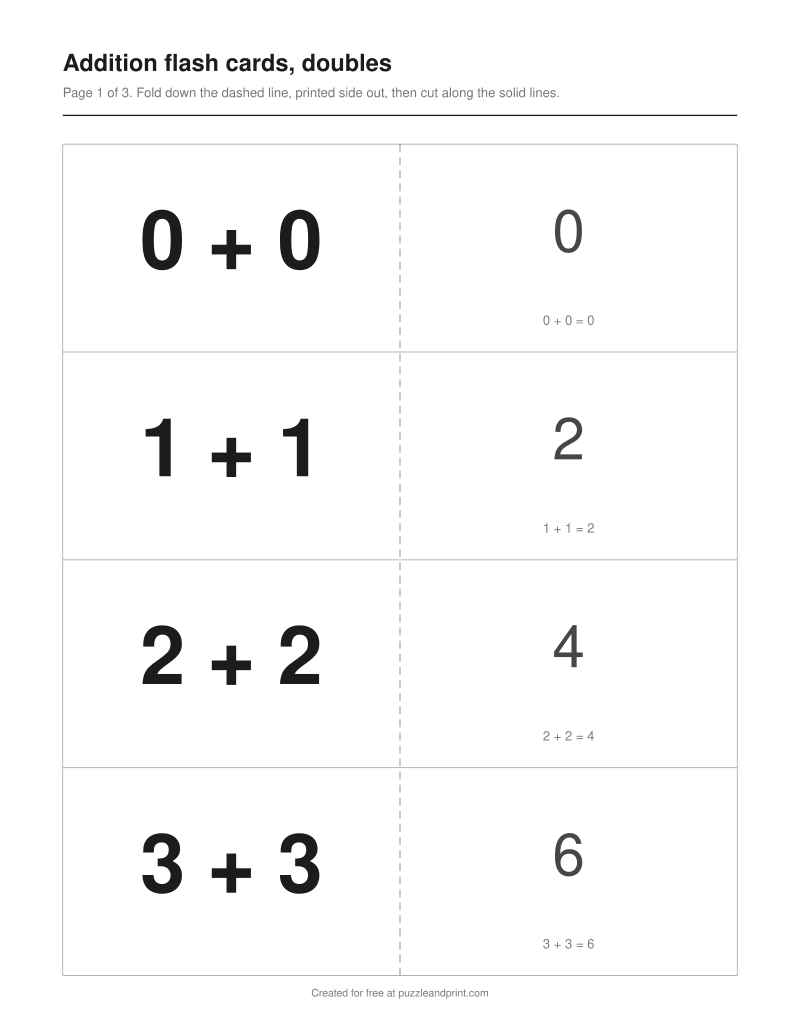 Addition flash cards, doubles11 cards · fold-over, 4 a page · 3 pagesDownload PDF ↓
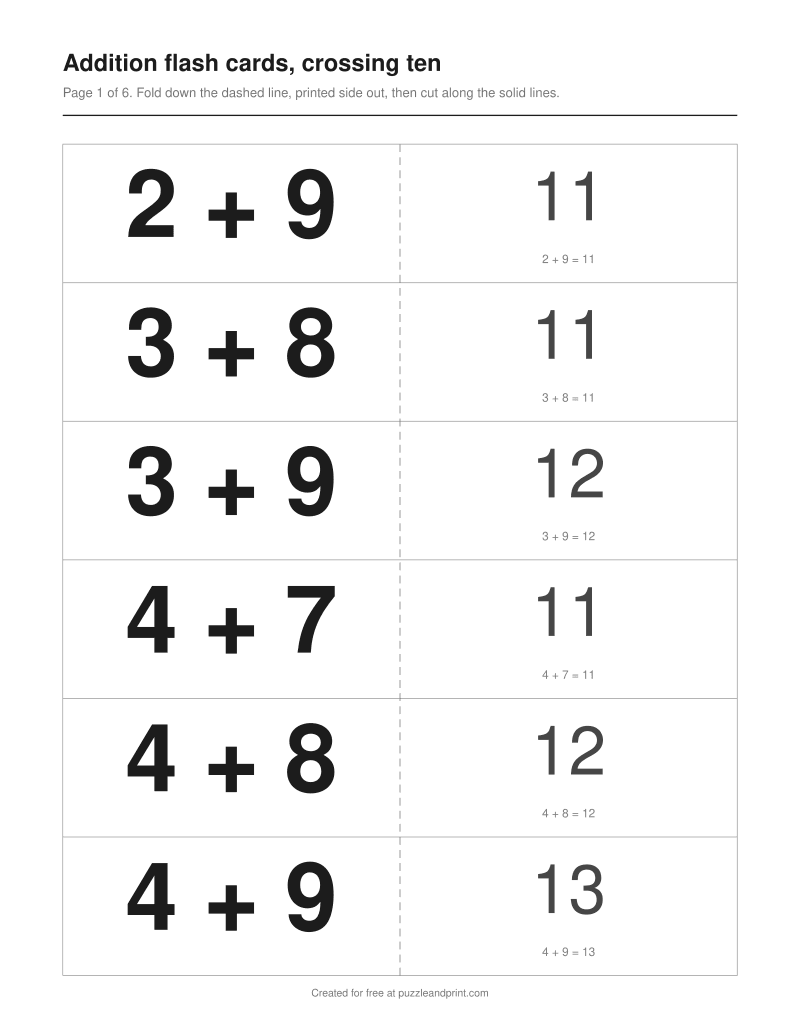 Addition flash cards, crossing ten36 cards · fold-over, 6 a page · 6 pagesDownload PDF ↓
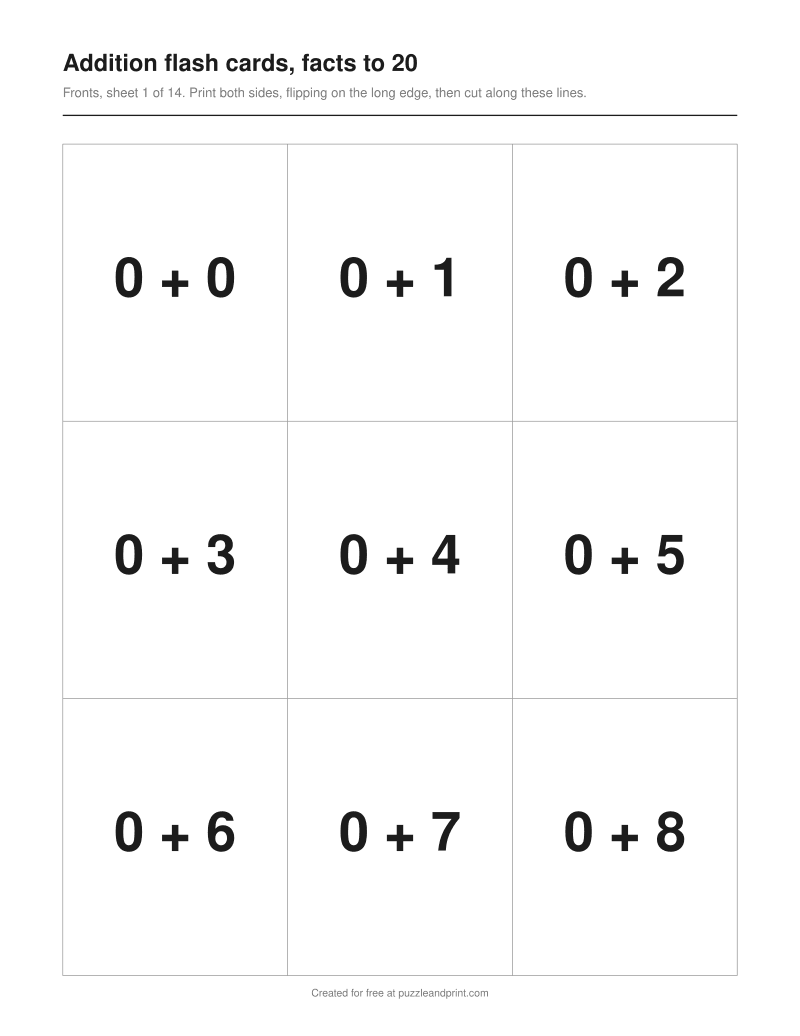 Addition flash cards, facts to 20, double-sided121 cards · double-sided, 9 a page · 14 sheets, both sidesDownload PDF ↓
Every sheet here is free to print as often as you like. If one saved you time, the tip jar is on Ko-fi.
These are addition flash cards in four sets, with the fact on the front and the answer on the back. Facts to 10 is every sum with a total of 10 or less, from 0 + 0 to 10 + 0, which is 66 cards. Facts to 20 takes every pair of numbers from 0 to 10, so the totals run up to 20: 121 cards, the same facts the addition within 20 worksheets on this site draw on.
The other two sets pull out facts that deserve practice of their own. The doubles run from 0 + 0 to 10 + 10, eleven cards on fold-over pages of four, each card about 3.6 by 2.2 inches. Crossing ten is every pair of one-digit numbers whose total passes 10, such as 8 + 5 and 9 + 7: 36 cards, six to a page on exactly six pages.
Facts to 10 prints eight cards to a fold-over page, on 9 pages. Facts to 20 is set up for a printer that prints both sides, nine cards a page on 14 sheets of paper; the maker above will print it folded instead, or print any of the sets at two to nine cards a page.
The cards in every set are ordered by the first number, then the second, the way an addition table reads: 3 + 0, 3 + 1, 3 + 2 and on. Under each answer a small line repeats the whole fact, so the adult holding a card up can read 3 + 4 = 7 on their own side.
Of the 66 cards, 21 have a zero in them, from 0 + 0 to 10 + 0, and eleven make exactly ten, 0 + 10 through 10 + 0. Those eleven pairs are worth knowing cold before crossing ten, because the make-ten way into the facts past ten starts from them.
The totals are not spread evenly. There is one way to make 0 and eleven ways to make 10, so a stack drawn from this set leans toward the bigger sums. Sorting by total, all the cards that make 7 together and then all that make 8, is a way to practice one number at a time before the stack is mixed.
The crossing ten set starts where counting on stops being quick. Its 36 cards run from totals of 11 to 18: eight ways to make 11, from 2 + 9 to 9 + 2, then seven ways to make 12, and so on down to the single card that makes 18, 9 + 9.
These are the facts a make-ten strategy is for: 8 + 5 is 8 + 2 + 3, ten and three more. Kept as their own small set, they can be drilled until they come as quickly as the facts to 10, and then mixed back in with the full facts to 20 set.
Yes. 3 + 5 and 5 + 3 are two cards in every set except the doubles, where each fact is its own turnaround. That is why facts to 20 is 121 cards: every pair of numbers from 0 to 10, in both orders.
Not a ready-made one. Type subtraction facts under Write my own, one to a line, such as 13 - 8 = 5, and each becomes a card with the answer on the back. For written practice, the subtraction within 20 worksheets on this site come with an answer key.
As the ready-made double-sided set, 121 cards print nine to a page on 14 sheets of paper, using both sides. Folded instead, at eight cards a page in the maker, the same set takes 16 pages printed on one side.
New printables when they go up, mostly seasonal, a few times a year.