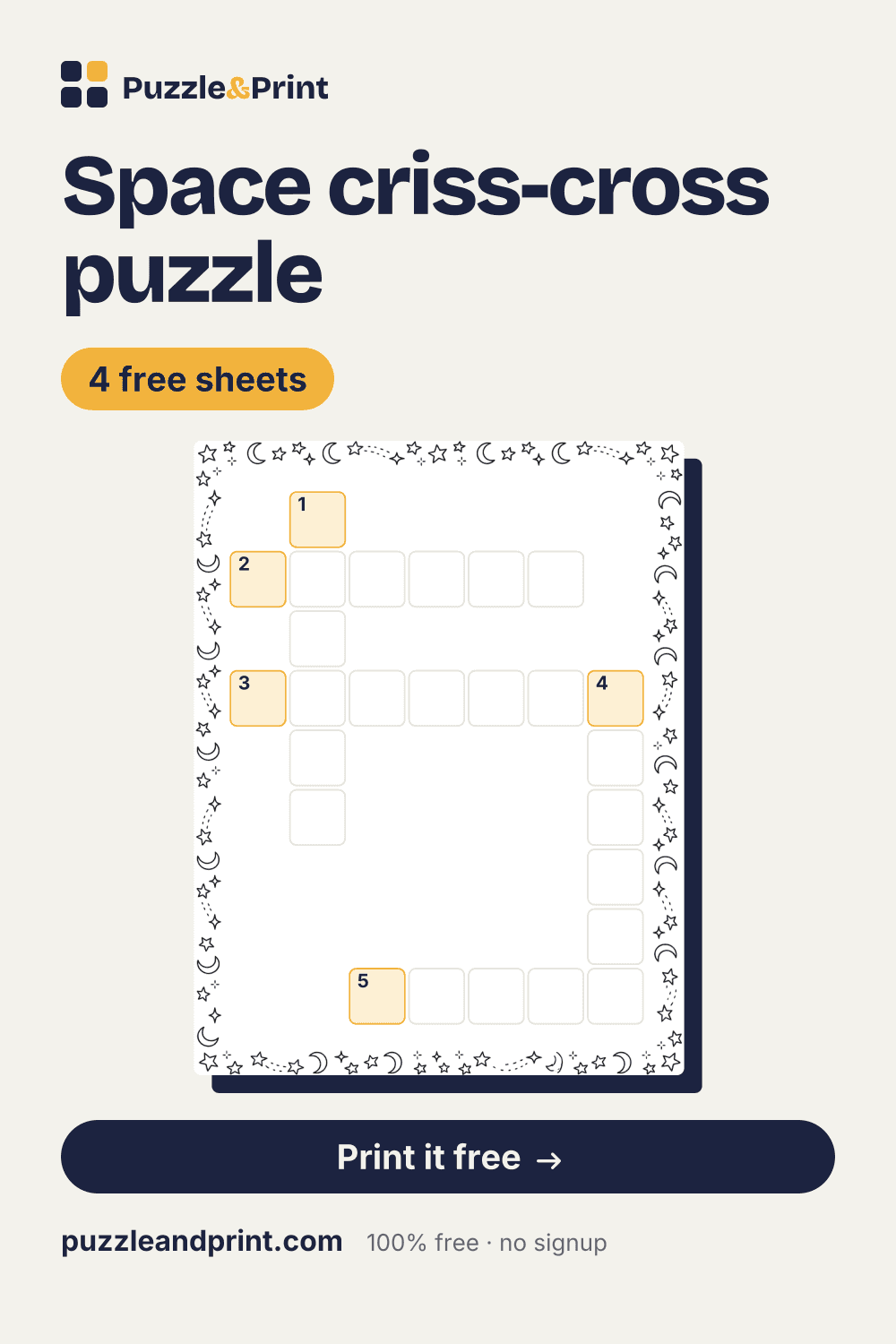
Space Criss-Cross
- CAPSULE
- EARTH
- METEOR
- NEBULA
- PLANET
- PLUTO
- PULSAR
- SHUTTLE
- SOLAR
- SUN
- TELESCOPE
- VENUS
Created for free at puzzleandprint.com
Interlock your own list, or take one of four ready-made space grids.
Save this to PinterestCreated for free at puzzleandprint.com
Created for free at puzzleandprint.com
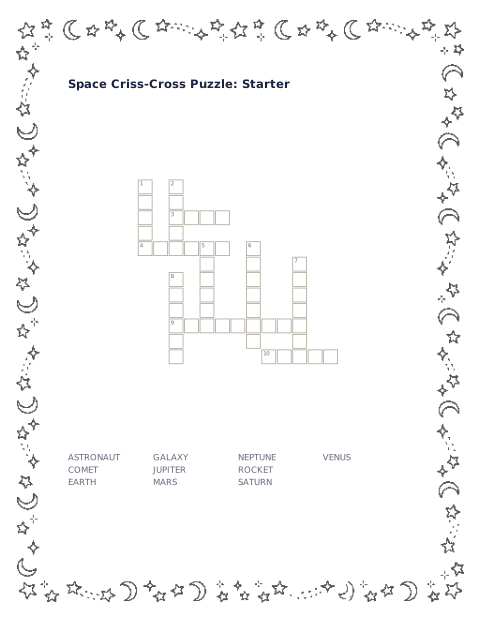
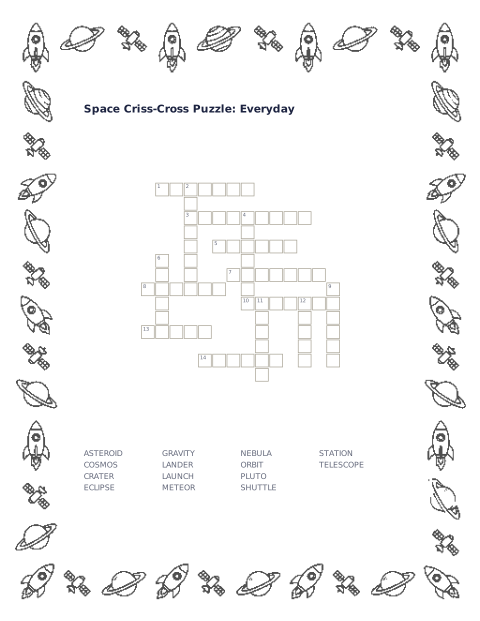
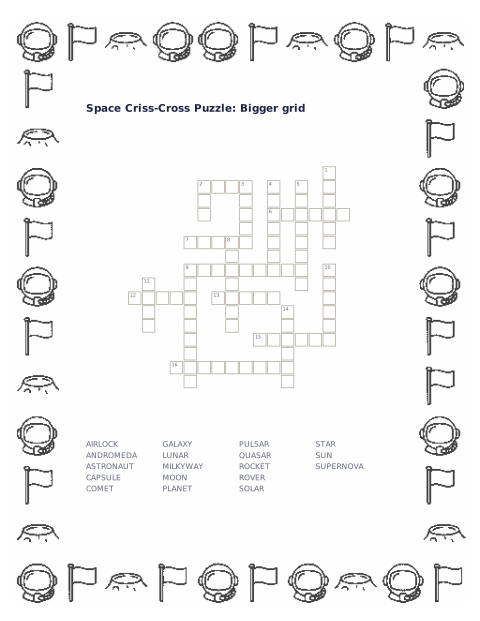
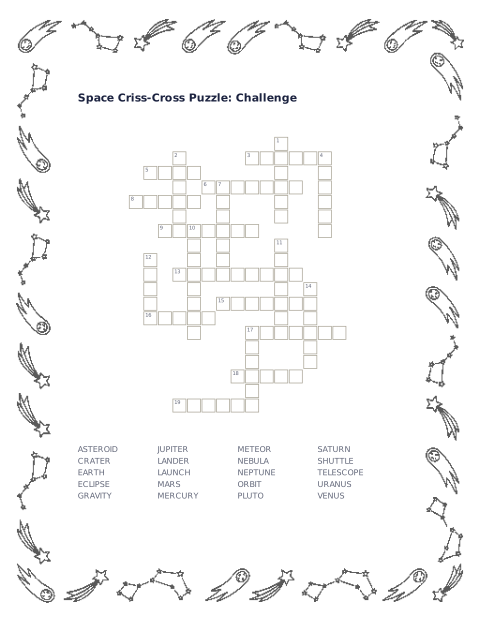
Four grids from ten words to twenty. Every one is a two-page PDF, the puzzle, then the answer key on its own page.
Space vocabulary interlocks better than almost anything else on this site. TELESCOPE, ASTRONAUT and CONSTELLATION are long, vowel-rich and full of the common letters a grid needs for its crossings, so the puzzles come out with the sprawling shape a criss-cross is supposed to have rather than a tight square in the middle of the page.
They are also words children meet far more often than they write. A ten-year-old has heard GRAVITY hundreds of times and may never have spelled it out. Putting it into seven squares, with the R fixed because ROCKET already crosses there, is frequently the first time the spelling has had to be exactly right rather than roughly right.
That makes this a good revision sheet at the end of a topic rather than an introduction to one. The words should be familiar before the puzzle, because a criss-cross gives no clues and no context: the word bank is the whole of the help available. Handed out cold to a class that has not done the topic, it becomes a copying exercise.
The four grids go from ten words to twenty, and the larger two use planet names, which have a useful property: a child who knows the order of the planets can work through them mentally and check each length against the gaps, which is a completely different solving strategy from letter-matching.
Length and vowels. TELESCOPE, ASTRONAUT and CONSTELLATION are long and full of the common letters a crossing needs, so the grid sprawls across the page instead of bunching into a square. A list of short words with unusual letters gives the interlock almost nothing to work with.
After. A criss-cross gives no context and no clues, so the words have to be familiar already. Handed to a class that has not done the topic it becomes a copying exercise, which practises handwriting and nothing else.
It shared no usable letter with anything already placed, so there was nowhere to interlock it. Unlike a word search, a criss-cross cannot put a word somewhere on its own. Press New puzzle to rearrange everything, or swap the word for one with more vowels in it.
No, and that is the point of this rather than a crossword. The solver gets the full word list and works out where each one goes, so a puzzle takes about as long to make as a word search does.
They mark where a word begins, numbered left to right and top to bottom the way a crossword is. Where an across word and a down word start in the same square, they share one number.
Ten to fourteen makes a comfortable grid for most lists. Fewer than that and the puzzle is over quickly; past about sixteen the grid starts to sprawl and the squares get small on a printed page.
Always, and it prints on its own page so you can hand out the puzzle without it. The key is the same grid with every letter filled in.
No. There is no sign-up, no email, and no watermark on the printed sheet. The grid is worked out in your browser, so your word list never reaches us.
New printables when they go up, mostly seasonal, a few times a year.