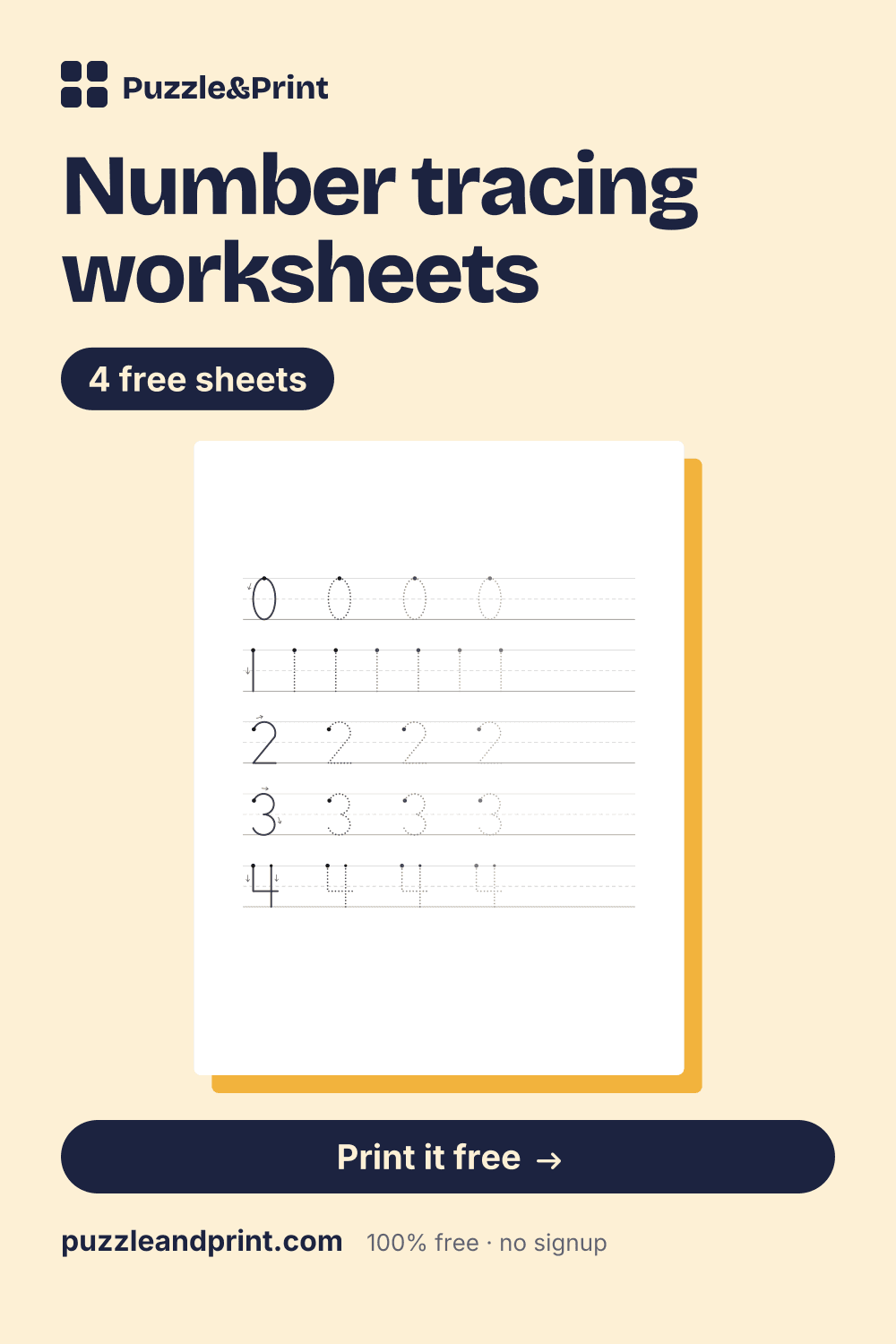
Number Tracing, 0 to 10
Numbers 0 to 5. Start at each big dot.
Created for free at puzzleandprint.com
The numbers 0 to 20 on primary writing lines, traced and then written.
Last updated
Save this to PinterestNumber Tracing, 0 to 10
Numbers 0 to 5. Start at each big dot.
Created for free at puzzleandprint.com
Number Tracing, 0 to 10
Numbers 6 to 10. Start at each big dot.
Created for free at puzzleandprint.com
Four ready-made sets, each one PDF of every page in it. There is no answer key: a tracing sheet checks itself.
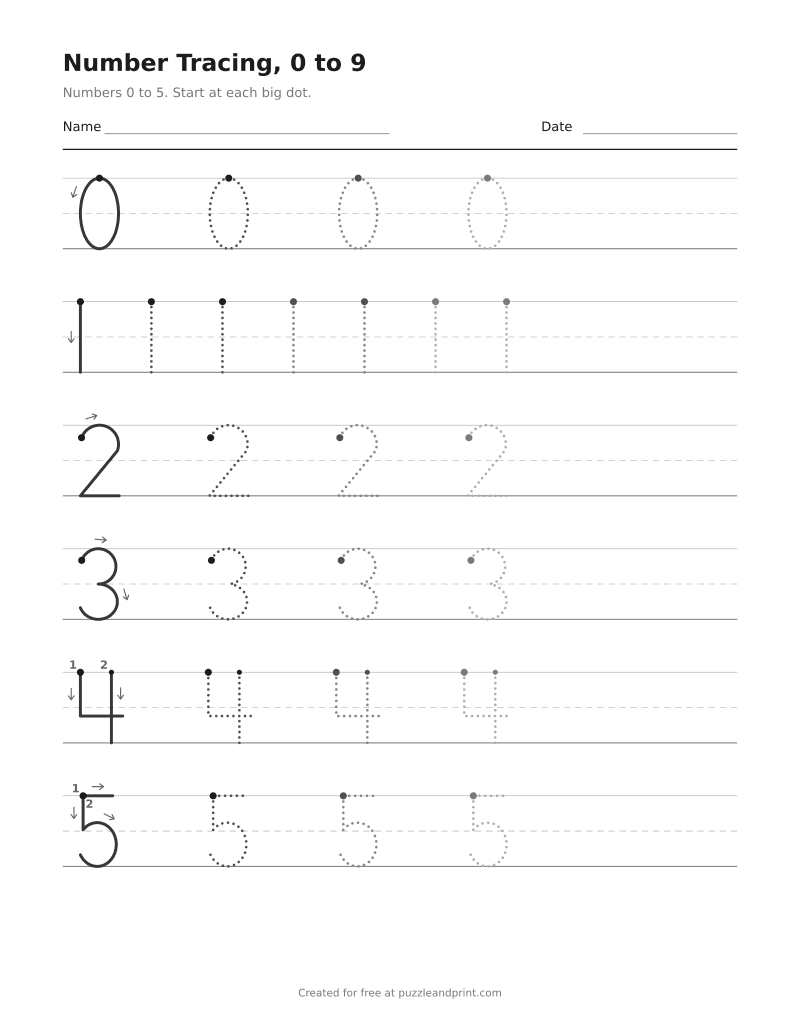 Number tracing worksheet, 0 to 92 pages · 3/4 inch lines · dottedDownload PDF ↓
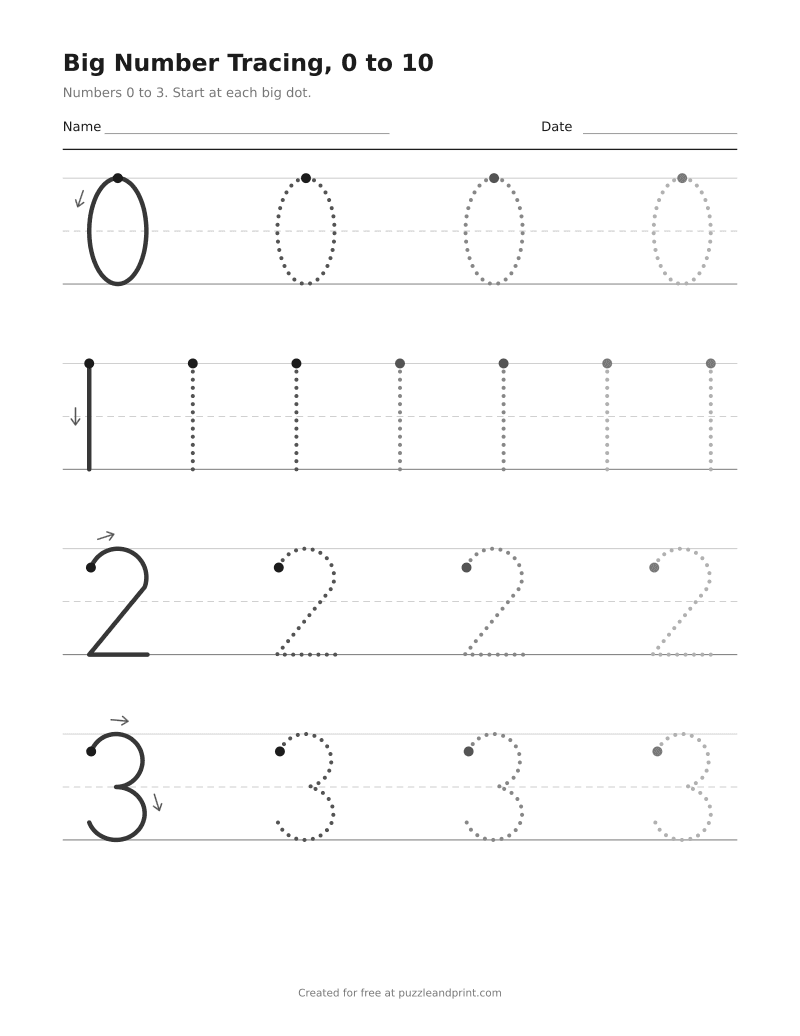 Big number tracing worksheet, 0 to 103 pages · 1 1/8 inch lines · dottedDownload PDF ↓
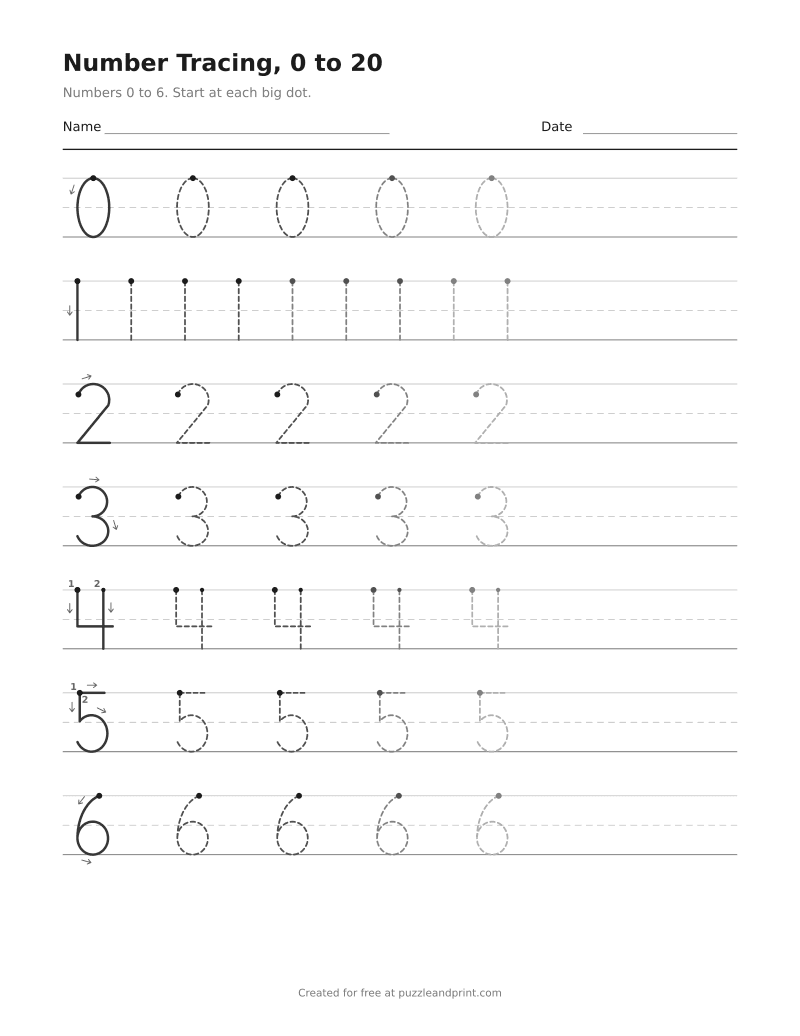 Number tracing worksheet, 0 to 203 pages · 5/8 inch lines · dashedDownload PDF ↓
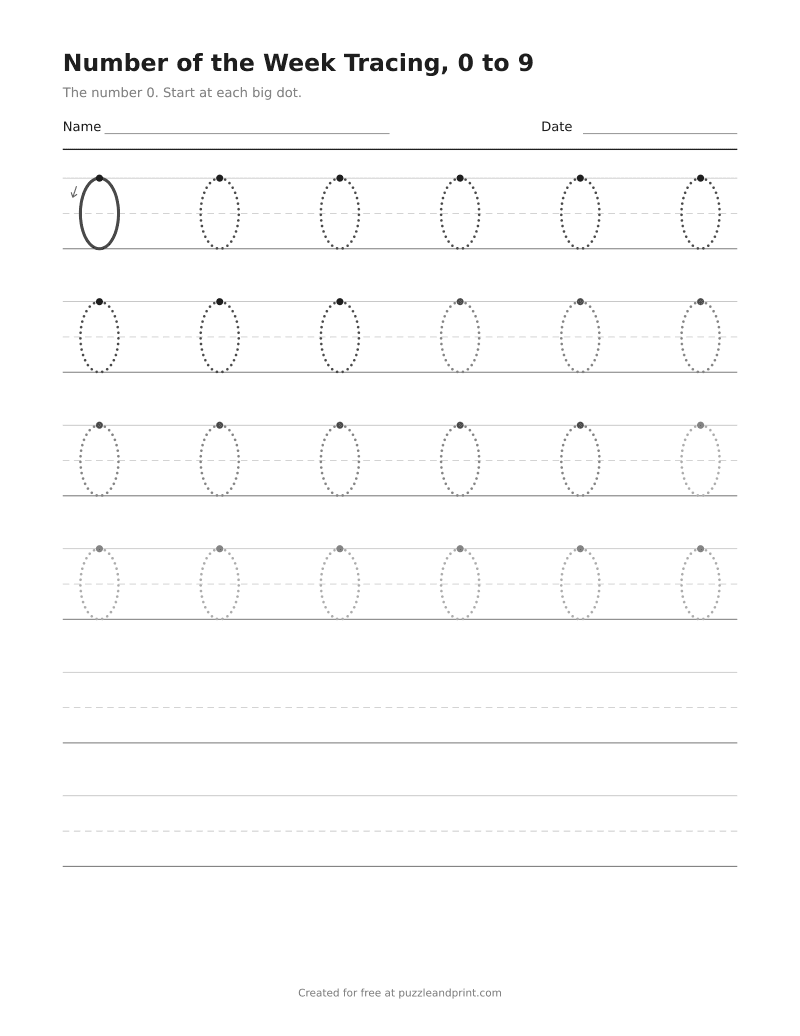 Number of the week tracing worksheet, 0 to 910 pages · 3/4 inch lines · dottedDownload PDF ↓
Every sheet here is free to print as often as you like. If one saved you time, the tip jar is on Ko-fi.
The numbers on these sheets are drawn in the same upright print as the letters: a 0 that starts at the top and circles back, a 1 that is a single stick, a 4 open at the top, and an 8 made in one stroke that crosses itself in the middle. Every number stands between the headline and the baseline of primary writing lines, and every stroke begins at a big dot.
On the sheets with a row for each number, every row opens with a solid model with arrows beside its strokes, then dotted or dashed copies, which fade from dark to light wherever a row has room for three or more, and the 0 to 9 and 0 to 20 sheets end each row with a stretch of bare line to write on. The number of the week pages open with one model at the top of the page and leave whole lines blank at the foot instead. Numbers from 10 up are traced as two digits side by side, so the 0 to 20 sheet practices the same ten shapes as 0 to 9, in the order they are counted.
The 0 to 9 sheet is two pages at the kindergarten size, 3/4 inch. The big numbers sheet runs from 0 to 10 at 1 1/8 inch across three pages and fills every row with copies, with no blank space, for children still learning the shapes. The 0 to 20 sheet uses 5/8 inch lines and dashes, seven numbers to a page across three pages, and the number of the week set gives each number from 0 to 9 a page of its own: ten pages, each with four lines to trace and two blank lines.
The maker above prints 0 to 9, 0 to 10 or 0 to 20, a row for each number or a page for each, at any of five line heights from 1 1/8 inch down to 3/8 inch, in dots or dashes, with the model, the fading, the blank space and the arrows each switched on or off.
The 0 starts at the top and circles back, counterclockwise, the same way as the letter o. The 1 is a single stick from the headline down. The 2 and the 3 both start at the upper left and curve over to the right, and the 7 starts at the upper left too, sliding right along the headline before it slants down. The 6 starts just right of the top and curves down the left side into its loop.
Four of the ten take a moment more. The 4 is two strokes: down and across, then a long stick from the headline that crosses the first. The 5 is two strokes as well, the stick and the curve first and the flag across the top last, which is why its model shows a 1 and a 2 at the same corner. The 8 starts at the upper right and is one stroke that crosses itself in the middle, and the 9 starts on its circle, like a lowercase a, then pulls down on the right.
Reversed numbers are common in kindergarten and first grade, and 2, 3, 5, 7 and 9 are among the ones most often turned around. Many reversals come from starting on the wrong side. A 3 begun at the right tends to come out facing the wrong way; begun at the upper left, where the start dot on every copy here sits, the curves bulge to the right as they should.
The 9 and the 6 are a pair in the way b and d are among the letters: the 9 starts on its circle and ends with a straight stick on the right, the 6 starts at the top of its long curve and ends in the loop at the bottom. The 5 goes wrong when it is drawn in one sweep from the top right, like an S. Drawn in the order shown here, stick and curve first and the flag added last, it has a square corner at the top left that an S does not.
Open at the top and in two strokes, the way the Zaner-Bloser program teaches it: pull down from the headline and slide right just below the midline, lift, then pull a longer stick down from the headline to the baseline, crossing the first stroke. The model 4 on each sheet carries the numbers 1 and 2 by the start dots to show the order.
Because a 1 is a single straight stick, the narrowest shape on the page, so more of them fit in the same stretch of line. On the 0 to 9 sheet a row holds four 0s or four 2s before the space left for writing, and seven 1s.
At the big dot at the upper right of the top loop. From there the pencil curves back over the top and down the left side, crosses the middle, goes around the bottom loop and comes back up through the middle to where it began, all in one stroke without lifting.
New printables when they go up, mostly seasonal, a few times a year.