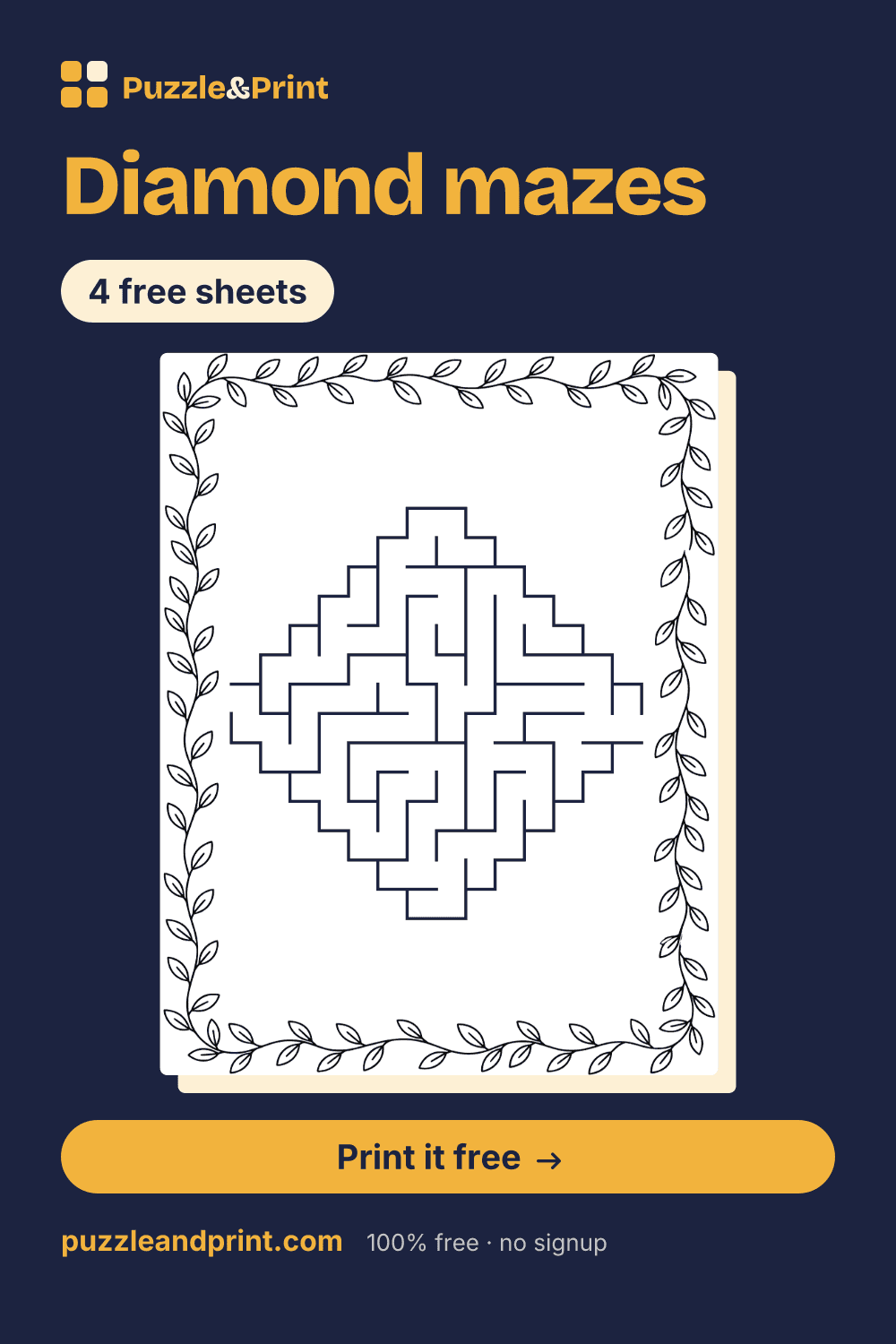
Diamond Maze
Created for free at puzzleandprint.com
A square turned on its point, with the solution on its own page.
Last updated
Save this to PinterestDiamond Maze
Created for free at puzzleandprint.com
Diamond Maze, Solution
Created for free at puzzleandprint.com
Four mazes, each a different size. Every one is a two-page PDF, the maze, then the solution on its own page.
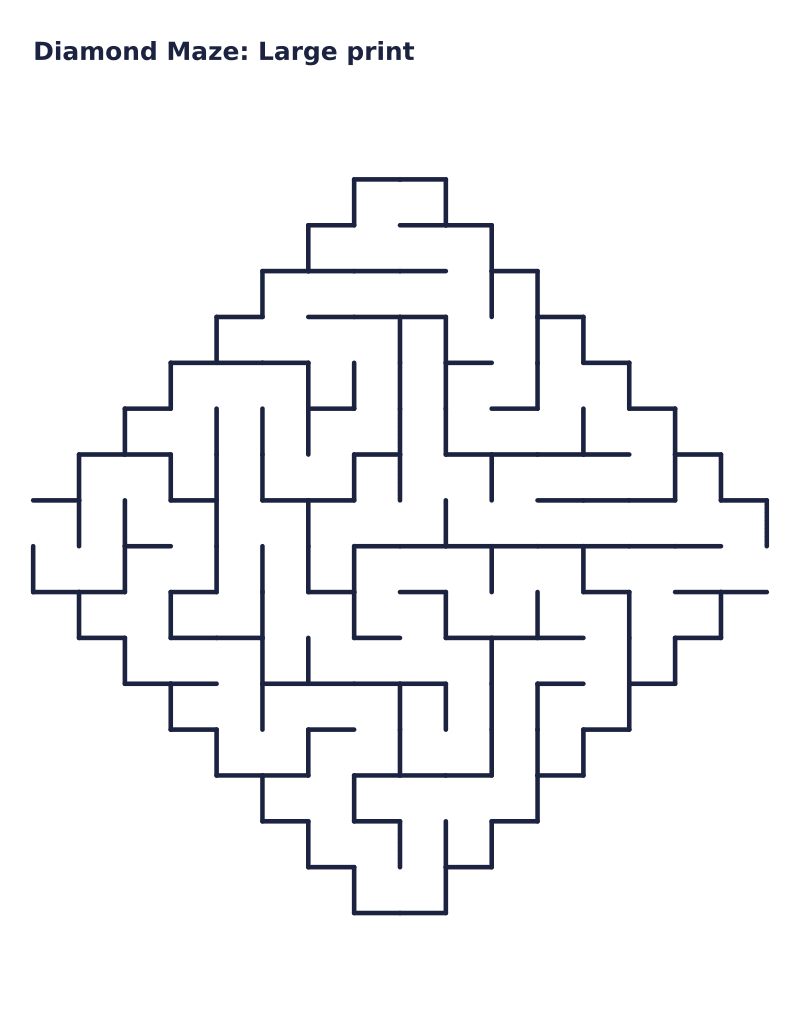 Diamond maze, large print16 × 16 grid · EasyDownload PDF ↓
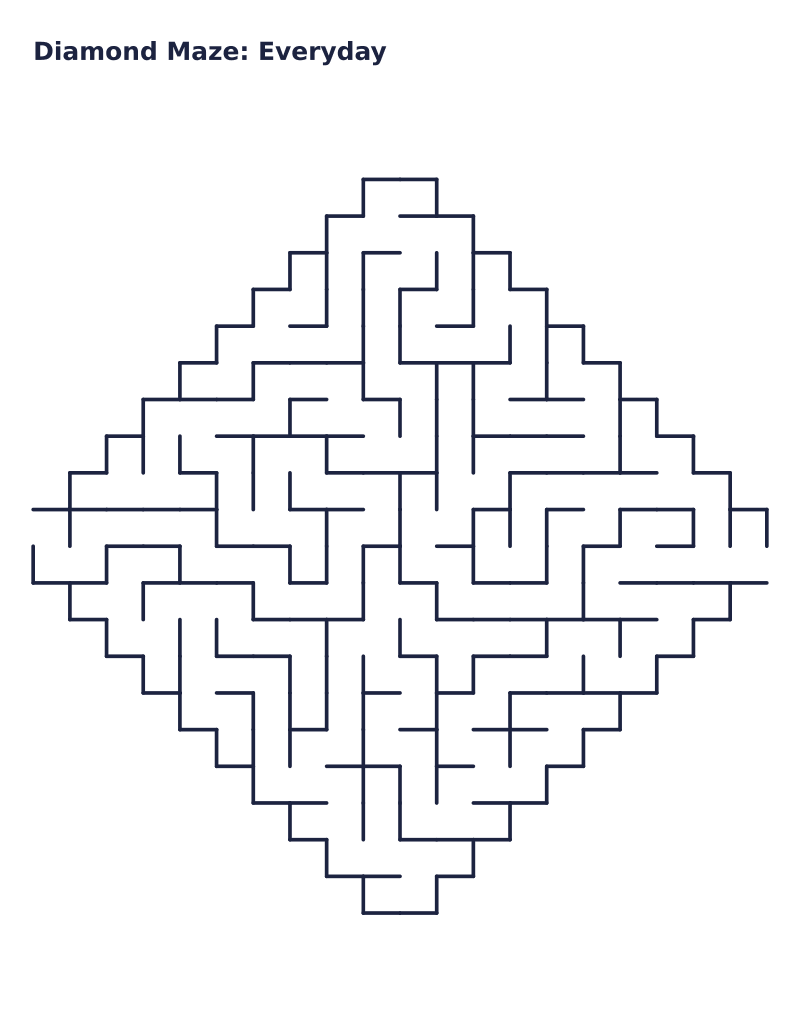 Diamond maze, everyday20 × 20 grid · MediumDownload PDF ↓
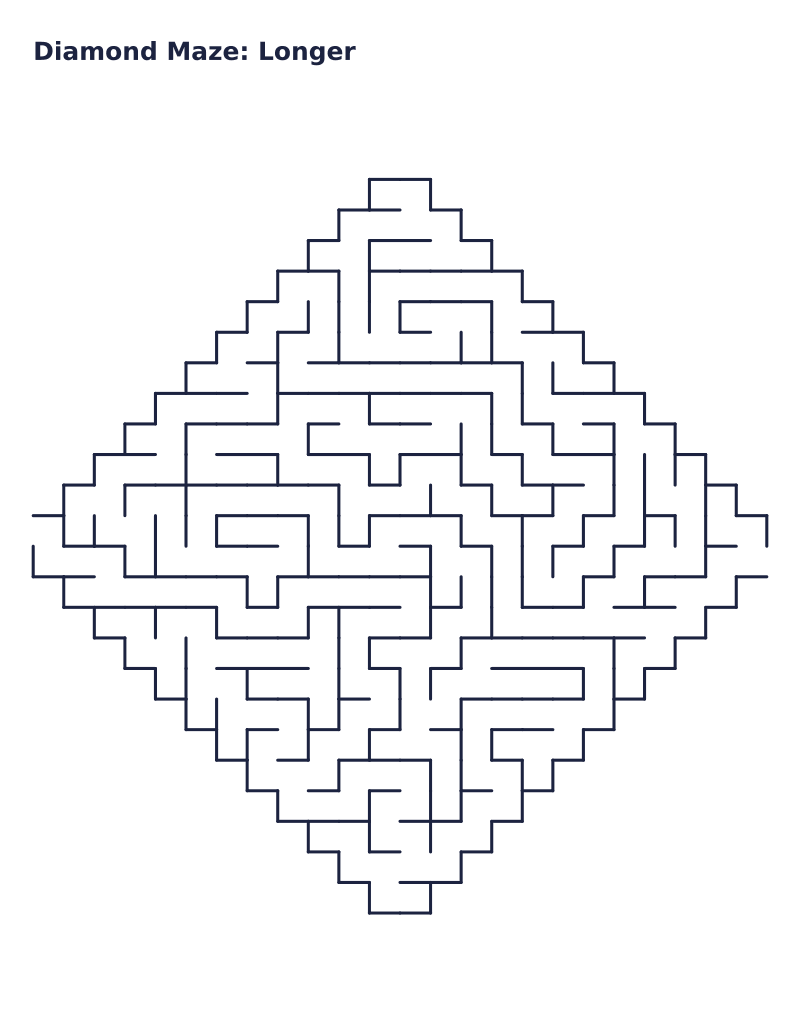 Diamond maze, longer24 × 24 grid · MediumDownload PDF ↓
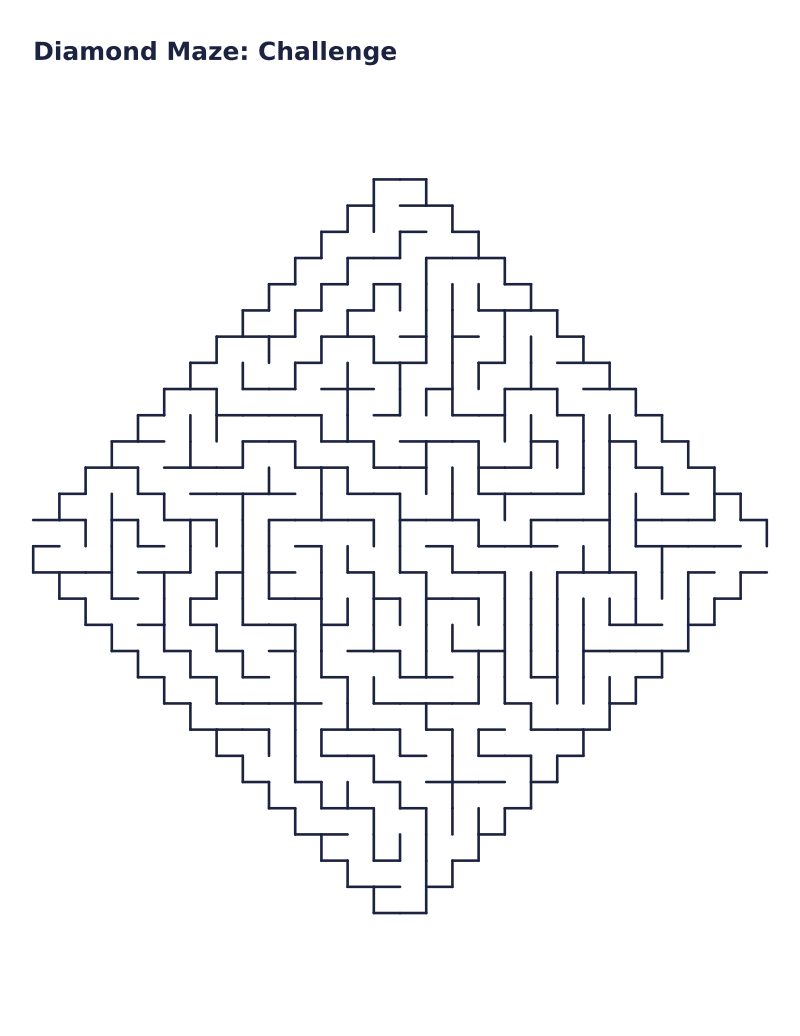 Diamond maze, challenge28 × 28 grid · HardDownload PDF ↓
Every sheet here is free to print as often as you like. If one saved you time, the tip jar is on Ko-fi.
A diamond is a square standing on a corner, and it keeps just over half the grid, 144 of the 256 squares on the Large print sheet. The stepped edges give it a look the plain rectangle does not have while staying simple enough that the shape never fights the puzzle.
The maker will draw one from 12 squares across, where a heart or a star needs at least 16. There is nothing to recognize and nothing seasonal about it, so it does not date and it does not belong to any one month, useful if you are printing a set to keep in a drawer rather than for an occasion.
The route enters at the left point and leaves at the right, which means it crosses the full width of the shape at its widest. That makes a diamond maze feel longer than its square count suggests, because the journey runs through the middle rather than around the edge.
Exactly one path through, no loops, and the answer prints separately.
Every square along the edge of a diamond maze has the outline on two of its sides, so it can only be a bend or a dead end, never a fork. The outline is cut from an upright grid, and a slanting line on a grid becomes a staircase of single squares, each closed above or below and to one side. No other shape here does that all the way around: a circle or a heart has flatter stretches where an edge square is closed on one side only and can still branch. The four diamond sheets have between 32 and 56 squares on the edge, and not one of them is a fork.
The result shows up as dead ends crowding the rim. On the Large print diamond, 14 of the 24 dead ends sit on the edge; on the Challenge, 24 of 54. Where a corridor runs along the edge it climbs it like a staircase, turning at every square, which makes the rim the most demanding part of the sheet for pencil control: the line has to change direction at every square without touching a wall. For a child working on that skill, tracing one of the edge corridors with a finger before picking up the pencil is a good warm-up for the maze itself.
The Large print diamond gives the most practice at choosing: its route passes 17 forks in 95 squares, more than any other Large print sheet across the maze pages, and no wrong turn on it runs more than seven squares. A child meets a decision every five or six squares on average, and every wrong choice ends quickly, so they get a great deal of practice at noticing a dead end and going back to the last fork, without long stretches of wasted drawing. The squares print about 11 mm across, wide enough for a young child who has a pencil under reasonable control.
The larger diamonds trade that rhythm for longer traps. The Everyday sheet has 12 forks, and its one long wrong turn, 51 squares deep, opens on the square just before the way out. The Longer sheet has the most forks of the four at 20, on a 157-square route, with nothing deeper than 32 squares. The Challenge has 16 forks on a 133-square route, shorter than the Longer's, but two wrong turns of 68 and 71 squares both open in its last 25 squares. Labels aside, the Longer diamond is the steadiest of the bigger three, and the Challenge the one most likely to catch a solver near the end.
On every diamond sheet the route stays off the outline for most of its length: only 6 to 16 of its squares touch the stepped rim, and none of its forks sit there. On the Large print sheet it passes through 95 of the 144 squares inside the outline, about two thirds of the maze, so the line covers most of the drawing before it reaches the exit.
When you want no occasion attached to it and a set that steps down evenly in size. The four diamond sheets are the same outline at 16, 20, 24 and 28 squares across, with squares printing from about 11 mm wide on the Large print sheet to about 6.5 mm on the Challenge, so one design can go to a mixed group, each child on the size that suits their pencil.
No. The grid stays upright, so every wall inside runs straight across or straight down, and only the outline is at an angle, cut as steps one square high. Turning a whole square maze would tilt its walls too, and the corridors would run diagonally across the page.
New printables when they go up, mostly seasonal, a few times a year.