120 Chart
1 to 120
Created for free at puzzleandprint.com
Twelve rows of ten, from 1 to 120, filled in, blank or with numbers missing.
Last updated
Save this to Pinterest120 Chart
1 to 120
Created for free at puzzleandprint.com
The filled charts are a single page. Every chart with numbers to fill in carries its answer key on the page after it.
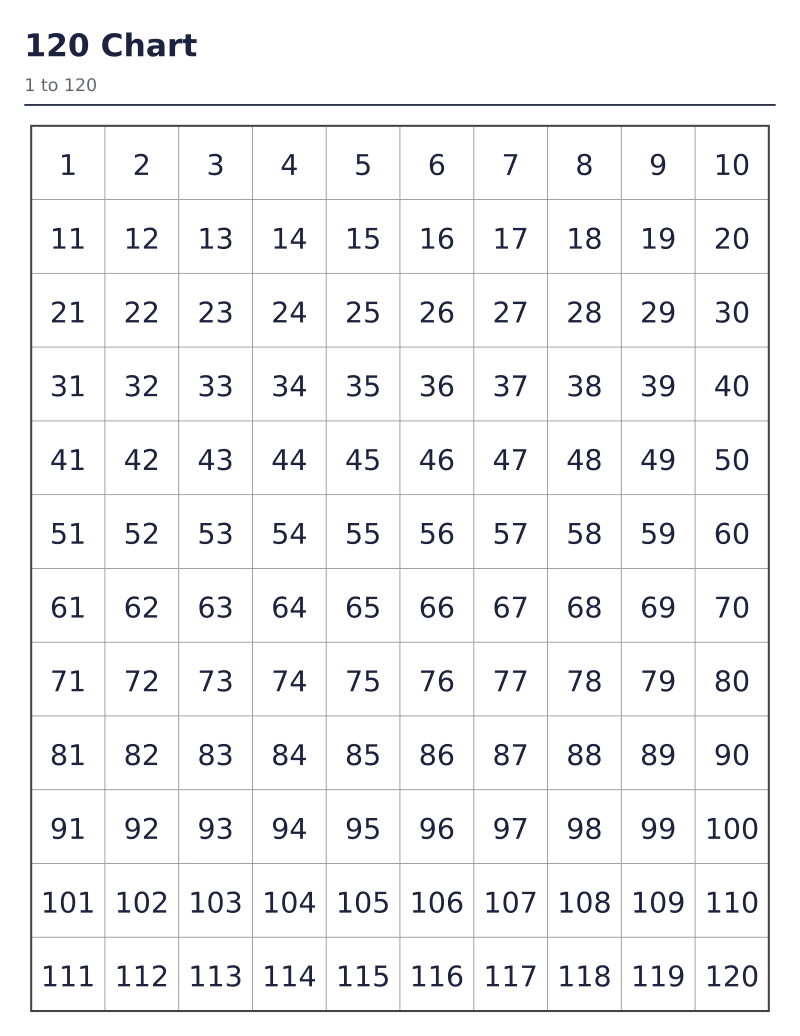 120 chart 1 to 12012 rows of 10 · 18.2 mm squaresDownload PDF ↓
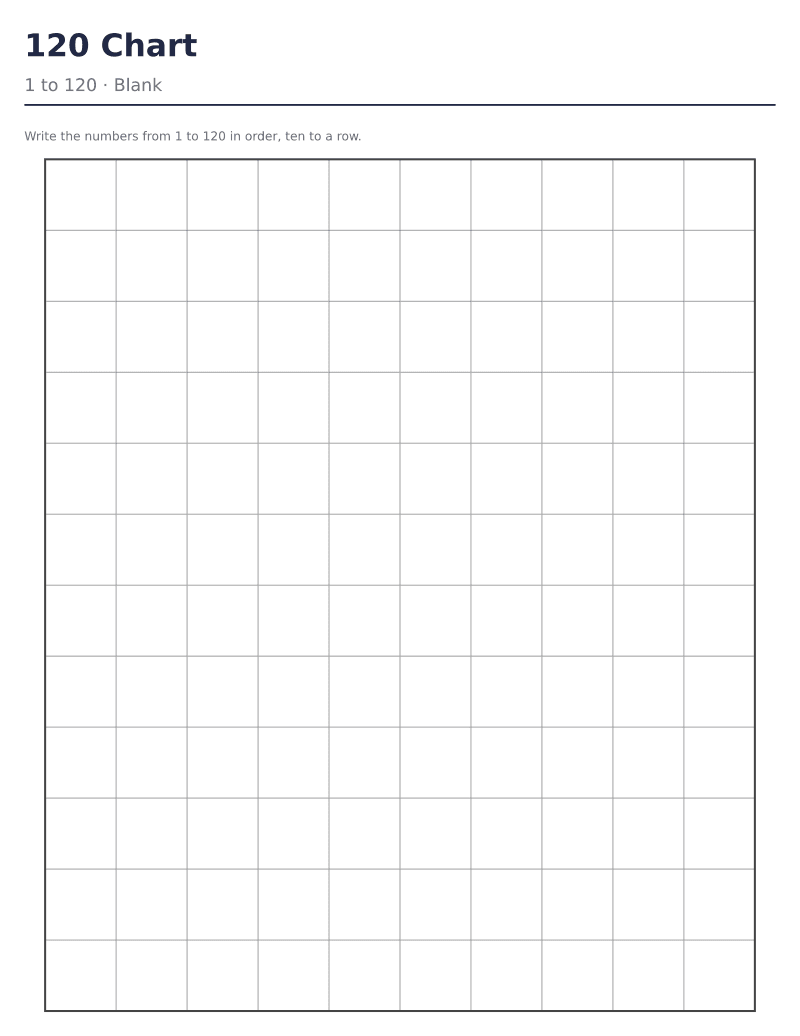 Blank 120 chart120 squares to fill · answer keyDownload PDF ↓
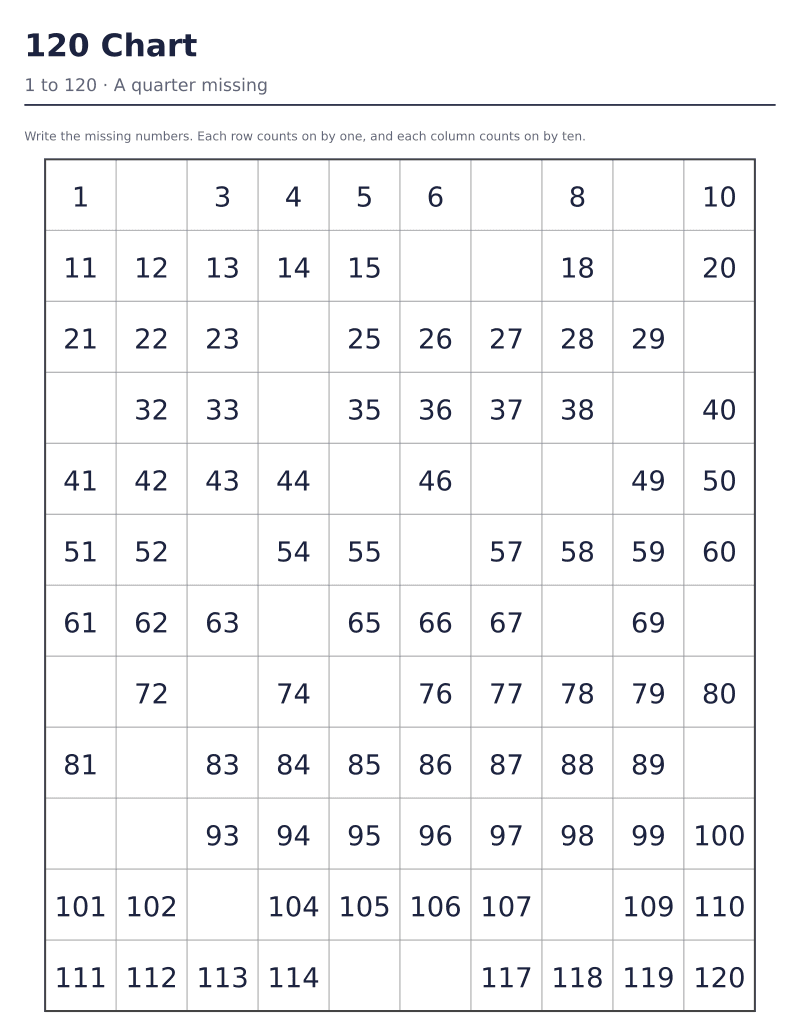 120 chart missing numbers30 of 120 empty · answer keyDownload PDF ↓
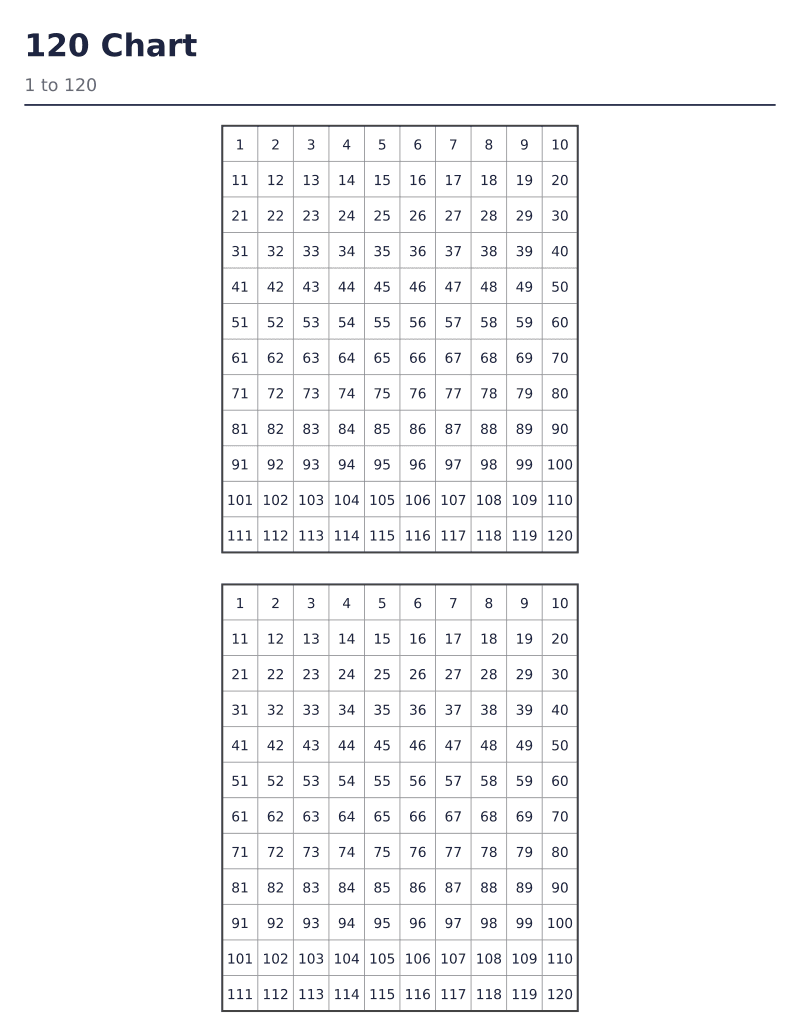 120 chart two per pageTwo filled charts, to cut apartDownload PDF ↓
Every sheet here is free to print as often as you like. If one saved you time, the tip jar is on Ko-fi.
A 120 chart is a hundreds chart with two more rows, 101 to 110 and 111 to 120, and it matches a first grade standard: the Common Core asks first graders to count to 120, starting at any number below it, and to read and write the numbers in that range. The two extra rows are where that gets interesting, because past 100 a child who writes numbers the way they sound puts down 10020 for one hundred twenty, and the chart shows it as three digits instead.
The four ready-made sheets all run from 1 to 120. The filled chart is one to a page, with squares 18.2 mm across. The blank chart leaves all 120 squares empty, for the whole count to be written in, and the missing-numbers chart leaves out 30 of the 120 at random, spread so every row has two or three gaps and the first square is always printed. The last sheet puts two filled charts on one page, one above the other, for cutting in half.
The blank and missing-numbers sheets have their answer keys on the next page: the whole chart with the answers in gray, printed plain with no border. The two filled sheets are references, so there is nothing on them to check and no key.
The maker above opens on the filled 120 chart. It can leave out half or three quarters of the numbers instead, or the multiples of any number from 2 to 10, shade those multiples, start the chart at 0 or at 101, 201 and up, and print one, two or four charts to a page.
The last two rows of the 120 chart, 101 to 110 and 111 to 120, repeat the first two with a hundred in front, and that is the lesson in them. Each column still holds numbers ending in the same digit, so 107 sits under 97 and 117 under 107, and moving down a square still adds ten, across the hundred as easily as anywhere else: the square under 95 is 105, two rows down from 85.
Those rows are also where writing goes wrong. A child who says one hundred five often writes the hundred and then the five, 1005, and the chart answers that by showing 105 as a three-digit number in the same column as 5, 15 and 95. Asking a child to find 112 on the chart and explain why it sits under 102 practices the same idea from the other direction.
The first grade standard asks for counting to 120 from any number below it, not only from 1, and a missing-numbers 120 chart practices exactly that: each gap is filled by counting on from the number before it or back from the number after it. On the ready-made sheet the 30 gaps are spread so that every row has two or three of them, which means every row of ten asks for some counting and none is left complete.
For counting by tens, shade the multiples of 10 in the maker: they fill the last column, 10 down to 120, twelve squares in a line. Leaving the multiples of 10 out instead turns that column into the exercise. Either way the column shows what counting by tens looks like on paper, the tens going up by one each row while the ones digit stays at zero.
Because counting to 120 is the first grade target in the Common Core, and the numbers past 100 are where place value is easiest to get wrong. On the chart, 101 to 110 sits directly under 91 to 100 and in the same columns as 1 to 10, so a child can see that 105 is 5 with a hundred in front of it, written with three digits and not as 1005.
Thirty of the 120, a quarter, with two or three gaps in every row and the 1 in the first square always printed. The maker on this page can leave out half instead, 60 numbers, or three quarters, 90, and makes a different chart each time New charts is pressed.
Yes. Alone on the page its twelve rows fit with squares 18.2 mm across, or 17.3 mm on the blank and missing-numbers sheets, where a name line and a line of instructions sit above the chart. Two charts to a page fit with squares 9 mm across, stacked one above the other.
New printables when they go up, mostly seasonal, a few times a year.