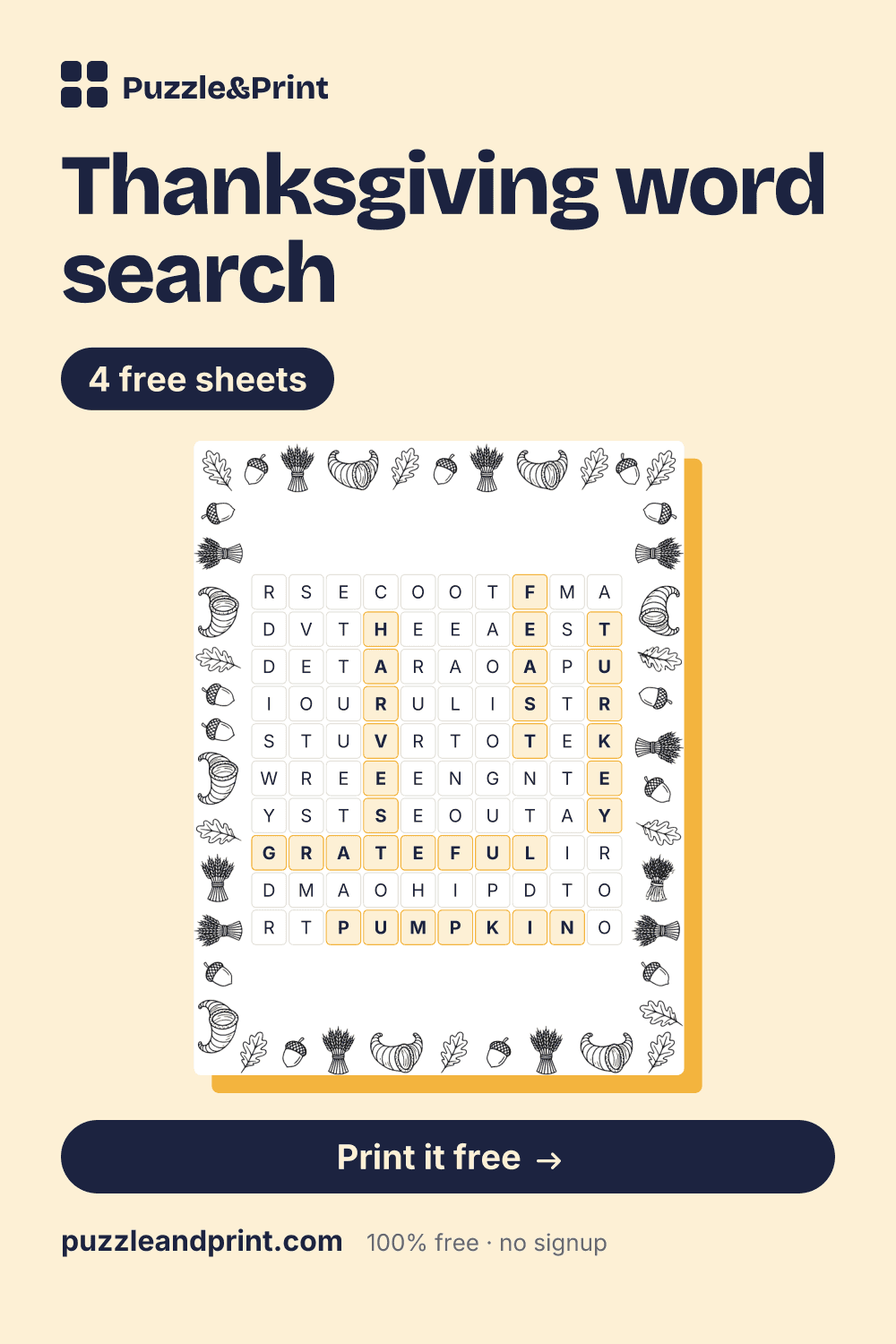
Thanksgiving Word Search
- POTATOES
- NUTMEG
- TRADITION
- CORN
- LEFTOVER
- ACORN
- FAMILY
- PUMPKIN
- TURKEY
- ROASTED
- PLATTER
- PIE
Created for free at puzzleandprint.com
Harvest, a full table and the words for being grateful.
Last updated
Save this to PinterestThanksgiving Word Search
Created for free at puzzleandprint.com
Thanksgiving Word Search, Answer Key
Created for free at puzzleandprint.com
Four sheets, each with a different job. Every one is a two-page PDF, the puzzle, then the answer key on its own page.
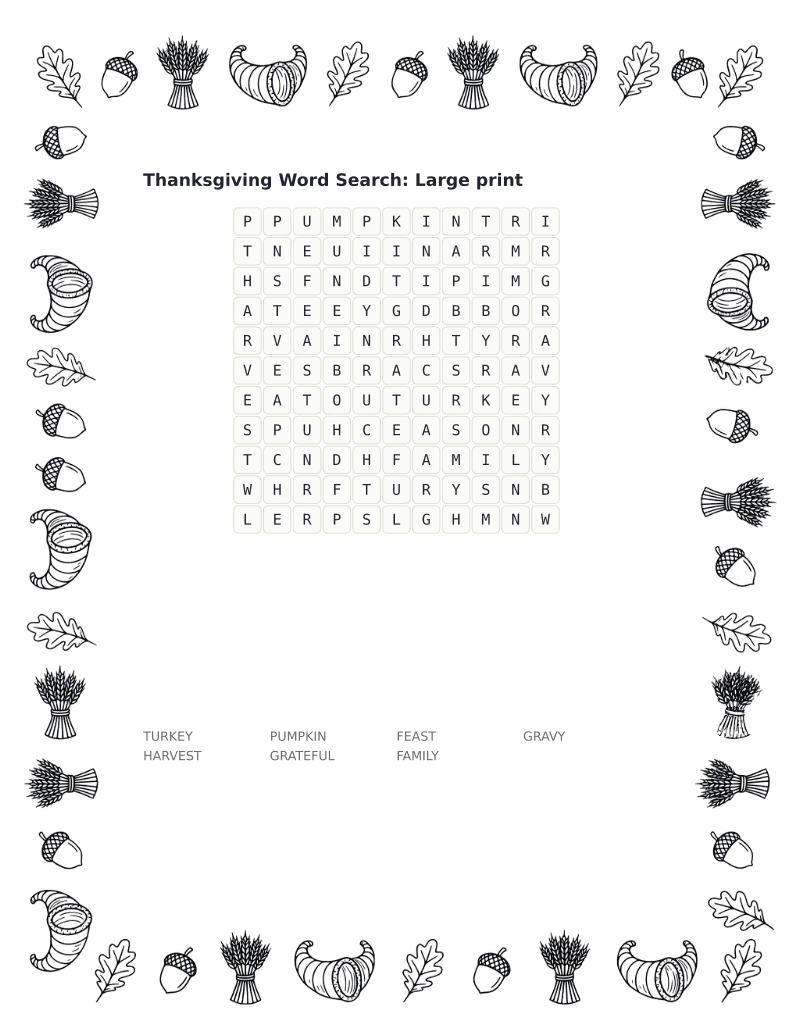 Thanksgiving word search, large print11 × 11 · 7 words · EasyDownload PDF ↓
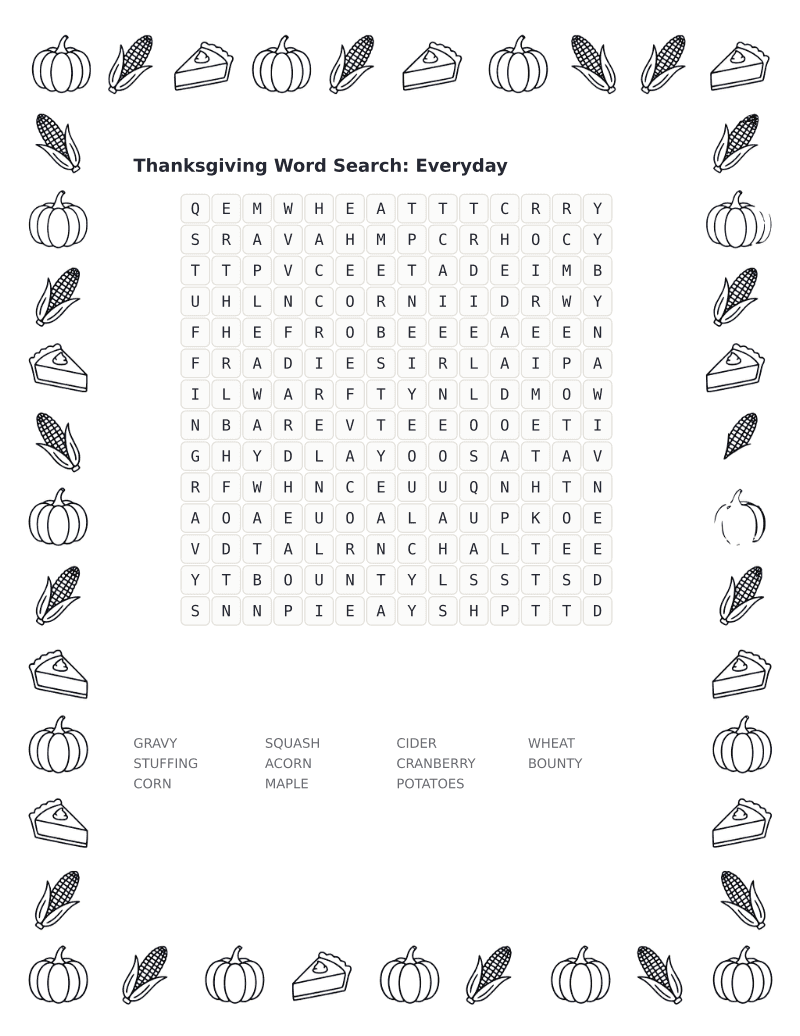 Thanksgiving word search, everyday14 × 14 · 11 words · MediumDownload PDF ↓
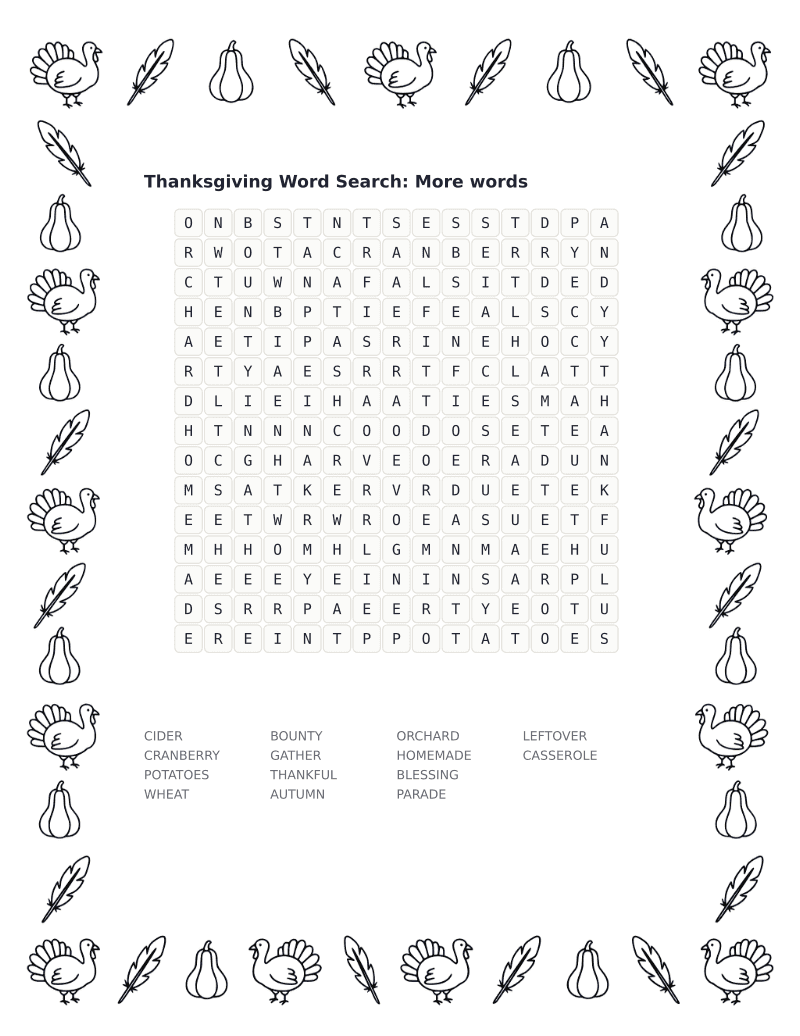 Thanksgiving word search, more words15 × 15 · 14 words · MediumDownload PDF ↓
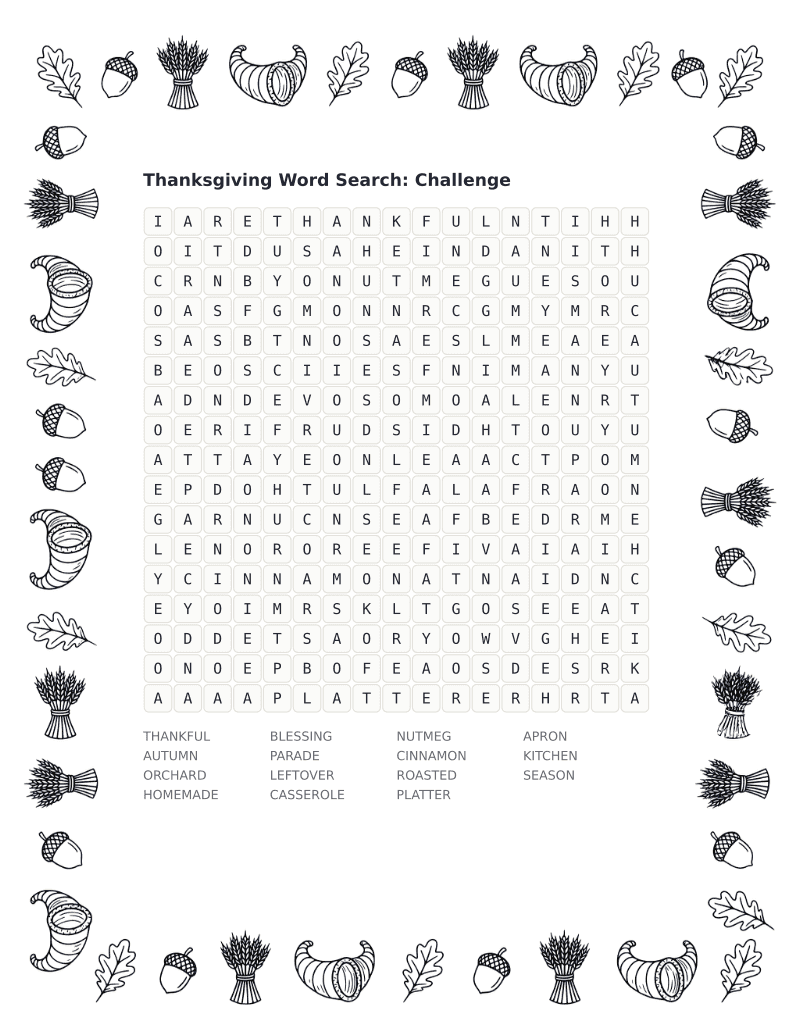 Thanksgiving word search, challenge17 × 17 · 15 words · HardDownload PDF ↓
Every sheet here is free to print as often as you like. If one saved you time, the tip jar is on Ko-fi.
This list is built from food, family and the season rather than the founding story. The holiday falls in both October and November depending on where you are, and only one of those traditions attaches a settlement narrative to it, so a harvest-and-gratitude list is the one that works in either classroom.
The cooking words are the strongest part. CASSEROLE and CRANBERRY are two of the four nine-letter words on the list, its longest, and CINNAMON, NUTMEG and PLATTER are specific enough to be worth talking about afterwards. Most children can taste these words before they can spell them.
Grateful, thankful, blessing, sharing and abundance give the sheet a use beyond the puzzle. They are a ready-made prompt for the writing task that tends to accompany the week, and having just found a word makes a child more likely to use it.
The list is deliberately long on food so a family can do it at the table while something is in the oven. Print the large-print sheet for whoever is youngest and the challenge sheet for whoever claims to be best at these.
Most of the food on the Thanksgiving list first came from the Americas: TURKEY, CORN, SQUASH, PUMPKIN, CRANBERRY, PECAN and POTATOES are all native to North or South America, and MAPLE syrup is a North American product. The spices are the exception. NUTMEG and CINNAMON came by sea from Asia, and WHEAT, the flour in the pie crust and much of the STUFFING, was first farmed in the Middle East. Two columns on the back of the sheet, the Americas and everywhere else, make a short geography lesson, and show children that a meal they think of as one tradition is a mix of very old trade routes.
YAMS deserves a footnote: what is served as yams at many tables in the United States is usually an orange sweet potato, while a true yam is a different, starchier root grown mostly in Africa and Asia. PECAN, YAMS and PIE are all on the list but on none of the four sheets, so a family that wants the dessert table represented can press New puzzle in the maker above, which picks from all forty. Apples are missing as a word, but CIDER and ORCHARD stand in for them, and both are on the more words sheet.
CORN hides inside ACORN on the everyday Thanksgiving sheet because the last four letters of ACORN spell CORN, and both words are on that sheet. On the sheet as printed, the only CORN in the grid is the one inside ACORN, so a child who finds ACORN has found CORN as well, and the answer key shows one inside the other. Rather than a flaw, it is a neat way into spotting words within words. The same sheet has SQUASH, which holds the only Q on the list, and POTATOES, whose e belongs only to the plural: potato has none, which is the half children tend to get wrong.
The challenge Thanksgiving sheet is mostly set in the kitchen: KITCHEN, APRON, PLATTER, ROASTED, CASSEROLE, NUTMEG, CINNAMON, HOMEMADE and LEFTOVER are nine of its fifteen words, on a seventeen-square grid where they can run in any direction. CASSEROLE and CINNAMON both have a doubled letter in the middle, a double S and a double N, and each is easy to misspell by doubling the wrong letter. The large print sheet, by contrast, is the meal and the people around it, TURKEY, HARVEST, PUMPKIN, FEAST, FAMILY and GRAVY, with GRATEFUL as its longest word at eight letters.
Yes, and that is why it is built the way it is. The list is harvest and gratitude, HARVEST, BOUNTY, GATHER, THANKFUL and ORCHARD, rather than the founding story, which only one of the two countries attaches to the day.
It is one of the few sheets designed for the waiting rather than the meal. It occupies the gap between arriving and eating, it needs nothing but a pencil, and GRATEFUL, BLESSING and SHARING give the adults something to ask about.
Canadian Thanksgiving is the second Monday in October and American Thanksgiving is the fourth Thursday in November. A class with families from both countries can use the same sheets twice in one fall, once for each.
New printables when they go up, mostly seasonal, a few times a year.