Place Value Chart
Hundred thousands to thousandths
Created for free at puzzleandprint.com
Place value charts that carry on past the decimal point, to tenths, hundredths or thousandths, with practice sheets and plain keys.
Last updated
Save this to PinterestPlace Value Chart
Hundred thousands to thousandths
Created for free at puzzleandprint.com
6 sheets. The 2 practice sheets are followed by their answer keys; the charts are a page each.
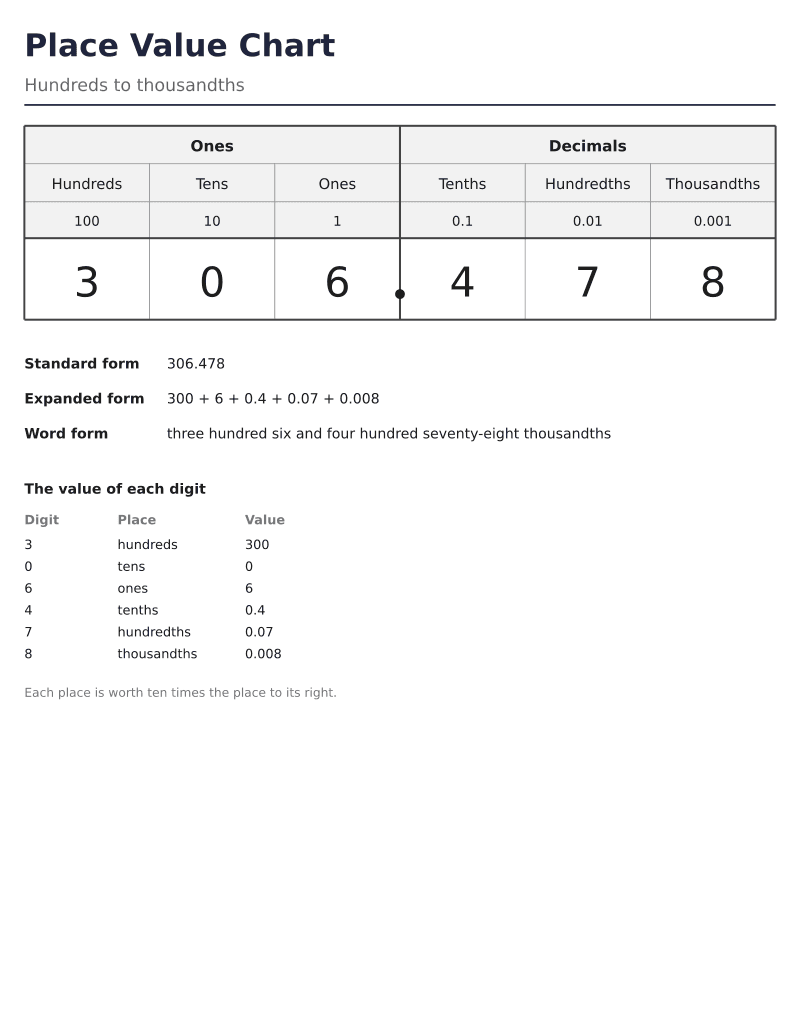 Decimal place value chart to thousandthsHundreds to thousandths · 6 columnsDownload PDF ↓
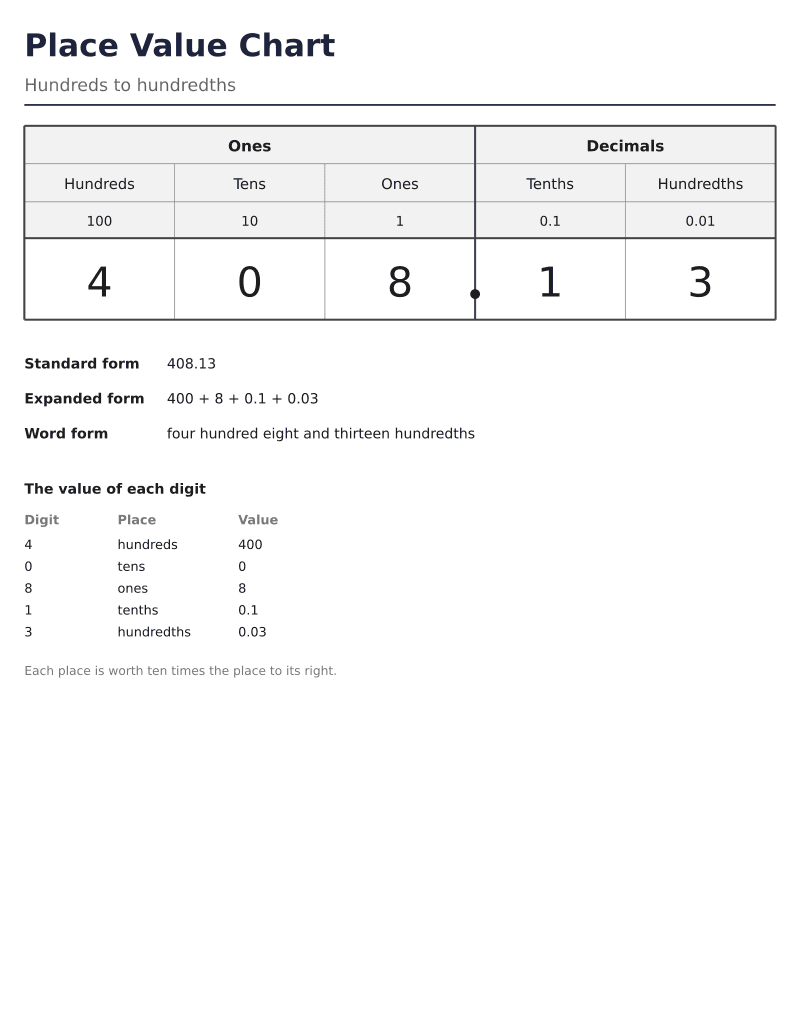 Decimal place value chart to hundredthsHundreds to hundredths · 5 columnsDownload PDF ↓
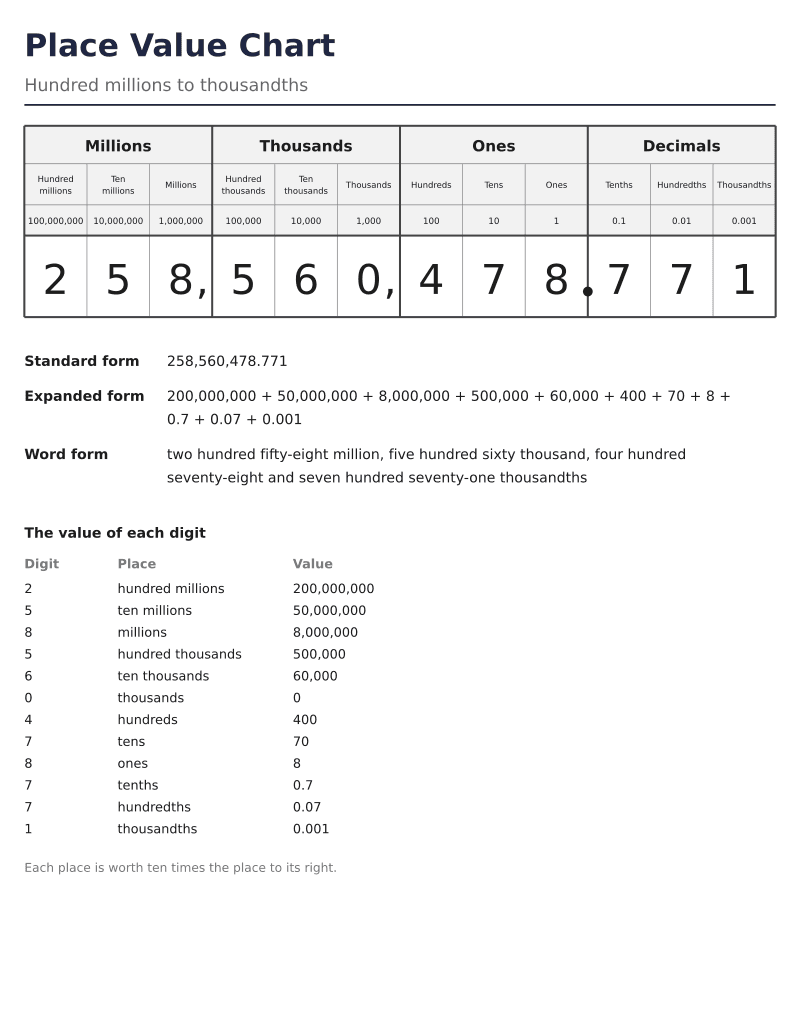 Place value chart millions to thousandths12 columns · names, values and an exampleDownload PDF ↓
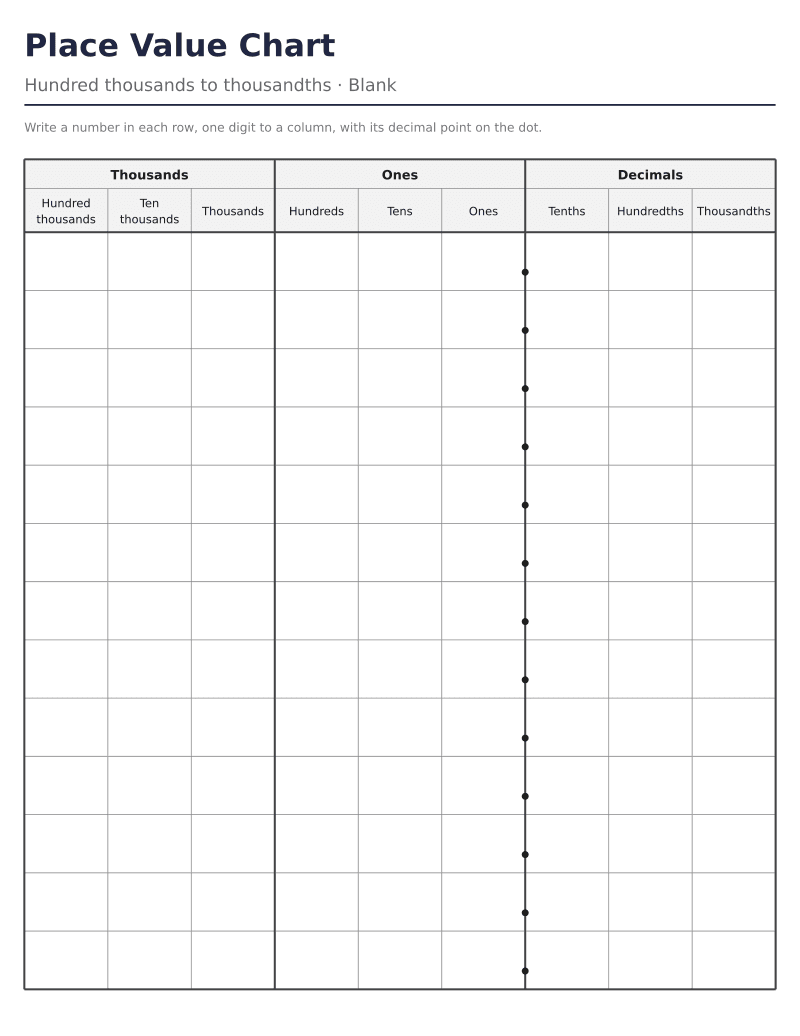 Blank decimal place value chartHundred thousands to thousandths · 13 empty rowsDownload PDF ↓
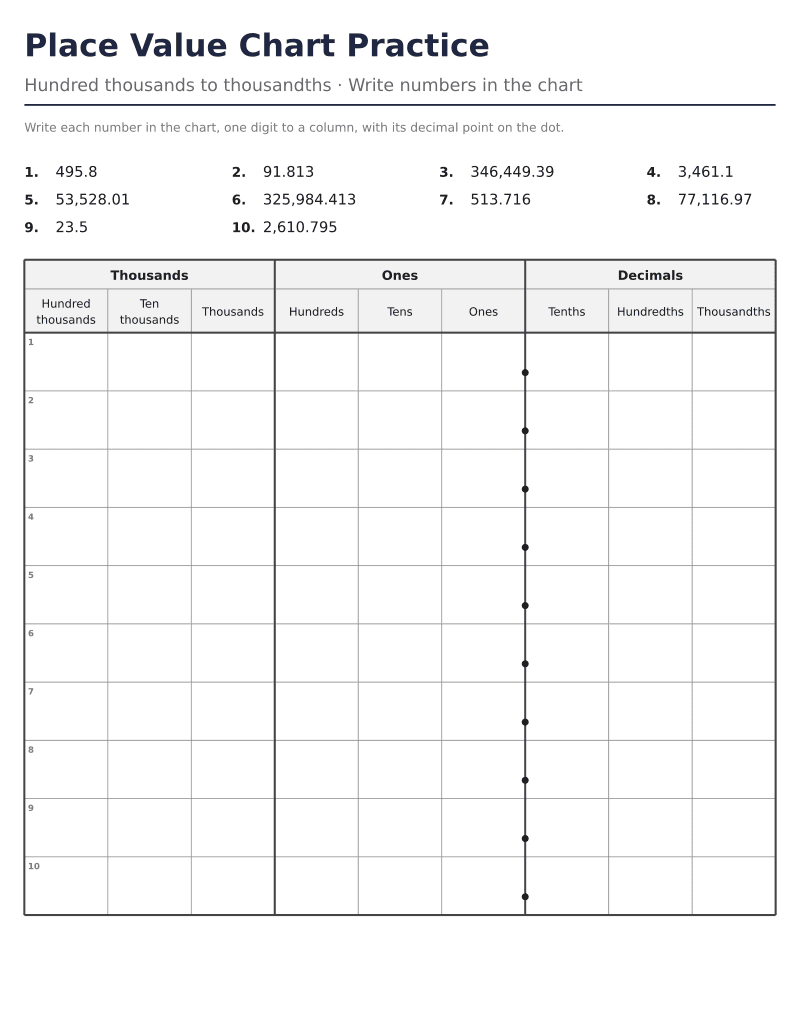 Decimal place value chart practice10 decimals to place · answer keyDownload PDF ↓
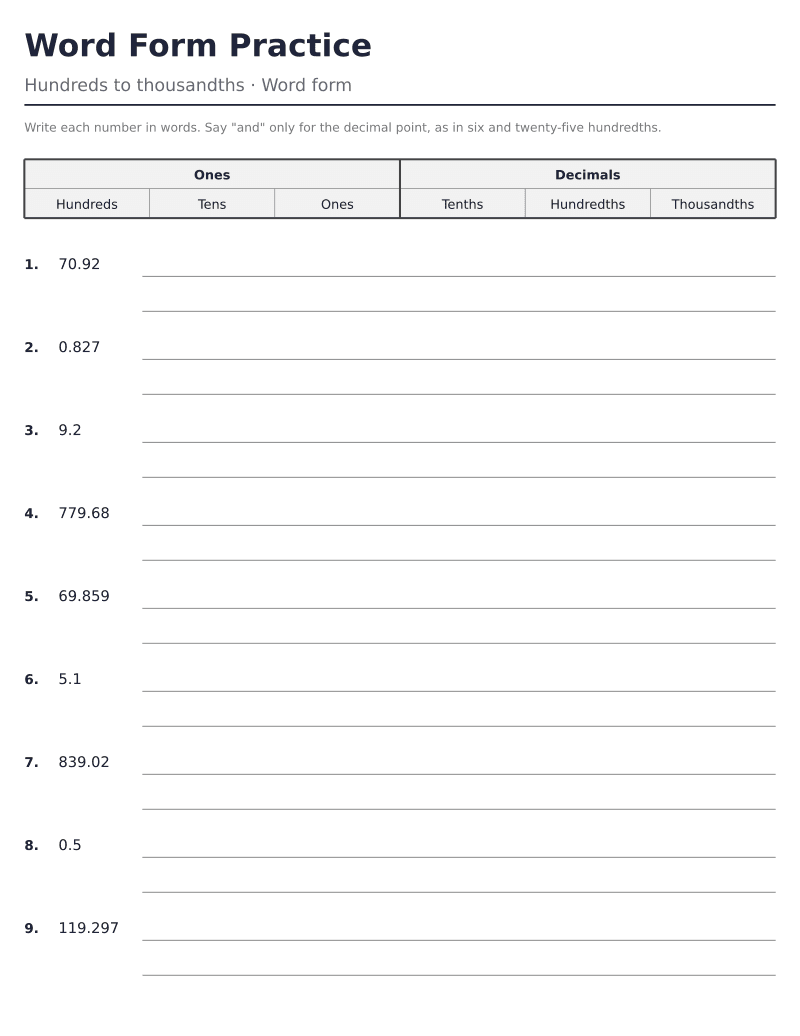 Decimal place value word form9 decimals to write in words · answer keyDownload PDF ↓
Every sheet here is free to print as often as you like. If one saved you time, the tip jar is on Ko-fi.
A decimal place value chart is the ordinary chart with columns added to the right of the ones: tenths, hundredths and thousandths. On these charts the decimal point is not a column of its own. It is printed as a dot on the heavy line between the ones and the tenths, in every row a number goes in, so a number written into the chart has nowhere to put its point but the right place, and a child lining up 4.5 and 12.06 lines them up on the dot rather than at the left edge.
There are six ready-made sheets. Three are filled reference charts: hundreds to thousandths in six columns, hundreds to hundredths in five, and the full chart from hundred millions to thousandths in twelve. Each names every column, prints its value under its name, 0.1, 0.01 and 0.001 for the decimal places, and writes one number in as an example with its standard, expanded and word forms below. The fourth sheet is a blank chart from hundred thousands to thousandths, thirteen empty rows to write any decimals in.
The last two are practice. One gives ten decimals to write into the chart from hundred thousands to thousandths, each with one, two or three decimal places so the digits after the point never line up by accident. The other gives nine decimals to write in words, some less than one and some in the hundreds, with one to three decimal places. Both have the answer key on the next page, printed plain to save ink.
The maker above opens on the filled chart from hundred thousands to thousandths. It can stop the decimals at tenths or hundredths, put them on any chart from hundreds, tens and ones up to millions, shade every other period, and make up to five different practice sheets in one download.
The most common decimal mistake is lining numbers up on the right, the way whole numbers line up in a sum. Written that way, the 5 of 0.5 sits over the 5 of 0.25, as if a tenth and a hundredth were the same kind of digit, and 0.25 looks bigger because it has more digits. On the chart the point is printed before any number is written, so every number has to be placed from it: the 5 of 0.5 lands in the tenths, the 2 of 0.25 in the tenths of the row below, and the comparison is a comparison of two digits in one column.
That is also the way to compare decimals without the chart. Line the points up, then read down the columns from the left until two digits differ; the larger digit belongs to the larger number. 0.5 and 0.25 differ first in the tenths, five against two, so 0.5 is larger, whatever the hundredths say. The practice sheet asks for ten decimals with one, two or three places, mixed, so lining up on the point is the only way to place them all.
Each decimal place is worth a tenth of the place to its left, the same rule that runs through the whole numbers, read the other way: a hundredth is a tenth of a tenth, so ten hundredths make one tenth and 0.1 is the same amount as 0.10. The value row on a filled chart prints them as 0.1, 0.01 and 0.001, after the 1 of the ones place, so the pattern is visible across the point.
In expanded form each decimal digit is written as its own value, so 3.47 is 3 + 0.4 + 0.07, and the table under each filled chart lists the example's decimal digits the same way. As fractions those values are tenths, hundredths and thousandths, 4/10 and 7/100, which is where the names come from, and the word form says the same thing in one go: three and forty-seven hundredths. A child who can move a decimal between those three forms knows what each digit after the point is worth.
Because the point takes no place of its own: it marks where the ones end and the tenths begin. Printed as a dot on the heavy line between those two columns, in every row a number goes in, it shows exactly where the point of each number goes, and a child who writes 3.4 and 12.05 on the chart lines the two up on the dot rather than at the left edge.
Read the whole number, say "and" for the point, then read the digits after it as one number and name the last place they reach: 4.06 is four and six hundredths, and 0.582 is five hundred eighty-two thousandths. The decimal word form sheet asks for exactly that, and its key writes every answer that way.
No. The last digit after the point is never a zero, so every decimal is written the shortest way, 0.5 rather than 0.50, and the number of decimal places a number has is the number its digits need. That keeps the word form honest too: 0.5 is five tenths, and 0.50 would be read as fifty hundredths, the same amount in other words.
New printables when they go up, mostly seasonal, a few times a year.