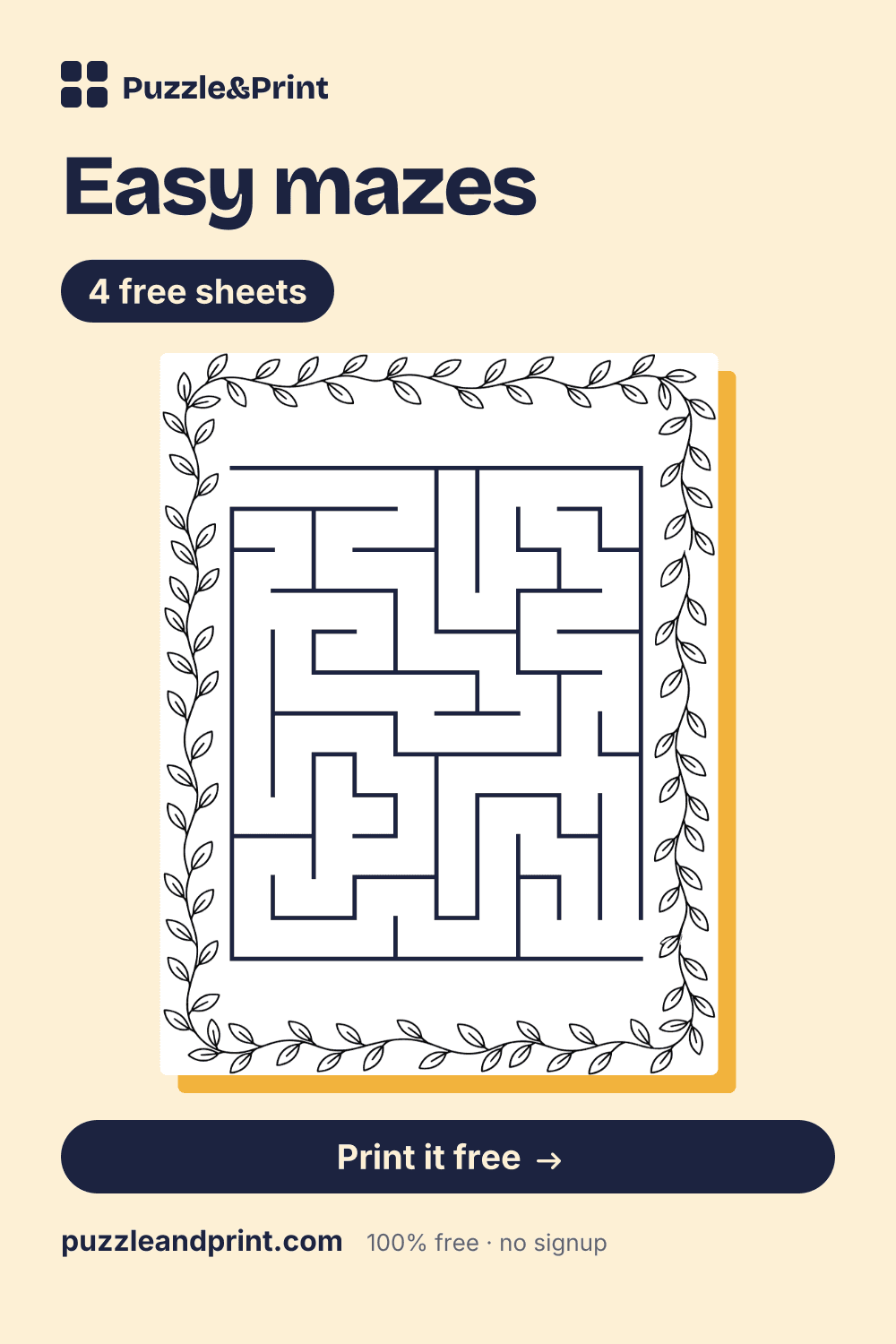
Easy Maze
Created for free at puzzleandprint.com
Four free printable mazes for beginners, from a first 8 by 8 maze to a 14 by 14 step up, each with the solution on its own page.
Last updated
Save this to PinterestEasy Maze
Created for free at puzzleandprint.com
Easy Maze, Solution
Created for free at puzzleandprint.com
Four mazes, each a different size. Every one is a two-page PDF, the maze, then the solution on its own page.
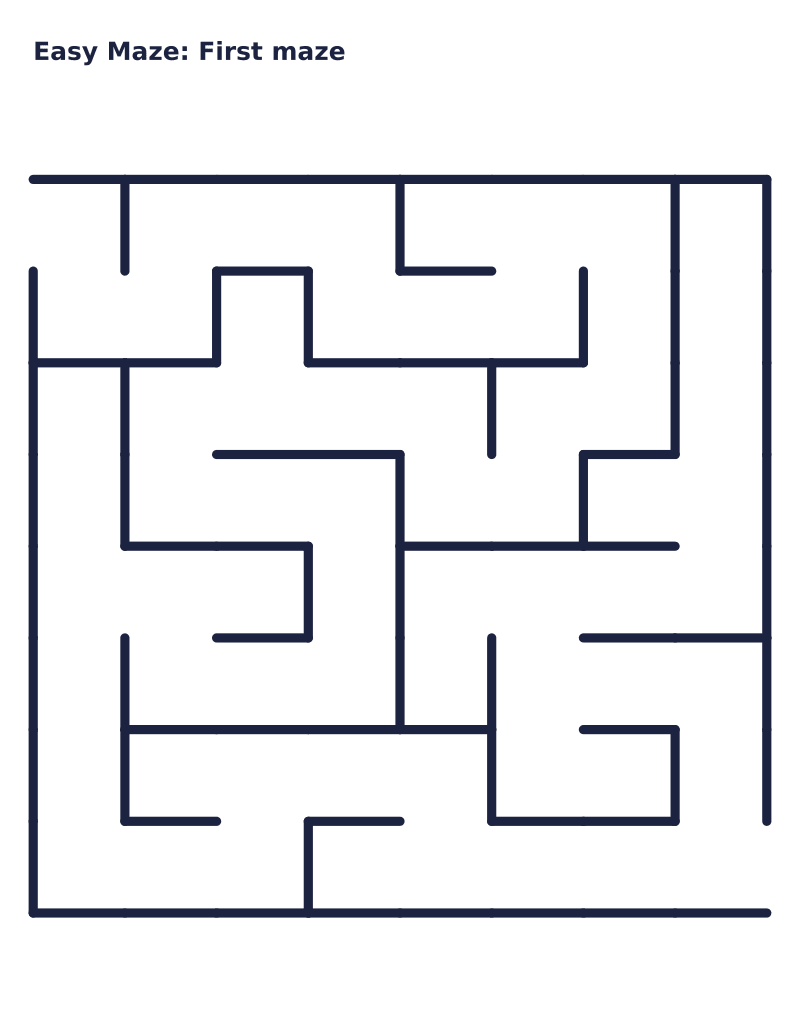 Easy maze, first maze8 × 8 squares · EasyDownload PDF ↓
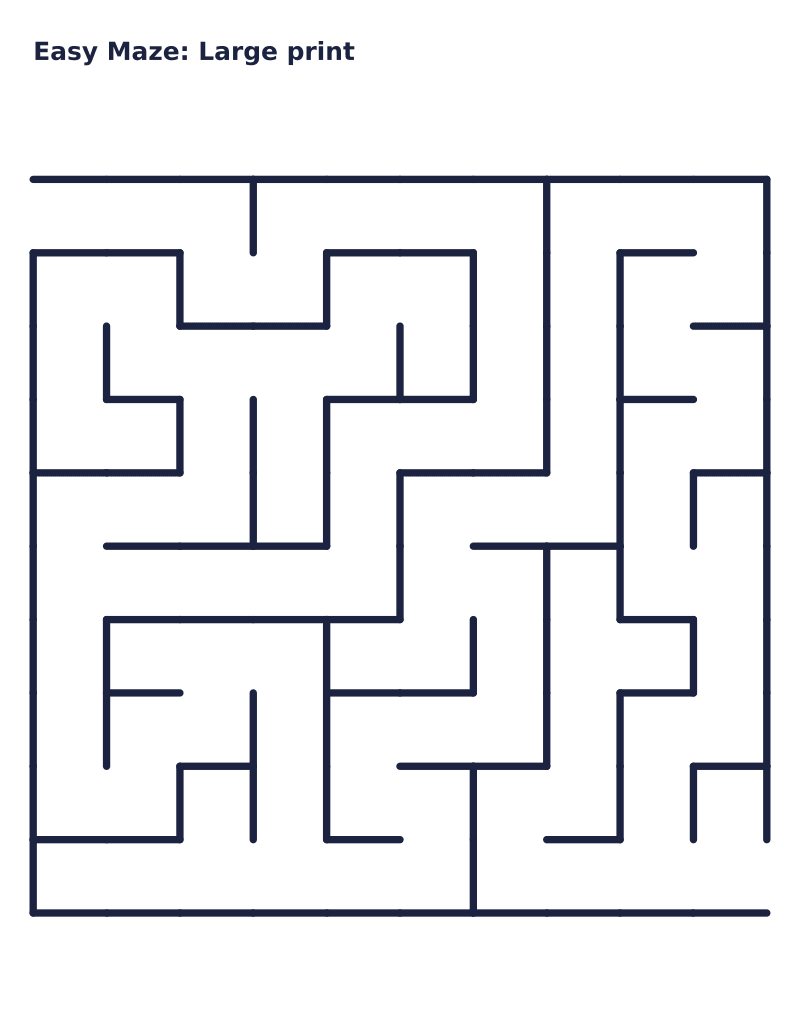 Easy maze, large print10 × 10 squares · EasyDownload PDF ↓
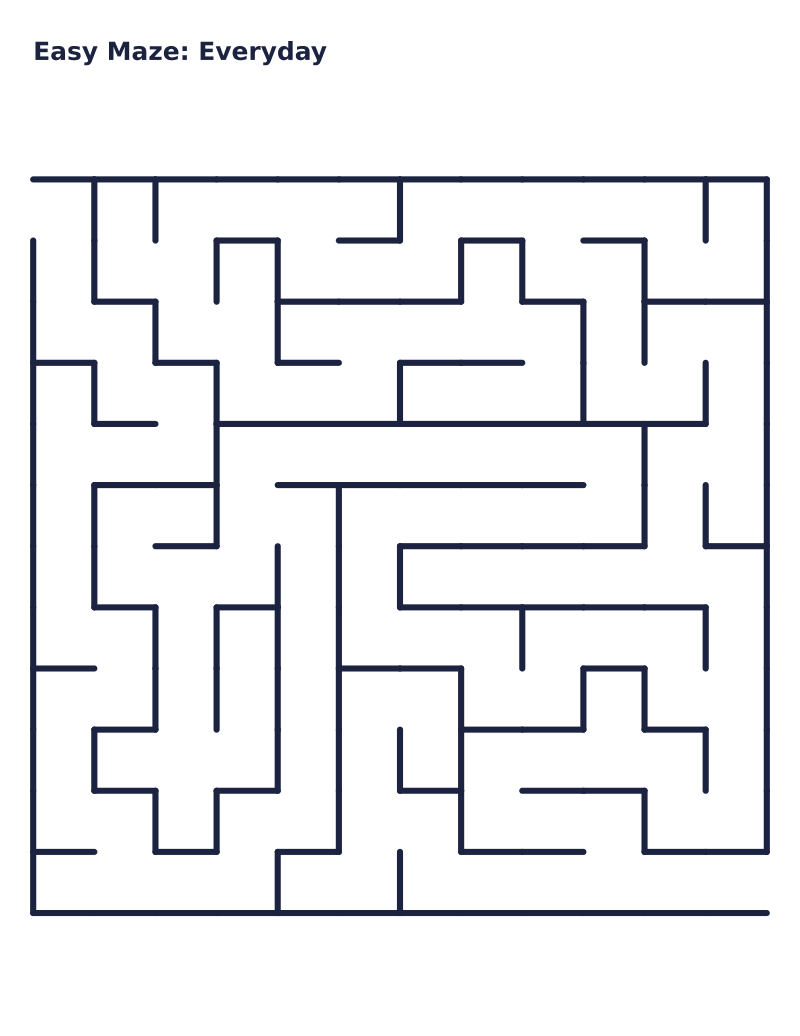 Easy maze, everyday12 × 12 squares · EasyDownload PDF ↓
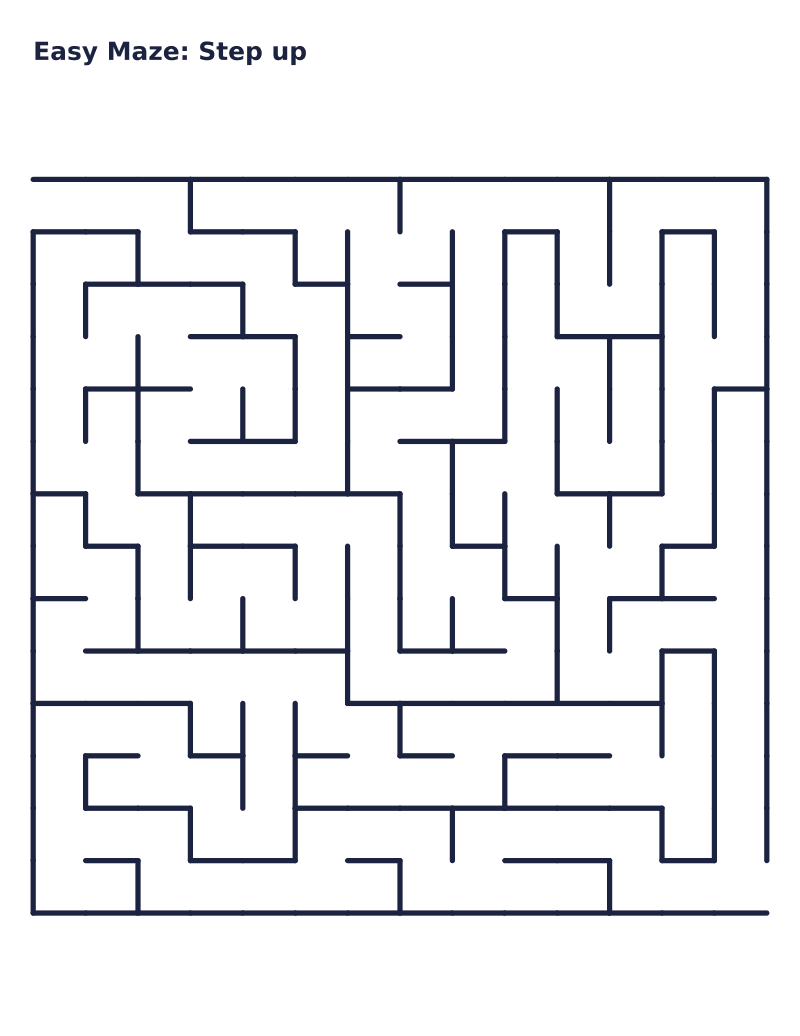 Easy maze, step up14 × 14 squares · MediumDownload PDF ↓
Every sheet here is free to print as often as you like. If one saved you time, the tip jar is on Ko-fi.
An easy maze is not just a small one. What makes a maze approachable is the width of the corridor relative to the pencil, and how often the route forks. On the twelve-square Everyday sheet the corridors are about 14 mm wide between the walls, which matters more than most people expect: a child who keeps crossing the walls is fighting the paper, not the puzzle.
The sheets here run from eight to fourteen squares. Eight is genuinely a first maze, though not a straight one: its route bends more than twenty times, and 13 of its 40 moves from square to square head up or to the left, away from the corner it is making for. Fourteen is long enough to reward looking ahead rather than guessing.
All four sheets are carved the same way: the generator wanders from square to square until it is boxed in, then backs up to the most recent square with an unvisited neighbor and sets off again. That tends to make long, winding corridors with few branches, and on the two smallest sheets the route alone covers about two thirds of the grid: 41 of 64 squares on the First maze, 65 of 100 on Large print.
None of the four sheets has a loop. The eight-square maze joins its 64 squares through 63 gaps in the inner walls, the fewest that can connect them all, and the bigger sheets keep the same rule: 99 gaps for 100 squares on Large print, 143 for 144 on Everyday and 195 for 196 on Step up. If none of the sheets is quite right, the maze maker on this page opens at twelve squares and runs from eight to 30.
The longest wrong turn on these easy mazes runs from two squares on one sheet to 36 on another. On the eight-square First maze none runs further than two, so a child sees the mistake almost as soon as it is made: the route there is 41 squares long and passes six forks, and five of those six lead into a single square. The ten-square Large print sheet is the natural next step, with a 65-square route and no wrong turn longer than 11 squares. Those two are the sheets to start on with a child who dislikes being wrong, because the maze shows them the dead end before they have traveled far enough to mind.
The twelve-square Everyday sheet is where that changes. Thirteen squares before the way out, one turn leads into a branch covering 52 of the maze's 144 squares, and the longest path into it runs 36 squares before it stops. The fourteen-square Step up sheet is bigger and labeled Medium, yet none of its wrong turns runs past 11 squares; what makes it harder is the number of decisions, ten forks on an 87-square route. So if a child finds the Everyday sheet frustrating, Step up is worth trying next despite its label, since its difficulty comes from choosing often rather than from one long detour.
Printed at full size on Letter paper, each square of the First maze measures about 23 mm across, Large print about 18 mm, Everyday about 15 mm and Step up about 13 mm. Every sheet draws its maze to the same width, roughly 18 cm, so fewer squares means wider corridors rather than a smaller drawing. The walls take up less than 2 mm of each square even on the First maze, which leaves a corridor of about 21 mm: a pencil line down the middle has about a centimeter of room on either side before it touches a wall.
For pencil control the useful exercise is to keep the line in the middle of the corridor rather than merely inside it. On the 23 mm squares there is plenty of room to manage that; on the 13 mm squares of Step up it takes deliberate care at every bend. A child can work through the four sheets in order of width as their control improves, and the solution page doubles as a check on neatness as well as on the route: the gray answer line runs through the center of every corridor it uses, so the attempt can be laid beside it and compared bend by bend.
Almost certainly not: drawing through the walls is a corridor-width problem rather than a difficulty one. Print the eight-square First maze, whose squares are the widest of the four at about 23 mm, and offer a pencil rather than a thick crayon. If you make your own eight-square maze in the maker instead, choose No arrows: the arrows need room beside the maze and shrink each square to about 19 mm.
The eight-square First maze is the quickest of the four, with a route of 41 squares against 87 on the fourteen-square Step up sheet, a little over twice as far to draw. Large print and Everyday both have 65-square routes, so any extra time the bigger Everyday grid takes goes on its side branches: 79 of its 144 squares are off the route, against 35 of 100 on Large print.
They show it as gaps in the outer wall: on all four sheets the way in is at the top left corner and the way out at the bottom right. The ready-made PDFs show only the gaps, so point them out to a child who has not done a maze before. The maze maker on this page also draws an arrow at each, and leaves them on unless you choose No arrows.
New printables when they go up, mostly seasonal, a few times a year.