Connect the Dots: Heart
10 dots, 1 to 10, large print
Start at the circled 1 and join the dots in order to 10, then join 10 back to 1 to finish the picture.
Created for free at puzzleandprint.com
Ten big dots, large bold numbers and one simple shape, for a child just learning to count to ten.
Last updated
Save this to PinterestEach is a two-page PDF on US Letter: the dots, then the finished picture as the answer key.
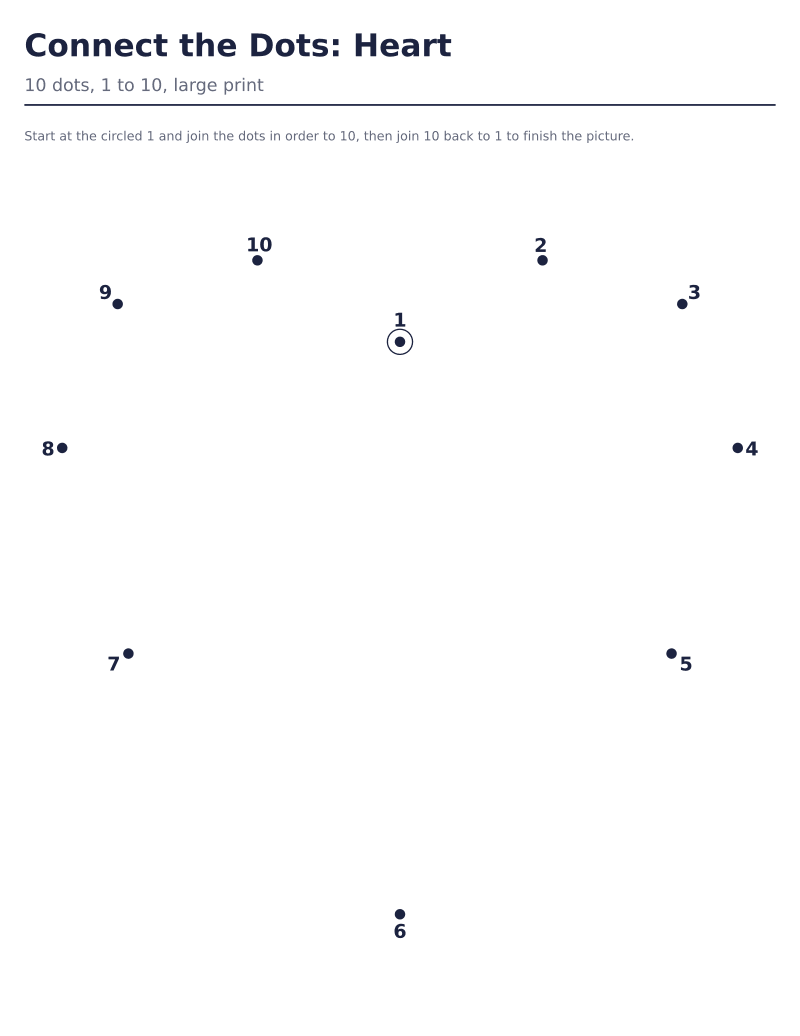 Heart connect the dots, large print 1 to 1010 dots · 1 to 10 · large print · answer keyDownload PDF ↓
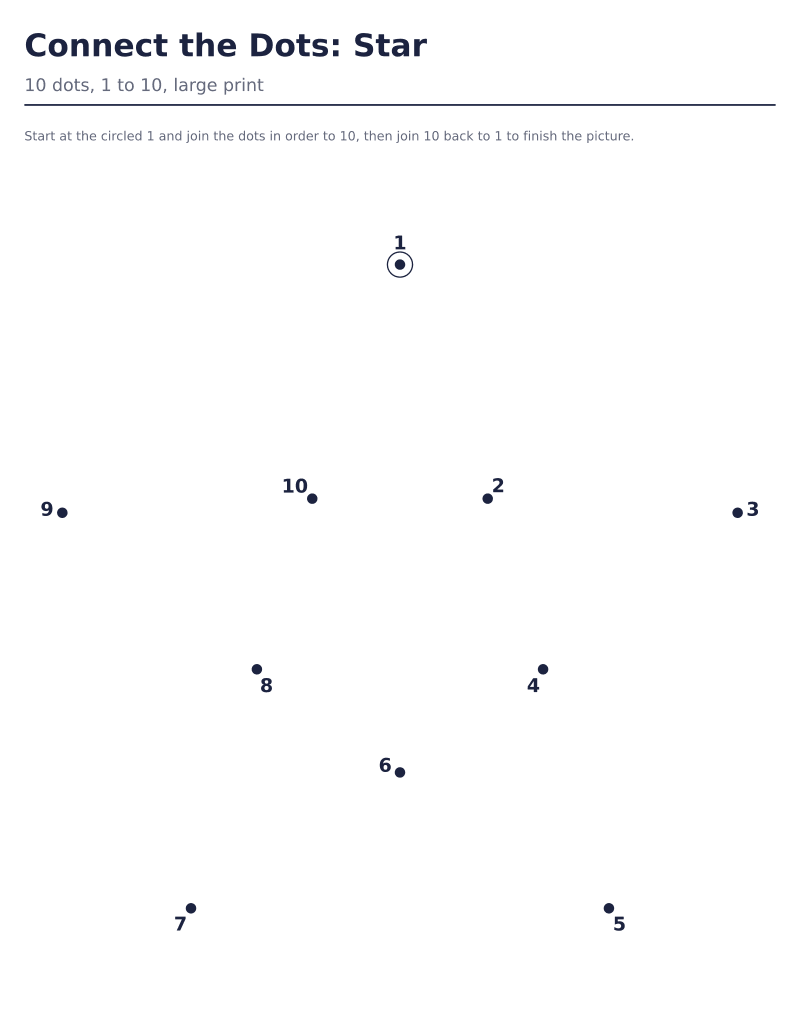 Star connect the dots, large print 1 to 1010 dots · 1 to 10 · large print · answer keyDownload PDF ↓
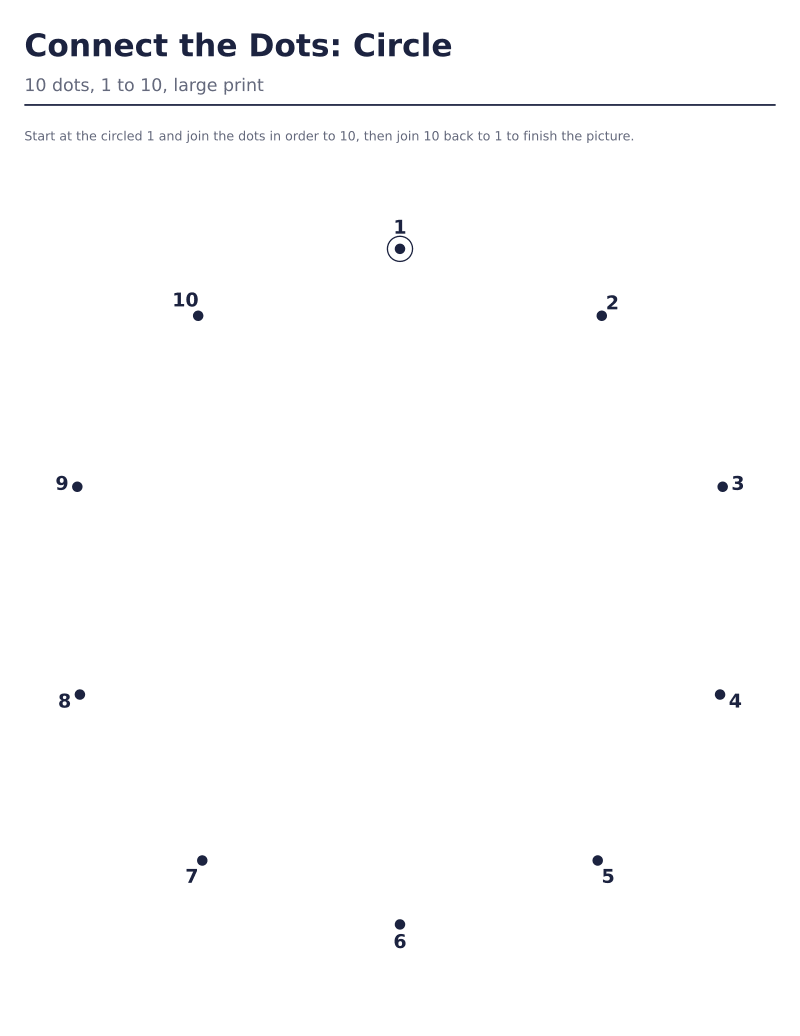 Circle connect the dots, large print 1 to 1010 dots · 1 to 10 · large print · answer keyDownload PDF ↓
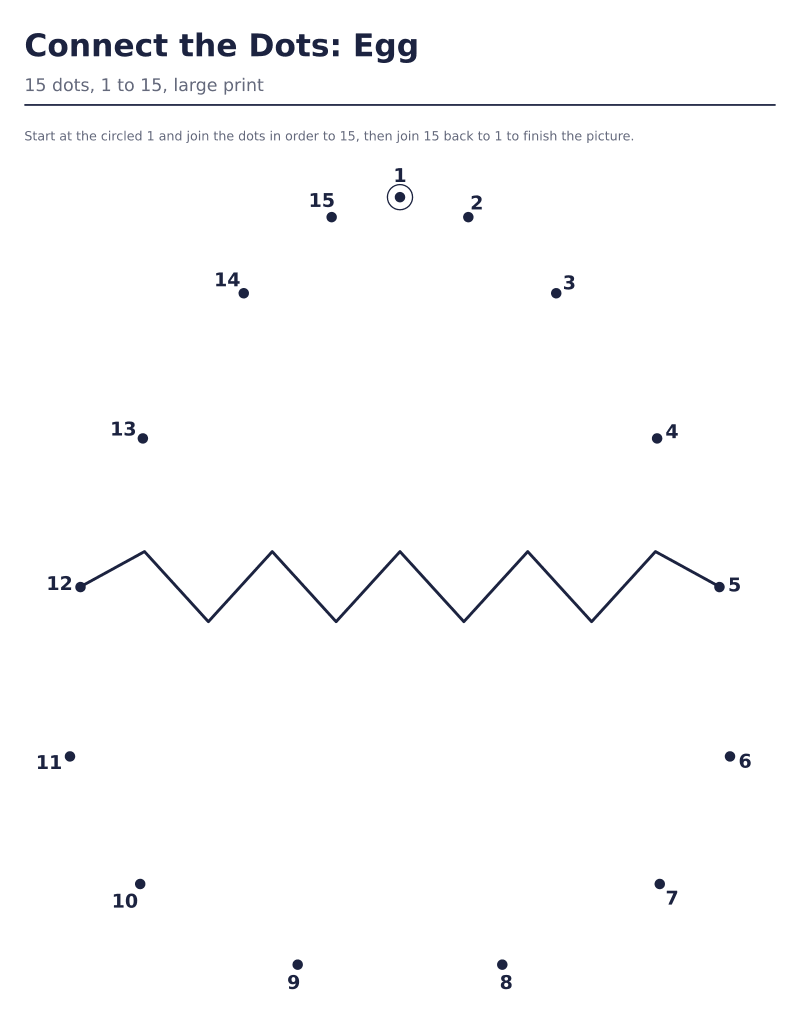 Egg connect the dots, large print 1 to 1515 dots · 1 to 15 · large print · answer keyDownload PDF ↓
Every sheet here is free to print as often as you like. If one saved you time, the tip jar is on Ko-fi.
Connect the Dots: Heart
10 dots, 1 to 10, large print
Start at the circled 1 and join the dots in order to 10, then join 10 back to 1 to finish the picture.
Created for free at puzzleandprint.com
Connect the Dots: Heart, Answer Key
10 dots, 1 to 10, large print
Created for free at puzzleandprint.com
These are the easiest connect the dots sheets on the site, made for children of about three to five: one simple shape, ten big dots and large bold numbers. The heart, the star and the circle each run from 1 to 10, and the egg from 1 to 15 for a child ready to count a little further. Every sheet is in large print, with dots about 2.5 mm across and bold numbers set at 15 points, and the first dot is circled.
The shapes were chosen because a young child knows them and because ten dots draw them well. The star’s ten dots are exactly its five points and five inner corners, so every line is a straight edge of the star. The circle’s ten dots are evenly spaced, and joined they make a ten-sided shape that reads as round. The heart has a dot in its cleft and one at its point, with four down each side. The egg has a printed zigzag band across its middle that starts and ends on two of its dots, so the finished egg looks decorated.
Each sheet tells the child to join the dots in order from 1 and then join the last dot back to 1, and its answer key on the second page shows the finished shape. In the maker above, which opens on the large print heart, any of the thirteen pictures can be printed in large print, from 10 dots on the simplest shapes up to 50.
A first connect the dots goes best with a finger before the pencil: trace from the circled 1 to the 2 while saying the numbers aloud, then do the same with a crayon or a thick pencil. On the three ten dot sheets the dots are about 3.5 cm apart or more, and on the star and the circle every gap is nearly the same length, so the child has room to wander and still find the next number.
The closing line is the one most often missed. Every sheet says to join the last dot back to the 1, and on the star and the circle that last line is the same length as all the others, so it looks like part of the shape rather than an extra step. Counting the dots together before starting, and saying "and back to 1" at the end, turns it into a habit.
A shape with few corners needs few dots. The star at ten dots has nothing to round off, and the circle and the heart are smooth enough that ten dots carry them. Pictures with small parts need more: the ghost cannot have its arms and wavy hem with fewer than 20 dots, the snowman needs 25 for its hat and the turkey 40, which is why none of them is on this page. They are all in the maker for when a child is ready.
Large print leaves room to spare on a page of ten dots. The numbers are bold and 15 points tall, each sits beside its own dot with the nearest other dot clearly further away, and the ring around the first dot is about 6 mm across, big enough to put a finger on.
Saying the numbers from 1 to 10 in order and recognizing them written down is enough for the ten dot sheets; the 15 dot egg asks for 11 to 15 as well. Holding a crayon well enough to draw from one point to another helps, but the lines do not need to be straight for the shape to come out.
Yes. In the maker, set First dot to Leave it plain, and the 1 prints like the other numbers, for a child who should find it alone. The ready-made sheets on this page all have the circle.
Yes. The second page of each PDF is the finished shape, the same dots joined in order with the numbers in gray. To print the dots alone, print page 1, or set Answer key to Puzzle only in the maker.
New printables when they go up, mostly seasonal, a few times a year.