Sopa de letras de los animales
- OVEJA
- CONEJO
- LOBO
- PINGÜINO
- TIGRE
- TIBURÓN
- ZORRO
- DELFÍN
- RANA
- RATÓN
- ÁGUILA
- GATO
Created for free at puzzleandprint.com
Nine ready-made sheets in Spanish with every accent and ñ in place, or a maker for your own vocabulary list.
Last updated
Save this to PinterestSopa de letras de los animales
Created for free at puzzleandprint.com
Sopa de letras de los animales: soluciones
Created for free at puzzleandprint.com
Nine sheets, each with a different job. Every one is a two-page PDF, the puzzle, then the answer key on its own page.
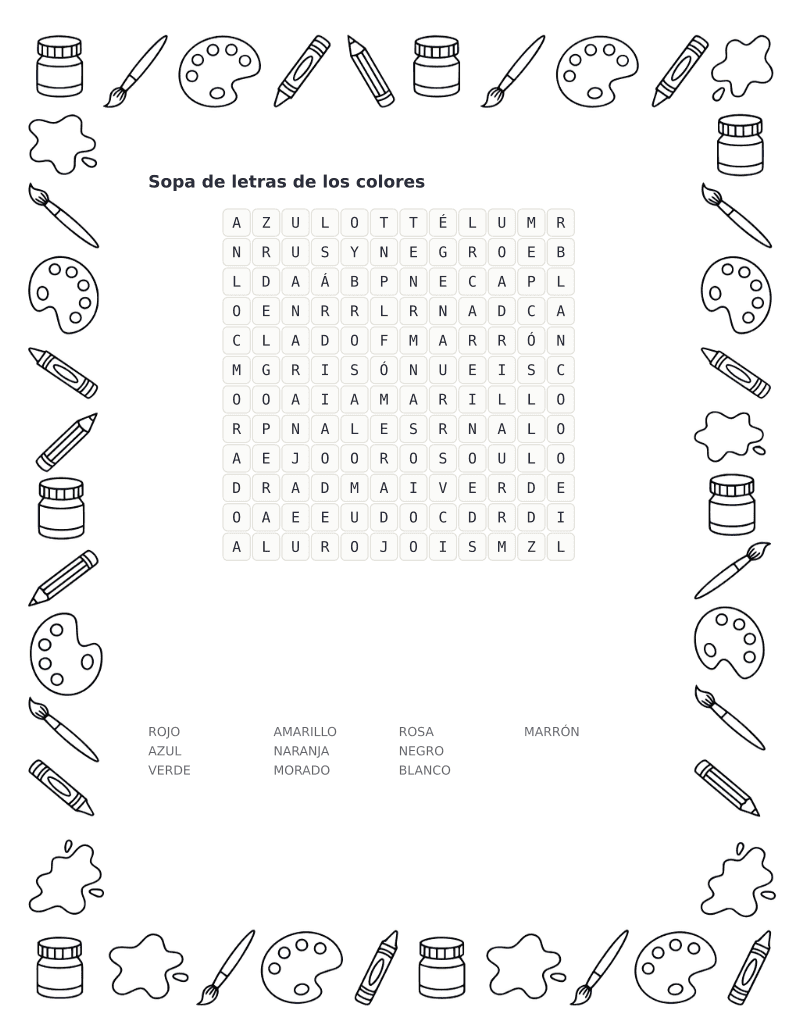 Spanish word search, sopa de letras de los colores12 × 12 · 10 words · Easy, across and down onlyDownload PDF ↓
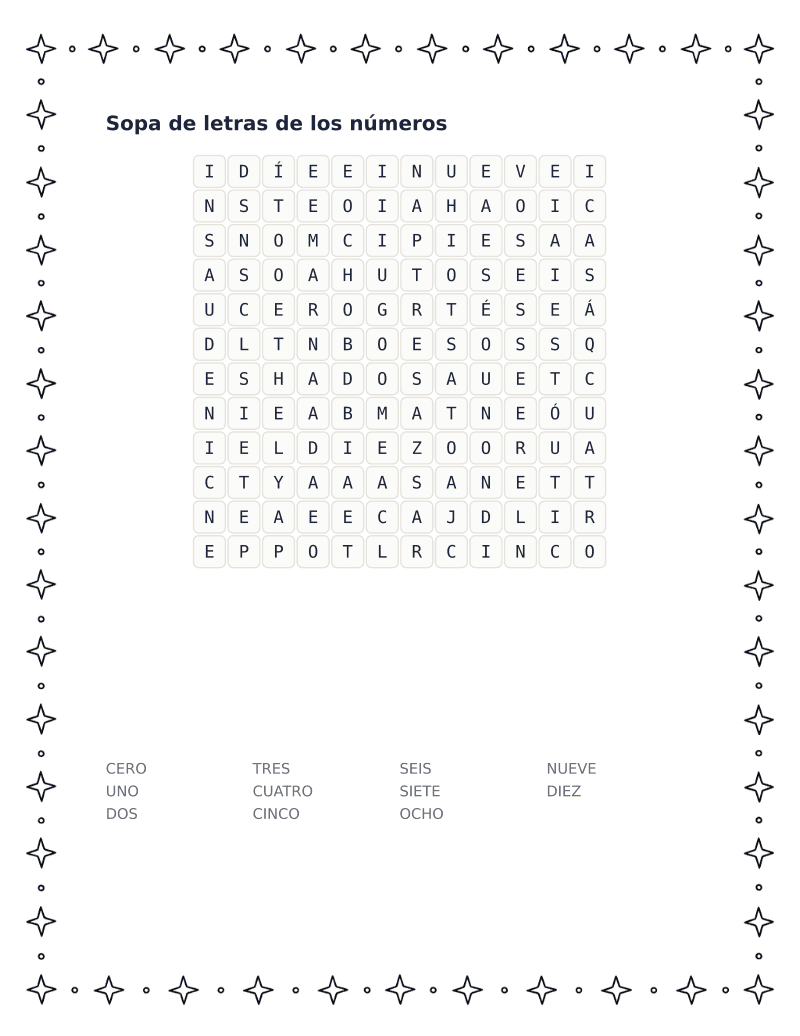 Spanish word search, sopa de letras de los números12 × 12 · 11 words · Easy, across and down onlyDownload PDF ↓
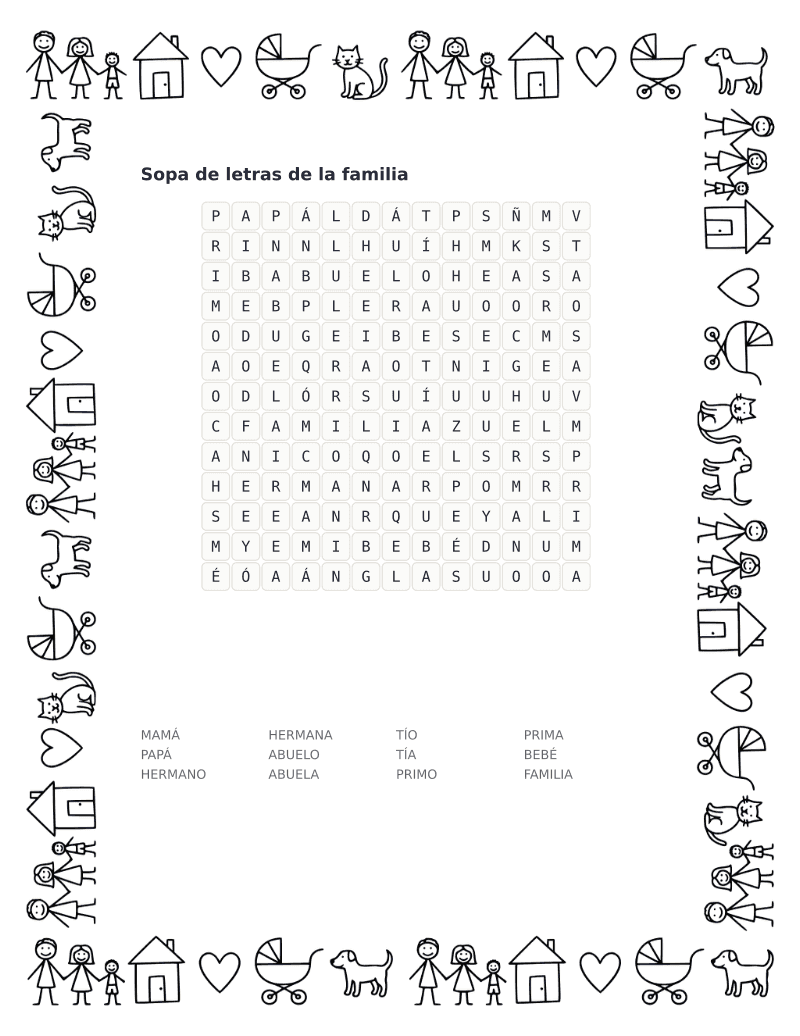 Spanish word search, sopa de letras de la familia13 × 13 · 12 words · Easy, across and down onlyDownload PDF ↓
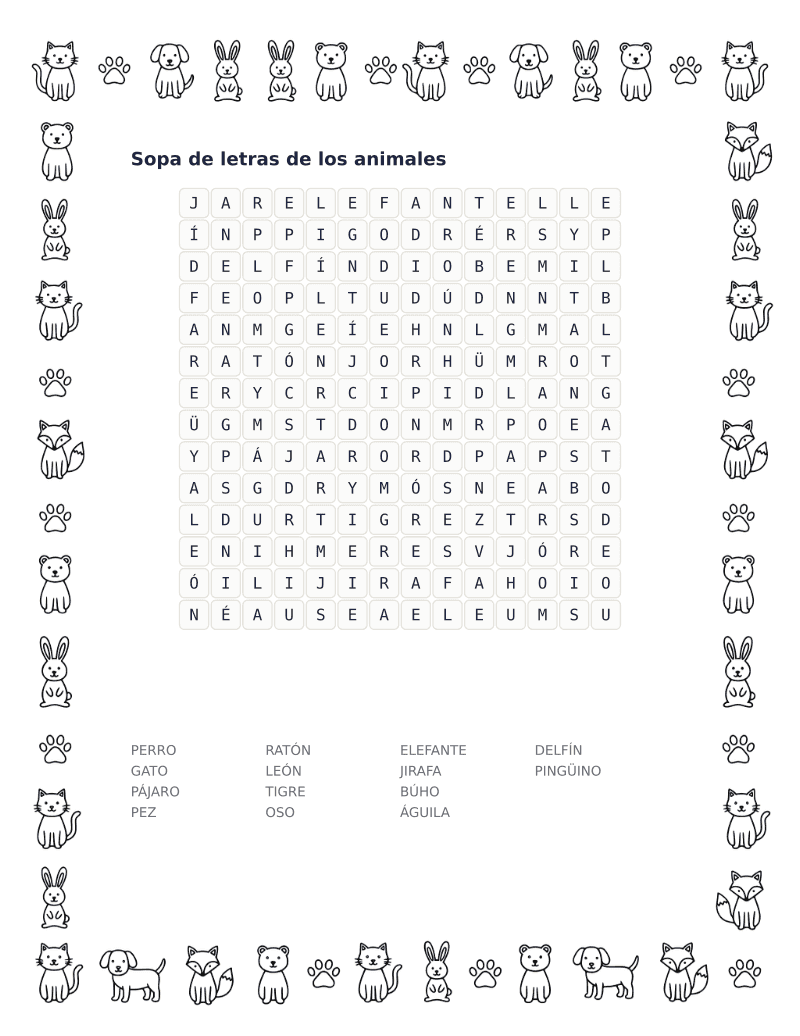 Spanish word search, sopa de letras de los animales14 × 14 · 14 words · Medium, adds diagonalsDownload PDF ↓
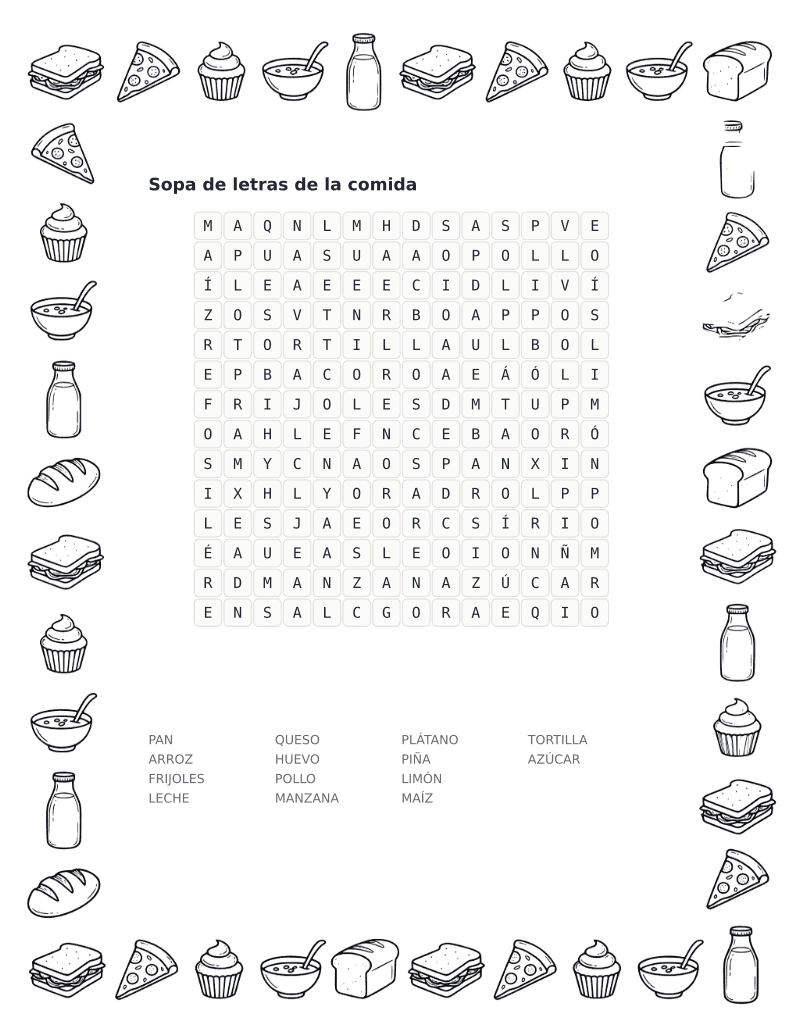 Spanish word search, sopa de letras de la comida14 × 14 · 14 words · Medium, adds diagonalsDownload PDF ↓
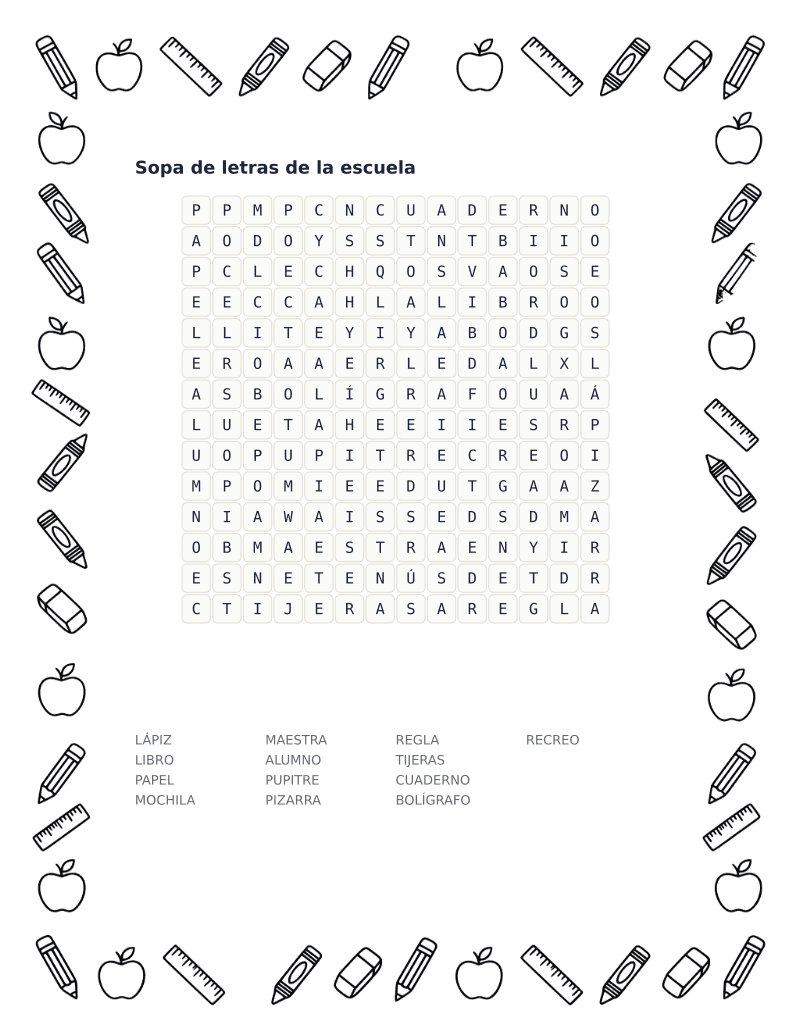 Spanish word search, sopa de letras de la escuela14 × 14 · 13 words · Medium, adds diagonalsDownload PDF ↓
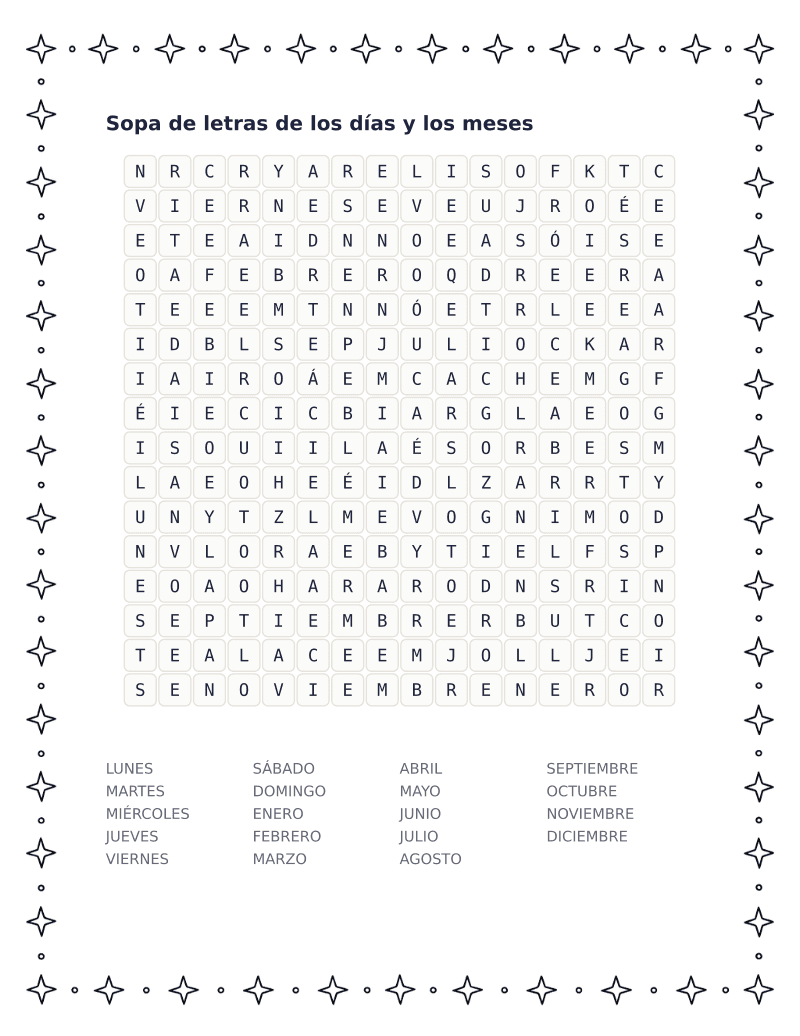 Spanish word search, sopa de letras de los días y los meses16 × 16 · 19 words · Hard, adds backwards wordsDownload PDF ↓
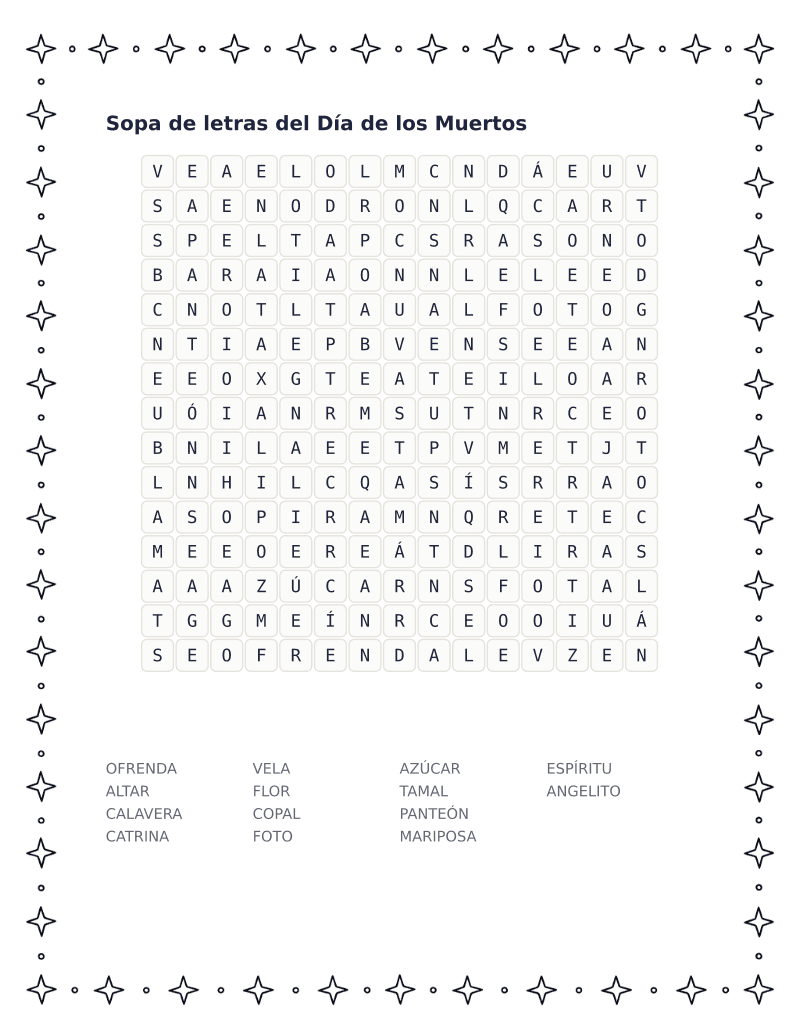 Spanish word search, sopa de letras del Día de los Muertos15 × 15 · 14 words · Hard, adds backwards wordsDownload PDF ↓
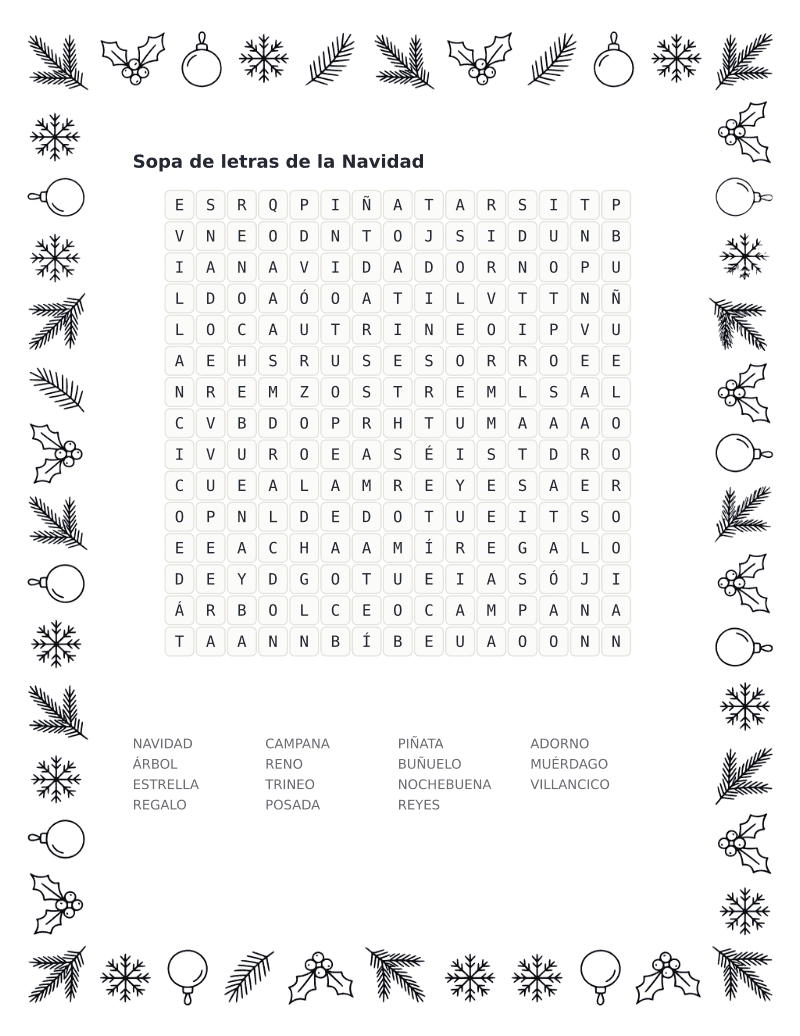 Spanish word search, sopa de letras de la Navidad15 × 15 · 15 words · Medium, adds diagonalsDownload PDF ↓
Every sheet here is free to print as often as you like. If one saved you time, the tip jar is on Ko-fi.
Sopa de letras, letter soup, is what Spanish calls a word search, and this page makes them in Spanish rather than in English with Spanish words poured in. A maker built for English throws the accents away and turns ñ into n, so piñata prints as pinata and año loses the letter that makes it mean year. Here the grid keeps Á, É, Í, Ó, Ú, Ü and Ñ exactly as each word is spelled, and the sheet speaks Spanish too: Nombre and Fecha at the head, Busca estas palabras over the word list, and an answer key headed soluciones.
The nine ready-made sheets follow the units a first year class works through: los colores, los números, la familia, los animales, la comida, la escuela and los días y los meses, then two holidays, Día de los Muertos and la Navidad. Three are easy and run every word across or down, four are medium and add diagonals, and the days and months and Día de los Muertos sheets are hard, with words that also run backwards and upward. Each is a two-page PDF, the puzzle and then its key.
The maker above opens on the animals list. Its theme picker holds twelve Spanish lists, from el cuerpo and la ropa to el tiempo, and Write my own takes a class vocabulary list typed with its accents, which the grid keeps. For plain vowels, set Accents to Leave them off; the Ñ stays either way, since in Spanish it is a letter of its own rather than an N with a mark on it.
Everything here is free to print as often as you need, for a Spanish class, a class of heritage speakers or a family reading together at home. The answer keys print without the frame, to save ink on the page only the adult needs.
In Spanish an accent is part of the spelling, and often of the meaning: PAPÁ is dad while papa is a potato. A grid that strips the marks teaches the wrong spelling to the very students who are learning the right one, so this maker keeps every mark, on capital letters too, the way Spanish writes them. The family sheet shows why it matters most on short words: five of its twelve, MAMÁ, PAPÁ, TÍO, TÍA and BEBÉ, carry an accent, and TÍO and TÍA are only three letters long. On the animals sheet half the words have one, from PÁJARO to PINGÜINO, whose two dots tell a reader to sound the U.
The letters around the words follow Spanish too. The filler is drawn in proportion to how often each letter turns up in written Spanish, so E and A are the commonest, and the accented vowels and Ñ appear at their own rates, about one filler square in thirty-five. That stops an accent from giving a word away: if only the hidden words had marks, a solver could hunt for the Ó in RATÓN instead of reading for the word. It is also why the numbers sheet, whose eleven words from CERO to DIEZ carry no accent at all, still has a few accented letters scattered through its grid.
The three easy sheets run every word across or down. Los colores puts ten colors in a twelve by twelve grid, from ROJO to MARRÓN, the only one of the ten with an accent, and los números holds every number from CERO to DIEZ in a grid the same size. La familia, thirteen squares a side, pairs its words the way Spanish does, HERMANO with HERMANA, ABUELO with ABUELA, PRIMO with PRIMA, which makes it a quick lesson in masculine and feminine endings. The four medium sheets, los animales, la comida, la escuela and la Navidad, grow to fourteen and fifteen squares and add the two diagonals that slope downward.
The two hard sheets let words run backwards and upward as well. Los días y los meses is the largest grid, sixteen squares a side, with all seven days and all twelve months: JUEVES, DOMINGO and OCTUBRE read from right to left, and MARTES, MIÉRCOLES, MAYO and JUNIO climb diagonally. Spanish writes the days and months with a small letter inside a sentence, el lunes and en enero, while the grid prints every letter as a capital, so it is worth a word before the sheet goes out. On the Día de los Muertos sheet, fifteen squares a side, VELA and MARIPOSA read backwards and TAMAL and ANGELITO run straight up.
The Día de los Muertos sheet is about remembering, as the holiday on November 1 and 2 is, so its fourteen words come from the ofrenda and the visit to the cemetery rather than from Halloween: OFRENDA and ALTAR, VELA and FLOR, COPAL for the incense, FOTO for the photographs of the people remembered, CALAVERA and AZÚCAR for the sugar skulls, PANTEÓN for the cemetery, MARIPOSA for the monarch butterflies that reach Mexico in the same week, and ANGELITO for the children remembered on the first day. Its frame is a plain border of stars and dots, not Halloween art.
La Navidad follows Christmas as Spanish-speaking families keep it, from the posadas before it to the Three Kings after it. POSADA is for the nine evenings of Las Posadas leading up to Christmas Eve, NOCHEBUENA for Christmas Eve itself, PIÑATA and BUÑUELO for the party and the fried pastry that go with it, and REYES for January 6, when the Kings bring the presents in many homes. ÁRBOL, PIÑATA, BUÑUELO and MUÉRDAGO are the four words with a mark, and ESTRELLA and MUÉRDAGO are the two that run diagonally.
Yes: set Accents to Leave them off in the maker above, and every á, é, í, ó, ú and ü prints as its plain vowel, in the grid and in the word list, while the Ñ stays. Two words that differ only by an accent then become one, so with PAPÁ and papa on the same list the maker keeps one and says it removed a repeat. The nine ready-made sheets keep their accents; for a plain-vowel sheet on the same subject, pick its list in the maker and leave the accents off.
No. The letters that fill the grid around the words are checked against a list of rude and offensive Spanish words, slang from several countries included, and against the English list the rest of the site uses, since a child in a US Spanish class reads both. The check reads every row, column and diagonal in both directions, looks past accents so a mark cannot disguise a word, and replaces a filler letter whenever it helps spell anything on either list. Words you type yourself are never changed.
Mostly the words a Spanish class in the United States meets, and where countries differ the lists lean to Latin America: FRIJOLES and TORTILLA are on the food sheet, and the food list has JUGO where Spain would say zumo. Where two words for one thing are both in wide use, the list has both, so the colors list carries MARRÓN and CAFÉ for brown, and the colors sheet uses MARRÓN. A few school words, BOLÍGRAFO and PIZARRA among them, are the textbook forms Spain uses too, where many Mexican speakers would say pluma and pizarrón.
New printables when they go up, mostly seasonal, a few times a year.