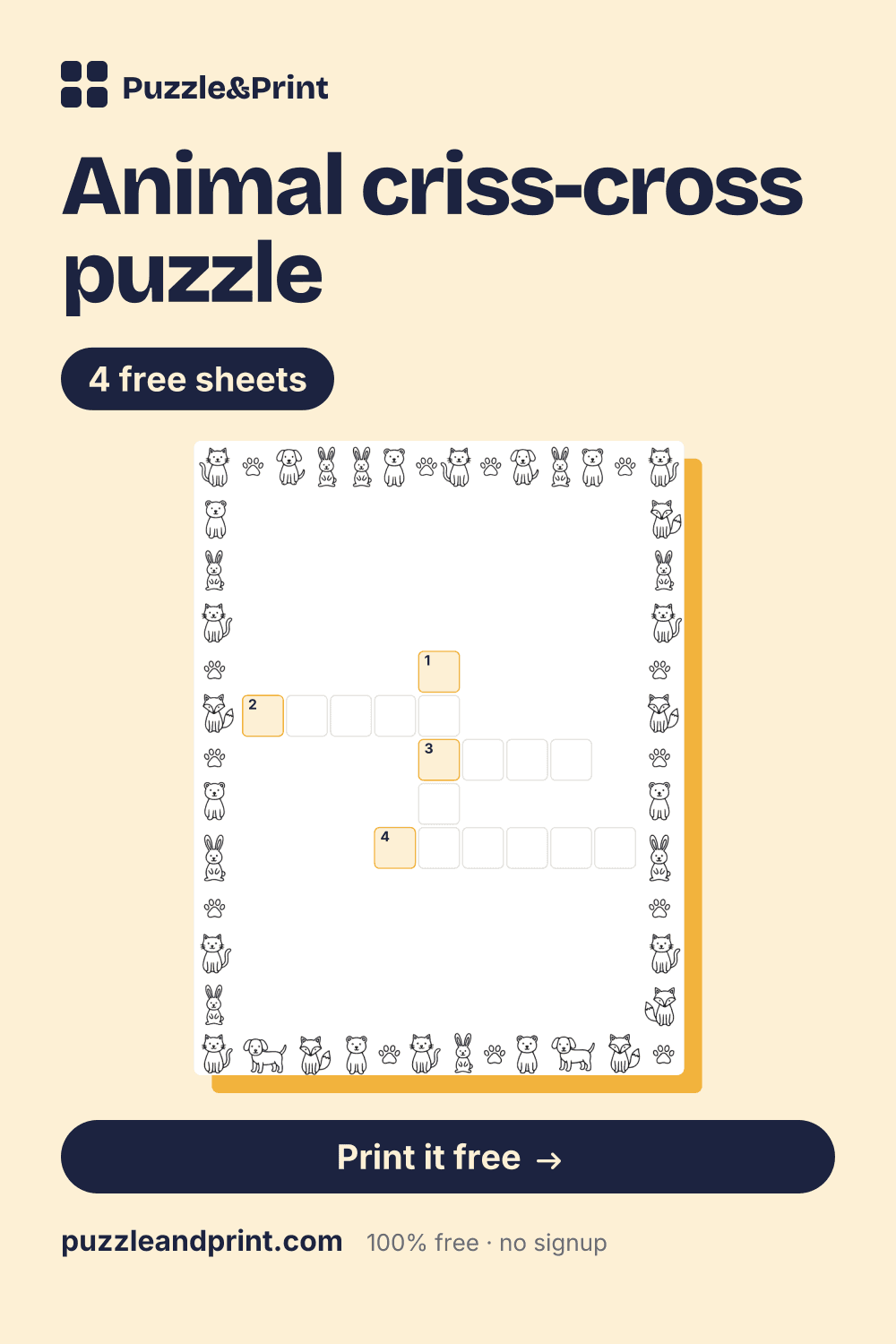
Animals Criss-Cross
- CAT
- DEER
- FOX
- GIRAFFE
- HIPPO
- KOALA
- LEMUR
- LEOPARD
- MOUSE
- SQUIRREL
- TIGER
- WOLF
Created for free at puzzleandprint.com
Interlock your own list, or take one of four ready-made animal grids.
Save this to PinterestCreated for free at puzzleandprint.com
Created for free at puzzleandprint.com
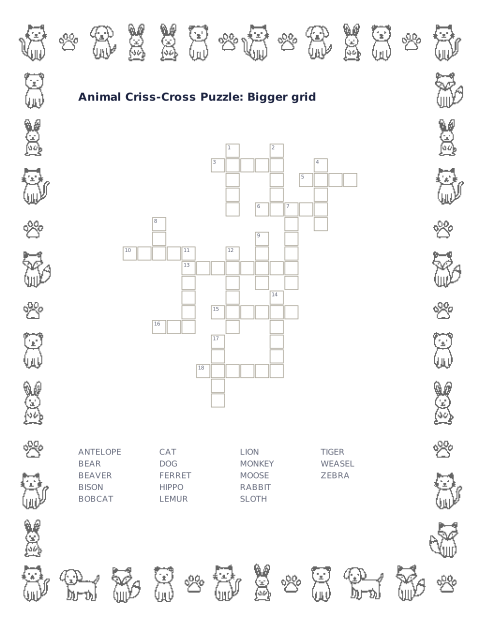
Four grids from ten words to twenty. Every one is a two-page PDF, the puzzle, then the answer key on its own page.
Animals are the right subject for a first criss-cross, because the spelling is already secure. A child who has to work out both where TIGER goes and how TIGER is spelled is doing two hard things at once and will give up on the puzzle. When the word is known, the whole of the attention goes to the fitting, which is the skill this puzzle is actually teaching.
The list also has the length spread the interlock needs. CAT and BAT are three letters, ELEPHANT and HEDGEHOG are eight, and a grid built from that mixture has room to breathe: long words running the height of the page with short ones hanging off them. A list where every word is six letters produces a cramped grid and a duller puzzle, which is worth knowing if you paste in your own.
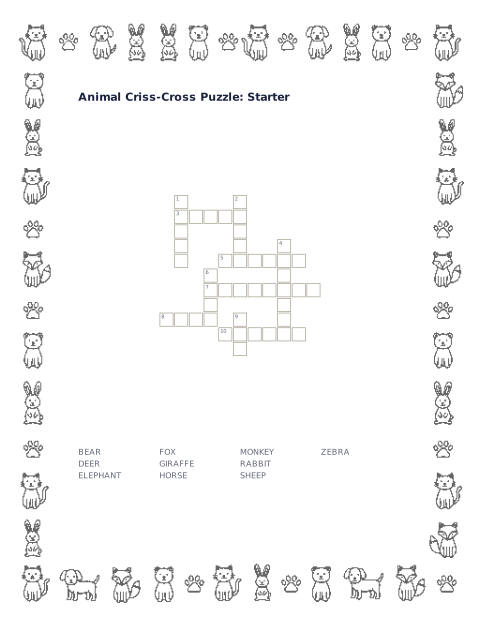
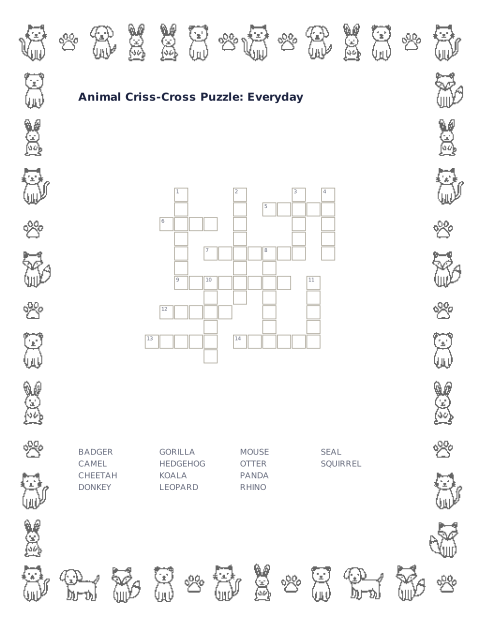
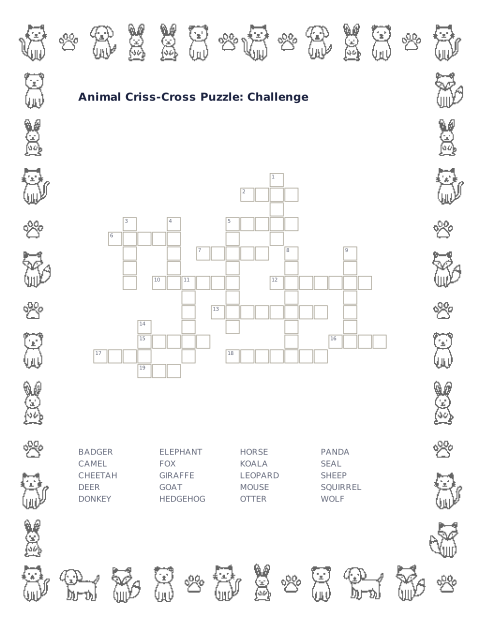
Start with the ten-word starter for a five to seven year old. The jump to fourteen is bigger than it looks, because the number of intersections grows faster than the number of words, and a child who breezed through the first sheet will slow down noticeably on the second. That is the sheet to give them next rather than the twenty-word one.
It pairs well with the animal word search on this site. Same list, different demand: the search lets you match letters you can see, and the criss-cross makes you produce them. Running the search first and the criss-cross a week later is a real step up rather than the same exercise twice.
The ten-word starter. The jump to fourteen is larger than it looks, because intersections grow faster than words do, so a child who breezed through the first will slow down on the second. Give them that one next rather than the twenty-word challenge.
That is what the maker on the page is for, and it is the most common use of this tool. One caution: a list where every word is a similar length produces a cramped grid. A mixture of short and long words interlocks into something that looks and solves much better.
It shared no usable letter with anything already placed, so there was nowhere to interlock it. Unlike a word search, a criss-cross cannot put a word somewhere on its own. Press New puzzle to rearrange everything, or swap the word for one with more vowels in it.
No, and that is the point of this rather than a crossword. The solver gets the full word list and works out where each one goes, so a puzzle takes about as long to make as a word search does.
They mark where a word begins, numbered left to right and top to bottom the way a crossword is. Where an across word and a down word start in the same square, they share one number.
Ten to fourteen makes a comfortable grid for most lists. Fewer than that and the puzzle is over quickly; past about sixteen the grid starts to sprawl and the squares get small on a printed page.
Always, and it prints on its own page so you can hand out the puzzle without it. The key is the same grid with every letter filled in.
No. There is no sign-up, no email, and no watermark on the printed sheet. The grid is worked out in your browser, so your word list never reaches us.
New printables when they go up, mostly seasonal, a few times a year.