Animals Secret Word Search
- SQUIRREL
- GIRAFFE
- BEAVER
- DONKEY
- OTTER
- MOOSE
- BISON
- LEMUR
- HIPPO
- BEAR
- GOAT
- SEAL
- MOUSE
- TIGER
- FOX
Created for free at puzzleandprint.com
Animals Secret Word Search
Created for free at puzzleandprint.com
Animals Secret Word Search, Answer Key
Created for free at puzzleandprint.com
Four sheets, each with a different job. Every one is a two-page PDF, the puzzle, then the answer key on its own page.
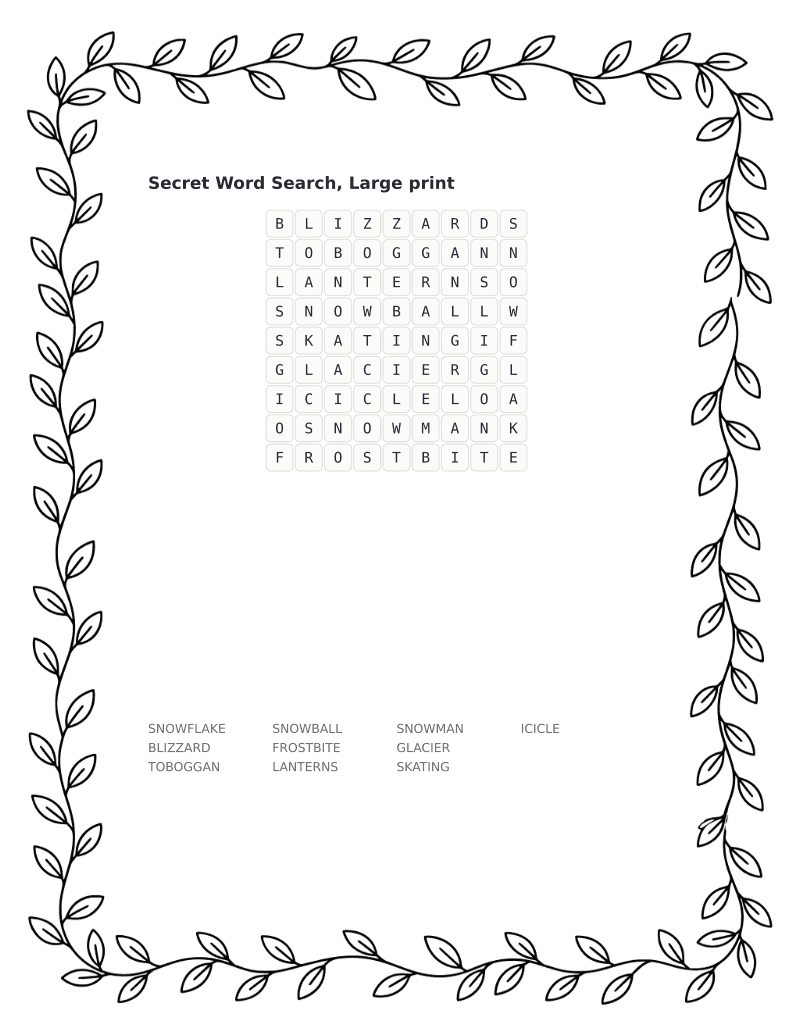 Secret word search, large print5 hidden letters · Easy, across and down onlyDownload PDF ↓
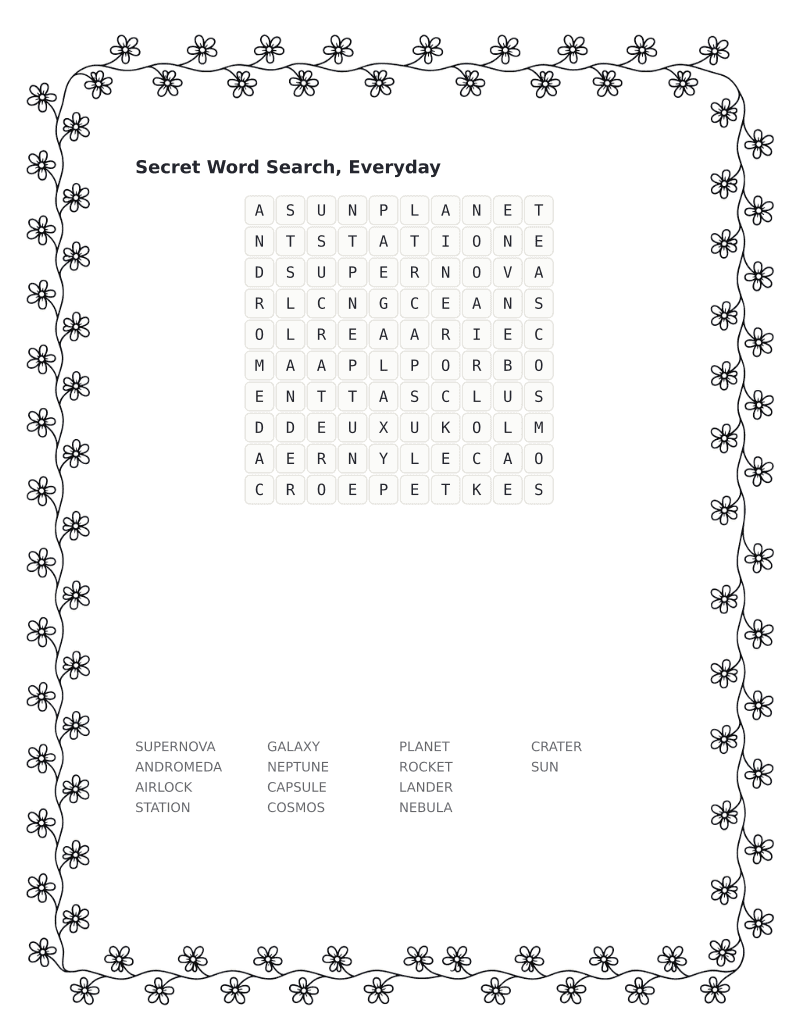 Secret word search, everyday9 hidden letters · Medium, adds diagonalsDownload PDF ↓
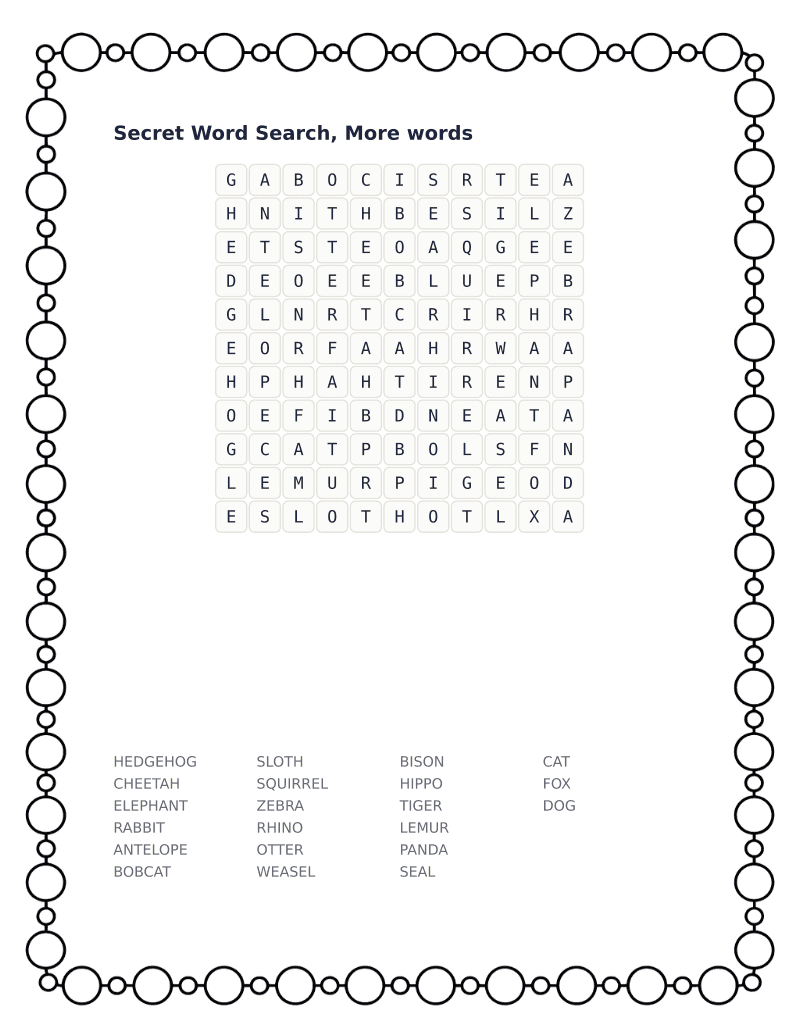 Secret word search, more words7 hidden letters · Medium, adds diagonalsDownload PDF ↓
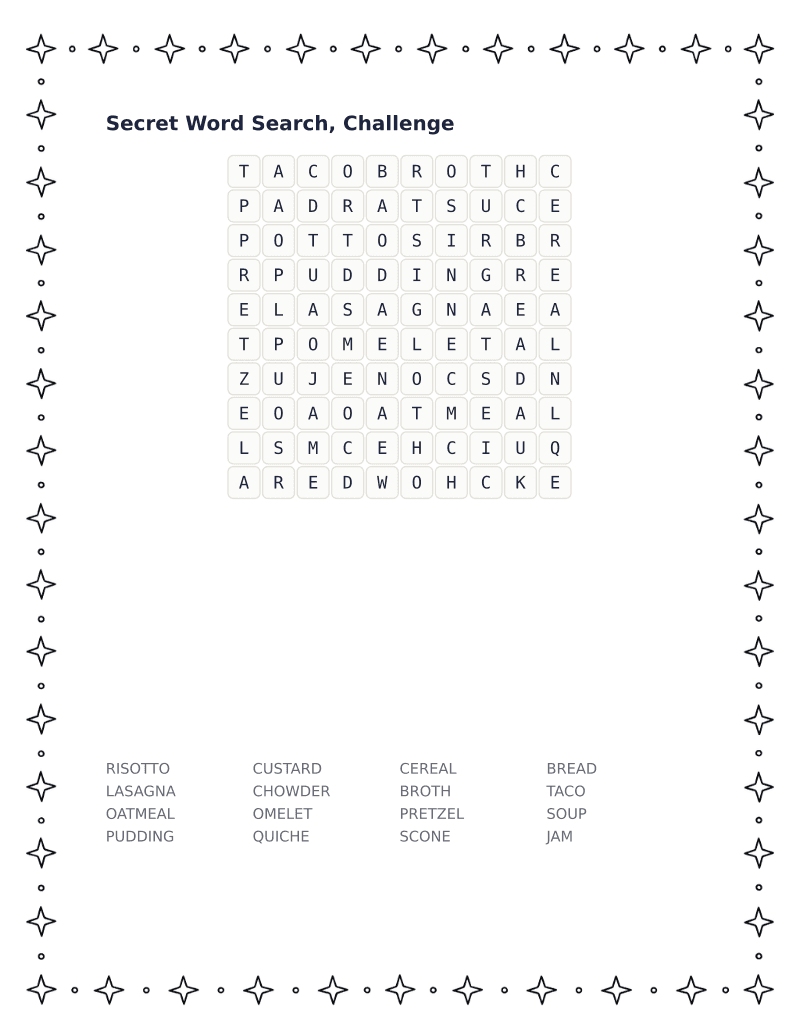 Secret word search, challenge7 hidden letters · Hard, adds backwards wordsDownload PDF ↓
Every sheet here is free to print as often as you like. If one saved you time, the tip jar is on Ko-fi.
A secret word search has a second puzzle inside the first. Cross off every word on the list, read the squares nobody used from left to right, and they spell one more word, one that belongs to the same theme but was never on the list.
That changes how the puzzle is solved. An ordinary word search can be abandoned halfway with nothing lost; this one cannot, because the answer only appears when the grid is clear. It is the difference between a puzzle you stop doing and one you finish.
The grids are smaller than a plain word search and much fuller. Leaving only the answer behind means the words have to cover nearly every square, so the four sheets below run from nine by nine to eleven by eleven and the maker’s size control starts at eight, where an ordinary word search here starts at ten. On the nine-by-nine large-print sheet, ten words cover 76 of the 81 squares. Finding them is easier than usual (they are everywhere), and the satisfaction is in what is left.
The four sheets below hide five to nine letters. The maker will hide a word of your own in your own list, or pick one from a theme for you, choosing one of the theme’s own words of four to nine letters and taking it off the list it hides among. If some of your own words cannot be fitted around the answer, it names them rather than quietly leaving them out.
Read the leftover letters along each row from left to right, starting at the top row and working down, exactly as you would read a page of text; the line printed under the word list says the same. On the large-print sheet the first four leftover squares sit together near the right-hand edge, on rows five to seven, and the last one is alone at the far left of row eight, so the answer finishes on the opposite side of the grid from where it starts. Crossing words off with a highlighter rather than a pencil loop helps here, because the squares still white at the end are the answer, and in a grid this full a loop around one word tends to run over its neighbors and hide a letter that should have been left showing.
Each card on this page gives the number of hidden letters (five, nine, seven and seven), which doubles as a check. If more squares are left than the card says, a word has been missed; if fewer, one has probably been crossed off in the wrong place. The worksheet itself never shows the answer, only the instruction to read what is left. The answer key is the second page: the solved grid with every word marked, the word list, and the hidden word printed below them beneath the heading secret word, so grading a class set takes a glance per sheet rather than a fresh solve.
The large-print sheet suits a child who needs simple directions but can read long words, the more-words sheet suits a younger reader who knows animal names, and the challenge sheet suits a solver happy to read backwards. Nine of the large-print sheet's ten words run straight across, one word to each row, SNOWFLAKE runs down the right-hand edge, and all ten are six to nine letters long. SNOWFLAKE fills the last column and FROSTBITE the bottom row, and BLIZZARD, TOBOGGAN, LANTERNS and SNOWBALL fill the first four rows up to SNOWFLAKE. SKATING, GLACIER, ICICLE and SNOWMAN are shorter, and the five squares they leave spare spell igloo. For a reader who would struggle with TOBOGGAN or GLACIER, read the ten words aloud together first; once the words are known, the grid itself is the gentlest of the four.
The other three ask more of the eyes and less of the reading. Everyday hides telescope in a ten by ten of fourteen space words, all running across or down, with SUN the only short one. More words is the largest grid at eleven by eleven, with twenty-one animals, and its short names (CAT, FOX, DOG, SEAL and OTTER) give a younger reader early wins, though RABBIT, HIPPO and DOG run diagonally. The challenge sheet hides pancake among sixteen foods in a ten by ten, and six of them read against the usual direction: RISOTTO, CUSTARD, CHOWDER, QUICHE and SCONE run from right to left, and SOUP reads upwards, from bottom to top.
They do not get the answer: until every listed word is crossed off, the leftover squares are mixed in with letters that still belong to words, and nothing readable comes out. A child who stalls is better helped to the last word than stopped, and the answer key on the second page marks every word in the grid, so an adult can find the missing one at a glance and point to where it starts without saying the secret. The large-print sheet, with ten words to find against at least fourteen on each of the others, is the place to start a child who gives up easily.
Five to nine letters across the four sheets: igloo on the winter grid, telescope on space, giraffe on animals and pancake on food. Each is a word from its own theme’s list, taken off that list before the grid was built, which is why none of them appears among the words printed with the sheet.
Yes, with a list of your own: choose your own words rather than a theme and a box for the secret word appears, which takes any name of three letters or more, or even a whole sentence. If no grid can be packed around it, the tool says so rather than printing a puzzle with no answer, and suggests adding a few more words.
New printables when they go up, mostly seasonal, a few times a year.