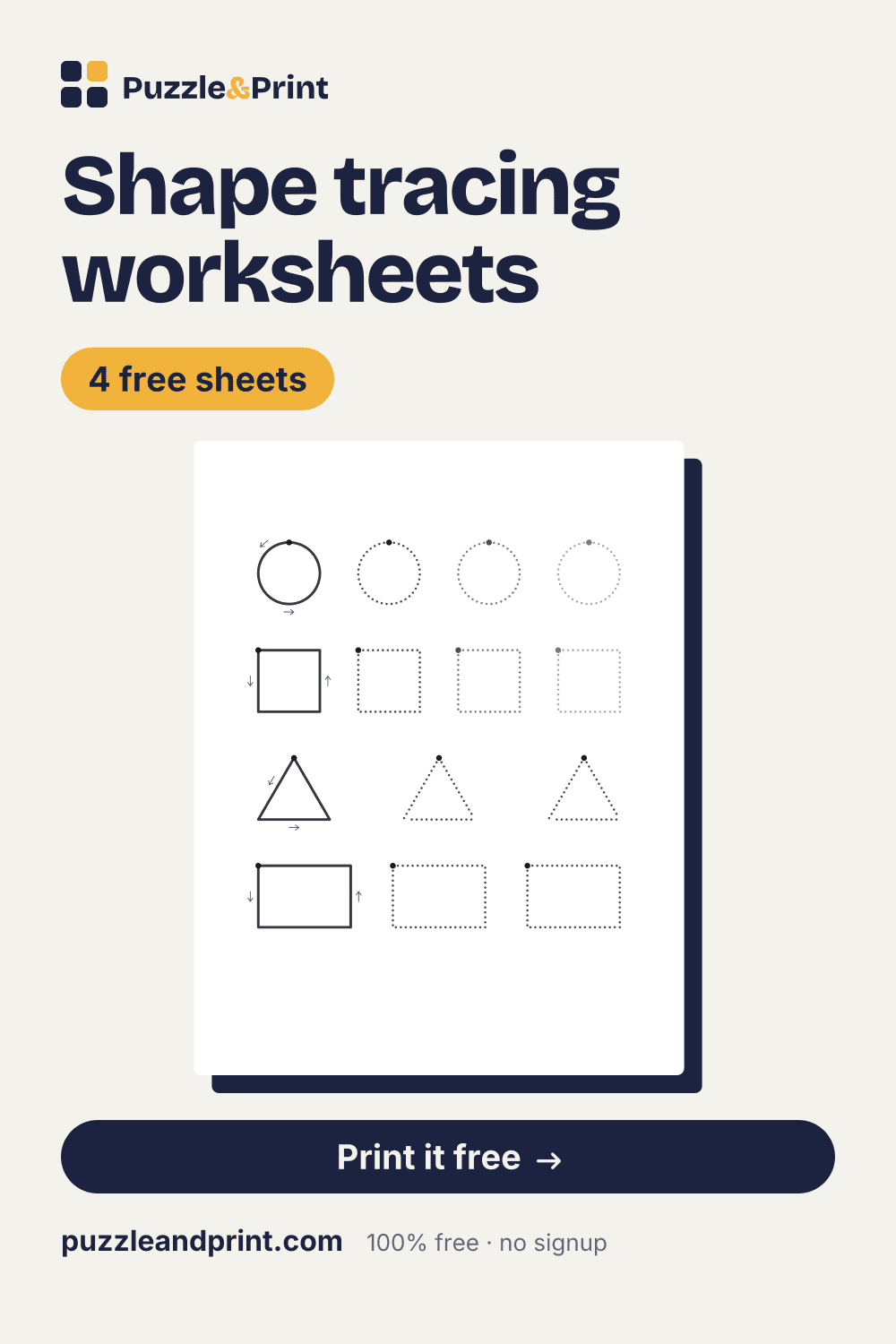
Shape Tracing
Circle, square, triangle and rectangle. Start at each big dot.
Created for free at puzzleandprint.com
Eight shapes to trace, each starting at a big dot and going the same way round.
Last updated
Save this to PinterestShape Tracing
Circle, square, triangle and rectangle. Start at each big dot.
Created for free at puzzleandprint.com
Shape Tracing
Star, heart, diamond and oval. Start at each big dot.
Created for free at puzzleandprint.com
Four ready-made sets, each one PDF of every page in it. There is no answer key: a tracing sheet checks itself.
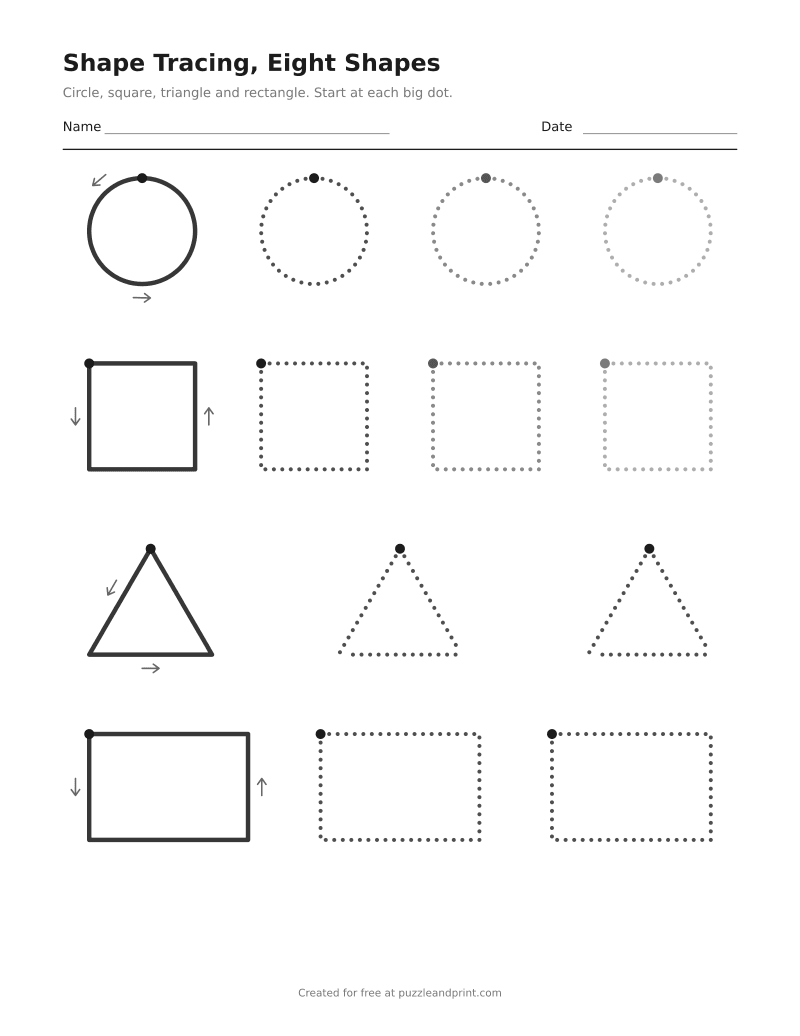 Shape tracing worksheet, eight shapes2 pages · 1 1/8 inch tall · dottedDownload PDF ↓
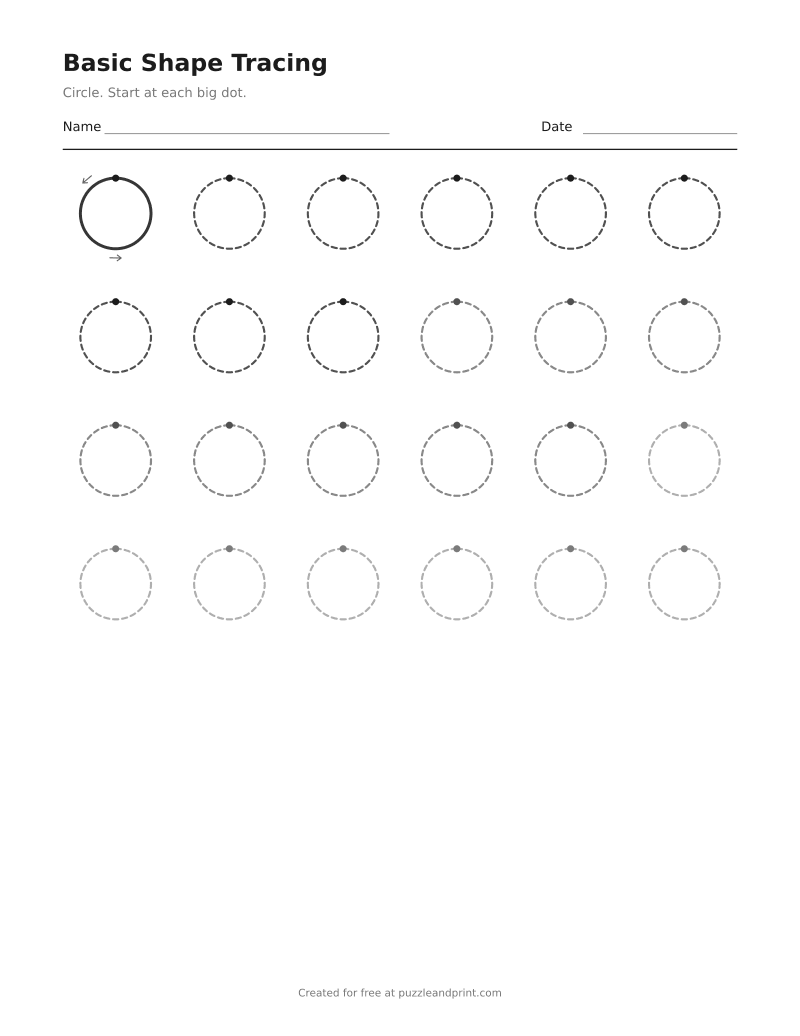 Basic shape tracing worksheet4 pages · 3/4 inch tall · dashedDownload PDF ↓
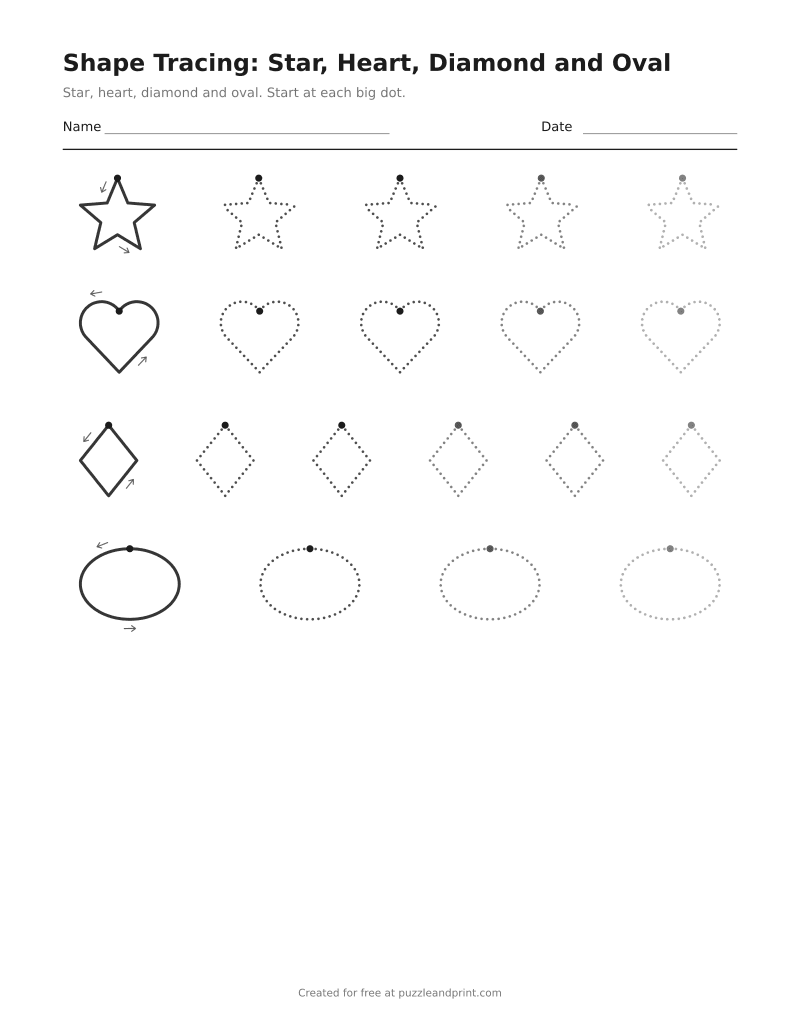 Shape tracing worksheet, star, heart, diamond and oval1 page · 3/4 inch tall · dottedDownload PDF ↓
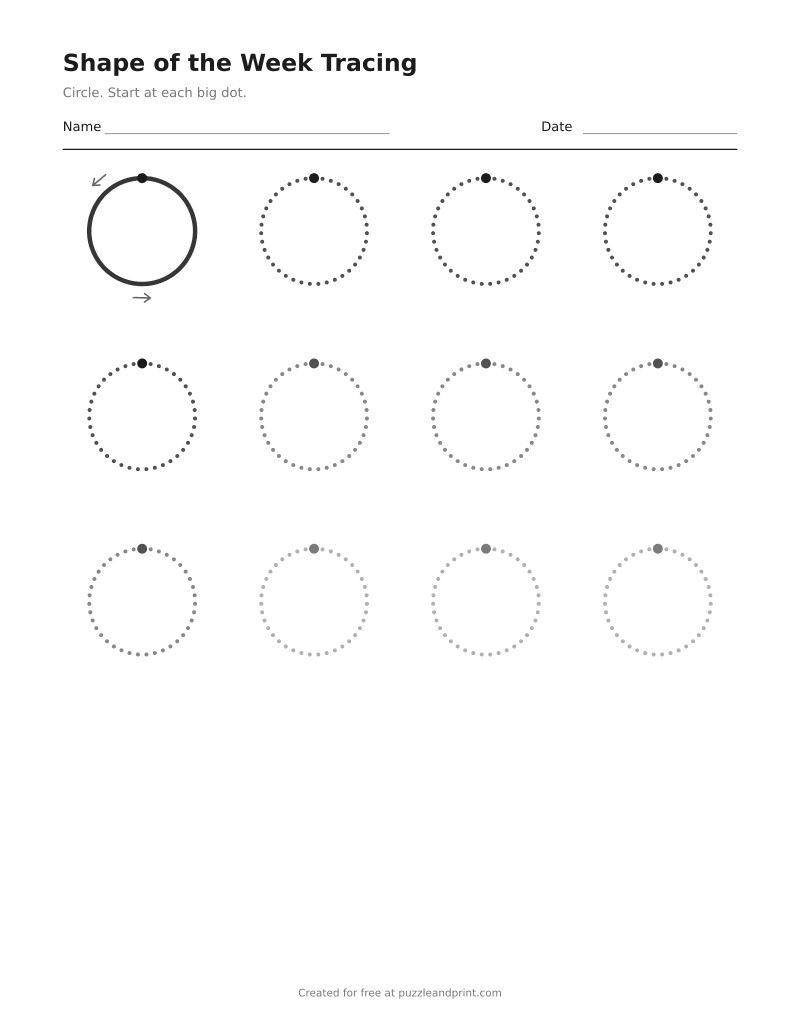 Shape of the week tracing worksheet8 pages · 1 1/8 inch tall · dottedDownload PDF ↓
Every sheet here is free to print as often as you like. If one saved you time, the tip jar is on Ko-fi.
These shape tracing worksheets cover eight shapes: circle, square, triangle, rectangle, star, heart, diamond and oval. Each is drawn as one line, without lifting the pencil, from a big start dot, and printed with the same dots or dashes, start dots and arrows as the letter tracing sheets. A shape stands as tall as a capital letter at the same size. The rectangle is half again as wide as it is tall, so it is never taken for the square, and the oval lies on its side for the same reason, so it is not read as a zero.
On the sheets with a row for each shape, every row opens with a solid model with arrows beside it, then copies to trace, which fade from dark to light wherever a row has room for three or more of them. The shape of the week pages give each shape a page: one model at the top, three rows of copies fading down the page, and a row of bare paper at the foot to draw the shape once more without dots. None of the sheets print writing lines, so nothing runs through the middle of a shape.
The eight shapes set is two pages at 1 1/8 inch, four shapes to a page, with four circles, squares or diamonds to a row and three of each of the wider shapes. The basic shapes set gives the circle, square, triangle and rectangle a page each at 3/4 inch, in dashes, with four rows to trace and two of bare paper. The star, heart, diamond and oval sheet puts the other four on one page at 3/4 inch, a row of each with four to six to a row, and the shape of the week set is eight pages at 1 1/8 inch, one shape to a page.
The maker above prints all eight shapes, the first four, the other four or any one of them, a row for each shape or a page for each, at 1 1/8, 3/4 or 5/8 inch, in dots or dashes, with the model, the fading, the blank space and the arrows each switched on or off.
Every shape goes around counterclockwise, the way a circle turns when it circles back, which is how a child is taught to make o, c, a, d, g and q. The circle and the oval start at the top. The square and the rectangle start at the top left corner and pull down the left side first, and the triangle, the diamond and the star start at their top point and set off down to the left. The heart starts in the dip between its two humps, goes back over the left one and down to the point, then up the right side and over the right hump to finish where it began.
One direction for all eight means a child who has learned where to start a circle has learned where to start the rest, and the habit carries into letters, where starting at the top and pulling down comes first in nearly every one. The arrows beside each model show the way twice, once on the way out from the start dot and once halfway round, on the side heading back.
Each shape asks for something different. The circle and the oval are one smooth curve with no corner. The square and the rectangle are straight lines and square corners, turning the same way four times. The triangle and the diamond add slants, the strokes of v, w, x and k, and the star needs ten changes of direction, five sharp points and five inner corners. The heart puts curves and straight lines together in one stroke, the way many letters do.
A child who finds one shape hard can have a page of it alone, from the maker or from the shape of the week set. On the shape of the week pages, at 1 1/8 inch, the circle, the square and the diamond have eleven copies to trace after the model, four to a row, and the five wider shapes eight, three to a row, with the last row left as bare paper.
A circle usually comes first, then a square, then a triangle, with the diamond among the last, because each adds something the one before did not: corners, then slants, then slants that meet at four points. The basic shapes sheet is the circle, square, triangle and rectangle, and the star, heart, diamond and oval sheet follows on with the rest.
So it cannot be taken for a zero or a capital O, which are both upright ovals on the number and letter tracing sheets. Lying flat it is clearly wider than it is tall, 1.4 times as wide as the circle on the same sheet, and it starts at the top and goes around counterclockwise like every other shape here.
No. The shapes and the pre-writing lines print without a headline, midline or baseline, so nothing runs through the middle of a shape. Each shape is as tall as a capital letter at the size chosen, and the rows are spaced as they are on the letter sheets, so the alphabet page at the same size carries on where a shapes sheet leaves off.
New printables when they go up, mostly seasonal, a few times a year.