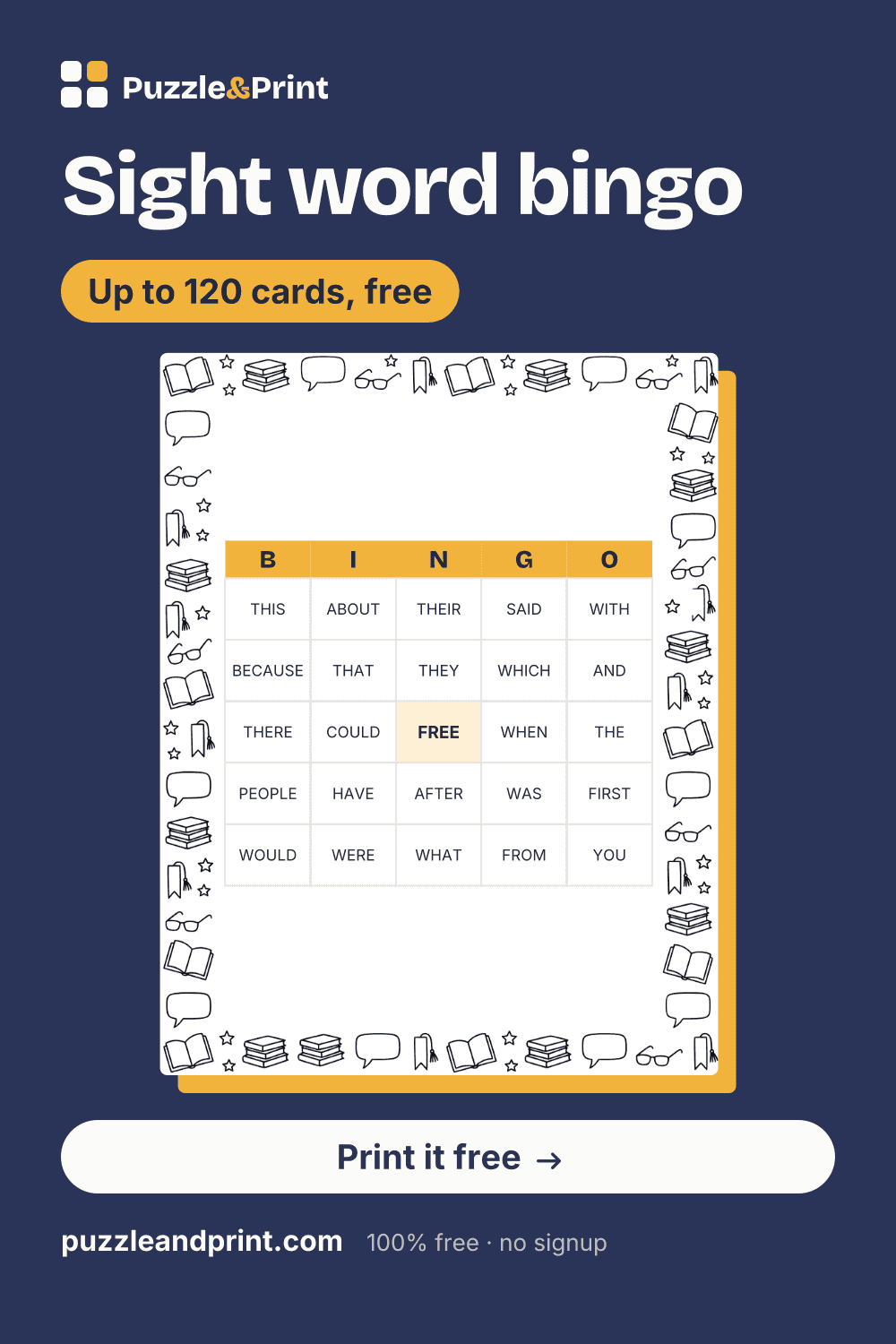
Sight Word Bingo, card 1
IfindhereplaycometwoyellowhelpforupityouFREEbluelittledownlookawaywherefunnymyseesaidato
Created for free at puzzleandprint.com
The Dolch lists level by level, every card different.
Last updated
Save this to PinterestSight Word Bingo, card 1
Created for free at puzzleandprint.com
Sight Word Bingo, call list
Check off each word as you call it. 40 words in play.
Created for free at puzzleandprint.com
Five sets sized for different groups. Every card within a set is different, and each prints on a page of its own after the call list.
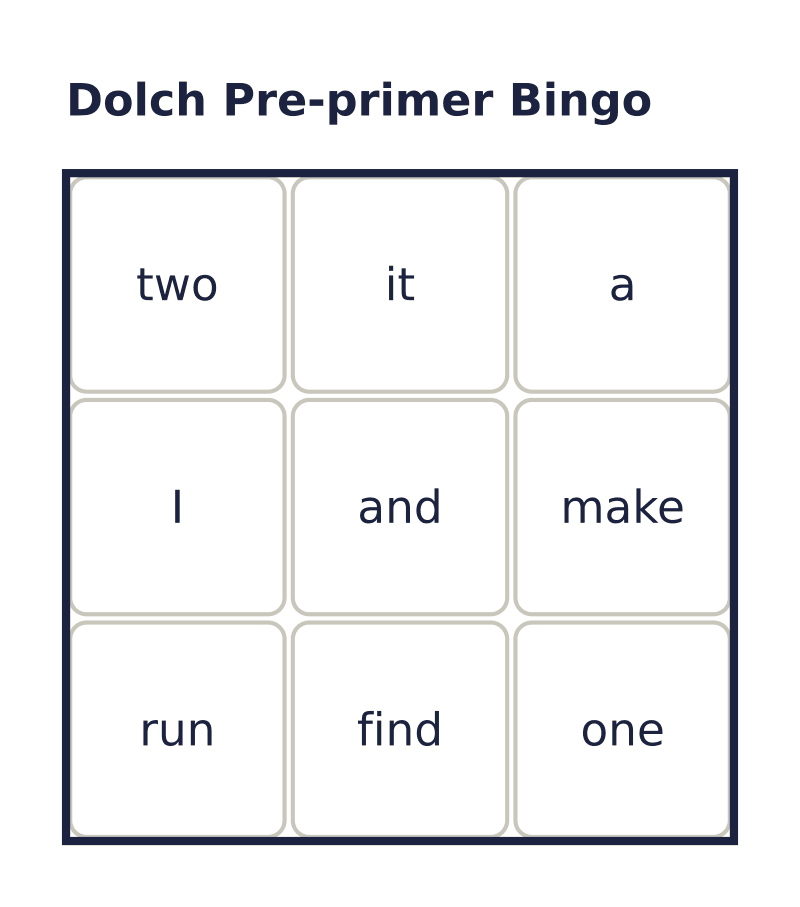 Dolch pre-primer bingo20 cards · 3 × 3 · 40 wordsDownload PDF ↓
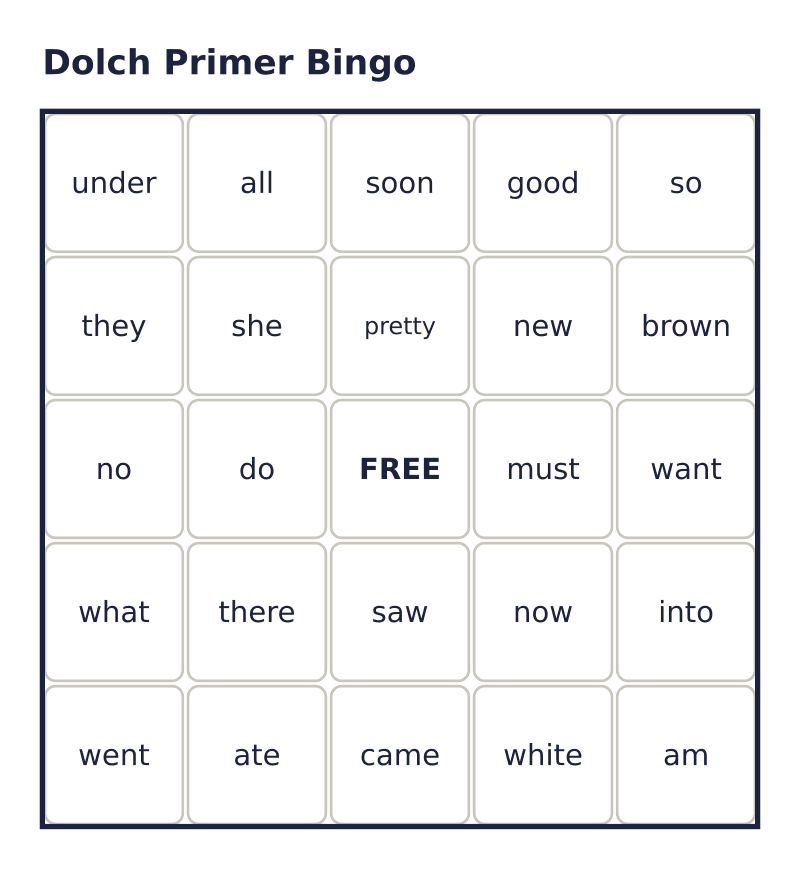 Dolch primer bingo24 cards · 5 × 5 · 52 wordsDownload PDF ↓
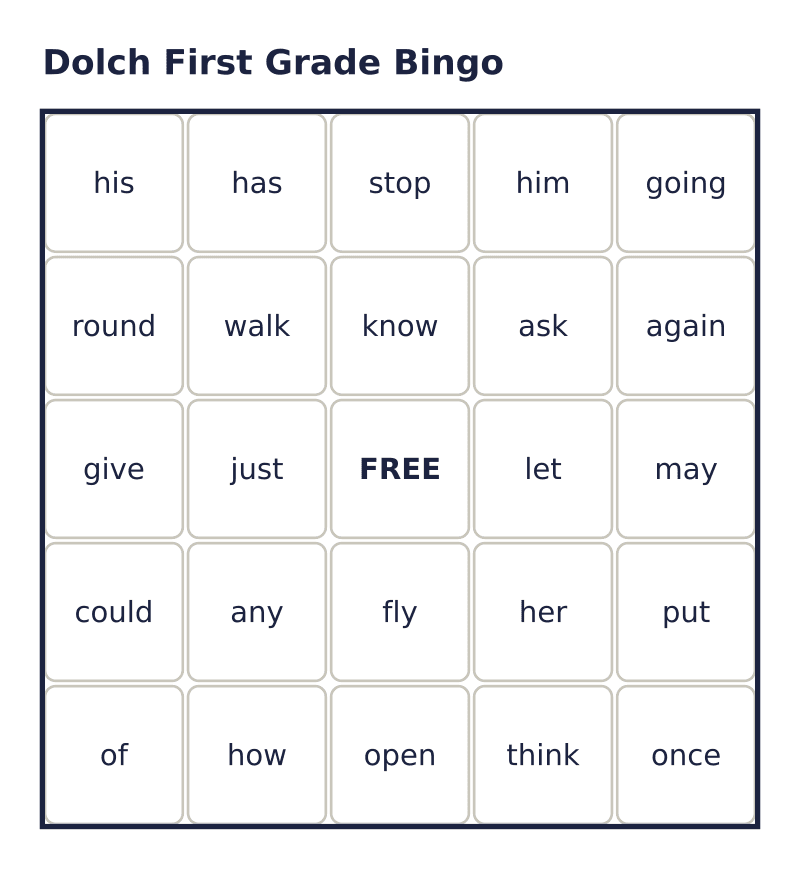 Dolch first grade bingo30 cards · 5 × 5 · 41 wordsDownload PDF ↓
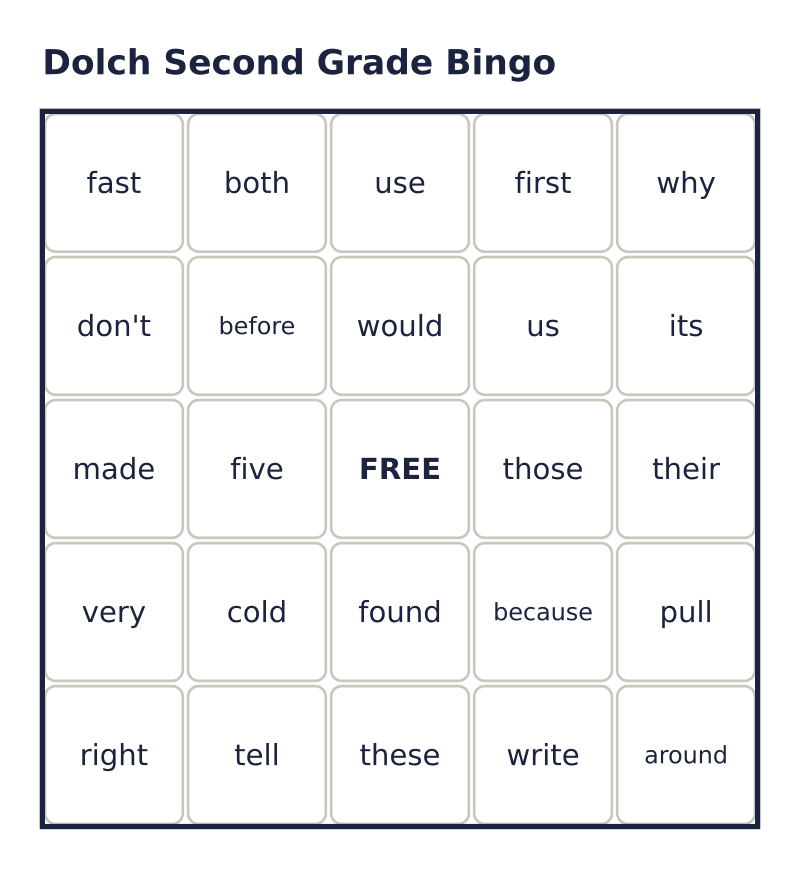 Dolch second grade bingo12 cards · 5 × 5 · 46 wordsDownload PDF ↓
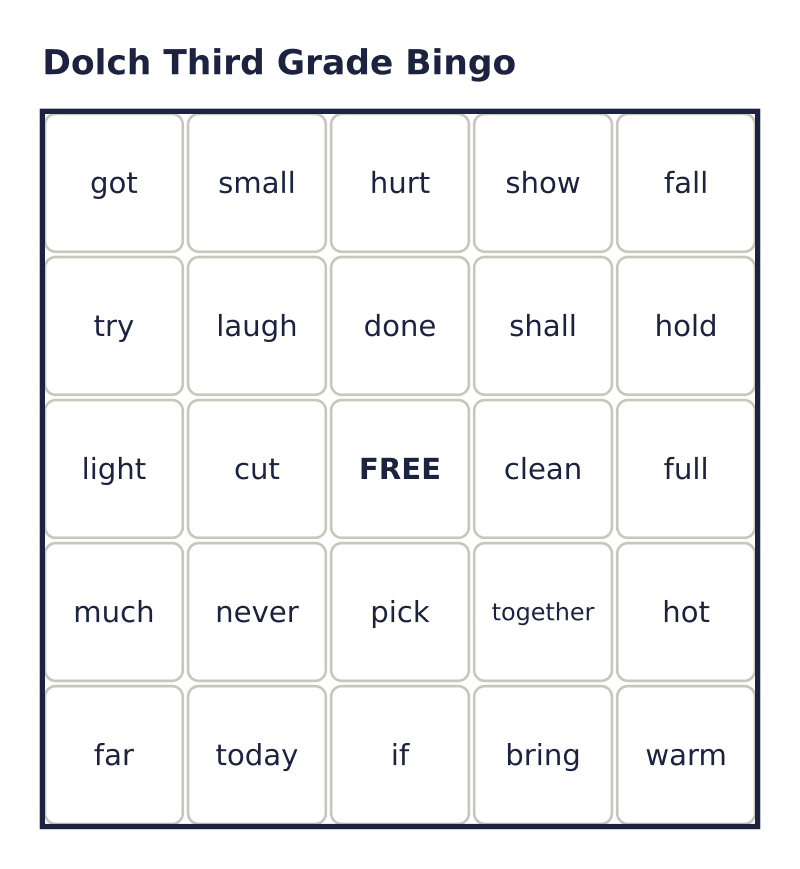 Dolch third grade bingo6 cards · 5 × 5 · 41 wordsDownload PDF ↓
Every sheet here is free to print as often as you like. If one saved you time, the tip jar is on Ko-fi.
Sight word bingo earns its place in a reading block because a call puts every child to work at once. Each one has to scan their own card for the word just heard, read the candidates, and decide, while a flashcard round asks one child and lets the rest wait. Repeated over a dozen calls, that is a lot of reading from a group that thinks it is playing a game.
The cards here are built from the Dolch lists: the 220 high-frequency words Edward W. Dolch sorted into five levels, from pre-primer to third grade, plus his separate list of 95 nouns. Each list is copied exactly as published and printed in lowercase, the way children meet these words in a book, so only I, Christmas and Santa Claus carry a capital. All six lists are in the maker at the top of the page.
The five ready-made sets take one level each, and each is sized for a different group. Pre-primer is twenty 3 × 3 cards for the youngest group, with nine words a card and no free square. Primer is twenty-four 5 × 5 cards for a kindergarten class, first grade is thirty for a full room, second grade is twelve for a reading group, and third grade is six for a small group at one table. Every 5 × 5 card has a free center and 24 words, and every word on a set’s call list is on at least one of its cards.
If your class is partway through a list, lower the word count in the maker, or type the words you taught this week. Typed words need at least three letters, so for the short ones choose a Dolch level instead: eleven of the forty pre-primer words, among them a, I, go and up, are one or two letters long.
Edward W. Dolch first published his list in 1936, in The Elementary School Journal, and again in his 1948 book Problems in Reading. It holds 220 words that are not nouns, the small words that hold sentences together, such as the, said, could and because, sorted into five levels that run from the pre-primer and primer readers of his day through the first three grades: pre-primer (40 words), primer (52), first grade (41), second grade (46) and third grade (41). A separate list of 95 nouns, from apple to wood, came out of the same survey of children’s books, which is why it still includes kitty and Santa Claus.
No word appears on two of the lists, so the 220 really are 220 different words, and each level assumes the one before it: a child who reads the, to and is from pre-primer is ready for that, they and was in primer. Many schools aim to finish pre-primer and primer in kindergarten and each grade list in its grade, but the levels are a sequence rather than a deadline, and a second grader still unsure of primer words is better served by the primer set. The lists are printed here exactly as published, so the second grade list keeps the apostrophe in don’t and the nouns keep good-bye hyphenated.
Played to one line, the first grade set of thirty cards usually finishes after about 12 calls, and nine games in ten end between the 8th and the 16th. The primer set takes about 15 calls with its twenty-four cards, because 52 words is the longest of the five levels and each card holds fewer than half of them, the twelve-card second grade set takes about 16, and the six-card third grade set about 16 as well. On the primer, first grade and second grade sets a typical card has seven or eight words marked when somebody wins, and on the third grade set nine or ten. Playing on to a full card takes far longer: about 37 calls for first grade, 39 for third grade, 43 for second grade and 47 for primer, close to the whole list each time.
The pre-primer set plays differently because its cards are small. Each 3 × 3 card holds nine of the forty words with no free square, so a call marks something on only four or five of the twenty cards, and a line comes after about 8 calls. By then a typical card has fewer than two words marked, so plenty of children will hear several calls without marking anything; tell them so before you begin. Every pre-primer word is on at least one card, so every call marks something for someone. With the first grade set, two or more children finish on the same call in about one game in six, and even among the six third grade cards it happens in about one game in nine, so agree beforehand what a tie wins.
Two of the five sets each hold a pair of words that sound the same. The pre-primer list has both to and two, and the second grade list has both right and write, so a bare call of either is a guess for a child holding the other. Call each inside a short sentence, "walk to the door" or "write your name", and the sentence does the sorting. Across levels there are more pairs, for and four, there and their, no and know, by and buy, ate and eight, but each pair is split between two lists, so they only meet on one card if you type a mixed list yourself.
Words that start alike matter more once children mark their own cards. The primer list has four words that begin with th (that, there, they and this) and three with wh (what, white and who), first grade adds them, then, thank and think, and second grade has their, these and those. Third grade has no th or wh words, but it has pairs of its own, such as draw and drink, shall and show, and today and together. A child who reads only the first two letters can mark the wrong square, so before a prize changes hands, ask the winner to read the line back aloud. A mismarked word shows up straight away, and reading it back is one more round of practice for everyone listening.
The list the children are learning now, or the one before it for a first game they can win. The order is pre-primer, primer, first grade, second grade, third grade. If a class is spread across levels, make a small set for each reading group in the maker rather than one mixed set, so every child reads words at their own level and each set’s call list stays short.
Because children meet them in lowercase in books, and that is how the Dolch lists are published, so a child who knows the shape of said in a story finds the same shape on the card. Only I, Christmas and Santa Claus carry capitals, as on the published lists. Words you type into the maker yourself print in capitals, like the other themes in the bingo maker.
Yes, in the maker at the top of the page, where the nouns sit under Dolch sight words after the five levels. They are the one Dolch list without a ready-made set here. The nouns list has 95 words, nearly twice the 52 of primer, the longest level, so with all 95 in play any two cards share only about a quarter of their squares and a line takes roughly twice as many calls; lower the word count for a shorter game.
New printables when they go up, mostly seasonal, a few times a year.