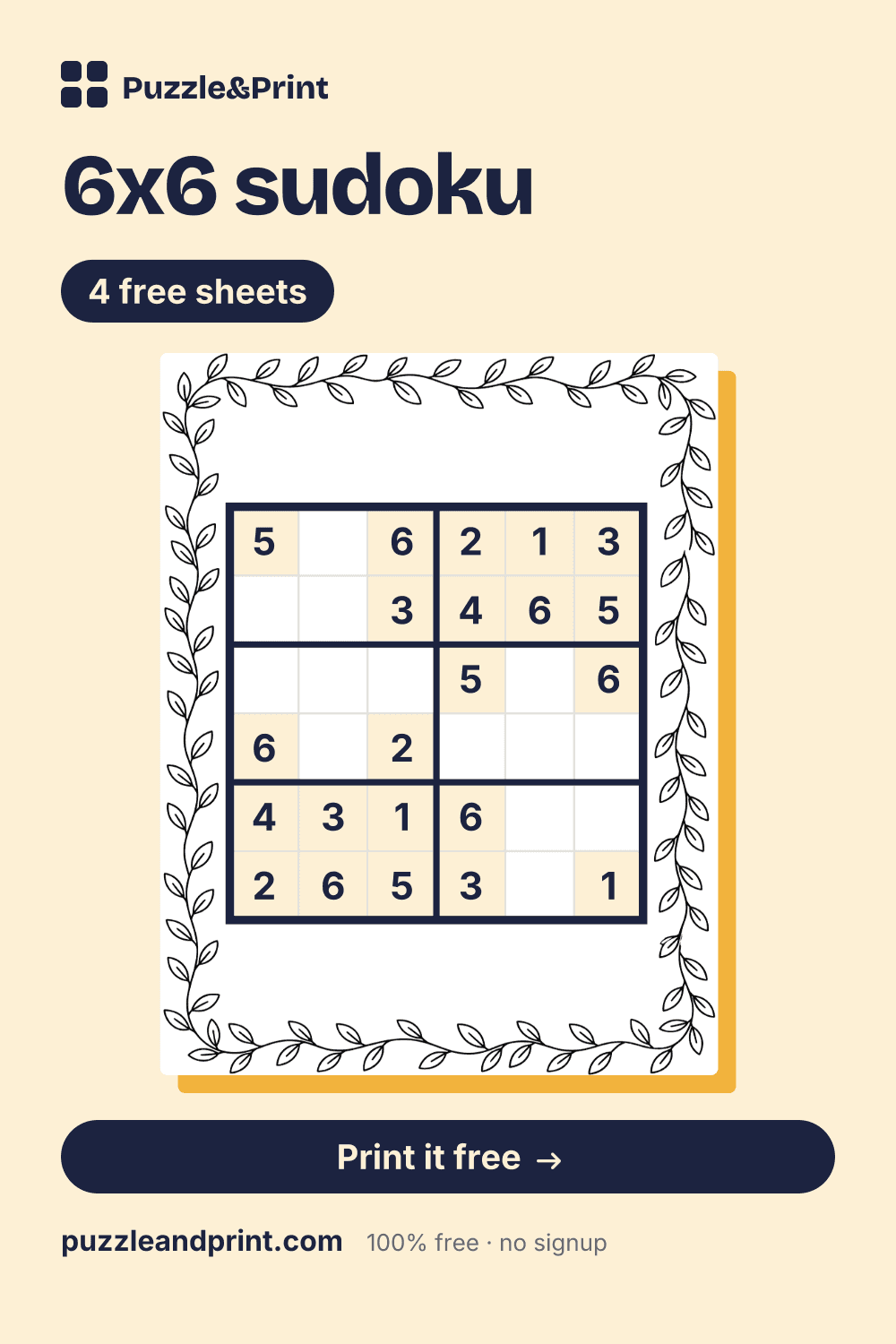
6x6 Sudoku
6 × 6 · Medium
Write 1 to 6 once in every row, every column and every 2 by 3 box.
Created for free at puzzleandprint.com
The step between 4x4 and the full grid, two or four to a page.
Last updated
Save this to Pinterest6x6 Sudoku
6 × 6 · Medium
Write 1 to 6 once in every row, every column and every 2 by 3 box.
Created for free at puzzleandprint.com
6x6 Sudoku, Answer Key
6 × 6 · Medium
Created for free at puzzleandprint.com
Four sheets, each a two-page PDF: the puzzles, then the answer key on its own page.
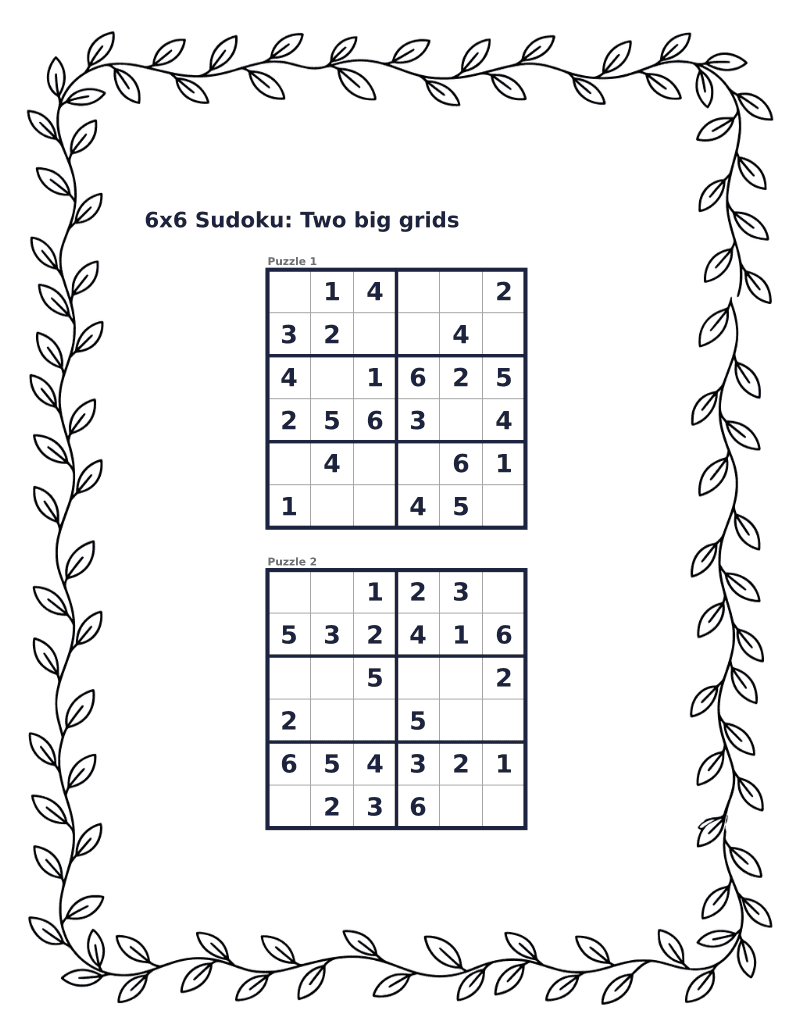 6x6 sudoku, two big grids6 × 6 · Easy · 2 puzzlesDownload PDF ↓
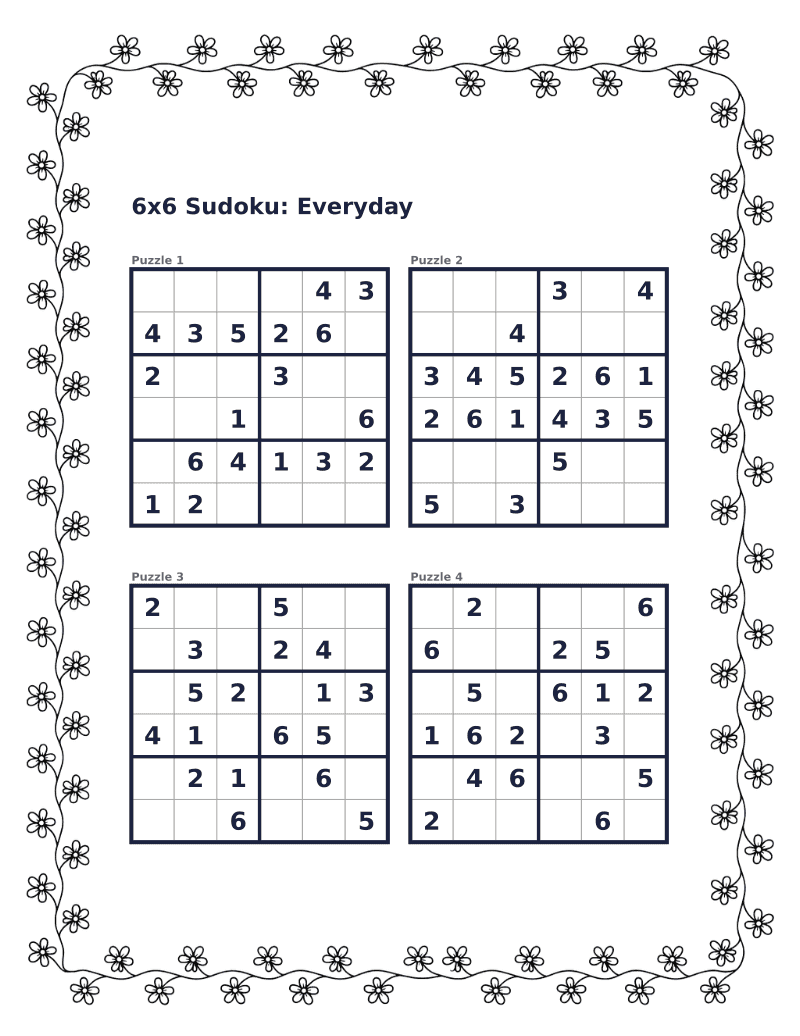 6x6 sudoku, everyday6 × 6 · Medium · 4 puzzlesDownload PDF ↓
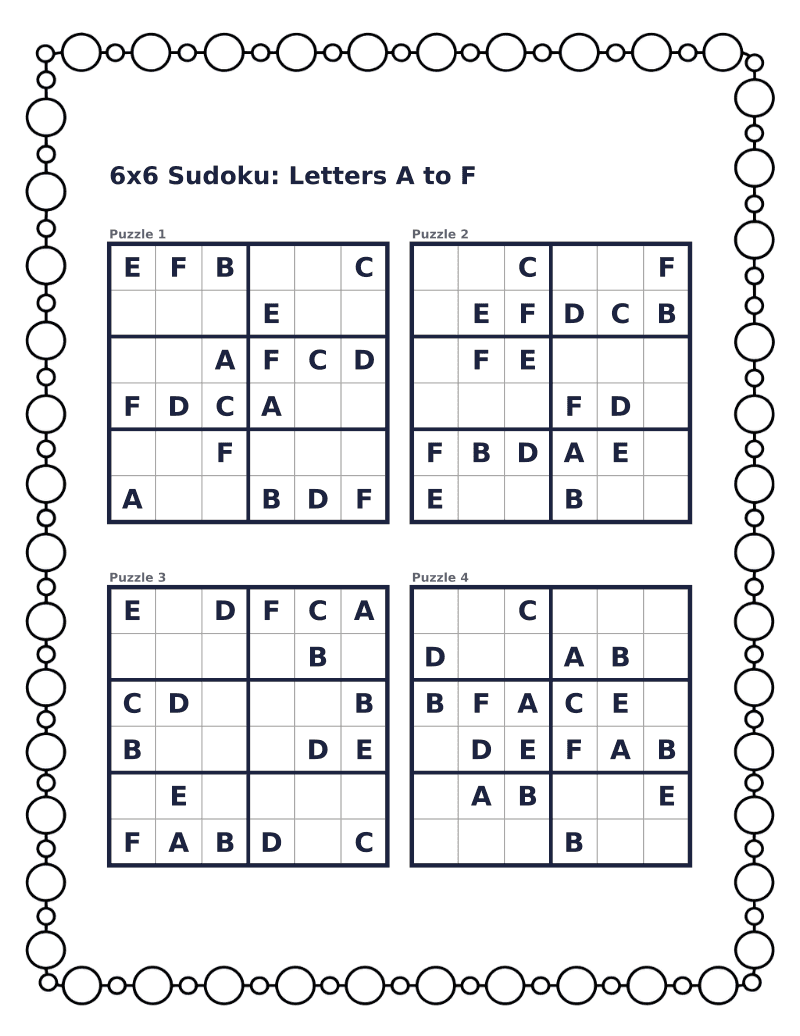 6x6 sudoku, letters A to F6 × 6 · Medium · letters · 4 puzzlesDownload PDF ↓
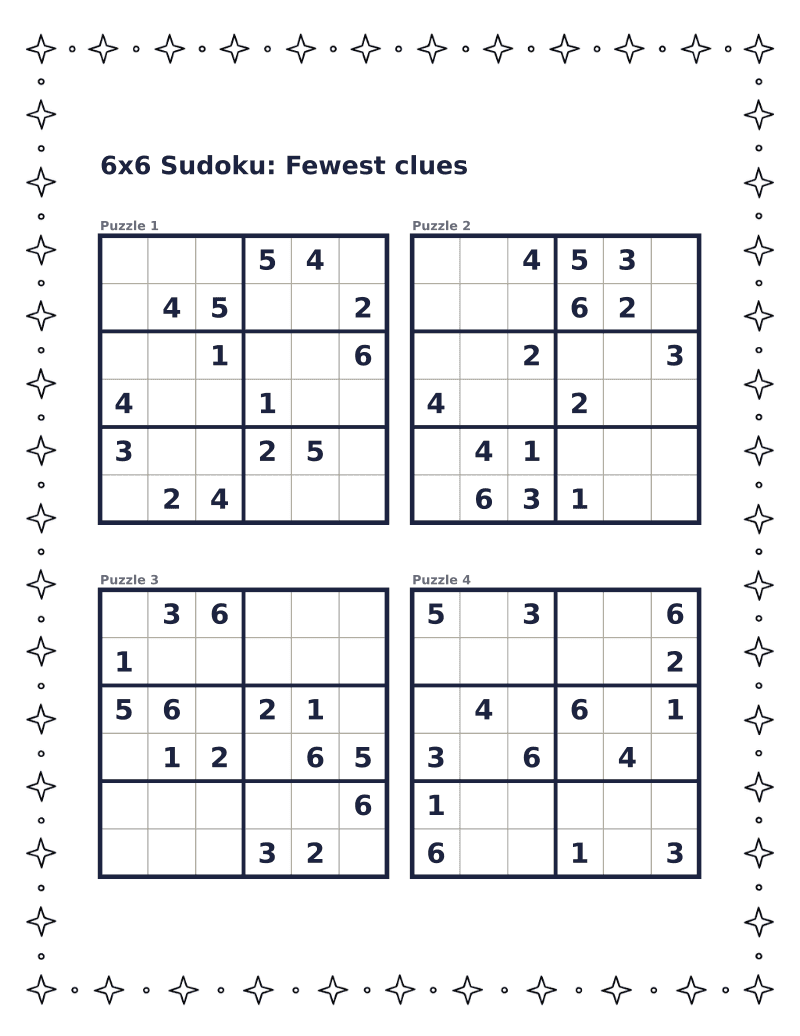 6x6 sudoku, fewest clues6 × 6 · Hard · 4 puzzlesDownload PDF ↓
Every sheet here is free to print as often as you like. If one saved you time, the tip jar is on Ko-fi.
A 6x6 sudoku uses the numbers 1 to 6 in a grid of thirty-six squares, split into six boxes that are two squares tall and three wide. That makes the boxes rectangles, two across the grid and three down, and the rectangle is the one genuinely new idea after a 4x4. A solver who checks a box by habit has to learn that a box here is a row of three on top of another row of three.
The four sheets step down in clues. Two big grids prints two puzzles a page with twenty-two of the thirty-six squares given. The everyday sheet and the letters sheet each hold four puzzles with eighteen given, the letters version using A to F. The fewest clues sheet gives fourteen in each of its four grids, which leaves twenty-two squares to work out.
Every 6x6 here can be finished with singles alone, never a guess. Across the fourteen grids on the four sheets, thirteen fall to the simplest move of all, a square where only one number fits. The odd one out is the second puzzle on the everyday sheet, which needs four hidden singles: a number that has only one possible square left in a row, column or box. It is the first taste of the move a medium 9x9 is built on.
That makes 6x6 a sensible bridge for a child of seven or eight who finds 4x4 too quick. When the fewest clues sheet goes smoothly, the easy 9x9 page is the next step, because it asks for exactly the same thinking, only with more squares to keep track of.
The fewest clues sheet gives fourteen numbers in each of its four grids, and the hard part is the very beginning. In the first and third puzzles exactly one square can be filled before anything else is written, so the opening is a search across all thirty-six squares for the one that has five of its six numbers ruled out. The second puzzle has four such squares and the fourth has five.
After that opening the rest follows one square at a time: all twenty-two empty squares in each of the four puzzles fall that way, with no hidden singles needed. The two big grids sheet is gentler from the start, with nine possible first moves in its first puzzle and five in its second, which is why it is the one to print for a first 6x6.
On these sheets the heavy lines fall after every third column and every second row, so each box is three squares wide and two tall, and the sentence above the grids says so: every 2 by 3 box. The usual slip is to treat a box as three squares tall, which puts six numbers into an area that is really parts of two boxes and leads to a row that cannot be finished.
A quick way to make the shape stick is to trace one box with a finger before starting and count its six squares. The letters sheet, with A to F given in eighteen squares of each grid, uses exactly the same boxes, so it doubles as a second round of practice reading the shape rather than a new puzzle type.
Both exist, and these sheets use two rows by three columns: each box is three squares wide and two tall, giving two boxes across the grid and three down. The instruction above every grid names the shape, and the answer key keeps the same heavy lines so a checked row is easy to find.
About twice as much. The fewest clues 6x6 sheet leaves 22 squares empty in each puzzle, and an easy 9x9 from this site leaves 45, since it starts with 36 of its 81 squares filled. The thinking is the same, so the jump is mostly in patience and in keeping track of nine numbers.
New printables when they go up, mostly seasonal, a few times a year.