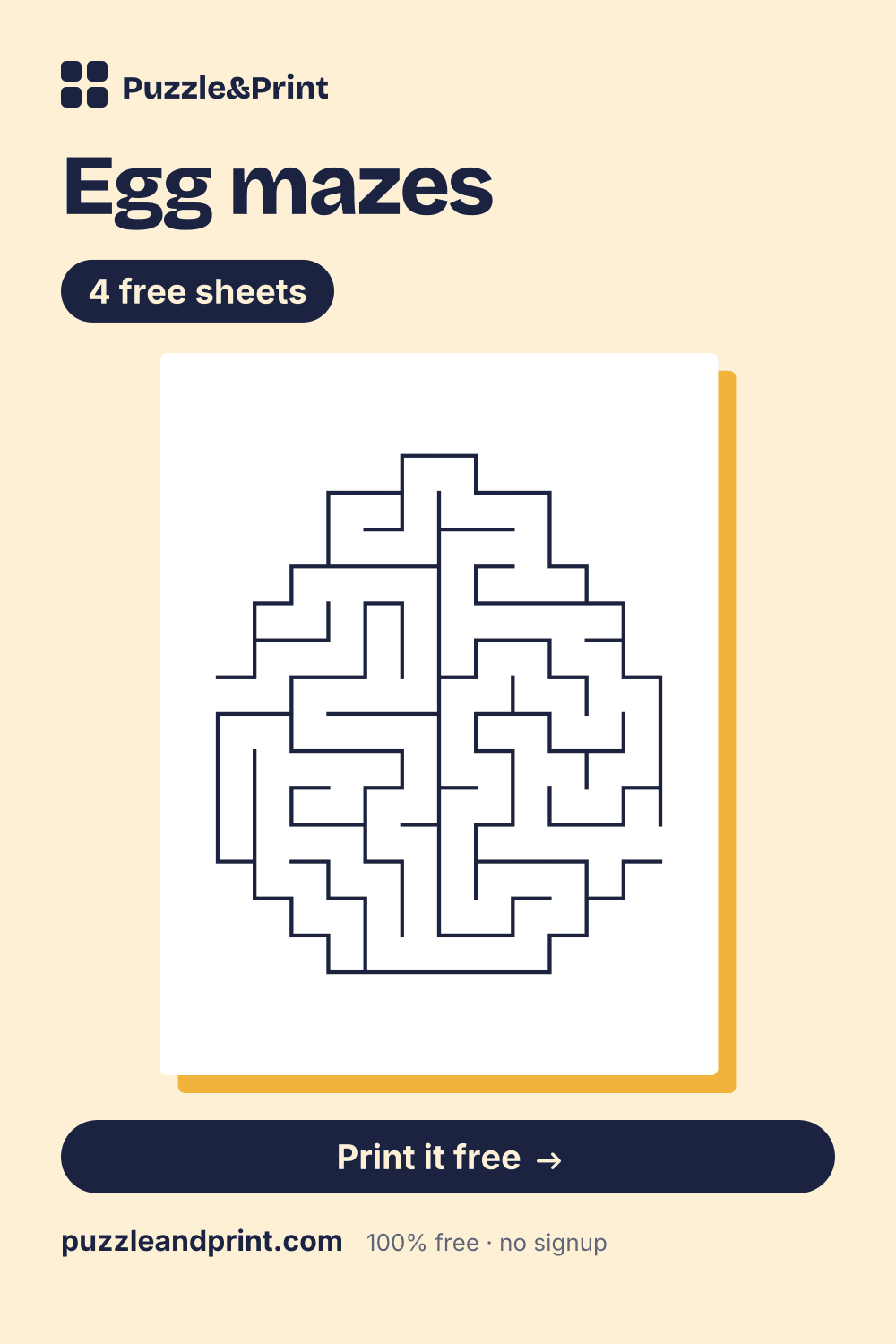
Egg Maze
Created for free at puzzleandprint.com
Egg Maze
Created for free at puzzleandprint.com
Egg Maze, Solution
Created for free at puzzleandprint.com
Four mazes, each a different size. Every one is a two-page PDF, the maze, then the solution on its own page.
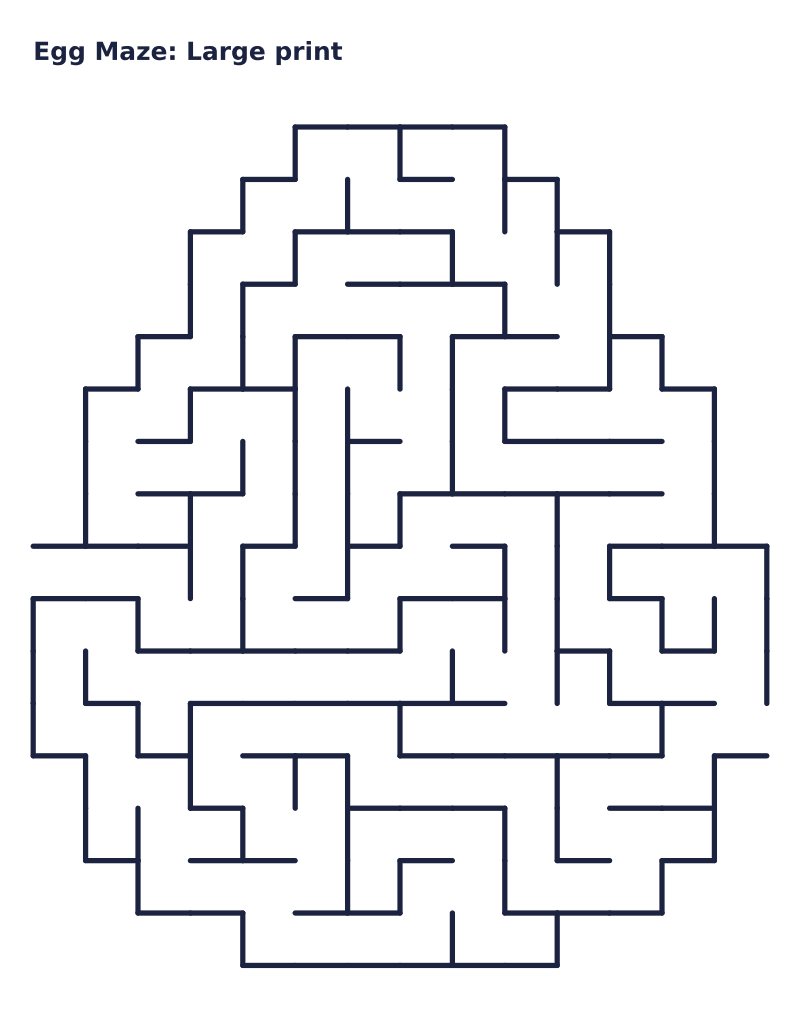 Egg maze, large print16 × 16 grid · EasyDownload PDF ↓
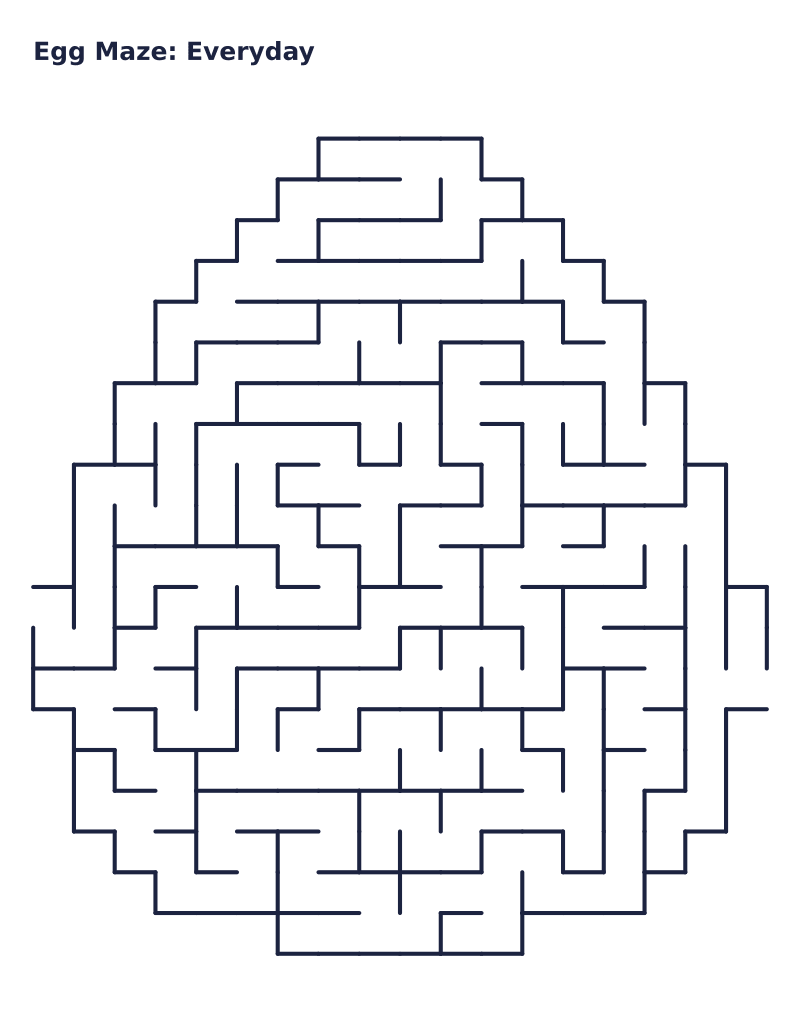 Egg maze, everyday20 × 20 grid · MediumDownload PDF ↓
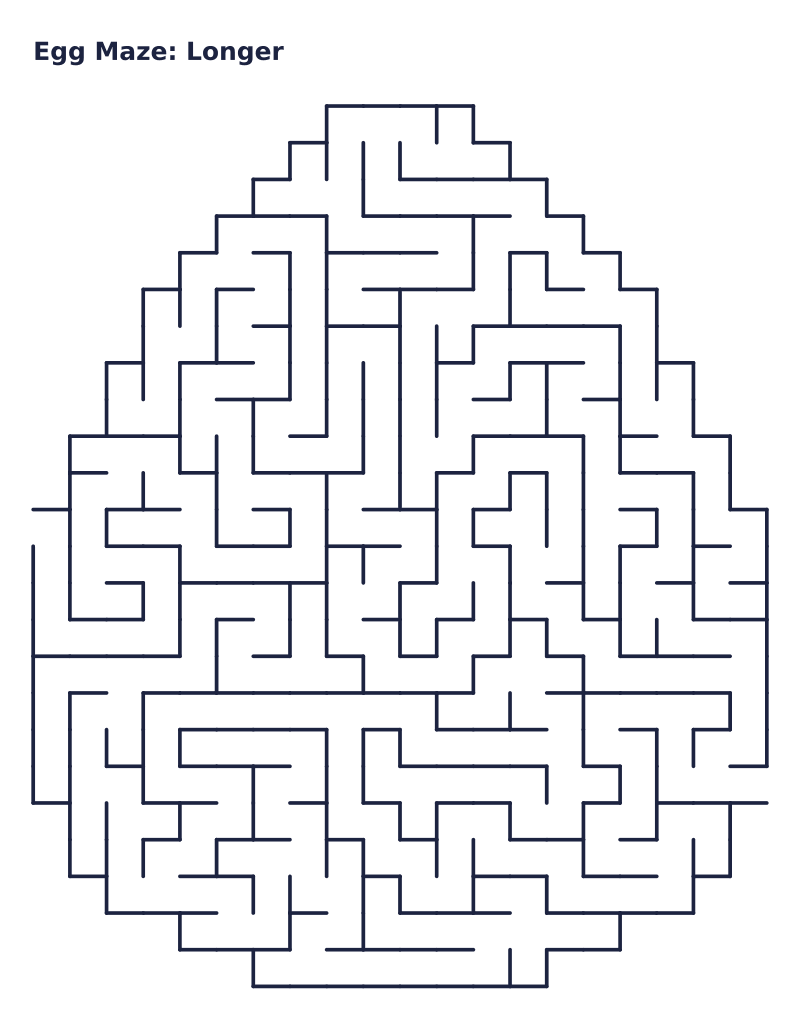 Egg maze, longer24 × 24 grid · MediumDownload PDF ↓
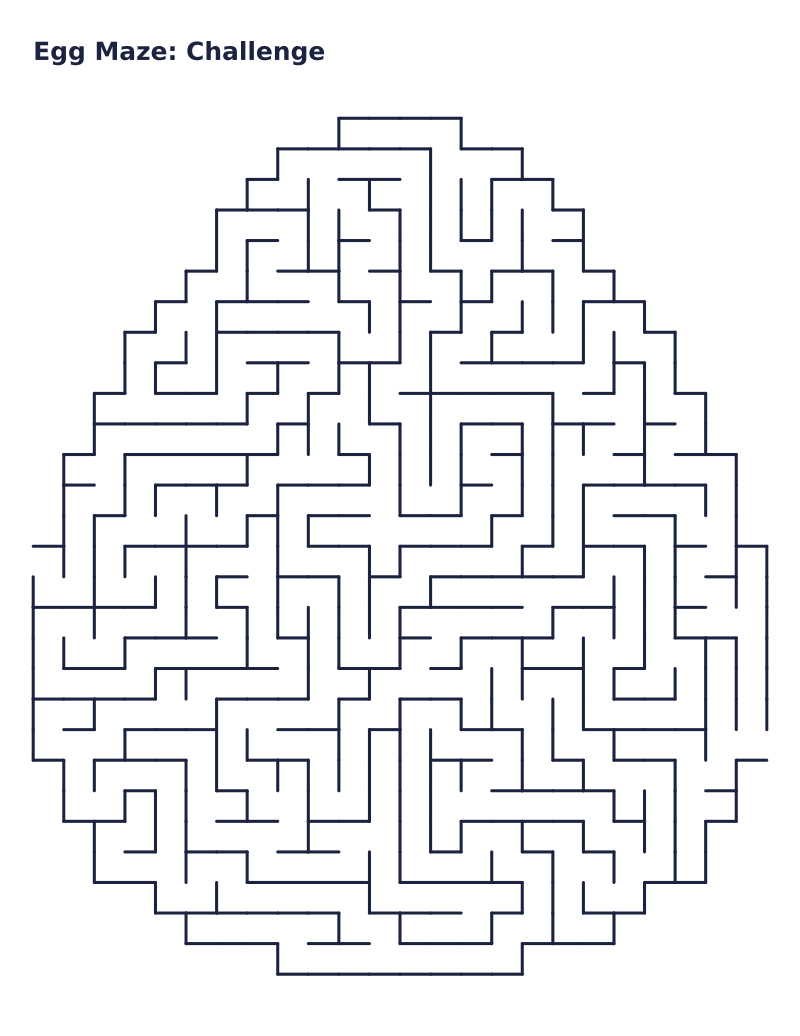 Egg maze, challenge28 × 28 grid · HardDownload PDF ↓
Every sheet here is free to print as often as you like. If one saved you time, the tip jar is on Ko-fi.
An egg keeps about two thirds of its grid, between 64 and 66 percent on the four sheets here, so these are proper puzzles rather than novelties. The shape is narrow at the crown and broad at the base, which puts more of the maze below the middle than above it: on the Challenge, 290 of its 508 squares are in the bottom half.
For Easter this is the sheet that needs nothing else. No coloring, no cutting, no glue, and it prints in black and white on ordinary paper, which matters when it is a class set rather than one child at a kitchen table.
It is also a good shape for decorating afterwards. An egg is the outline children already paint at Easter, so once the route is drawn in, the corridors either side of it can take the stripes, zigzags and spots of a painted egg, which turns one printable into two activities.
No egg here has a loop, so every square off the route sits in a dead-end branch; on the Everyday sheet those branches hold 146 of its 262 squares. The solution is on page two of every PDF.
The Large print egg is the most forgiving shaped maze here: no wrong turn short of the way out runs more than four squares before it ends, the shortest of any shaped maze sheet across the maze pages. Its route is 51 squares long with six forks, and every one of those forks leads into a stub of one to five squares, so a child who chooses wrongly finds out almost at once. The squares print about 11 mm across, which leaves room for a thick pencil. For a young child doing an Easter sheet beside older brothers and sisters, it is the one to give the youngest.
The route itself is the unexpected part. It climbs from the way in, on the left side, up to the top row of the egg and down the right side to the way out, and it never goes below the twelfth of the sheet’s sixteen rows, so the broad base of the egg is never on the way at all. Everything inside that arch, 101 squares reaching from the third row down to the base, hangs off the very last square of the route, next to the way out, and a child solving from the way in has no reason to go there. The Everyday route does reach the bottom row, but the Longer’s stops five rows short of it, so a bigger egg does not always mean a route that goes further down.
For older solvers the Challenge egg is the one to print: its route runs 284 squares through corridors about 6.5 mm wide and passes 32 forks, the second-longest route of any shaped sheet here after the Challenge round maze. The egg holds 508 squares, so the route uses more than half of them, and it reaches from the second row at the top of the egg down to the bottom row. No wrong turn on it runs more than 47 squares, which makes it a long, even puzzle rather than one built around a single trap.
The two middle sheets are less predictable than their labels. The Everyday egg's route, at 116 squares, is longer than the Longer egg's 101, and the Longer egg keeps its two biggest wrong turns for the end: one opens five squares before the way out and the other on the square just before it, leading into branches of 95 and 148 squares. Printing one of each size for a family table on Easter morning gives every age something to do at once, from the Large print for the youngest to the Challenge for a teenager or an adult, all with the same shape on the page.
A real one. Each ready-made egg has dead ends spread right across the outline, 23 on the Large print, 32 on the Everyday, 49 on the Longer and 59 on the Challenge, and the route alone takes up between 27 and 56 percent of the squares inside the egg.
Color it in. The Large print sheet leaves the most room for that, with squares about 11 mm across against about 9 mm on the Everyday and 6.5 mm on the Challenge, so a younger child can color the dead ends beside the drawn route with a crayon rather than a fine pen.
Yes. The egg can be carved down to twelve squares, and choosing Easy in the maker gives exactly that, an egg of 92 squares with wider corridors than the Large print sheet. Among the outlines only the circle, the egg and the diamond go that small; the rest stop at sixteen, or at eighteen for the fall leaf and twenty for the turkey, while the plain square goes all the way down to eight.
New printables when they go up, mostly seasonal, a few times a year.