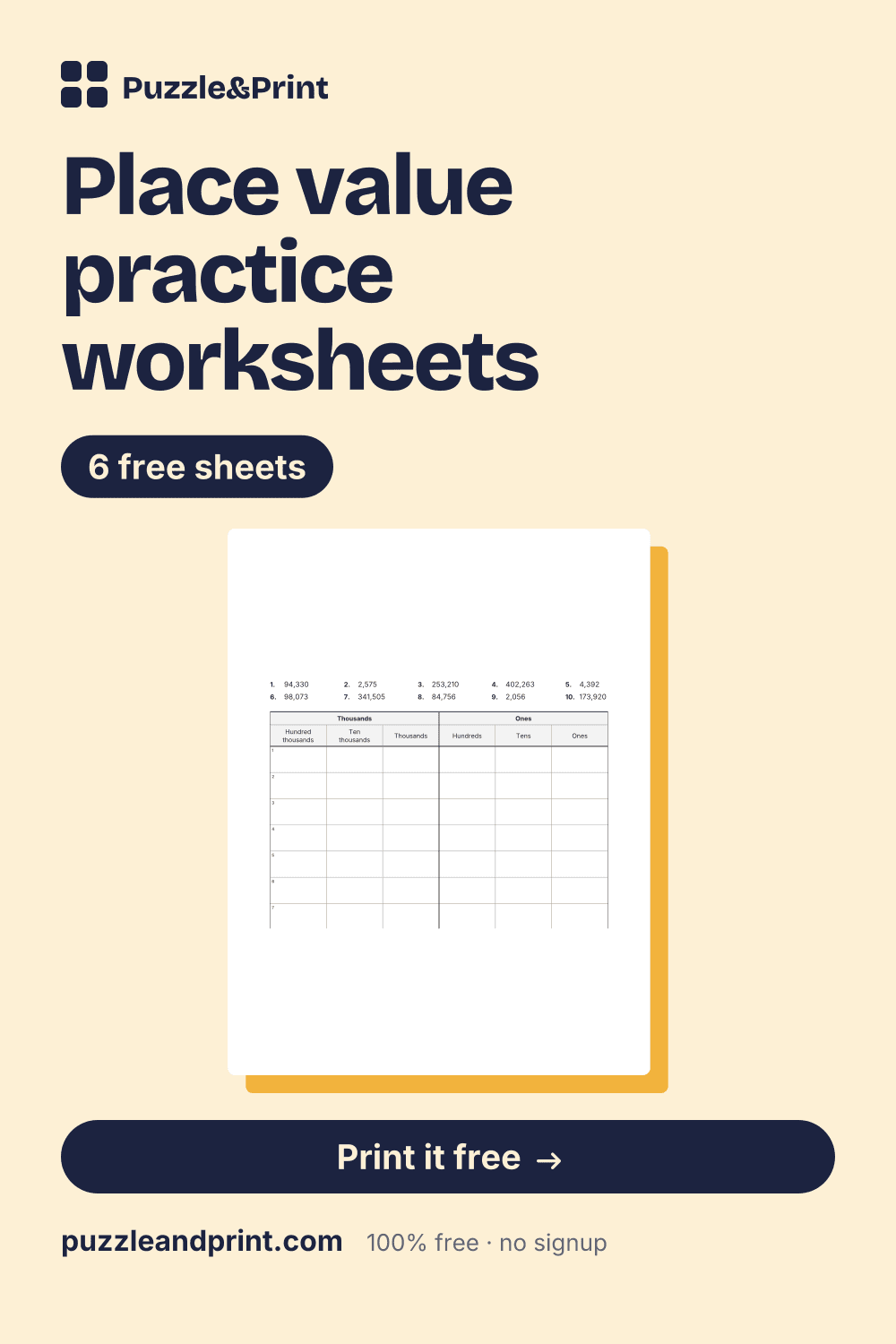
Place Value Chart Practice
Hundred thousands to ones · Write numbers in the chart
Created for free at puzzleandprint.com
Six ready-made downloads, from hundreds, tens and ones up to millions: numbers to write into the chart, in expanded form or in words, every sheet with its answer key.
Last updated
Save this to PinterestPlace Value Chart Practice
Hundred thousands to ones · Write numbers in the chart
Created for free at puzzleandprint.com
Place Value Chart Practice, Answer Key
Hundred thousands to ones · Write numbers in the chart
Created for free at puzzleandprint.com
6 downloads, every sheet in them followed by its answer key on a page of its own.
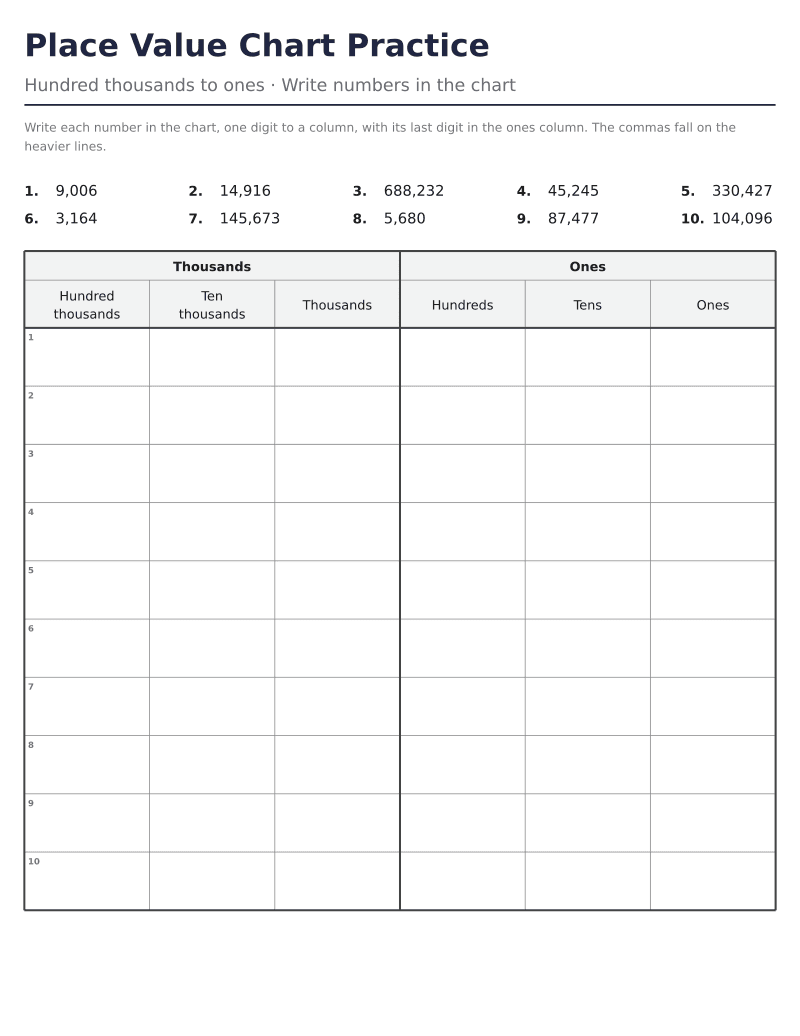 Place value chart practice to thousands10 numbers of 4 to 6 digits · answer keyDownload PDF ↓
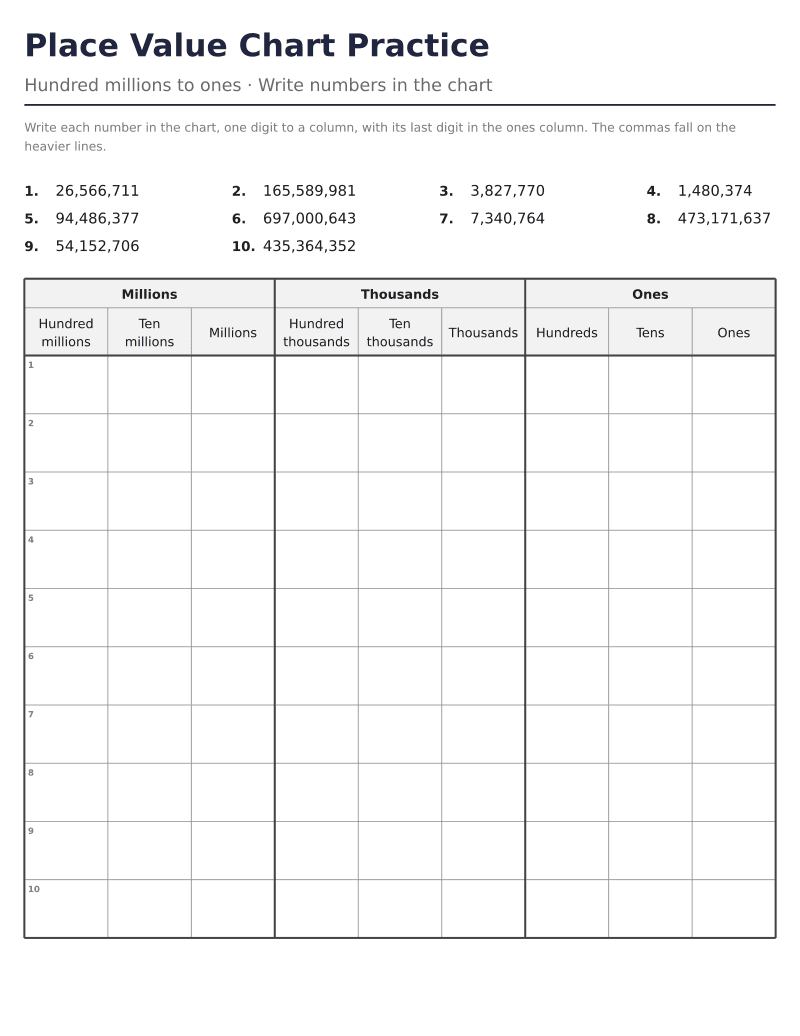 Place value chart practice to millions10 numbers of 7 to 9 digits · answer keyDownload PDF ↓
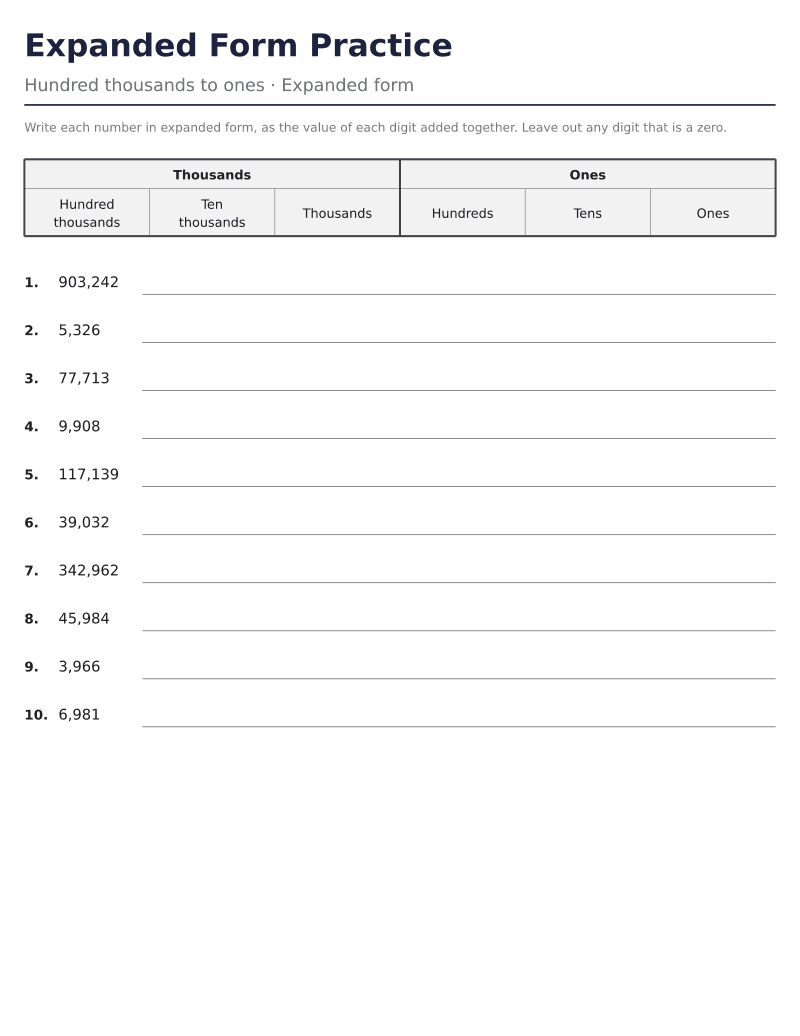 Expanded form place value worksheet10 numbers of 4 to 6 digits · answer keyDownload PDF ↓
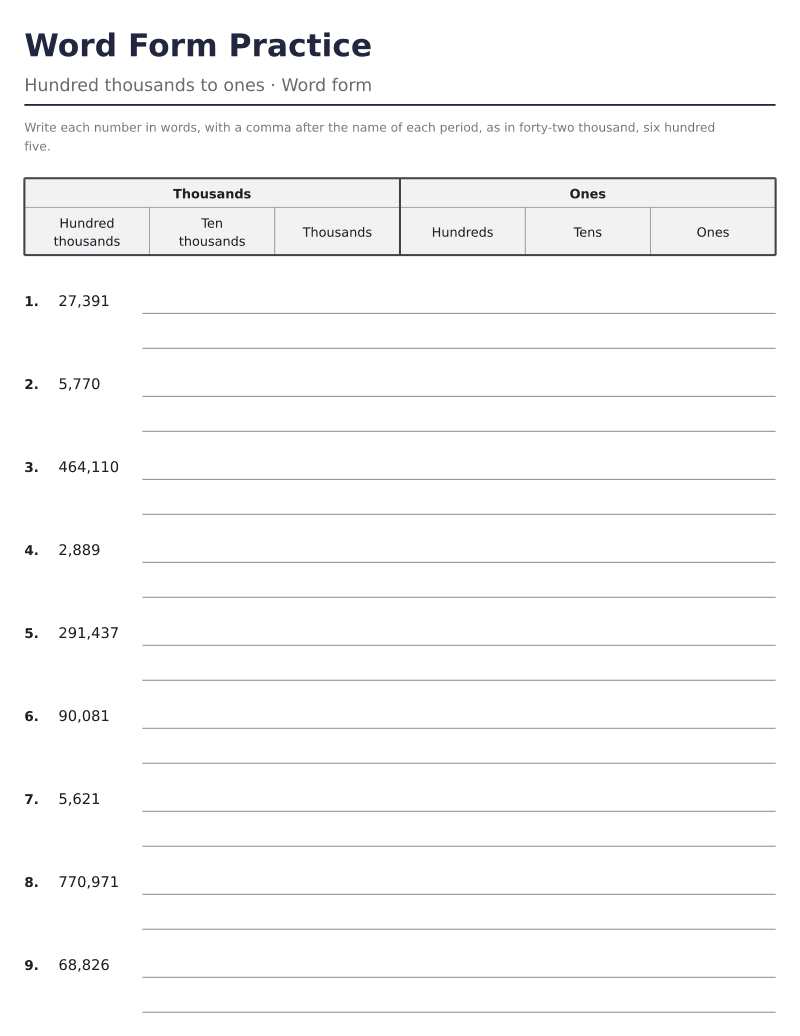 Word form place value worksheet9 numbers of 4 to 6 digits · answer keyDownload PDF ↓
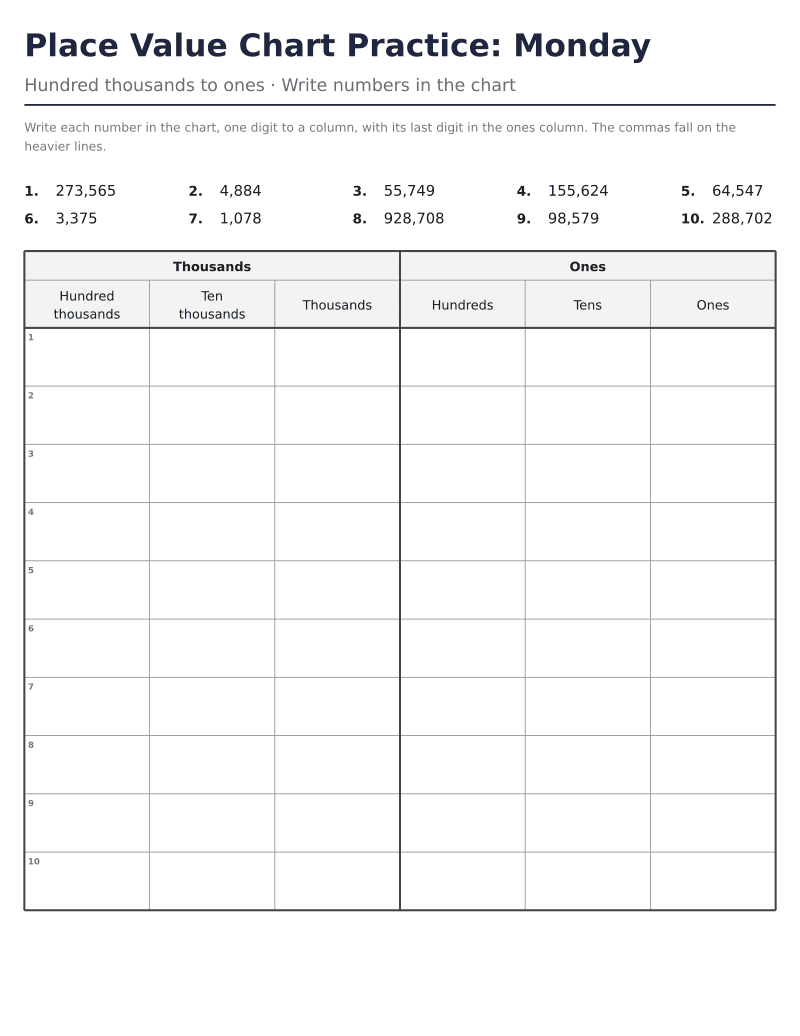 Place value practice Monday to Friday5 different sheets, each with its keyDownload PDF ↓
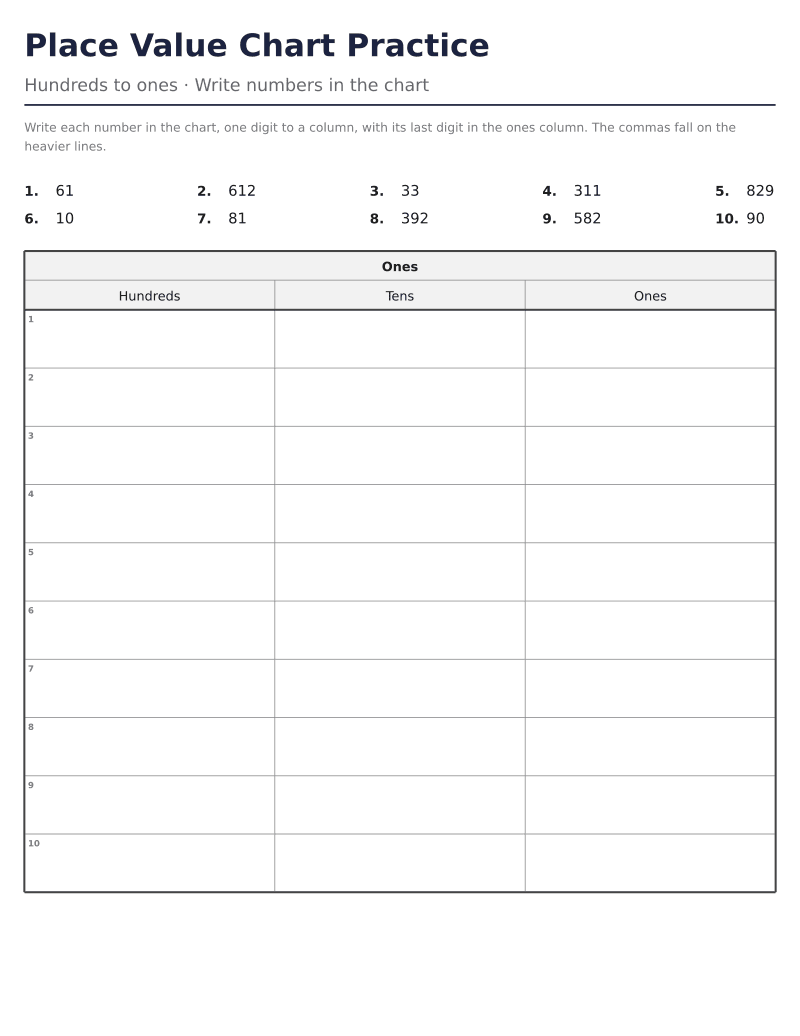 Place value chart practice, hundreds, tens and ones10 numbers of 2 or 3 digits · answer keyDownload PDF ↓
Every sheet here is free to print as often as you like. If one saved you time, the tip jar is on Ko-fi.
Place value is learned by moving a number between its forms: the digits as they are usually written, the same digits sorted into the columns of a chart, the values of those digits added together, and the number read aloud in words. Each sheet here practices one of those moves, with the number given in standard form and the other form to write.
The chart sheets list ten numbers above an empty chart, and each is written into its numbered row, one digit to a column. On the chart to thousands the numbers have four to six digits and on the chart to millions seven to nine, so they start in different columns and the child has to find where each begins by counting back from the ones. At least two numbers on every sheet hold a zero, as in 40,306, because a zero is the digit place value is most often got wrong on. The expanded form sheet has ten numbers of four to six digits, each with a ruled line, and the word form sheet nine, each with two lines.
Every sheet has its answer key on the next page. On a chart sheet the key is the chart with every number written in, the digits in gray and the commas where the numbers have them; on the form sheets each answer is written on its lines. The Monday to Friday set is five different sheets with five keys, ten pages in one PDF. The keys print plain, with no border, as every key on the site does.
The maker above opens on the chart sheet to thousands. New numbers makes a different sheet every time, versions puts up to five different ones in a download, and the same practice works on any chart from hundreds, tens and ones to billions, and with decimal places on any of them but the chart to billions.
On a chart sheet the ten numbers are printed in rows across the top of the page, numbered 1 to 10, and the chart below has ten rows with the same numbers in small type in the corner of each row's first square. Each number goes in its own row, one digit to a column, a whole number ending in the ones column, and the commas fall on the heavier lines between the periods. The key writes every number in, in gray, with each comma after the digit that closes a period, as the number is written.
On a form sheet the names of the places run across the top, as the chart's own header, so a child can find the place of any digit while writing. The numbers are listed down the page, each with its ruled lines beside it. Expanded form asks for the value of every digit that is not a zero, added together, so 6,027 is 6,000 + 20 + 7; word form asks for the number in words, with a comma after each period's name, so 6,027 is six thousand, twenty-seven.
The Monday to Friday set is five different sheets in one PDF, each followed by its key, ten pages in all, every one on the chart to thousands. Monday and Tuesday write ten numbers each into the chart, Wednesday and Thursday write ten each in expanded form, and Friday writes nine in words. The order is deliberate: placing digits comes first, the value of each digit second, and the words last, since saying a number correctly depends on knowing what each digit is worth.
Each day is drawn from its own seed, so no day repeats another's numbers, and every day has at least two numbers with a zero in them. For a class, print the odd pages for the children and keep the even pages, the keys, for checking. The maker can make the same kind of week on any chart, from hundreds, tens and ones to billions, by setting versions to five, though every page of a download from the maker asks the same kind of question.
Because a zero is where place value goes wrong most often. A child who writes forty thousand, three hundred six as 4,306 has dropped the zero that holds the thousands place, and a sheet of numbers with no zeros never shows whether they would. So at least two numbers on every sheet hold a zero inside them, chosen at random like the rest.
Ten on every chart sheet. The form sheets hold as many as fit with room to write: on the chart to thousands, ten in expanded form with one line each and nine in words with two lines each. A sheet to millions in words gives six numbers three lines each, and one to billions four, four lines each, since a twelve-digit number in words can run to more than a hundred characters.
Yes. On a chart key each comma is written after the digit that closes a period, wherever the number has digits to its left, so 46,291 has one comma and 507 has none. Expanded form keys write every value of a thousand or more with its commas, 40,000 + 6,000, and word form keys put a comma after each period's name.
New printables when they go up, mostly seasonal, a few times a year.