Easter Criss-Cross
- BASKET
- BLOSSOM
- CARROT
- CHOCOLATE
- LAMB
- NEST
- PAINTED
- PRIMROSE
- RENEWAL
- RIBBON
- SPECKLED
- TREATS
Created for free at puzzleandprint.com
Four Easter criss-cross grids, from a ten-word starter built on CHOCOLATE to a twenty-word full page, each with its answer key on its own page.
Last updated
Save this to PinterestEaster Criss-Cross
Created for free at puzzleandprint.com
Easter Criss-Cross, Answer Key
Created for free at puzzleandprint.com
Four grids from ten words to twenty. Every one is a two-page PDF, the puzzle, then the answer key on its own page.
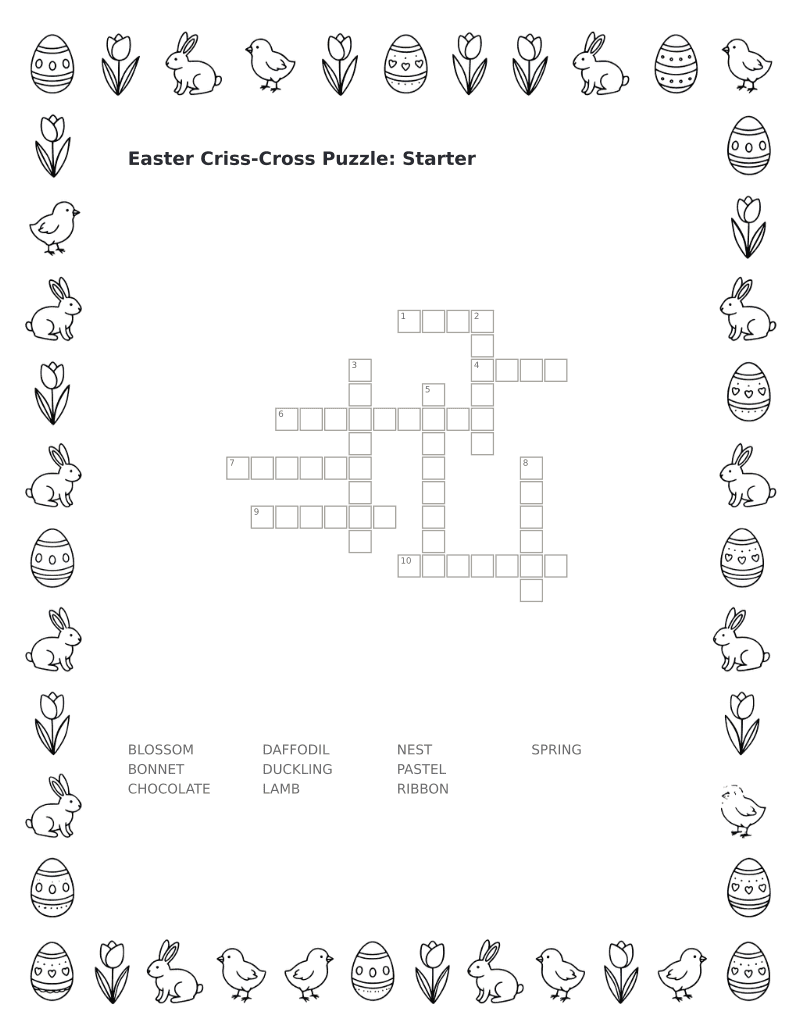 Easter criss-cross puzzle, starter10 words · small gridDownload PDF ↓
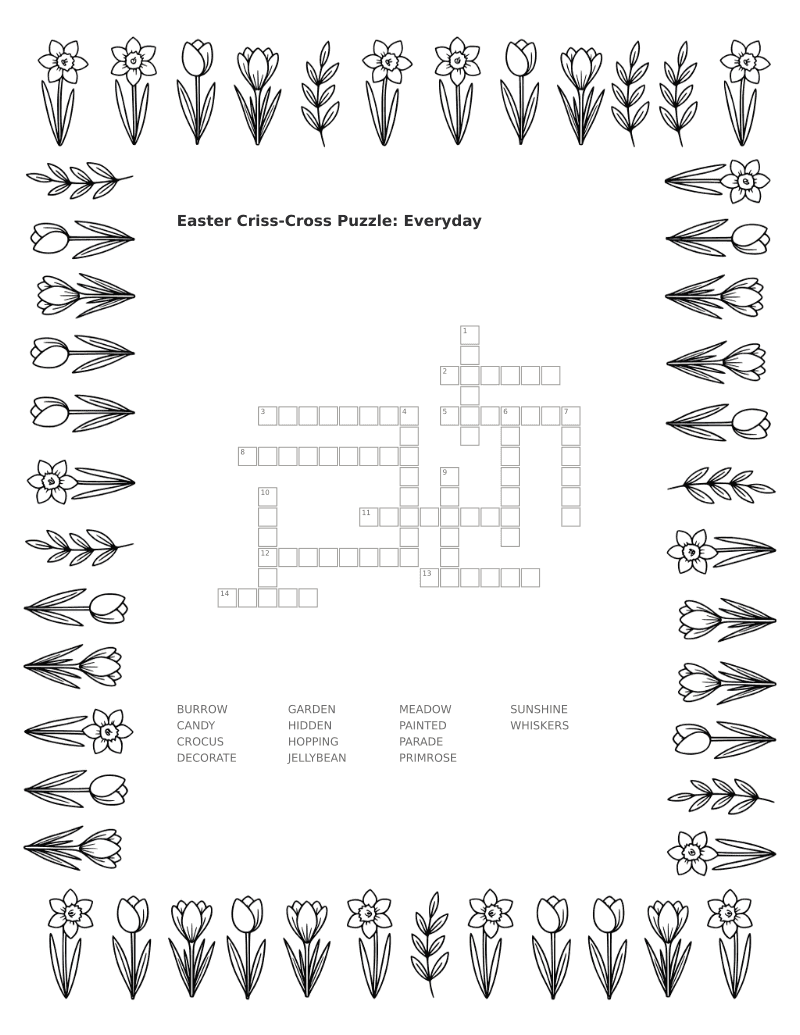 Easter criss-cross puzzle, everyday14 words · medium gridDownload PDF ↓
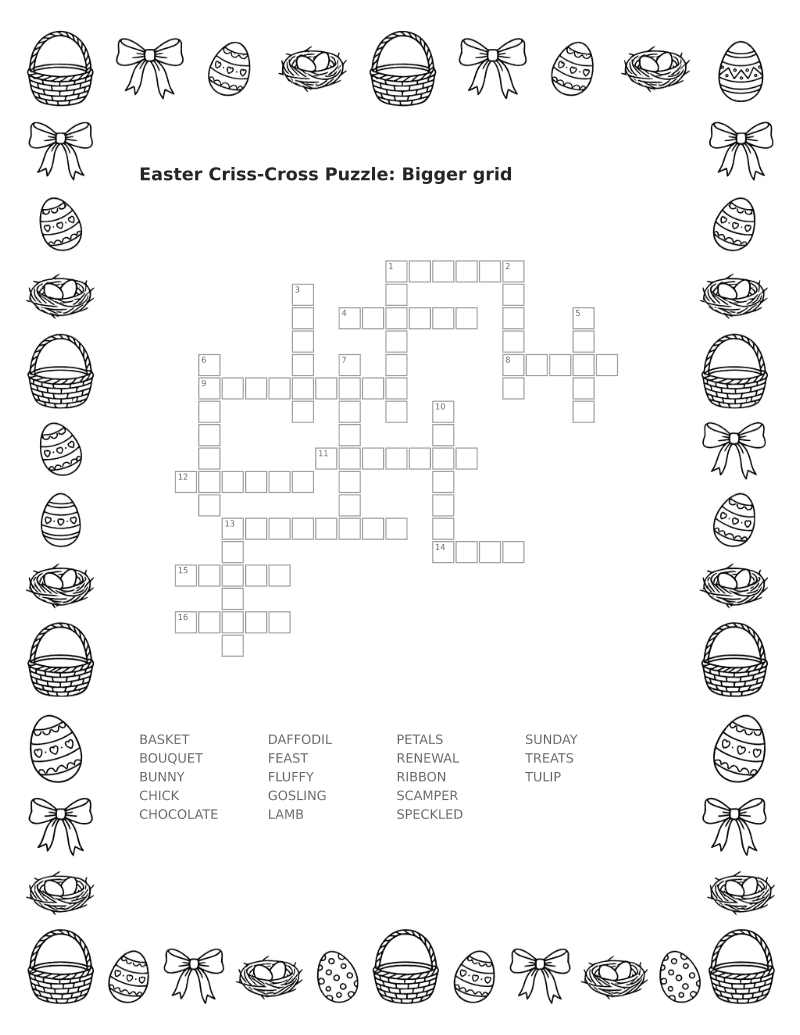 Easter criss-cross puzzle, bigger grid18 words · large gridDownload PDF ↓
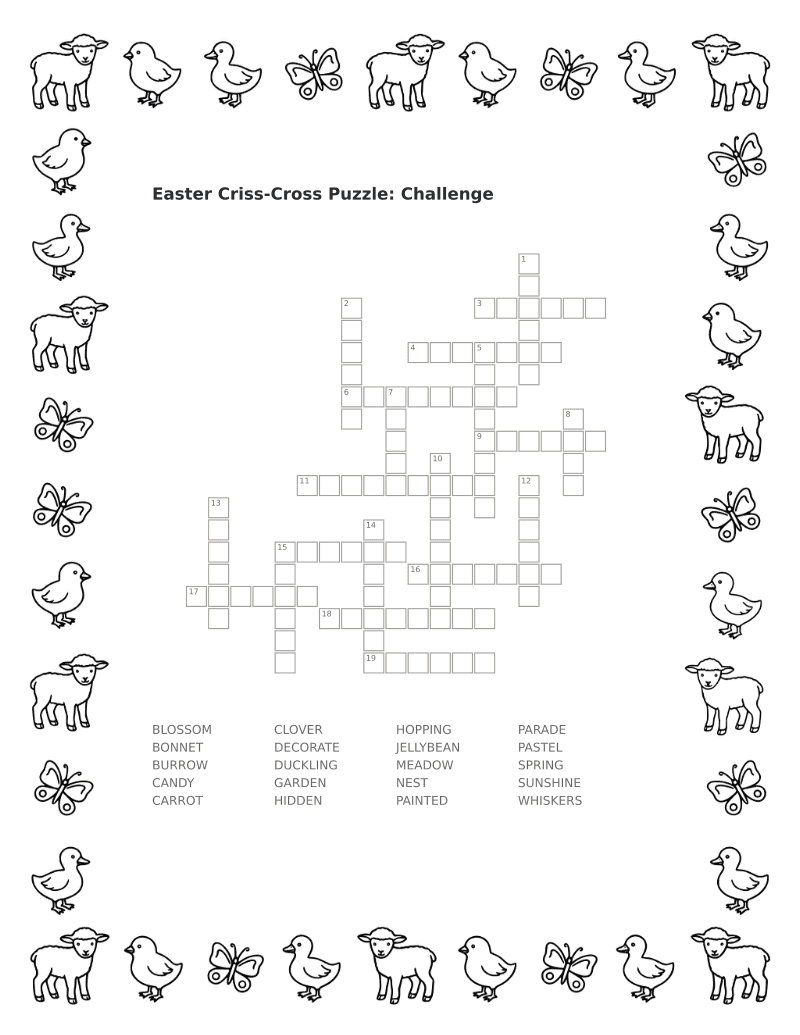 Easter criss-cross puzzle, challenge20 words · full pageDownload PDF ↓
Every sheet here is free to print as often as you like. If one saved you time, the tip jar is on Ko-fi.
An Easter criss-cross is a sitting-down sheet for a season of running around. The words are printed under the grid, so the only question is where each one goes, and the puzzle checks the answer itself, because a word spelled wrong stops the next one fitting. That makes it a fair thing to hand out on the last afternoon before spring break, when nobody wants a new lesson.
Easter words are full of doubled letters, and a doubled letter is where a speller most often drops one. Eleven of the forty have a pair side by side, from BUNNY and RIBBON to HOPPING, BURROW and FLUFFY. On the everyday grid PAINTED hangs down from the second P of HOPPING, so a child who writes hoping puts an I where PAINTED needs its P, and finds out from the grid rather than from a red pen.
The four grids hold ten, fourteen, eighteen and twenty words, with 9, 13, 17 and 20 crossings, and they grow from a starter twelve squares tall and fourteen across to a challenge nineteen squares each way. Each puzzle page wears a different Easter frame, and each answer key prints plain on the page after it, to save ink.
For words of your own, a class spelling list or the names of a reading group, the maker on this page interlocks four to twenty of them, each three letters or more. If a word will not link to the rest, the maker says which one, and its Fit them again button tries another arrangement.
Begin with CHOCOLATE. At nine letters it is the longest word on the starter, so only one run of squares is long enough for it, and three words cross it: DUCKLING at its second C, DAFFODIL at its A and BONNET at its final E. DUCKLING and DAFFODIL are the only eight-letter words on the sheet and both cross CHOCOLATE, so the letter each shares with it tells them apart: the run that meets CHOCOLATE at a C is DUCKLING.
After that the grid splits into three short branches. LAMB and NEST cross BONNET, at its B and its first N; PASTEL and SPRING cross DUCKLING, at its L and its N; and BLOSSOM runs across near the bottom, joining the L at the end of DAFFODIL to the O of RIBBON. LAMB, NEST, PASTEL, SPRING and RIBBON touch only one other word each, so they are the ones to leave until the long words are in, when each has a letter given.
JELLYBEAN is the word to place first on the challenge, because it is the only nine-letter word on the sheet. Three words cross it: CANDY comes down onto its Y, DECORATE through its second E and SUNSHINE through its final N. In ordinary writing jelly bean is usually two words; the grid holds letters only, so here it fills nine squares in a row, which is worth saying before a child counts the squares and decides the word cannot fit.
SUNSHINE is the word the grid hangs on. Four words cross it, BLOSSOM, DUCKLING, HIDDEN and JELLYBEAN, more than any other word on the sheet, while JELLYBEAN, DUCKLING, DECORATE and HOPPING carry three crossings each. The four eight-letter words, SUNSHINE, DUCKLING, DECORATE and WHISKERS, are where the sheet slows down, because counting squares cannot tell them apart. The letters already in place can, so they are best left until CANDY, NEST and the six-letter words have filled in a few crossings.
CHOCOLATE comes back on the bigger grid, and it is still the place to begin: it is the only nine-letter word on the sheet, against two of eight, DAFFODIL and SPECKLED. Here four words cross it rather than three, SCAMPER at its first C, RIBBON at its second O, DAFFODIL at its A and BOUQUET at its final E, so a child who placed it on the starter meets the same word holding up more of the grid.
Two pairs of words on this grid start in the same square, which is worth pointing out to a child who has not met the idea. BASKET and BOUQUET share the B numbered 1, one running across and the other down, and SPECKLED and SUNDAY share the S numbered 13, so placing one word of each pair gives the other its first letter. Seven words touch only one other word, RIBBON, FLUFFY, CHICK, PETALS, LAMB, BUNNY and FEAST, and those are the ones to leave until the end.
The starter, with one warning: it is not all short words. LAMB and NEST have four letters, but CHOCOLATE has nine and DUCKLING and DAFFODIL eight, so a young child will want the word bank read aloud before starting. After that the long words are the friendly ones, because a nine-square run can only be CHOCOLATE.
Every starter word comes back once: DAFFODIL, LAMB, CHOCOLATE and RIBBON on the bigger grid, and PASTEL, SPRING, BONNET, NEST, DUCKLING and BLOSSOM on the challenge. Twelve of the fourteen everyday words return on the challenge too, all but CROCUS and PRIMROSE, so a child who has done the first two sheets meets only CARROT and CLOVER as new words on the full page. The bigger grid has fourteen words that are on no other sheet, from BASKET and FLUFFY to GOSLING and SUNDAY.
No. The forty words on the Easter list are about spring and the egg hunt, young animals, flowers, sweets and baskets, with nothing from the religious side of the day. For a church group or a Sunday school class, the maker on this page will interlock the words from your own lesson, four to twenty of them.
New printables when they go up, mostly seasonal, a few times a year.