Multiplication flash cards, the 7s
Page 1 of 2. Fold down the dashed line, printed side out, then cut along the solid lines.
Created for free at puzzleandprint.com
Every times table from 0 to 12, with the answer on the back.
Last updated
Save this to PinterestMultiplication flash cards, the 7s
Page 1 of 2. Fold down the dashed line, printed side out, then cut along the solid lines.
Created for free at puzzleandprint.com
5 sets, each one PDF. Under each: how many cards, how the backs print, and how much paper it takes.
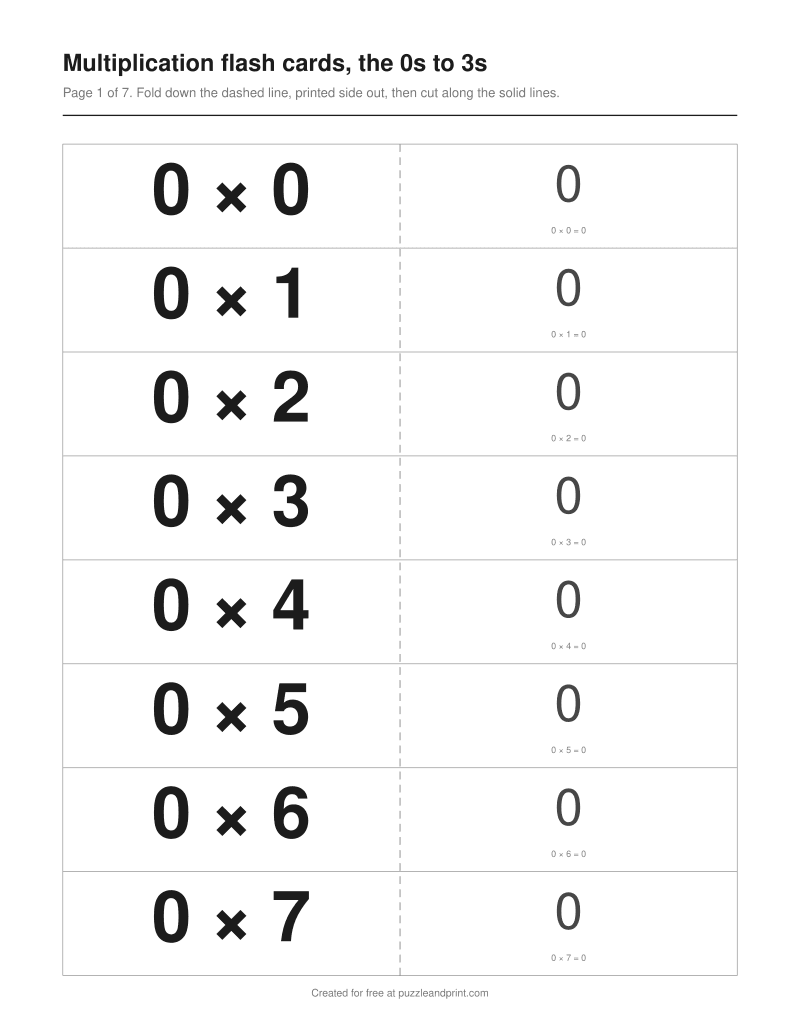 Multiplication flash cards, the 0s to 3s52 cards · fold-over, 8 a page · 7 pagesDownload PDF ↓
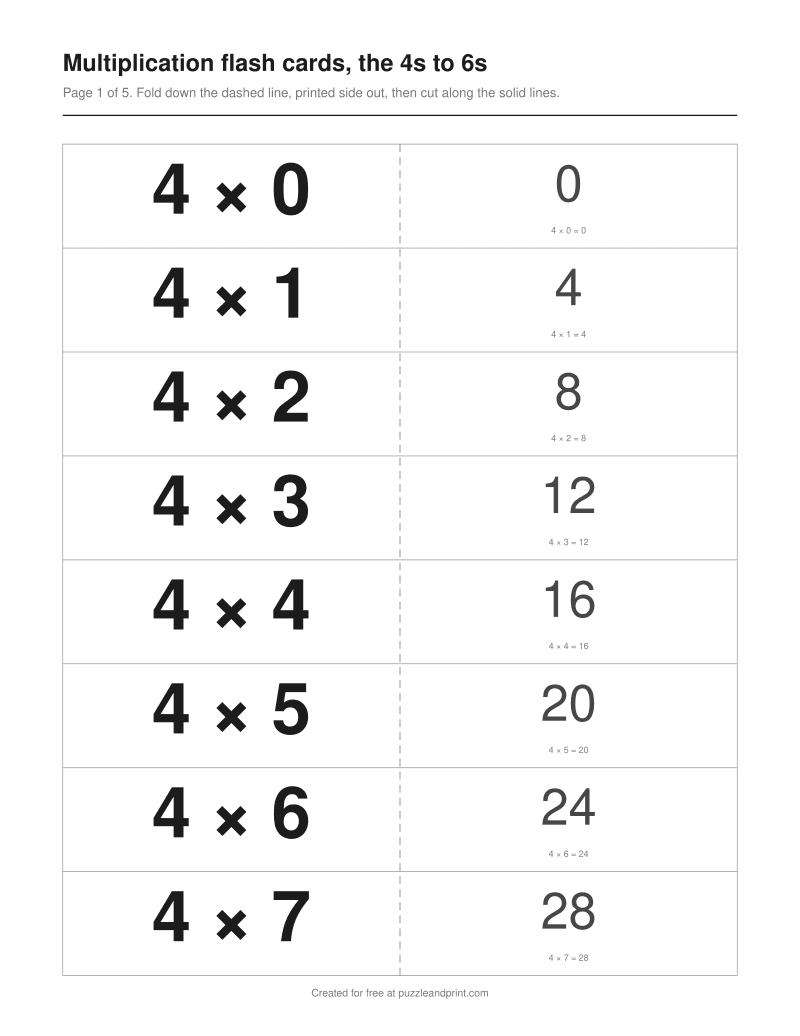 Multiplication flash cards, the 4s to 6s39 cards · fold-over, 8 a page · 5 pagesDownload PDF ↓
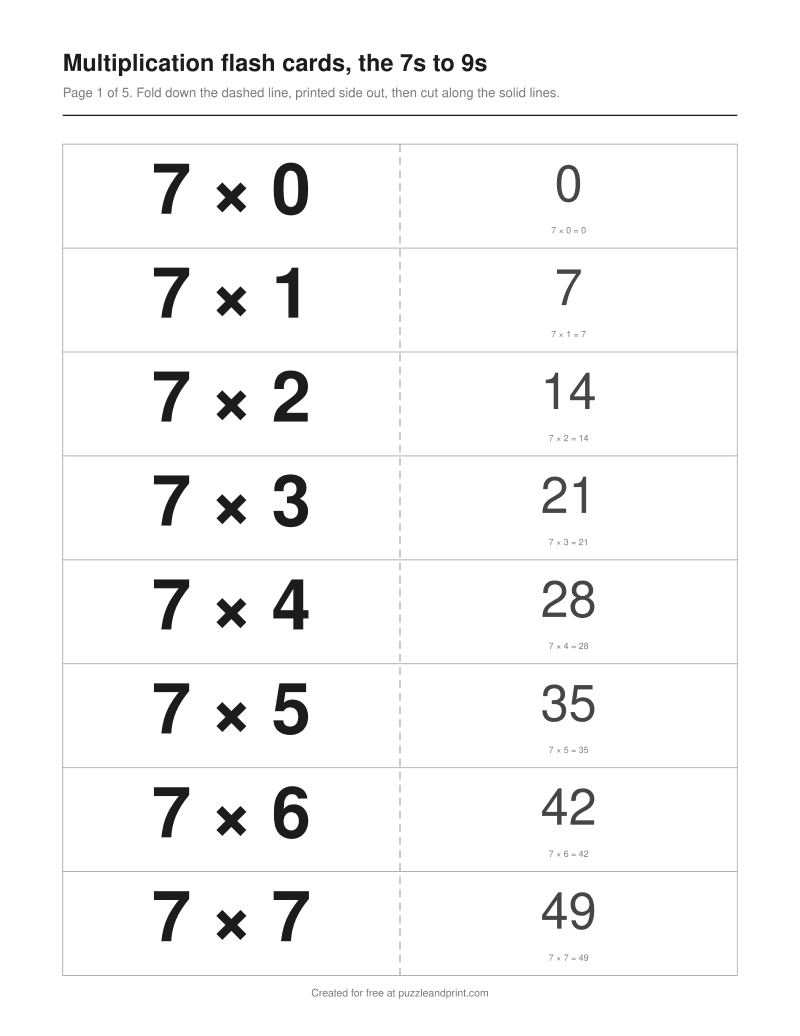 Multiplication flash cards, the 7s to 9s39 cards · fold-over, 8 a page · 5 pagesDownload PDF ↓
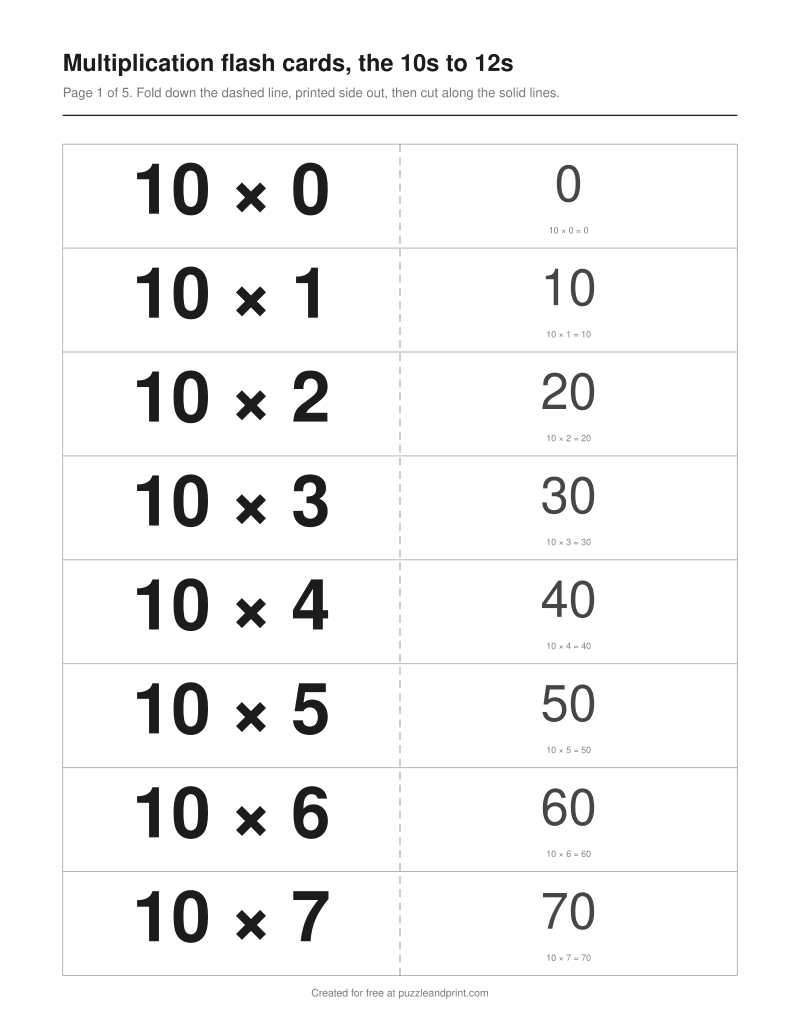 Multiplication flash cards, the 10s to 12s39 cards · fold-over, 8 a page · 5 pagesDownload PDF ↓
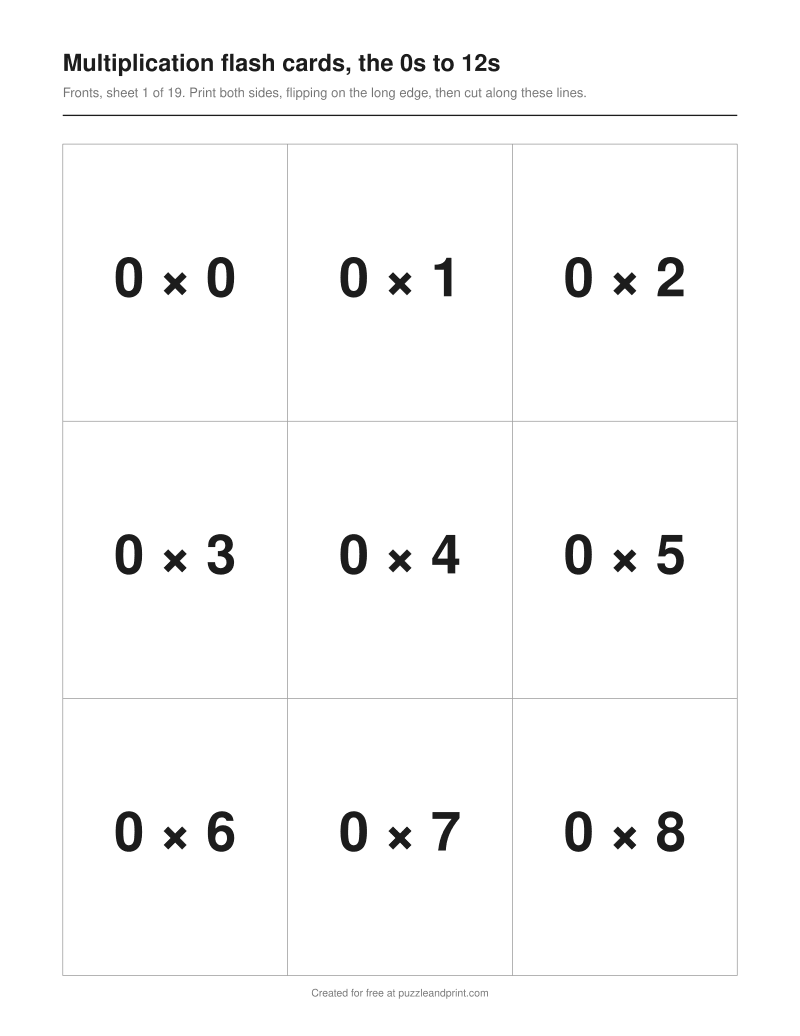 Multiplication flash cards, the 0s to 12s169 cards · double-sided, 9 a page · 19 sheets, both sidesDownload PDF ↓
Every sheet here is free to print as often as you like. If one saved you time, the tip jar is on Ko-fi.
These are flash cards for every times table from 0 to 12, thirteen facts to a table from times 0 to times 12, which makes 169 cards in all. The fact is on the front and the answer on the back, with the whole fact printed small under the answer, so whoever holds a card up, facing a child, can read 7 × 8 = 56 on their own side without turning it around.
Each card puts its table's number first. The 7s run 7 × 0, 7 × 1 and on to 7 × 12, the way a times table chart prints them, so a child drilling the sevens sees sevens. The turned-around facts are on the other tables' cards, which means the full set holds 3 × 7 as well as 7 × 3.
Four of the ready-made sets split the tables into groups: the 0s to 3s, the 4s to 6s, the 7s to 9s and the 10s to 12s, eight cards to a fold-over page, each card about 3.6 by 1.1 inches. The cards run in table order, so the first two pages of the 7s to 9s set hold all thirteen 7s and the start of the 8s. The fifth set is every fact in one PDF for a printer that prints both sides, nine cards a page, each about 2.4 by 2.9 inches, on 19 sheets of paper.
The maker above opens on the 7s and prints any single table or any run of tables, at two to nine cards a page, folded or double-sided. The multiplication tables worksheets on this site are the written half of the same practice: the 1 to 12 facts in random order, with an answer key on its own page.
A full stack of 169 is less work than it looks, because a good share of it is quick. Twenty-five cards have an answer of 0, every one of the 1s gives back the number it started with, and every answer in the 10s ends in a zero. Pulling those out early leaves the cards that need real recall, which is where the practice belongs.
The hard core is small. Only 16 cards have both numbers between 6 and 9, from 6 × 6 to 9 × 9, and they are worth a pile of their own. At the top of the range, the 10s to 12s set holds 10 cards with three-digit answers, from 10 × 10 = 100 to 12 × 12 = 144, while the 7s to 9s set has only one, 9 × 12 = 108.
Hold a card up with the fact facing the child and read the answer on your side, under which the whole fact is printed small. Cards answered at once go on one pile and cards that needed working out on another; the next session starts with the second pile. A table is only thirteen cards, so it can go round several times in one sitting.
Because each set prints in table order, a cut stack comes out sorted, and one table can be lifted out without hunting through the rest: the 7s are the first thirteen cards of the 7s to 9s set. Shuffle only once a table is going well, since a mixed stack tests recall where a sorted one lets the rhythm of the table carry the answer.
Yes. Each table has its own thirteen cards with its number first, so 3 × 7 is in the 3s and 7 × 3 is in the 7s, while the squares, from 0 × 0 to 12 × 12, appear once each. Thirteen tables of thirteen facts make the 169 cards.
To match the multiplication tables worksheets on this site, which run from 1 to 12, with the zeros added. Each table goes from times 0 to times 12. For the top two alone, set the maker to tables 11 to 12, which prints 26 cards.
Folded at eight cards a page, all 169 cards take 22 pages printed on one side. Double-sided at nine a page they take 19 sheets of paper printed on both sides, which is the ready-made every fact set. Cards at eight a page folded are about 3.6 by 1.1 inches; at nine double-sided, about 2.4 by 2.9.
New printables when they go up, mostly seasonal, a few times a year.