Word Maze
Letter maze · 8 × 10 · Medium
Spell HELLO over and over from START to FINISH. Move up, down, left or right, and never use a square twice.
Created for free at puzzleandprint.com
Hide a word or message as the only path through a grid of letters, or make a sight word path to color in.
Last updated
Word Maze
Letter maze · 8 × 10 · Medium
Spell HELLO over and over from START to FINISH. Move up, down, left or right, and never use a square twice.
Created for free at puzzleandprint.com
Word Maze, Answer Key
Letter maze · 8 × 10 · Medium
Spell HELLO over and over from START to FINISH. Move up, down, left or right, and never use a square twice.
Created for free at puzzleandprint.com
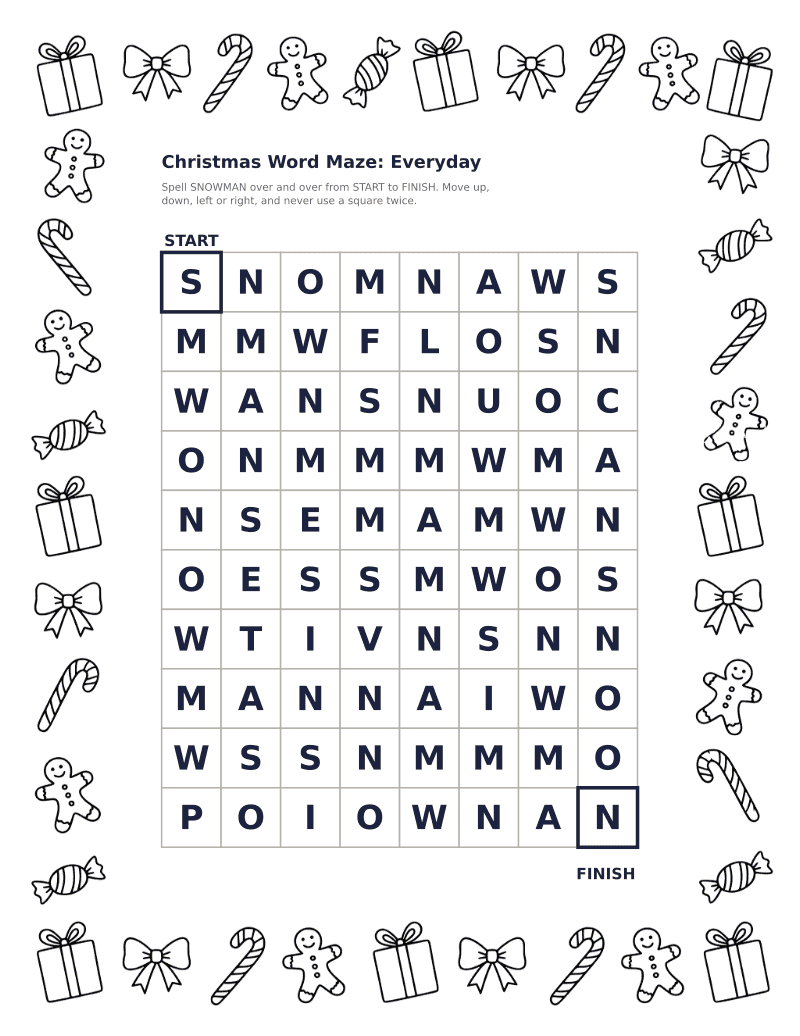
A holiday message leads while it is in season. Follow one to its page, where the key shows the path drawn in.
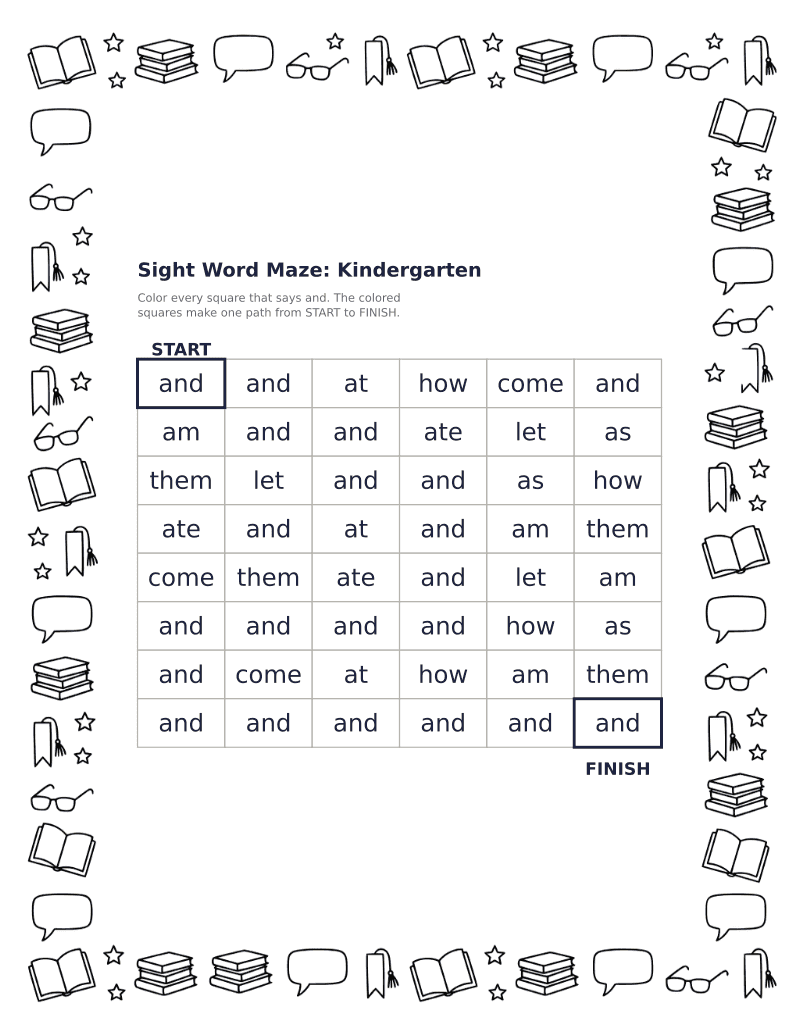
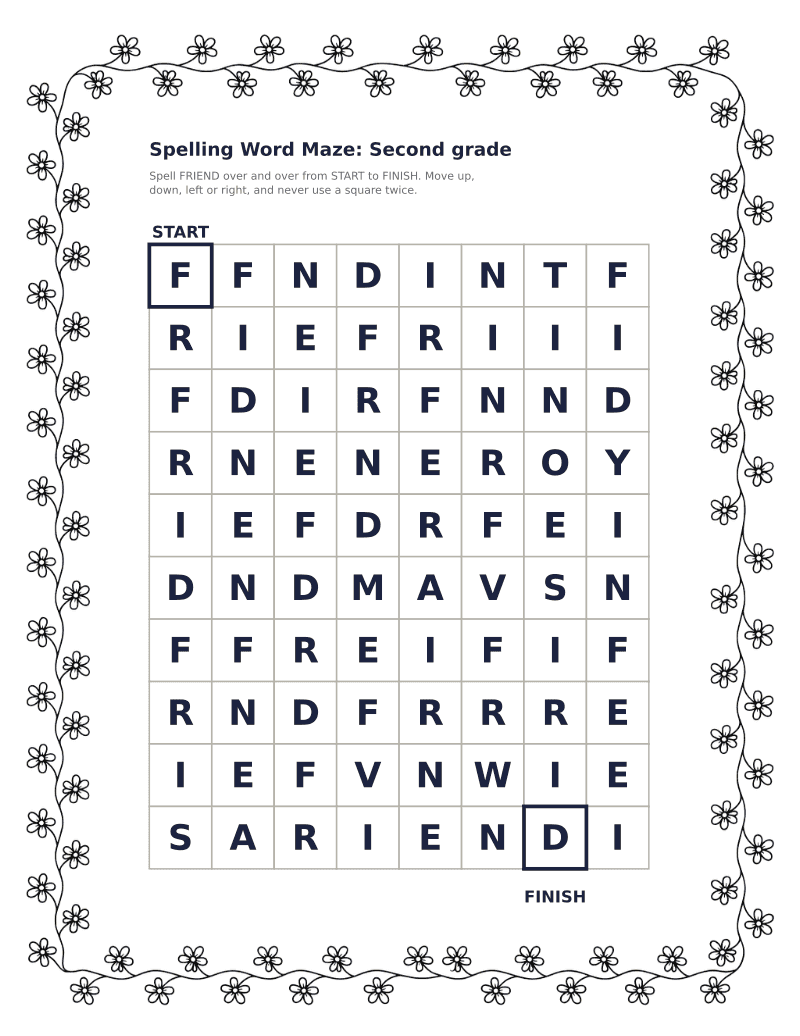
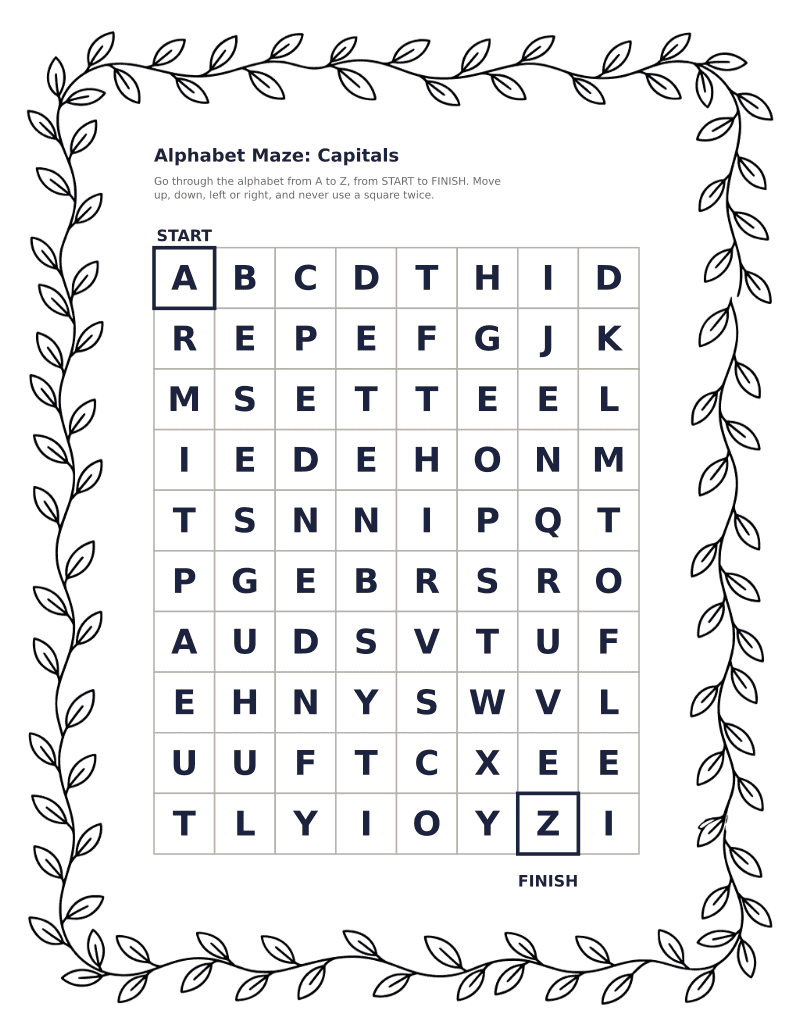
A title, a line for a name and a date, and one sentence of instructions, then a grid of squares with a letter in each. START is the outlined square in the top left corner and FINISH the outlined square at the bottom right. The solver begins on START, steps up, down, left or right to a square holding the next letter of the word, and keeps going, never using a square twice, until FINISH.
Grids run from 6 by 8 squares to 12 by 15 for letters, and from 4 by 5 to 7 by 9 for sight words, where each square is wider to hold a whole word. The squares are outlined in light gray so it is easy to see which ones touch, and the letters are large and bold.
The answer key is the same grid again with the path drawn through it as a wide gray band under the letters, on a page of its own and without any border, so it costs little ink and can stay on the teacher’s desk.
A letter maze with two routes is broken in a way nobody notices until a child takes the other one and is marked wrong. So before a maze is shown, a search tries every route from START that follows the rule, never reusing a square, and counts them, stopping at two. A maze is only kept when that count is exactly one and the one route is the path the maker laid.
The path is laid so it cannot offer itself a shortcut: no square of the route sits beside an earlier route square that needs its letter next. The letters around it are then checked one by one, and any that would let a walk from START reach FINISH some other way are changed. A maze that still fails the count is thrown away and another is made, inside a fixed number of attempts, so the same settings always give the same maze.
Easy fills the other squares with letters that are not in the message, so a child following PUMPKIN never sees a stray P or K and the path never forks. For the alphabet, which uses every letter, easy instead makes sure no square beside the path holds the letter the path needs next.
Medium takes about two thirds of its other letters from the message itself and adds false trails, one for roughly every twelve squares of route, that start spelling the message for two or three squares and stop. Hard draws its other letters from the message alone, turning to another letter only where every letter of the message would open a second route, adds a trail for about every seven squares, and makes them three to five squares long.
The difference shows in how many wrong turns there are. With the maker’s opening message, HELLO, 300 mazes on an 8 by 10 grid averaged no squares beside the route offering the next letter on easy, 5.5 on medium and 6.6 on hard. On 12 by 15 the figures were 11.6 on medium and 14.8 on hard.
Switch Kind of maze to Sight word path and every square holds a short word instead of a letter. The path is the squares holding one word, such as the or was, and the job is to color each of them; the colored squares join up into a single track from START to FINISH. The track never touches itself, so it reads as one clear line once it is colored.
The other squares hold words from the Dolch sight word lists. Easy picks words that start with another letter and look nothing like the target. Medium mixes in look-alikes, such as them or then for the, and drops two stray copies of the word away from the path. Hard uses look-alikes where there are enough of them and keeps the strays, then adds two short dead-end spurs of the word off the path. The smallest grid, 4 by 5, sometimes has room for only one stray. You can also type your own list of other words.
The route covers about four in ten squares of the grid, so a short word has to repeat to get from START to FINISH: CAT on a 12 by 15 grid is spelled 24 times along a 72 square route. A longer message repeats fewer times: a sentence of eighteen letters runs once on the smallest grid and four times on the largest. In tests at every length, messages of up to 30 letters fit every grid from 8 by 10 up, and up to 28 fit the smallest.
The route always ends on the last letter of the message, so the word is never left half spelled at FINISH. Because a grid’s squares alternate like a checkerboard, some route lengths cannot end on the corner square; then FINISH sits one square to the left of it, and the sheet marks it either way.
Everything is worked out in your browser. What you type is never sent anywhere and never added to the address of the page, so a child’s name or a class message does not travel to us, to an advertiser or to anyone else. The download and Print this sheet both use the maze already on your screen.
The other squares are also screened against the same list of rude words the word search filler uses, in all eight directions, so a decoy letter can never complete one by accident. Only the decoys are ever changed: a message is printed exactly as it was typed.
Each page has four ready-made mazes to print, plus the maker above opened on that page's words.
A regular maze, like the ones the Maze Generator on this site prints, has walls, and the solver finds the one way through by looking for the gaps between them. A word maze has no walls: a step up, down, left or right is allowed only when the square it lands on holds the next letter of the message, or on a sight word path the word itself, so the way through is found by reading rather than by looking.
No. Every maze is checked by a search that tries every route from START that follows the letters without reusing a square, and the maze is only kept if exactly one route reaches FINISH. That route is the one drawn on the answer key.
Up to 30 letters, which is about a sentence. Spaces and punctuation are allowed but only the letters go in the grid. In tests the smallest grid, 6 by 8, took up to 28 letters; if a message is too long for the grid you picked, the maker says so and a bigger grid will take it.
Yes. Type the sight word, then list the other words you want around it, separated by commas. With two or more of your own words the maze uses them instead of the built-in look-alikes, and the path is still checked so only one route of your word reaches FINISH.
Yes. Under Letters choose Lowercase and the whole grid, the instruction line and the answer key switch together. The maze itself does not change, only how the letters are printed.
The route has to end on the last letter of the message, and on a grid the squares alternate like a checkerboard, so some route lengths can only finish on a square next to the corner. When that happens FINISH moves one square to the left, and it is outlined and labeled the same way.
Neither. Make as many mazes as you like, with up to five different versions in one PDF, and print them for a class or a family. Nothing you type is sent to us, and it is kept between visits only if you ask the maker to remember it, in your own browser.
New printables when they go up, mostly seasonal, a few times a year.