Multiplication Chart
1 to 12 · Blank
Fill in each empty square with its row number times its column number.
Created for free at puzzleandprint.com
The factors along the edges, and every product left for the child to write.
Last updated
Save this to PinterestMultiplication Chart
1 to 12 · Blank
Fill in each empty square with its row number times its column number.
Created for free at puzzleandprint.com
Multiplication Chart, Answer Key
1 to 12 · Blank
Created for free at puzzleandprint.com
Five charts, each a two-page PDF: the chart, then its answer key on a page of its own.
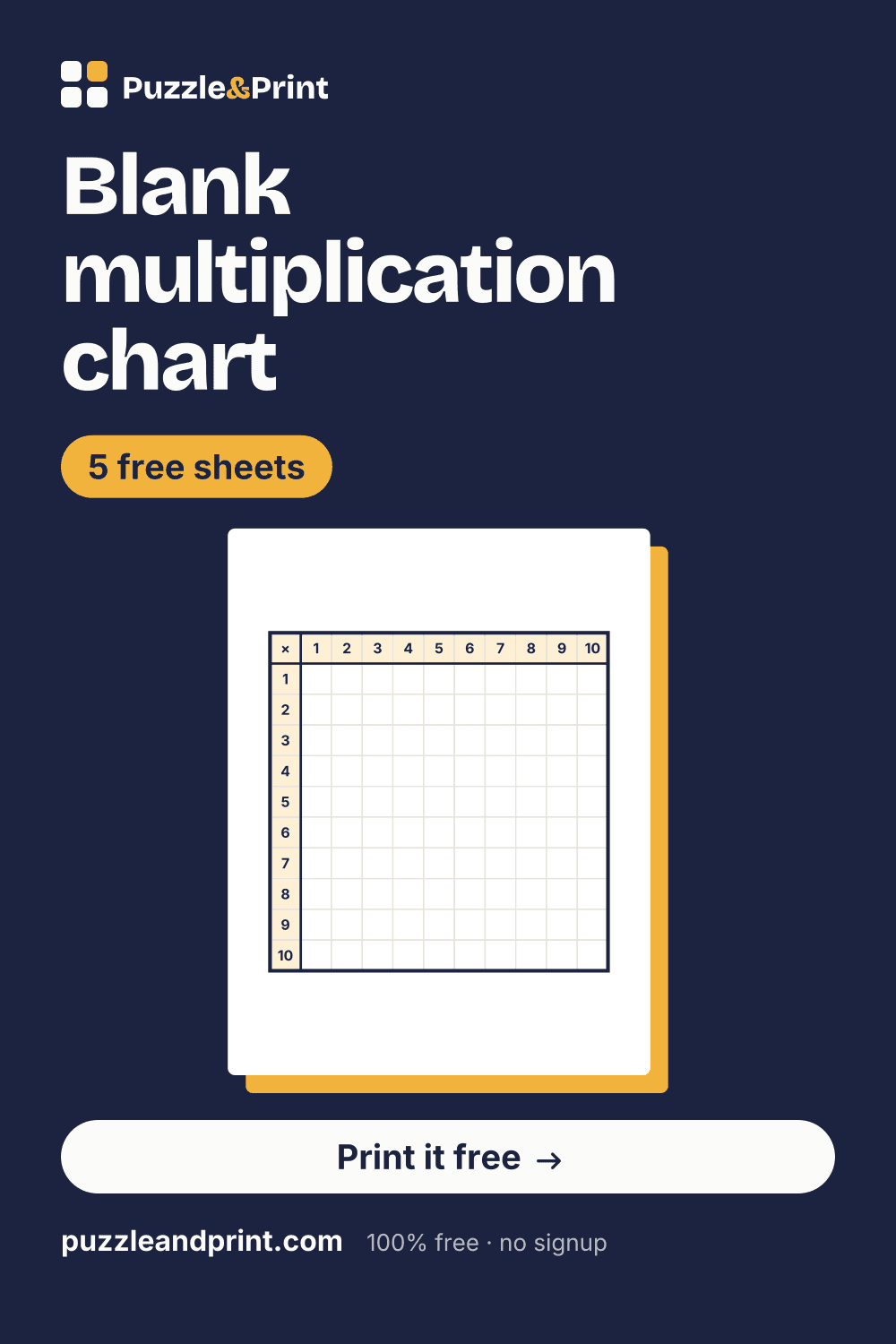
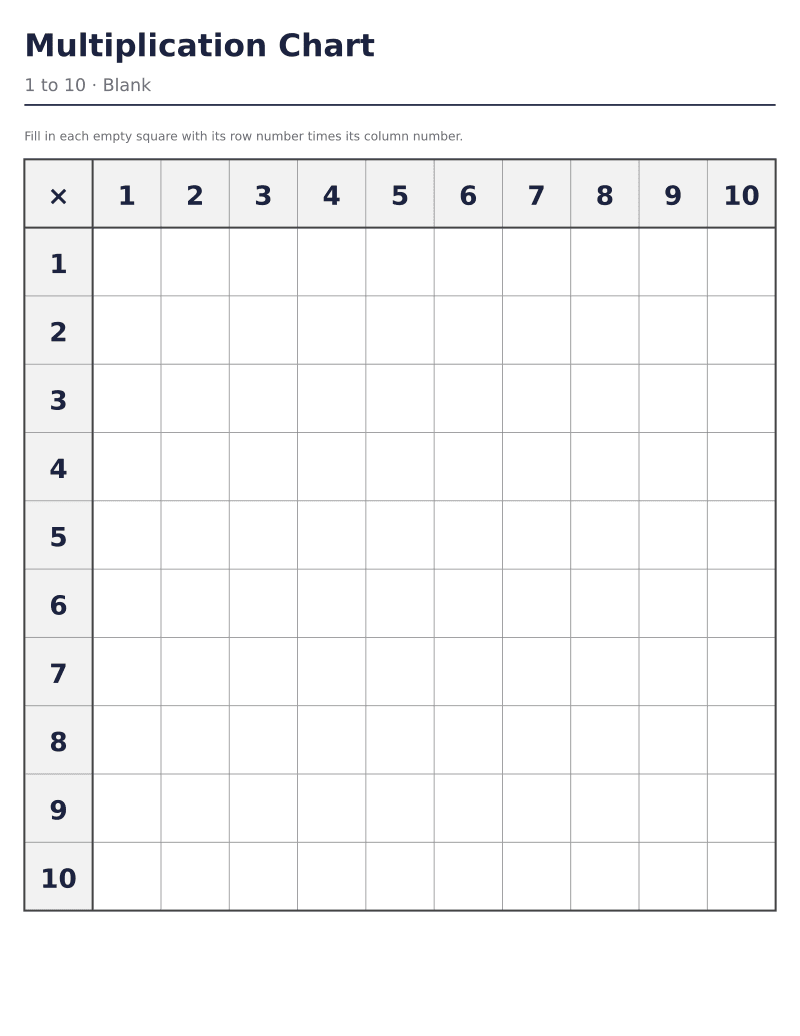 Blank multiplication chart 1 to 10100 squares to fill · 16.5 mmDownload PDF ↓
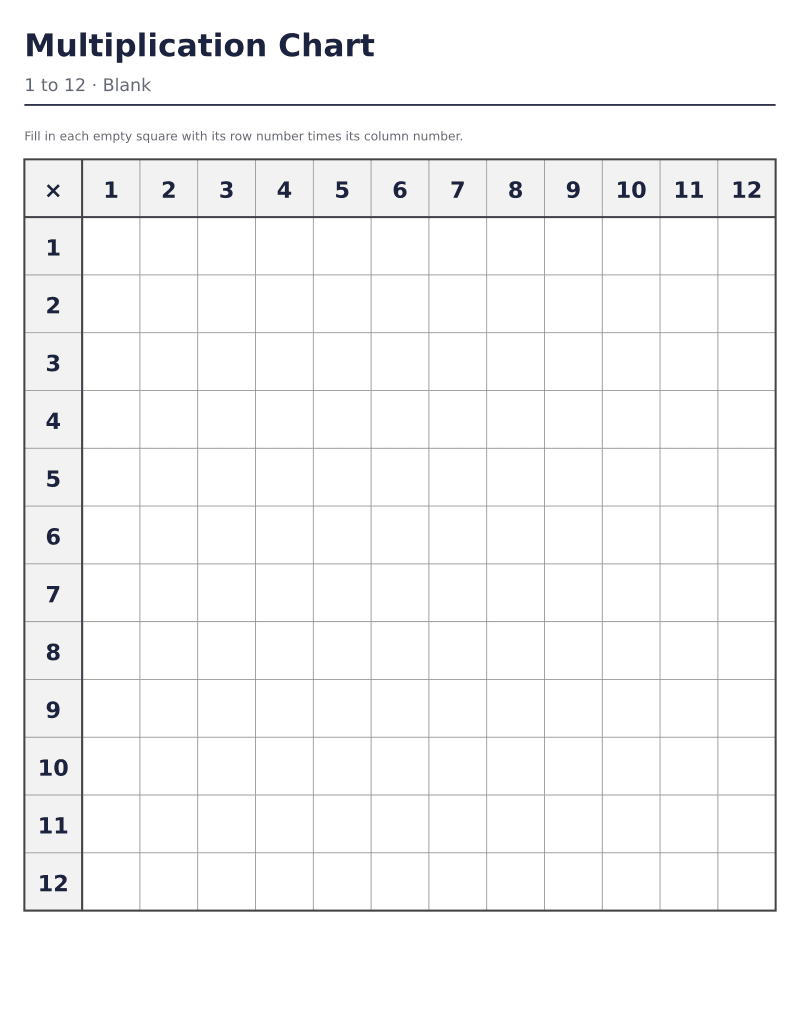 Blank multiplication chart 1 to 12144 squares to fill · 14 mmDownload PDF ↓
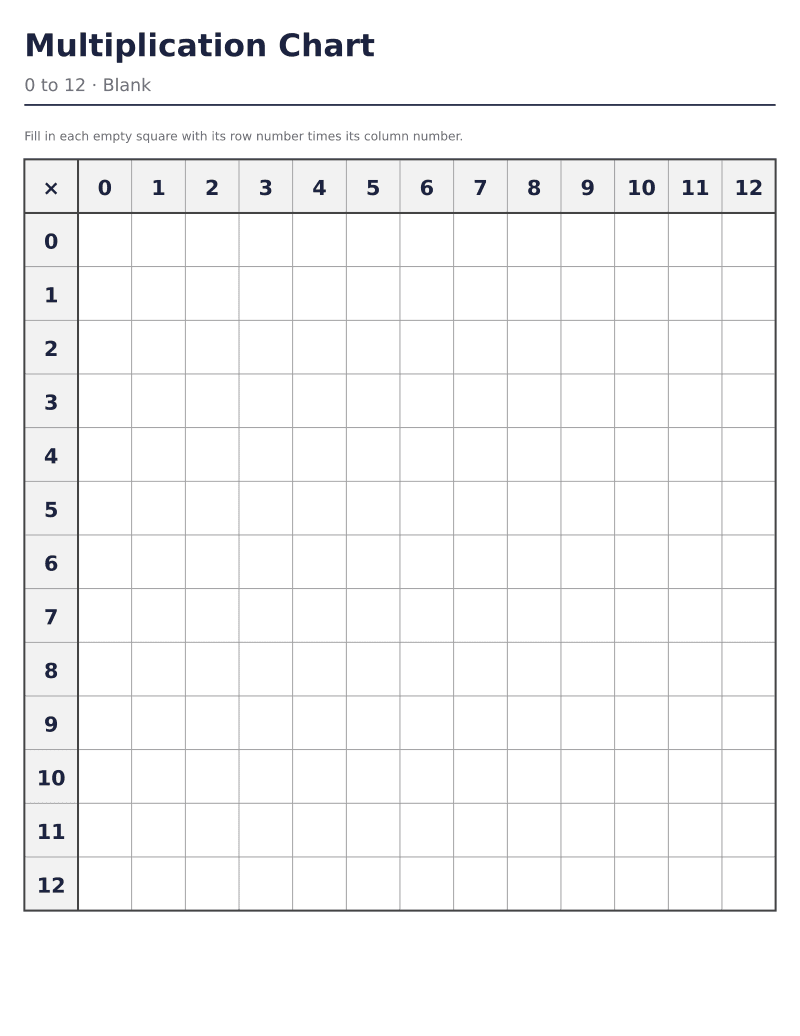 Blank multiplication chart 0 to 12169 squares to fill · 13 mmDownload PDF ↓
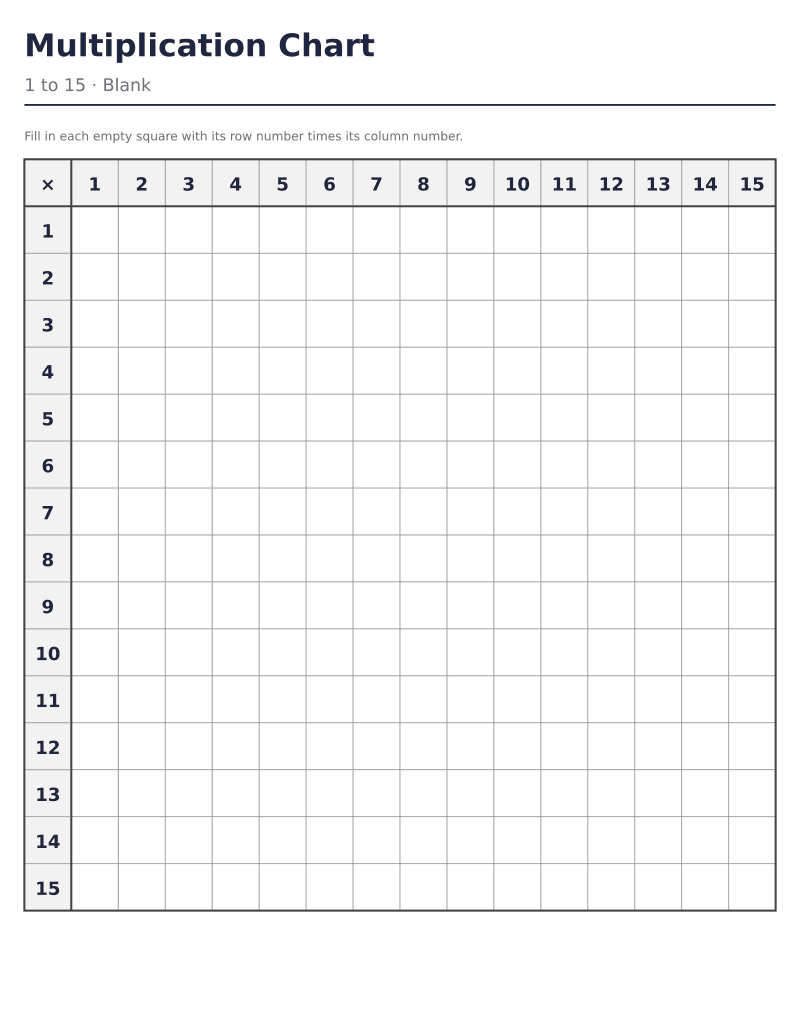 Blank multiplication chart 1 to 15225 squares to fill · 11.4 mmDownload PDF ↓
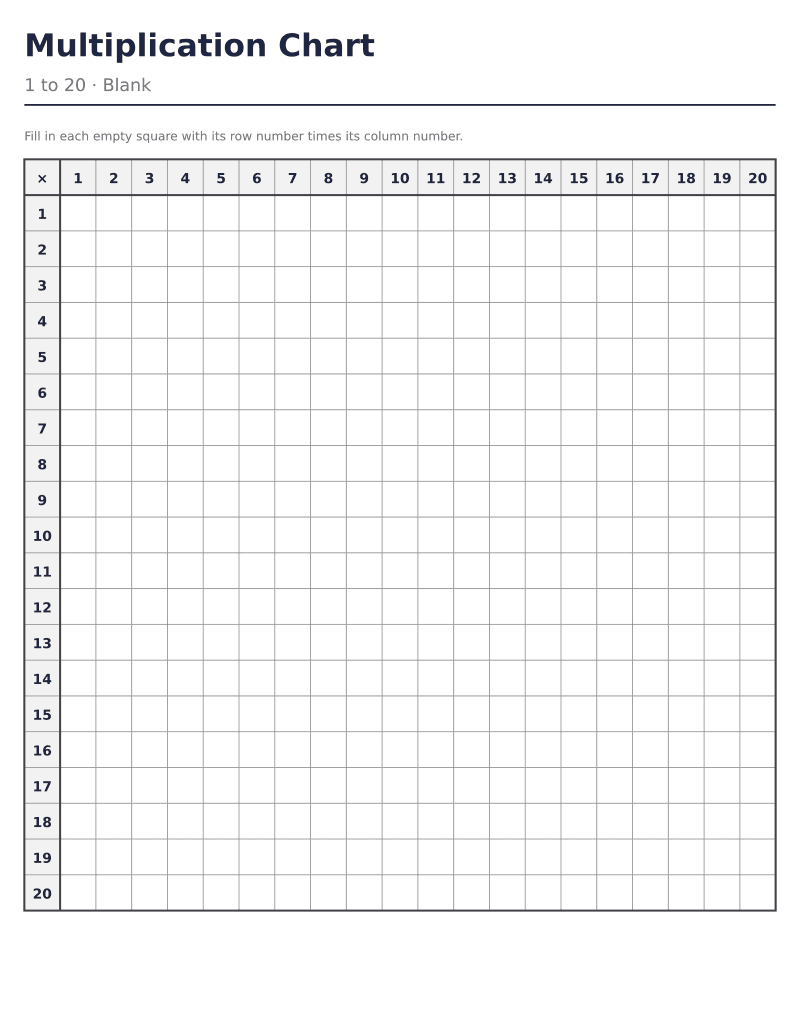 Blank multiplication chart 1 to 20400 squares to fill · 8.7 mmDownload PDF ↓
Every sheet here is free to print as often as you like. If one saved you time, the tip jar is on Ko-fi.
A blank multiplication chart prints the numbers being multiplied along the top row and down the left column and nothing else, so every square in between is filled in by hand. Building the whole chart row by row shows how each table grows by the same step every time, and finishing it in one sitting is a fair measure of how many facts are already known.
There are five ready-made sizes. The 1 to 10 chart has 100 squares to fill, the 1 to 12 chart 144, the 0 to 12 chart 169 with a row and a column of zeros, the 1 to 15 chart 225 and the 1 to 20 chart 400. All five print 182 mm wide on US Letter, so the squares get smaller as the range grows, from 16.5 mm across on the 1 to 10 chart to 8.7 mm on the 1 to 20, which is a small square for a young child to write a three-digit number in.
Every blank chart has its answer key on the next page, the filled chart with the answers in gray, printed plain to save ink. The sheet itself has a line for a name and the date and one line of instructions over the chart, and nothing on either page is printed in color.
The maker above opens on the blank 1 to 12 chart. It can shade the square numbers or one table on a blank chart as a guide, set the grid lines faint, normal or strong, or turn the chart into a fill-in with some of the products printed.
There are two good orders for filling in a blank multiplication chart. Row by row turns each row into a table counted on by its own step, the threes as 3, 6, 9, 12, which is slow but gets every square right. Filling by pattern is quicker and teaches more: the 1s copy the edges, the 10s add a zero, the 2s double, the 5s end in 5 or 0, and the diagonal holds the square numbers. On the 1 to 12 chart those leave 56 squares, which are only 28 facts, each written once on either side of the diagonal.
The bigger charts reward the same method. The 1 to 20 chart has 400 squares but only 210 different facts once each pair is counted once, 190 pairs and the 20 square numbers on the diagonal. The 15s alternate between endings of 5 and 0, and the 20s are the 2s with a zero added, so a child who knows the 1 to 10 chart can fill a good part of the larger one with no new facts at all.
The blank sheet prints a title, the range, a line for a name and the date, one line of instructions and the chart: the factors in bold along the top and the left on a faint gray wash, a heavier rule around the chart and under the factors, and empty squares ruled in gray. The answer key on the next page is the same chart with every product written in gray, so it reads as a filled chart printed a shade lighter.
Both pages are black and white. The shading choices in the maker, the square numbers or a single table, put a light gray tint behind those squares without filling them in, which turns a blank chart into a guided one: shade the diagonal and the child knows where the square numbers go before writing any of them.
The 1 to 10 chart, or the 1 to 12 one if the class learns the 11s and 12s. The Common Core asks third graders to know from memory every product of two one-digit numbers, and the 1 to 10 chart holds every one of them from 1 × 1 to 9 × 9 in its 100 squares, which are also the largest here at 16.5 mm across. Only the zero facts are left off, and the 0 to 12 chart adds those.
The 0 to 12 chart adds a row and a column of zeros, 25 squares that are all 0, which are quick to fill and make the point that any number times zero is zero. Print it when the zero facts are being taught alongside the others; otherwise the 1 to 12 chart leaves more of the page for the products that take some thought.
Yes. The key is on by default and prints on the page after the chart; set Answer key to Puzzle only in the maker and the download is the chart alone. Every ready-made sheet on this page has its key as page two, so print page one only if that is all you need.
New printables when they go up, mostly seasonal, a few times a year.