Isometric Paper
Created for free at puzzleandprint.com
A triangular grid for drawing in three dimensions.
Last updated
Save this to PinterestIsometric Paper
Created for free at puzzleandprint.com
Ruled sheets at the standard sizes, each one a single page. The measurement is printed at the foot, so a reprint can be checked against a ruler.
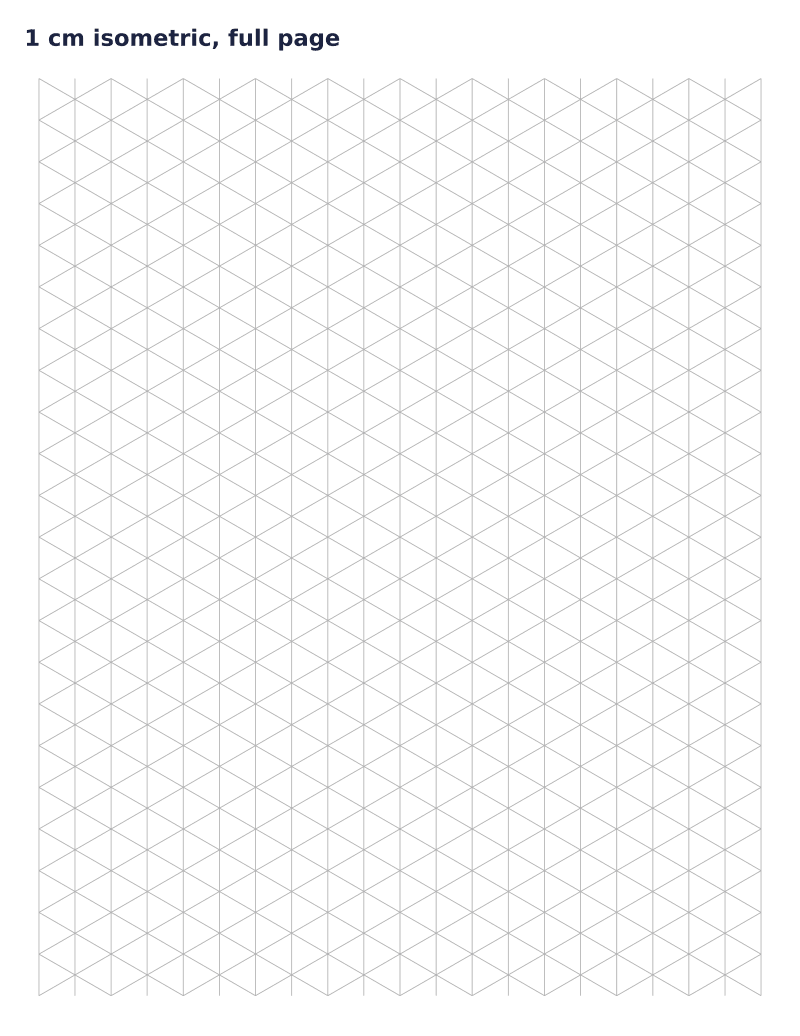 1 cm isometric graph paper, full page10 mm lines · 11.55 mm triangles, about 8 mm from the sidesDownload PDF ↓
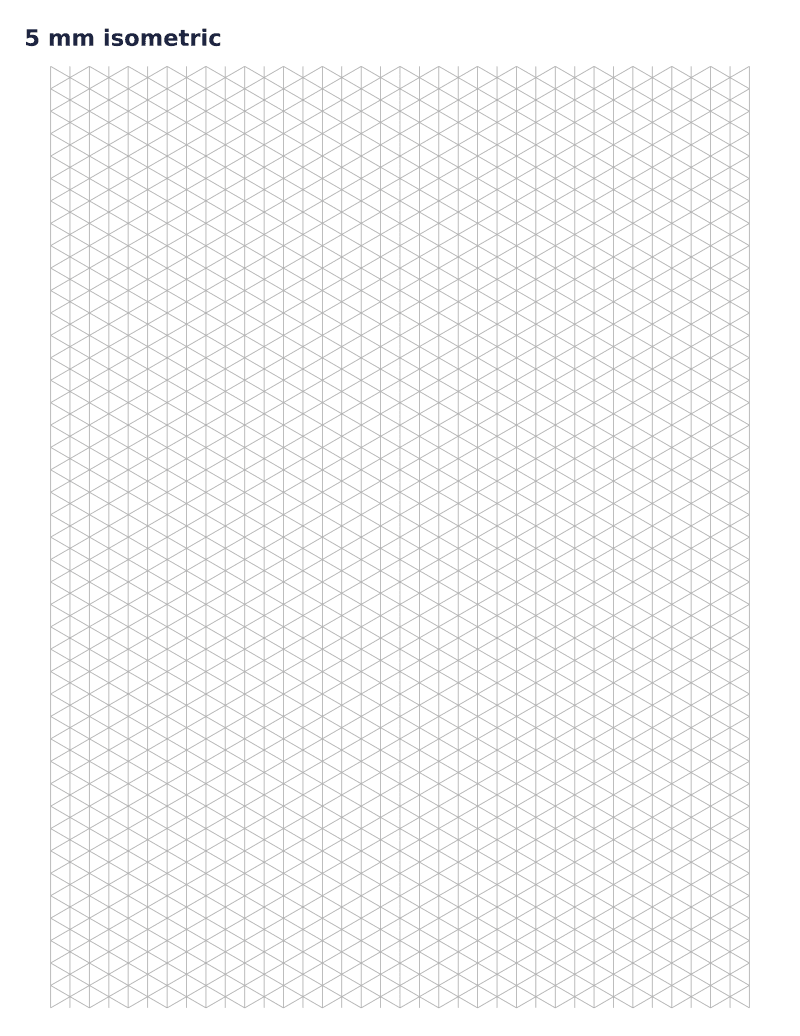 5 mm isometric graph paper5 mm lines · 5.77 mm trianglesDownload PDF ↓
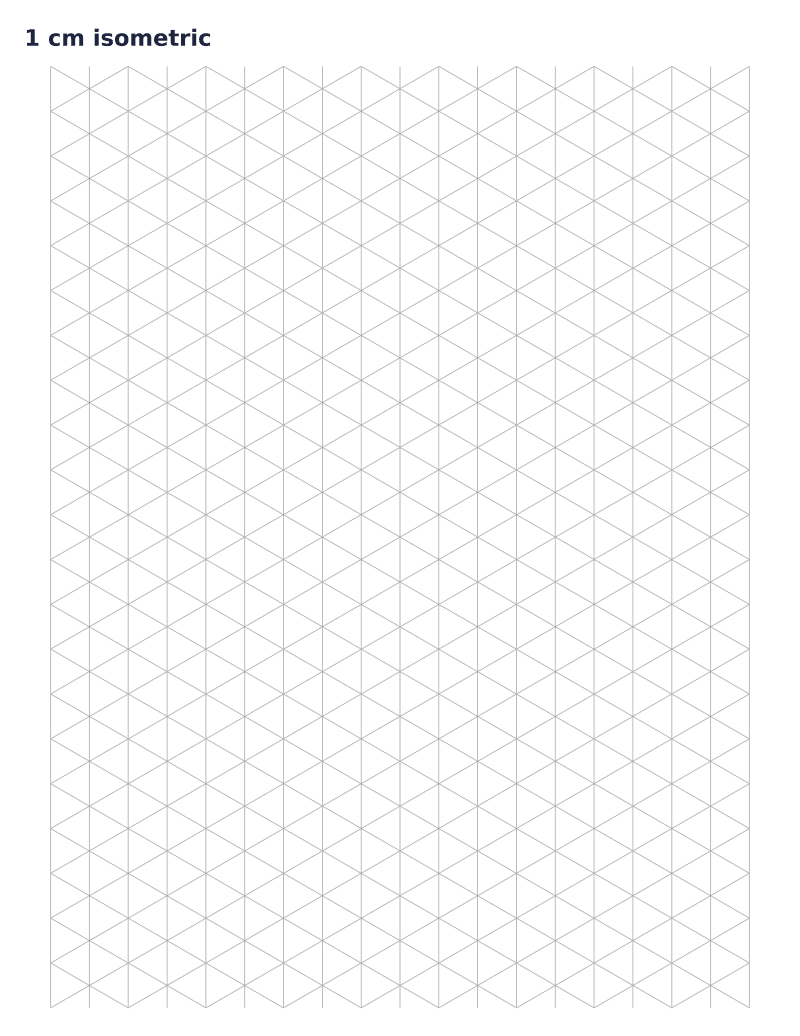 1 cm isometric graph paper10 mm lines · 11.55 mm trianglesDownload PDF ↓
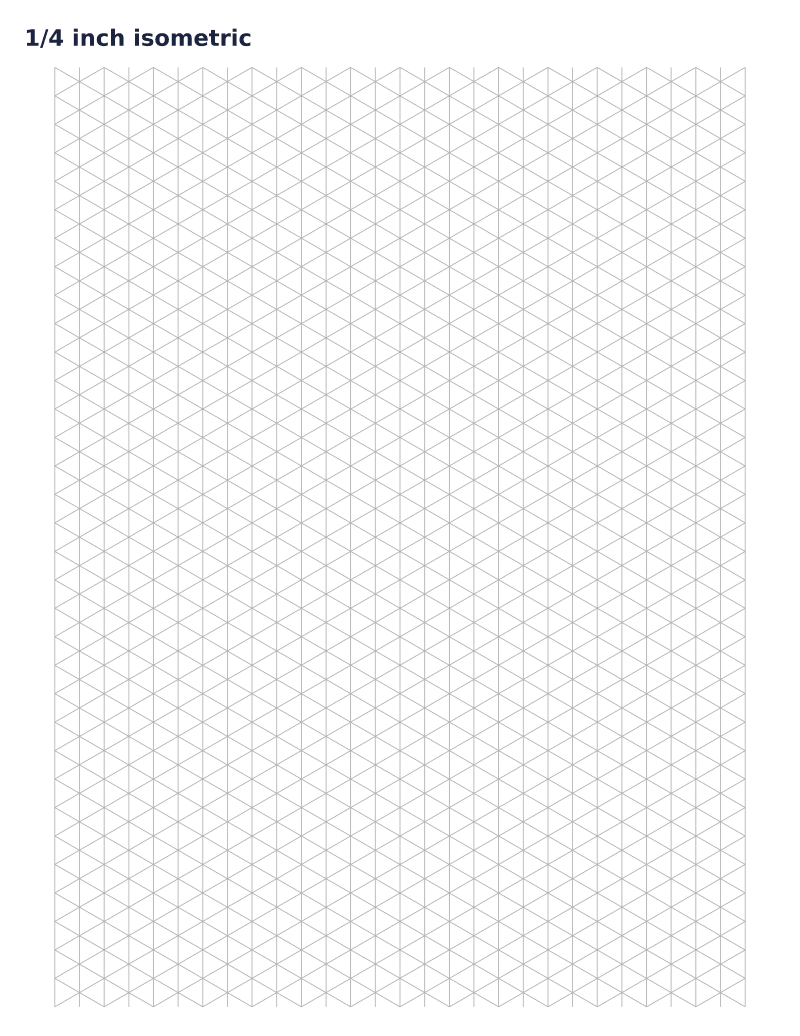 1/4 inch isometric graph paper6.35 mm lines · 7.33 mm trianglesDownload PDF ↓
Every sheet here is free to print as often as you like. If one saved you time, the tip jar is on Ko-fi.
Isometric paper is ruled in three directions, the verticals plus two families of diagonals at thirty degrees to the horizontal, one sloping each way, and together they close into equilateral triangles. Solids drawn on it need no vanishing points, so an edge keeps the same length wherever it sits on the page rather than shrinking toward the back as it would in perspective.
It is the paper for technical sketching, product design, tabletop terrain and any math topic that involves volume. Children asked to draw a solid from a net usually find it far easier here than on squares, because the paper supplies the angles for them.
One centimeter is the general-purpose size and the one to print if you are unsure. Five millimeters suits detailed work; quarter inch, 6.35 mm between lines, is for matching American pads sold by line spacing.
Each ready-made sheet is one US Letter page with the lattice centered from side to side. Three keep inside the margins: on the 1 cm sheet that is 19 vertical lines spanning 180 mm, each 242.5 mm tall, exactly 21 triangle sides; the 5 mm sheet fits 37 vertical lines across the same 180 mm, and the quarter inch sheet 29 across 177.8 mm. The fourth, shown first, is the 1 cm lattice as a full page: 21 vertical lines spanning 200 mm, about 8 mm from each side of the paper, each 254 mm tall, exactly 22 triangle sides.
The 1 cm isometric sheet has triangles 11.55 mm along each side because its size is the distance between parallel lines, 10 mm, rather than the length of a triangle's side. The two are linked by a fixed ratio: in an equilateral triangle the side is about 1.155 times the height, so the 5 mm sheet has 5.77 mm triangles and the quarter inch sheet 7.33 mm triangles. Each sheet states both figures, on its card on this page and in small type at the foot of the printed sheet. On any one sheet all three families of lines, the verticals and the two sets of diagonals, are the same distance apart, which is what keeps every triangle equilateral.
The difference matters when matching paper a class already has, because isometric paper is sold both ways. If a worksheet or pad gives its size as the side of the triangle, a 1 cm triangle falls between the quarter inch sheet here at 7.33 mm and the 1 cm sheet at 11.55 mm, and none of the three matches it exactly. For drawings that will be measured, such as a rectangular prism with given edge lengths, count edges in triangle sides rather than measuring with a ruler: one triangle side is one unit, whichever sheet is in use. These sheets are ruled with continuous lines; isometric dot paper, the other common form, marks only the points where the lines would cross.
A single cube drawn on isometric paper covers exactly six triangles: three visible faces, each a diamond made of two triangles, which together form a regular hexagon outline. To draw one, put a vertical edge on one of the vertical lines, then run the top and bottom edges back along the diagonals on each side, and every edge of the cube lands on a printed line. On the 1 cm sheet each cube edge is 11.55 mm, large enough to shade the top, the left face and the right face in three different tones so the solid reads clearly at a glance.
That makes isometric paper the natural record for models built from interlocking cubes: build the model, draw it, then count the cubes to find its volume. A drawing cannot show a cube hidden behind or underneath the others, which is worth raising with a class, because counting only the cubes you can see then gives the wrong volume. The reverse task, drawing the plan from above and the front and side elevations from an isometric drawing, is a topic in middle school math and uses the same picture; the elevations go on squared paper, one square for each cube face.
Drawing solids without constructing perspective. The three line directions stand for the three directions of the solid, the verticals for height and the two diagonal families for width and depth, so a 3 by 2 by 4 rectangular prism is drawn by counting 3, 2 and 4 steps along them. Every corner then lands where three lines cross, so a drawing can be checked by counting rather than by eye.
Yes, and a ruler can confirm it on the printed 1 cm sheet: neighboring crossings are 11.55 mm apart along a vertical line and 11.55 mm apart along either diagonal, so all three sides of every triangle match. That matters because on paper where the triangles are only roughly equilateral, a shape drawn facing left will not match the same shape drawn facing right.
With one family of lines running straight up and down the page and the other two slanting, which is how these sheets print. Isometric drawing keeps vertical edges vertical and sends the others back at thirty degrees, so a sheet turned a quarter turn gives horizontal lines instead and every cube drawn on it comes out lying on its side.
New printables when they go up, mostly seasonal, a few times a year.