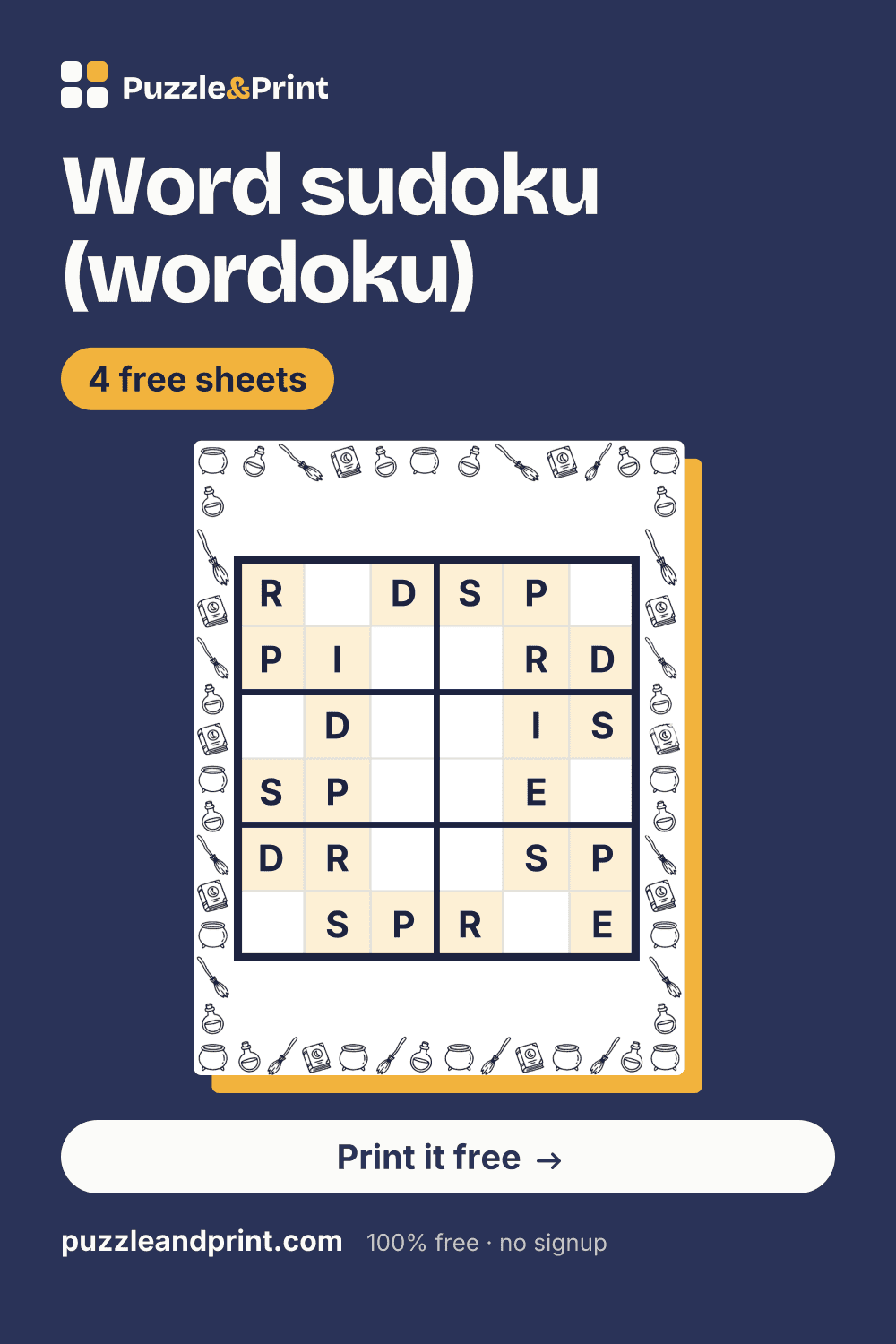
6x6 Word Sudoku
6 × 6 · Easy
Write the letters of SLEIGH once in every row, every column and every 2 by 3 box. When the grid is full, one row spells SLEIGH.
Created for free at puzzleandprint.com
Sudoku written in the letters of a word, and one row of the answer spells it.
Last updated
Save this to Pinterest6x6 Word Sudoku
6 × 6 · Easy
Write the letters of SLEIGH once in every row, every column and every 2 by 3 box. When the grid is full, one row spells SLEIGH.
Created for free at puzzleandprint.com
6x6 Word Sudoku, Answer Key
6 × 6 · Easy
Created for free at puzzleandprint.com
Four sheets, each a two-page PDF: the puzzles, then the answer key on its own page.
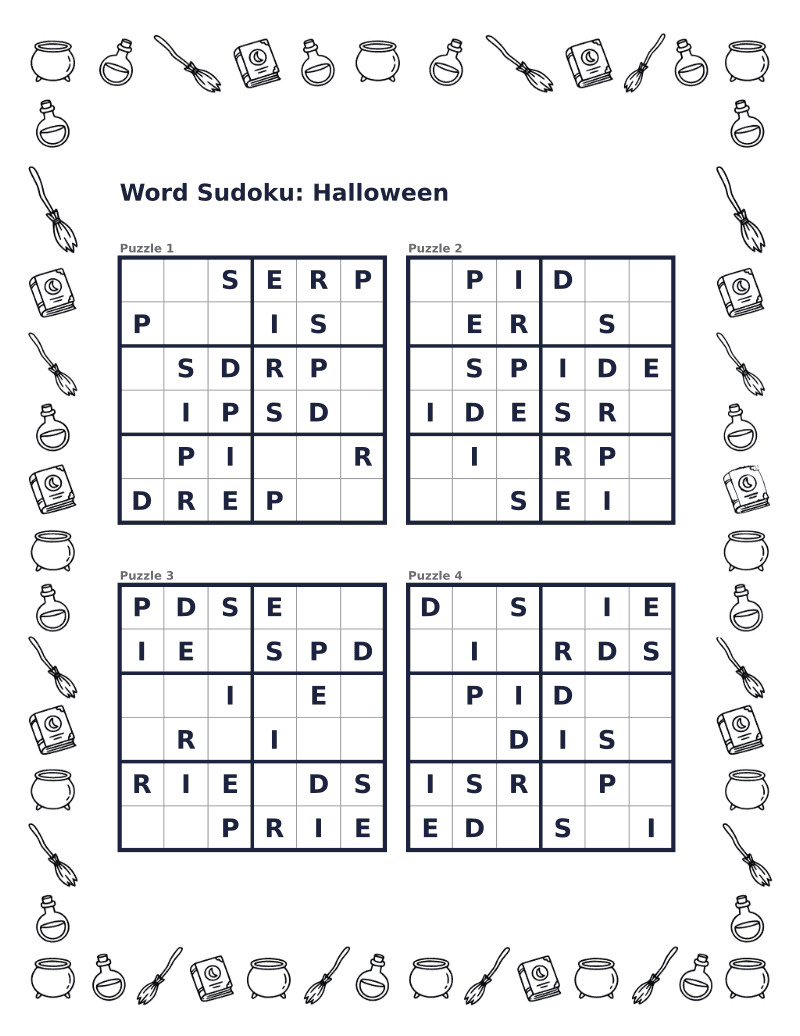 Word sudoku, Halloween6 × 6 · Easy · SPIDER · 4 puzzlesDownload PDF ↓
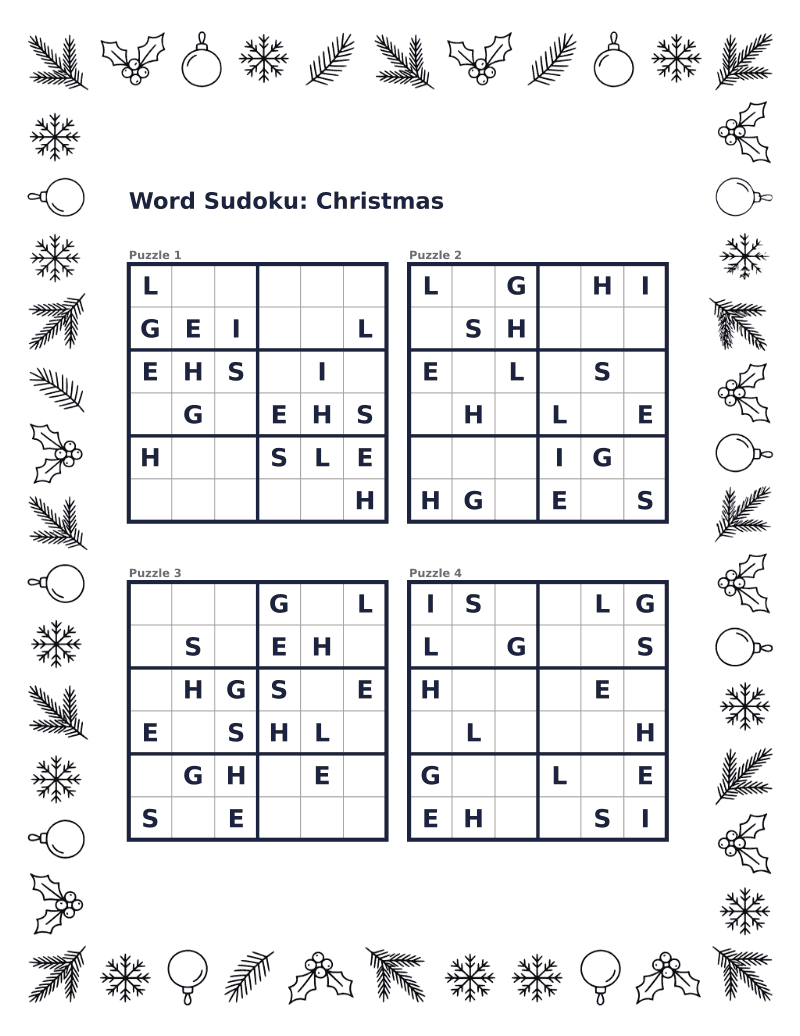 Word sudoku, Christmas6 × 6 · Medium · SLEIGH · 4 puzzlesDownload PDF ↓
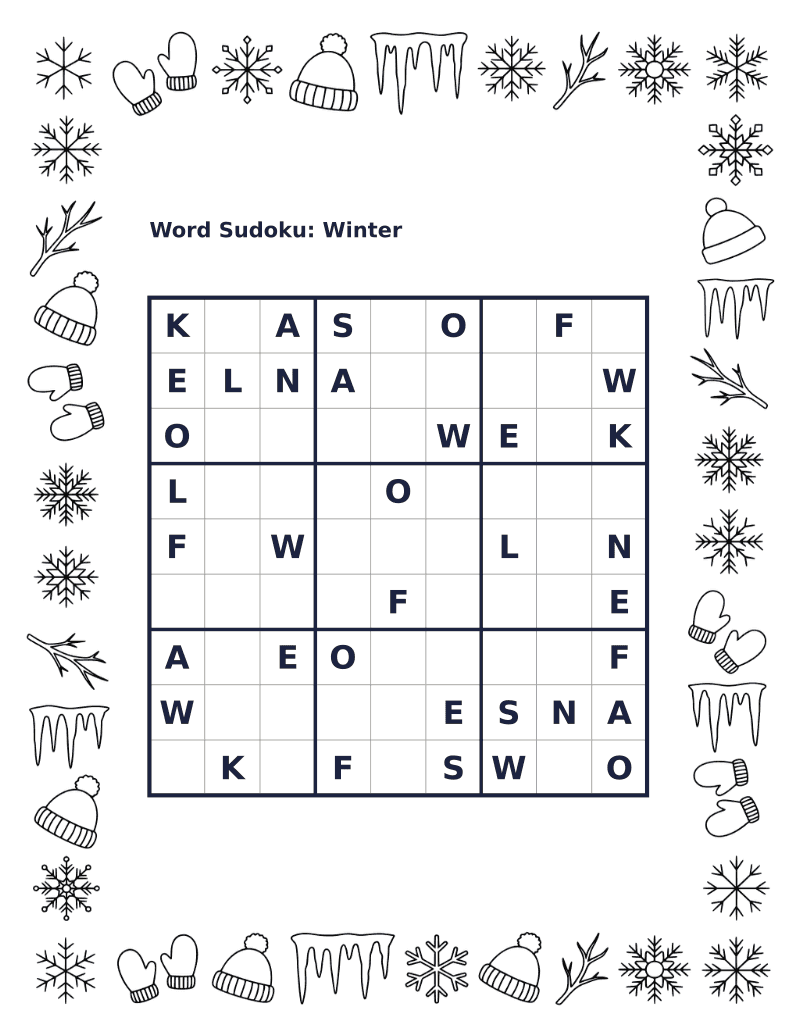 Word sudoku, winter9 × 9 · Easy · SNOWFLAKE · 1 puzzleDownload PDF ↓
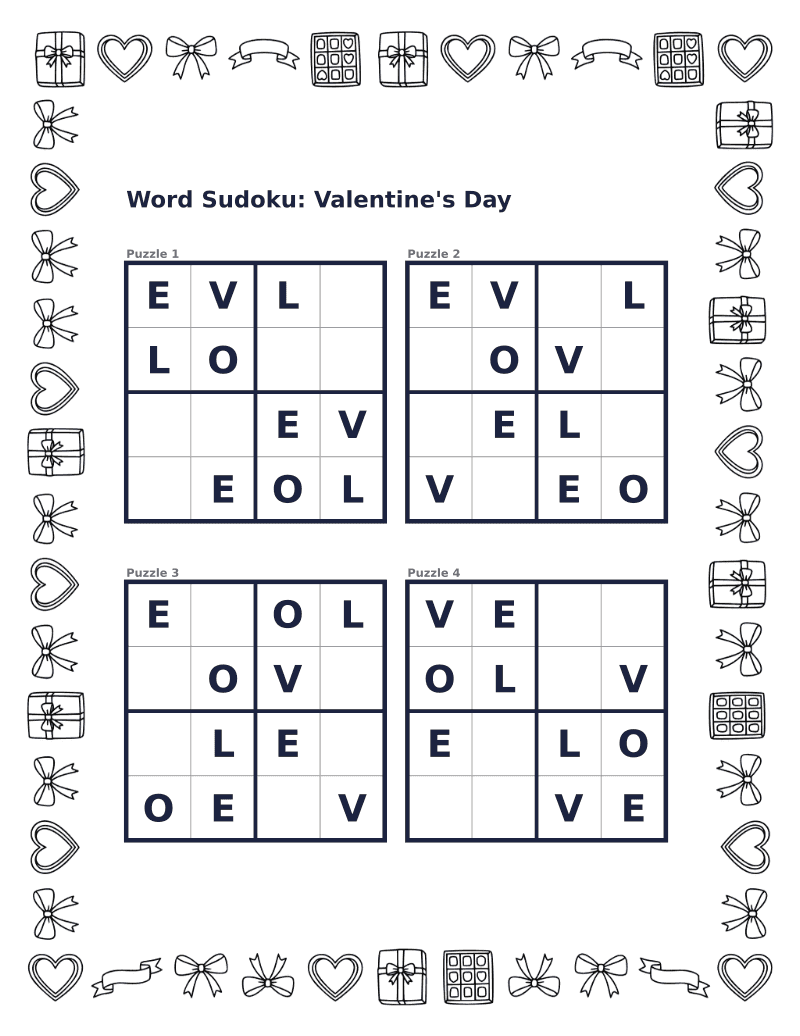 Word sudoku, Valentine's Day4 × 4 · Easy · LOVE · 4 puzzlesDownload PDF ↓
Every sheet here is free to print as often as you like. If one saved you time, the tip jar is on Ko-fi.
Word sudoku, also called wordoku, is an ordinary sudoku written in letters instead of numbers, where the letters come from one word. Every row, every column and every box still holds each letter exactly once. The reward comes at the end: when the grid is full, one row of the answer spells the word. The sheets on this page use SPIDER for Halloween, SLEIGH for Christmas, SNOWFLAKE for winter and LOVE for Valentine’s Day, each printed inside that holiday’s frame.
Under the letters, each puzzle is a normal sudoku from the same maker as the number sheets, with exactly one solution and a measured level. The letters are assigned only after the grid is made, in the order that makes the chosen row come out as the word. Renaming the symbols like that cannot change how a puzzle solves, and the site checks it anyway on more than a thousand grids covering every size and level: the same squares given, the same single answer, the same grade.
The Halloween sheet holds four 6x6 grids with 22 of their 36 squares filled. The Christmas sheet has four 6x6 grids with 18 filled, which is what medium means at this size: fewer letters to start from, although every grid on it still falls to the simplest move there is, a square where only one letter fits. The winter sheet is a single 9x9 with 36 of its 81 squares filled, and the Valentine’s Day sheet has four 4x4 grids of L, O, V and E with 10 of 16 filled, for the youngest solvers.
The word always runs along a row, never down a column, and the puzzle page does not say which row. Saying so would hand over every square in it, and the level printed on the sheet was measured without that help. The maker puts the word in the row with the fewest printed letters, so it is not sitting in plain sight before the solve begins, and the answer key on the second page shades that row in light gray.
Counting rows from the top, SPIDER runs along row 5 of the first Halloween puzzle, row 1 of the second and row 3 of the third and fourth, and each of those rows starts with two or three of its six letters printed. On the Christmas sheet SLEIGH is in row 6 of the first and third puzzles, row 5 of the second and row 4 of the fourth. The first Christmas puzzle prints only the H at the end of its row, so there the word arrives as close to a surprise as a 6x6 allows.
The winter 9x9 spells SNOWFLAKE along row 6 with just two of its nine letters printed, the F in the middle and the E at the end, on a grid that leaves 45 squares to fill. LOVE runs along row 2 in the first three Valentine’s Day grids and along row 4 in the last, each time with two of its four letters given. If a solver is stuck, saying which row holds the word is a fair hint: it turns that row into a short spelling task, and every letter placed there helps with the columns and boxes it crosses.
Set Fill with to A word in the maker above, then pick a word from the theme lists or choose Type my own word. A word has to be exactly as long as the grid is wide, four, six or nine letters, with no letter used twice, because each letter stands in for one of the numbers. A word such as butter cannot fill a 6x6, since the row that spells it would need two of the same letter. The maker says which rule a word breaks while you type, and nothing typed is sent anywhere or added to the page address.
Four and six letter words are easy to come by, and the picker offers 114 different words for a 4x4 and 135 for a 6x6, drawn from the same theme lists as the word searches. Nine letters with none repeated is rare in English: those lists hold only ten, among them supernova, dragonfly, submarine and the two winter words snowflake and snowdrift, so a typed word is often the better route for a 9x9. A 9x9 word sudoku prints one, two or four to a page rather than six. Its instructions take a second line, and a theme word brings its theme’s frames, some of them narrow, so six grids in the narrowest of those would leave squares about a sixth of an inch across, too small to write a letter in.
Yes. Wordoku is the name puzzle books and apps often use for the same idea: a sudoku in letters, where the letters come from one word and the word turns up in the finished grid. The sheets here always spell it along a single row of the answer, and the answer key shades that row so it is easy to check.
Not by the rules. Each one here is a number sudoku with the numbers renamed, so it keeps the same single solution and the same level. Letters can feel slower to scan because they have no counting order to run through, which is why the Valentine’s Day sheet, with four letters and ten of sixteen squares given, is the gentlest place to start.
New printables when they go up, mostly seasonal, a few times a year.