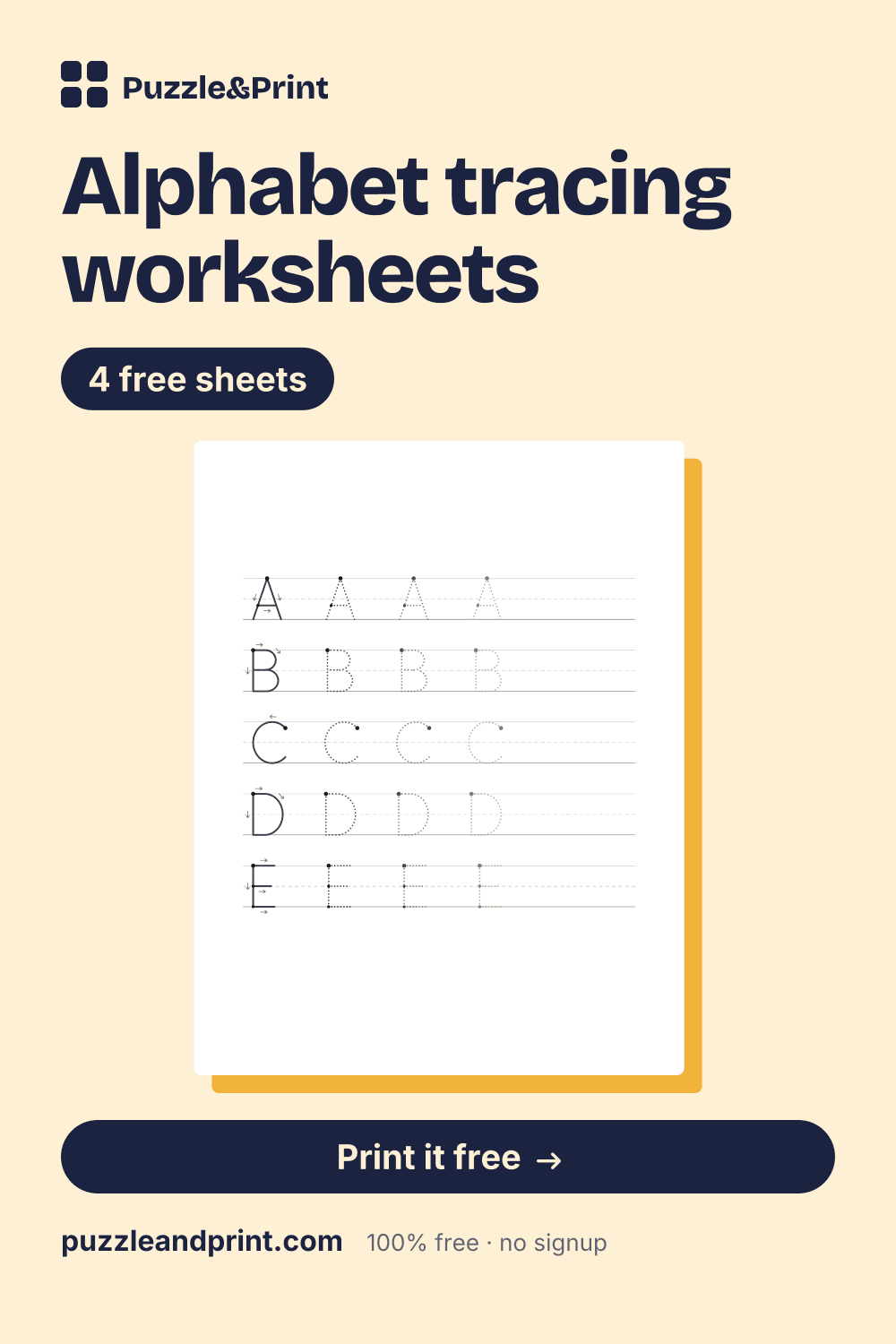
Capital Letter Tracing
Capital letters A to F. Start at each big dot.
Created for free at puzzleandprint.com
Capital and lowercase letters A to Z, with a start dot on every stroke.
Last updated
Save this to PinterestCapital Letter Tracing
Capital letters A to F. Start at each big dot.
Created for free at puzzleandprint.com
Capital Letter Tracing
Capital letters G to L. Start at each big dot.
Created for free at puzzleandprint.com
Capital Letter Tracing
Capital letters M to R. Start at each big dot.
Created for free at puzzleandprint.com
Capital Letter Tracing
Capital letters S to X. Start at each big dot.
Created for free at puzzleandprint.com
Capital Letter Tracing
Capital letters Y to Z. Start at each big dot.
Created for free at puzzleandprint.com
Four ready-made sets, each one PDF of every page in it. There is no answer key: a tracing sheet checks itself.
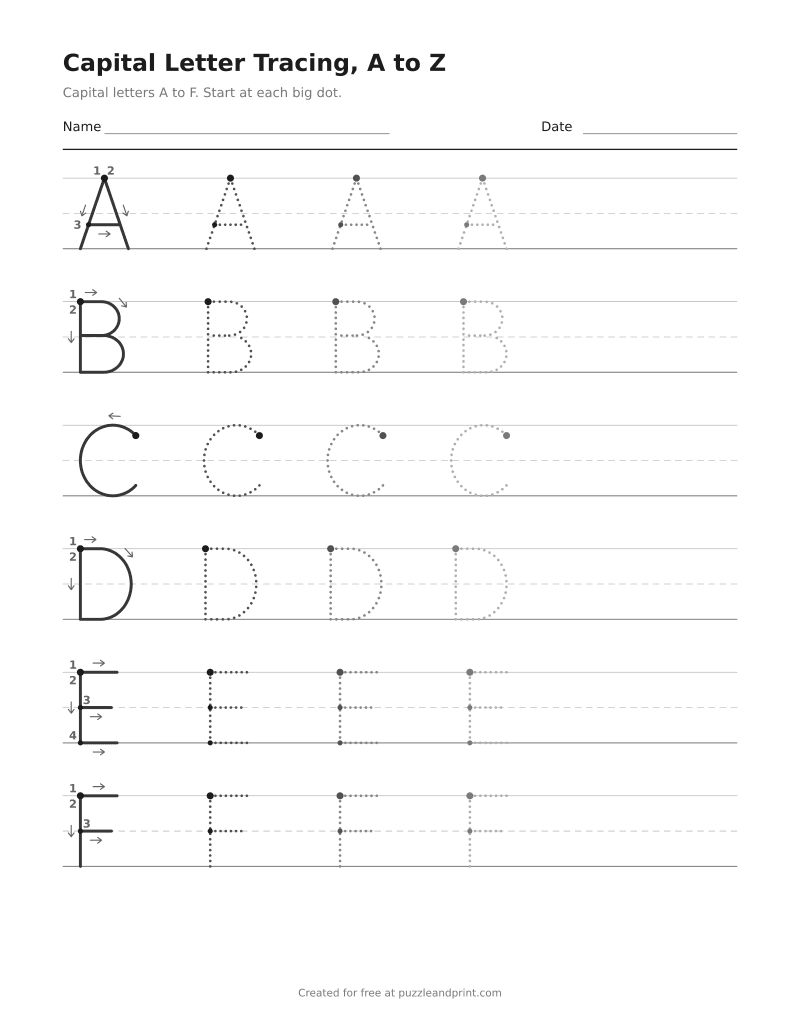 Capital letter tracing worksheet, A to Z5 pages · 3/4 inch lines · dottedDownload PDF ↓
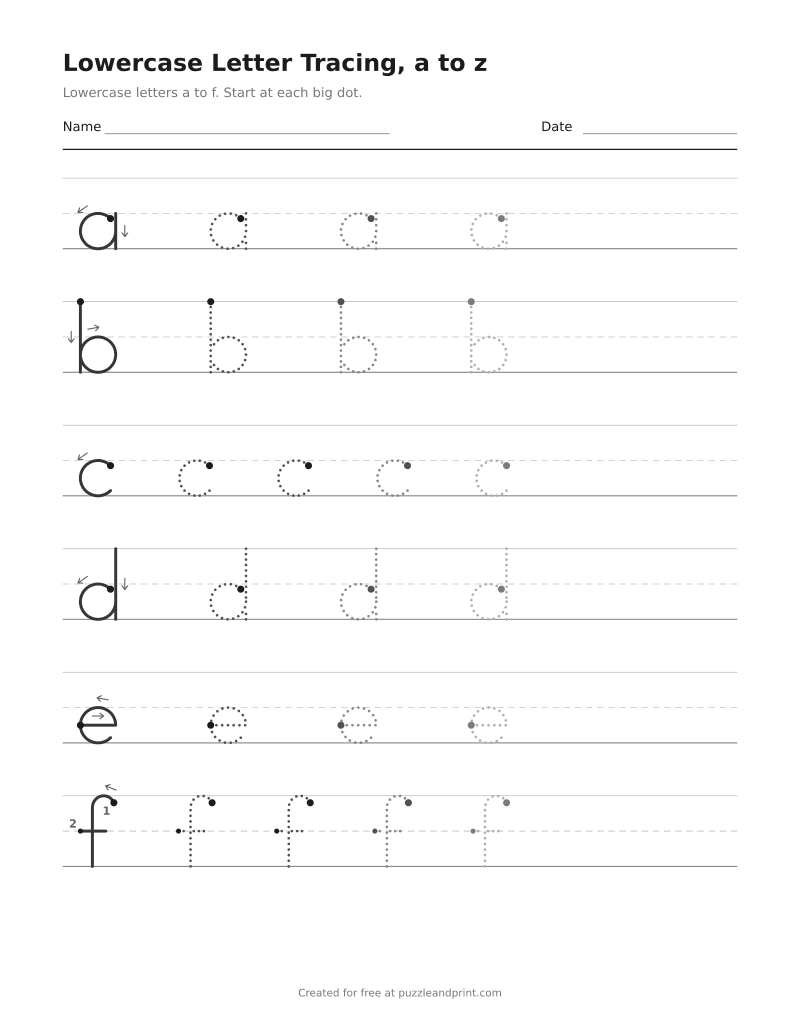 Lowercase letter tracing worksheet, a to z5 pages · 3/4 inch lines · dottedDownload PDF ↓
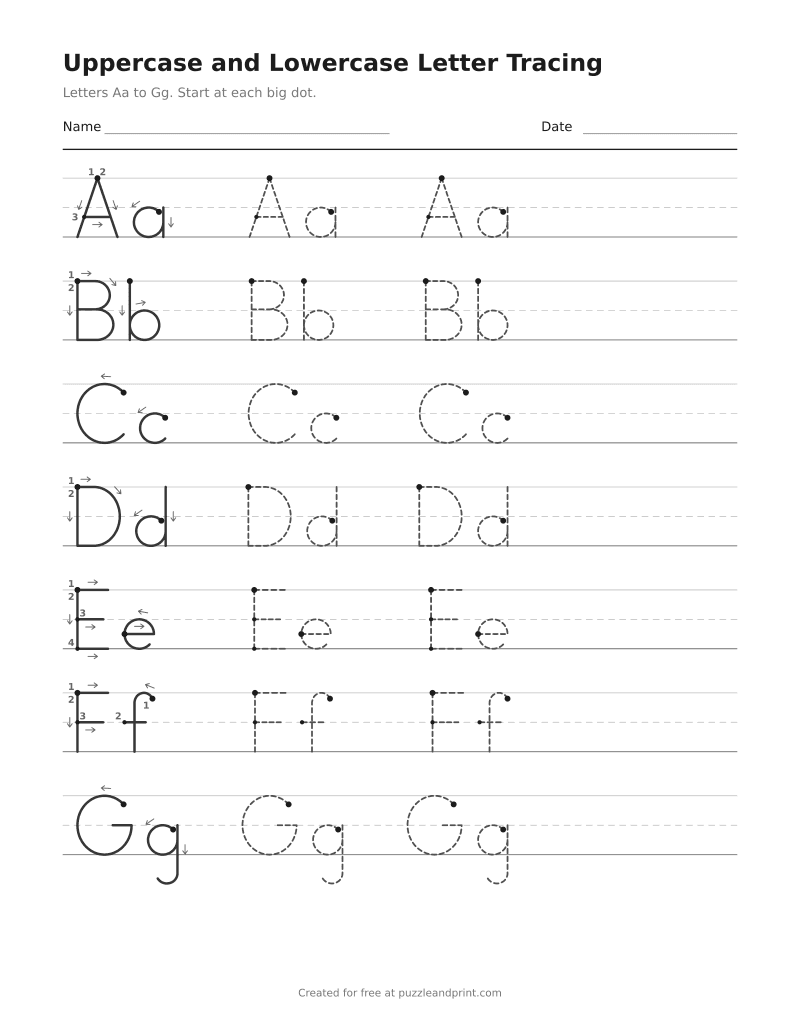 Uppercase and lowercase letter tracing worksheet4 pages · 5/8 inch lines · dashedDownload PDF ↓
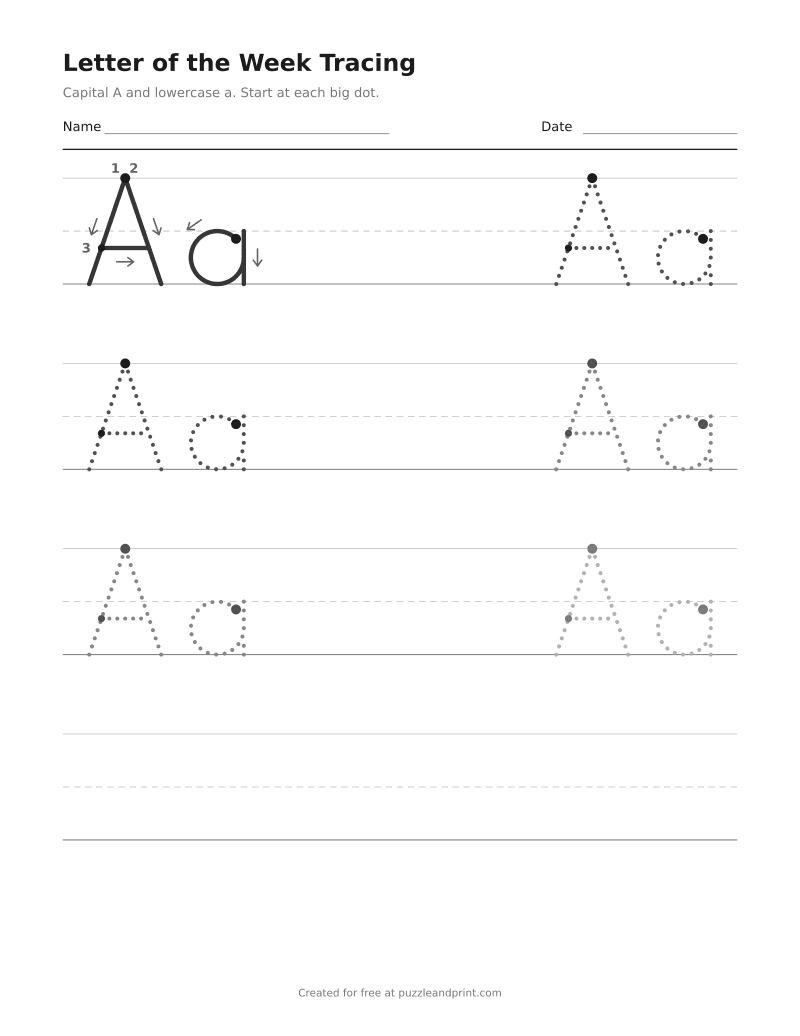 Letter of the week tracing worksheet26 pages · 1 1/8 inch lines · dottedDownload PDF ↓
Every sheet here is free to print as often as you like. If one saved you time, the tip jar is on Ko-fi.
These alphabet tracing worksheets are drawn in upright ball-and-stick print, the style taught in many American kindergartens, built from straight lines and circles: a single-story a and g, a capital J that is a plain hook with no bar across the top, a capital G whose bar sits on the midline, and a q whose tail curves forward so it cannot be read as a g. Every letter sits on primary writing lines, and every stroke starts at a big dot.
On the sheets with a row for each letter, every row opens with a model drawn as a solid line, with small arrows beside its strokes and, on letters made in more than one stroke, numbers giving the order. Tracing copies follow, fading from dark to light across any row with room for three or more of them, and the last third of the row is left as bare line for writing the letter without a guide. The letter of the week pages put one model at the start of the first line and fade the copies down the page instead.
The capital and lowercase sheets are five pages each at 3/4 inch, the kindergarten size, with six letters to a page and the last two on the fifth. The pairs sheet puts each capital beside its lowercase letter, Aa to Zz, at the first grade size of 5/8 inch and in dashes rather than dots, seven pairs to a page and five on the last. The letter of the week set gives each pair a page of its own at 1 1/8 inch: 26 pages, each with three lines to trace and a blank line at the foot.
The maker above sets the same things for any size: capitals, lowercase or both, a row for each letter or a page for each, dots or dashes, the model and the fading on or off, how much line to leave blank, and the arrows. Arrows are offered from 5/8 inch up; below that they crowd the letters they are meant to explain.
Every letter is made from four kinds of stroke: straight down, straight across, a slant, and a circle. Circles that go counterclockwise, "circle back" in the classroom phrase, are used for a, c, d, e, g, o and q, and in all of them but e the circle starts just right of the top, between one and half past one on a clock face; the e starts with its bar. Circles that go clockwise, "circle forward", are used for b and p, which start with the stick and then swing the bowl out to the right.
Capitals and the tall lowercase letters, b, d, f, h, k, l and t, reach the headline. The short letters reach the midline, and the tails of g, j, p, q and y hang half a writing space below the baseline, the full depth of the skip space on Zaner-Bloser paper, where a tail just touches the next writing line. These sheets leave a quarter of a writing space more under each line than that paper does, so every tail ends clear of the start dots, arrows and stroke numbers on the line below. The bars of t, f and capital G sit on the midline, and the crossbar of capital A sits a third of the way up from the baseline, low enough that the triangle above it is clearly a triangle.
The letters children most often swap are b and d, and p and q, because each pair looks like the other turned around. On these sheets the start dots keep them apart. The b starts at the top of its stick, on the headline, and pulls down before the bowl is added on the right; the d starts on its bowl, just under the midline, circles back, and only then adds the stick. The p and q follow the same pattern lower down: p starts with its stick at the midline, q with its circle.
So a child who starts every letter at the big dot cannot make a d by drawing a b backward, because the first movement is different. That is the reason the start dots are on every copy rather than only on the model, and why they stay a shade darker than the dots around them as the copies fade across the row. The q has a second difference too: its tail ends in a short curve to the right, where the tail of g curves to the left.
Capitals are usually the easier start. Every capital on these sheets runs from the headline to the baseline, so there are only two lines to aim for, while lowercase letters add the midline and the tails of g, j, p, q and y that hang below the baseline. Many children write their name in capitals before school, so the capital sheet often builds on letters they already half know.
The numbers give the stroke order on letters made in more than one stroke. On capital E, 1 is the stick from the headline down, then 2, 3 and 4 are the three bars from top to bottom, each starting at the stick. Letters made in one movement, such as O, C and lowercase a, have a start dot and arrows but no numbers.
Twenty-six pages, one for each letter, with the capital and lowercase side by side. Each page has four 1 1/8 inch writing lines: three to trace, starting with a solid model, and a blank one at the foot. Because page 1 is A and page 26 is Z, a single letter can be printed on its own by entering its page number in the print dialog.
New printables when they go up, mostly seasonal, a few times a year.