Hundreds Chart
1 to 100 · A quarter missing
Write the missing numbers. Each row counts on by one, and each column counts on by ten.
Created for free at puzzleandprint.com
A different missing-numbers chart every time, each with its own answer key.
Last updated
Save this to PinterestHundreds Chart
1 to 100 · A quarter missing
Write the missing numbers. Each row counts on by one, and each column counts on by ten.
Created for free at puzzleandprint.com
Hundreds Chart, Answer Key
1 to 100 · A quarter missing
Created for free at puzzleandprint.com
Every chart here carries its answer key, on the page after the chart it belongs to.
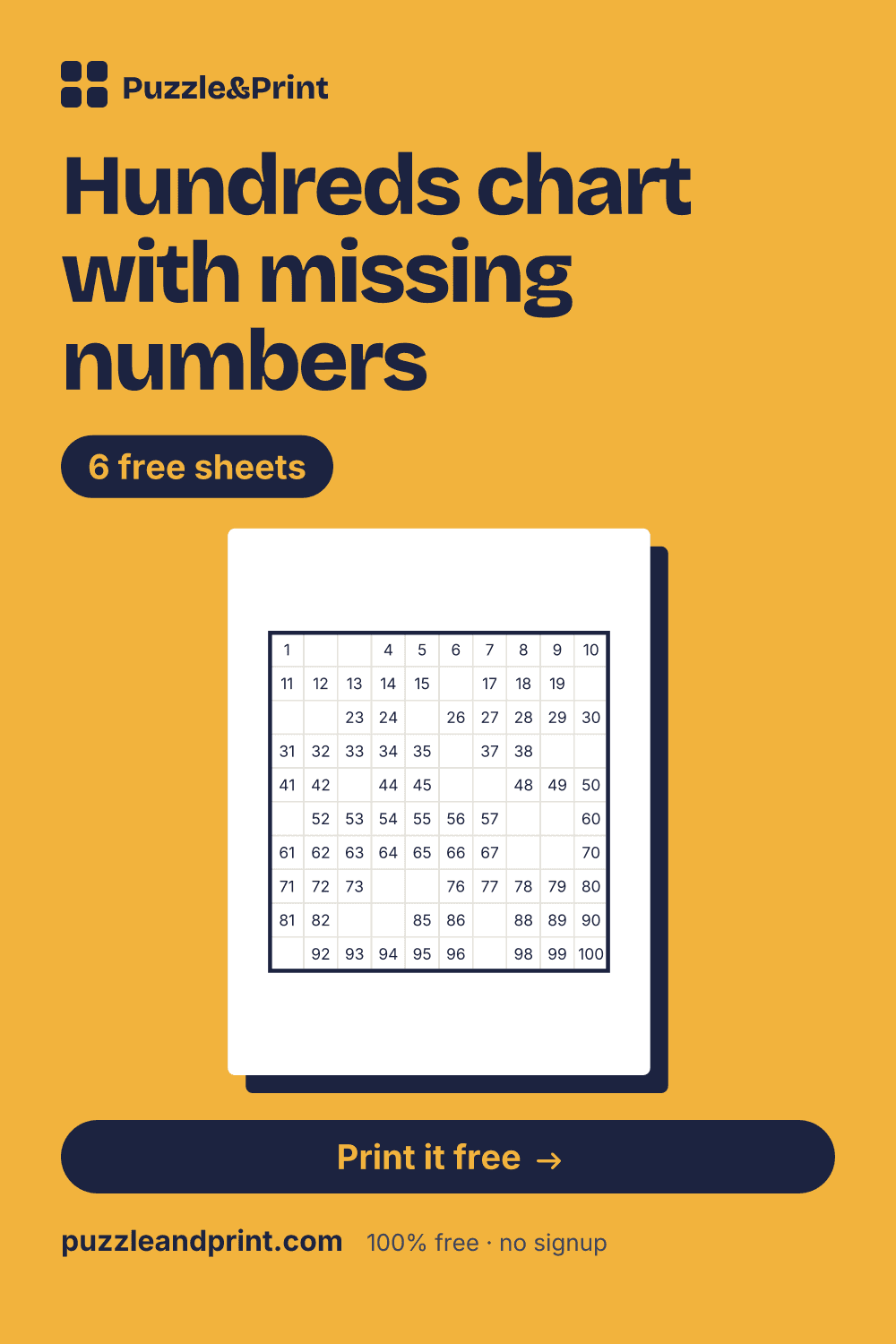
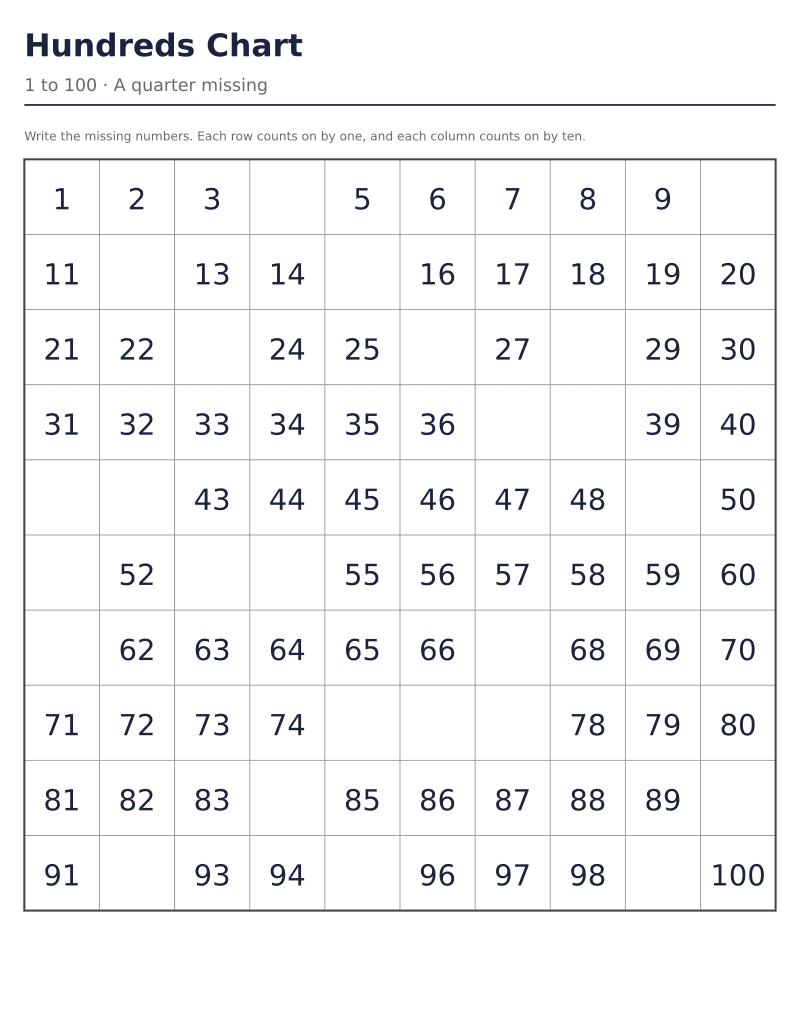 Hundreds chart missing numbers, a quarter25 of 100 empty · answer keyDownload PDF ↓
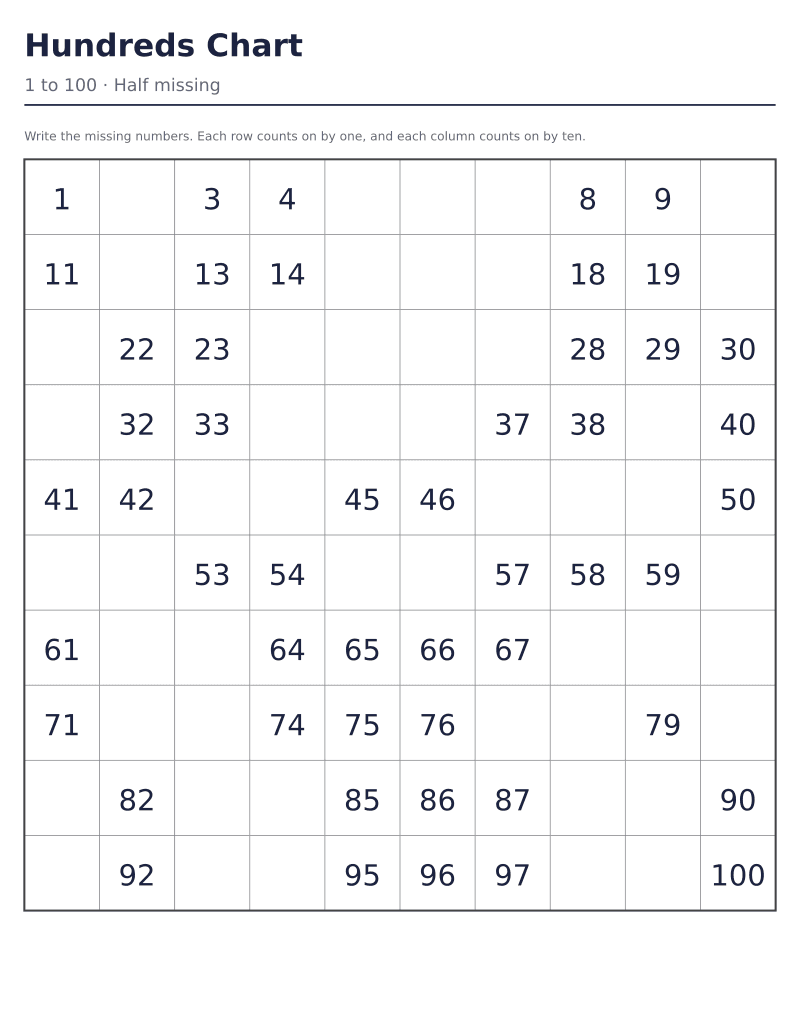 Hundreds chart missing numbers, half50 of 100 empty · answer keyDownload PDF ↓
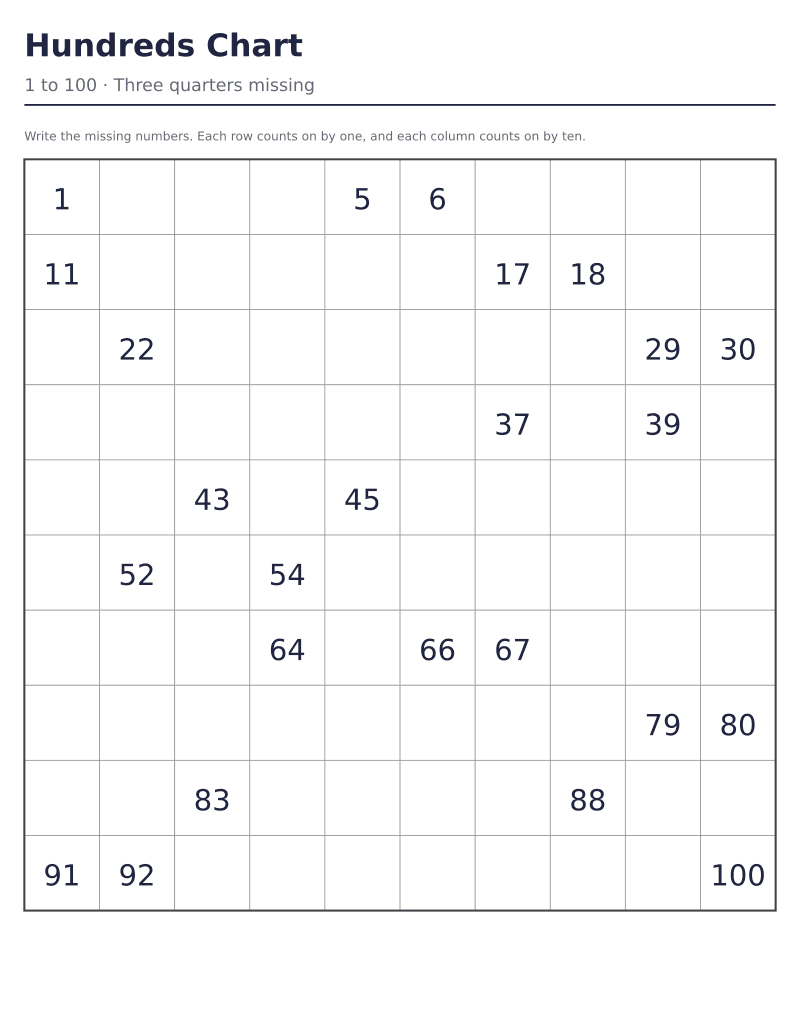 Hundreds chart missing numbers, three quarters75 of 100 empty · answer keyDownload PDF ↓
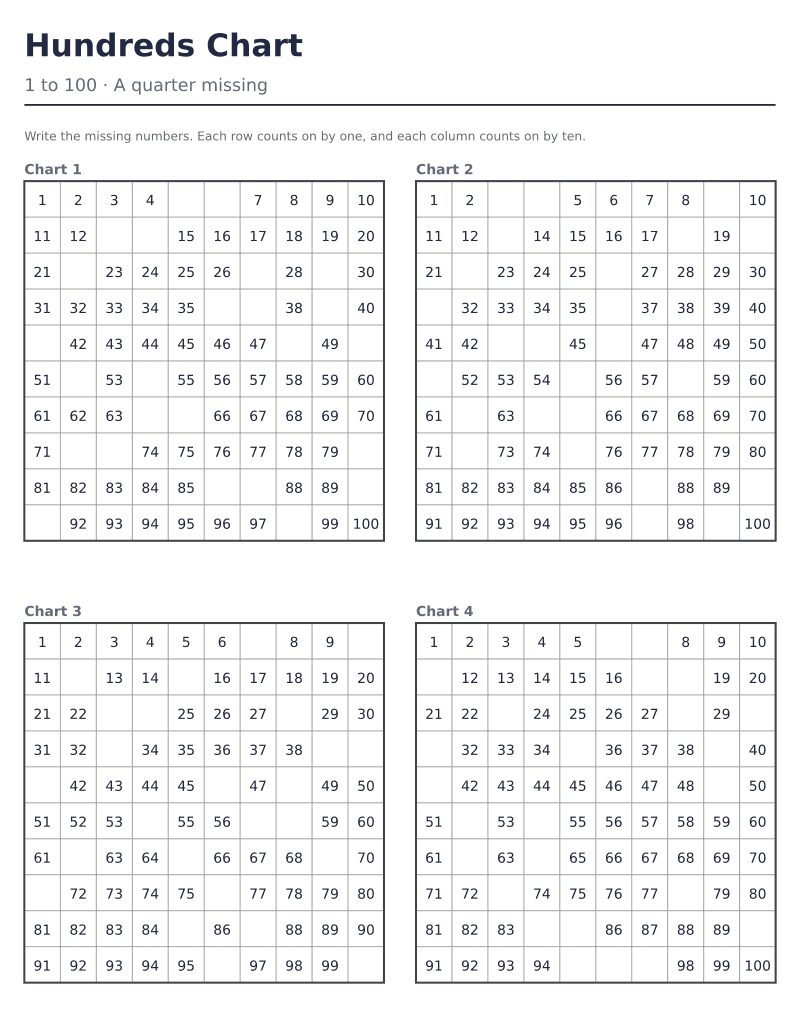 Hundreds chart missing numbers, four per pageFour different charts, a quarter missingDownload PDF ↓
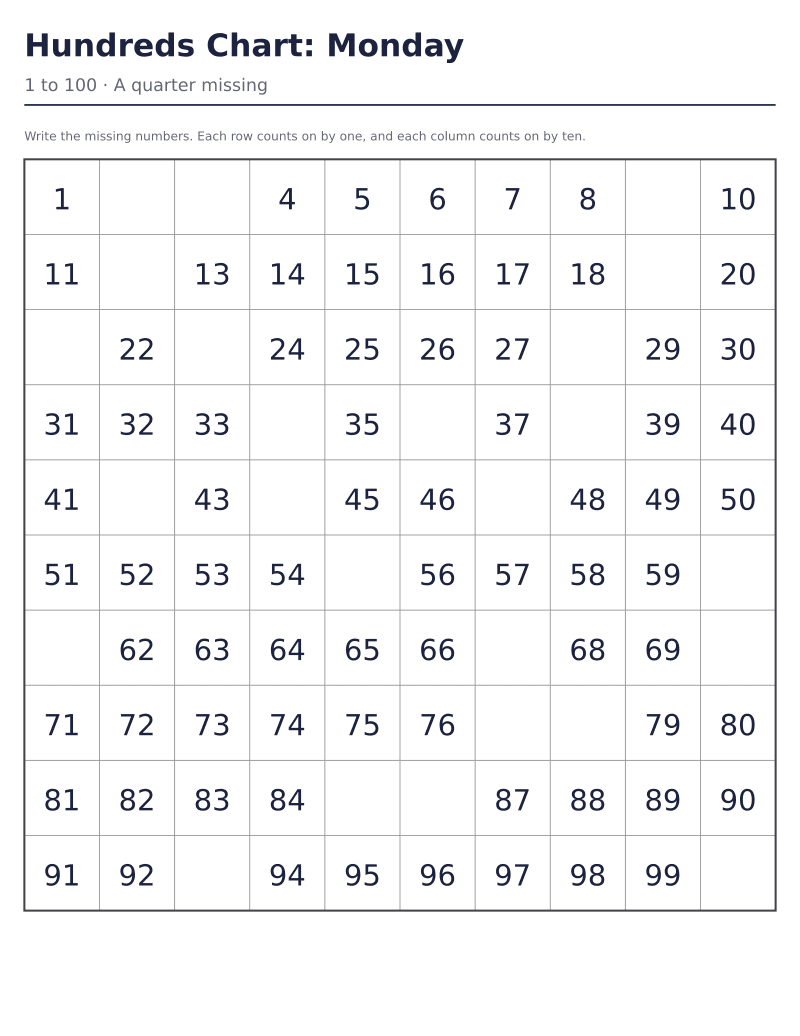 Hundreds chart missing numbers, Monday to Friday5 different charts, each with its keyDownload PDF ↓
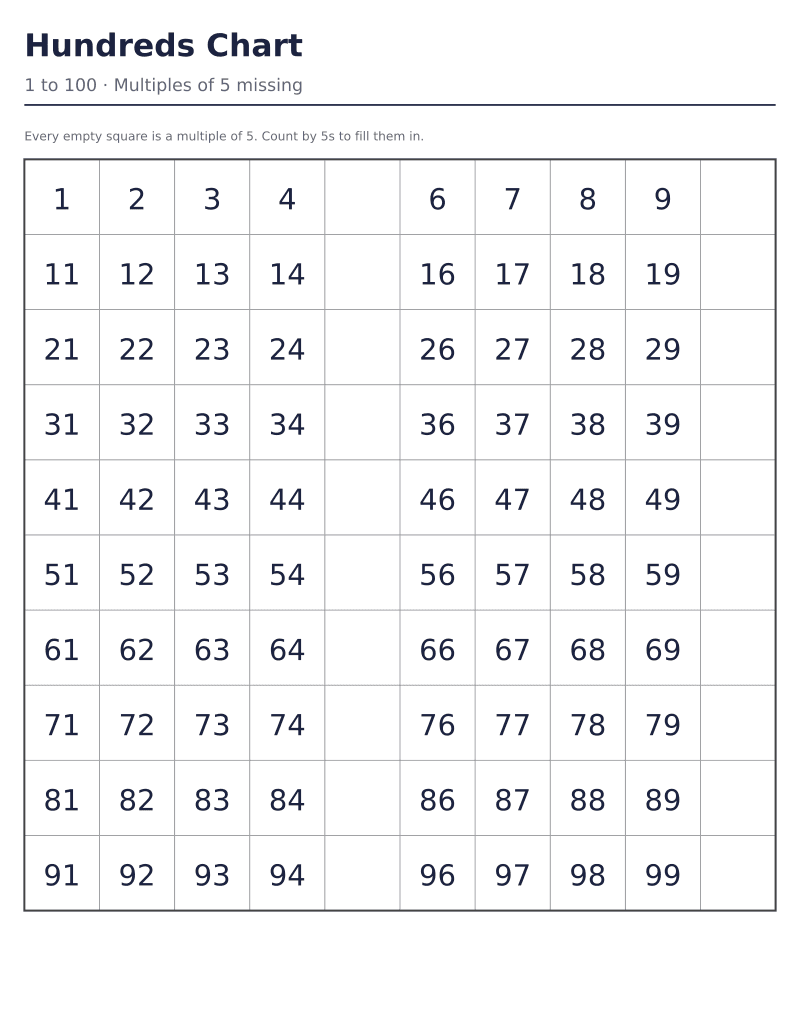 Hundreds chart missing numbers, count by 5sThe 20 multiples of 5 empty · answer keyDownload PDF ↓
Every sheet here is free to print as often as you like. If one saved you time, the tip jar is on Ko-fi.
A missing-numbers chart is a hundreds chart with gaps in it, and filling them asks a child to use the chart's patterns rather than only read it: the square under 34 is ten more, the square before 60 is one less. It is a staple of number sense practice in the early grades, and one a single fixed PDF serves badly, because once a class has done that sheet the answers are known.
Every sheet here is a 1 to 100 chart. The first three leave out a quarter, half or three quarters of the numbers at random, 25, 50 or 75 of the 100, spread so each row has its share and never including the first square. The four-to-a-page sheet prints four different charts with a quarter missing, labeled Chart 1 to Chart 4, and the Monday to Friday set gives five charts, a quarter missing on Monday and Tuesday, half on Wednesday and Thursday and three quarters on Friday. The last sheet leaves out the multiples of 5, the twenty squares from 5 to 100, for counting by fives.
Every sheet has its answer key: the same chart with every number written in and the answers in gray. On the four-to-a-page key the charts carry the same labels as the sheet, and in the Monday to Friday set each day is followed by its own key. The keys print plain, with no border, to save ink.
The maker above makes a new set whenever New charts is pressed, up to five pages in one download, at one, two or four charts to a page. It does the 120 chart too, any hundred from 101 to 200 up to 901 to 1000, and gaps at the multiples of any number from 2 to 10.
There are three ways to find a missing number on a hundreds chart, and a good sheet calls for all three. Count on from the number before it in the row, count back from the number after it, or move up or down the column, where every step is ten: the gap under 47 is 57, and the gap above it is 37. On the half-missing sheet, where every row has five gaps, the column move is often the only one available, because the squares either side of a gap are empty too.
Watching which way a child reaches for tells you where they are. Counting up from 1 to find 48 means the patterns have not landed yet; finding it as one more than 47, or ten less than 58, means they have. The three quarters sheet, with seven or eight gaps in each row, leaves little to count along a row from, so it pushes children toward the column move, and it is the one to save until they are ready for it.
The Monday to Friday set is five different charts in one PDF, each followed by its key, ten pages in all. Monday and Tuesday have 25 numbers missing, Wednesday and Thursday 50 and Friday 75, so the week steps up twice and ends on the emptiest chart. For a class, print the odd pages for the children and keep the even pages, the keys, for checking.
The count by 5s sheet is a different exercise. Its 20 gaps are exactly the multiples of 5, so the empty squares make two whole columns, the fifth and the tenth. Filling them across the rows is counting by fives, 5, 10, 15, 20, and each column of gaps also counts by tens, 5, 15, 25 down the fifth and 10, 20, 30 down the tenth. The maker can leave out the multiples of any number from 2 to 10 in the same way.
The quarter sheet, with 25 of the 100 numbers missing and two or three gaps in each row, so most of every row is printed and each gap sits near a number to count on from. Half missing leaves exactly five gaps in every row; three quarters leaves only two or three numbers printed in each row, and suits a child who can already count to 100 without the chart.
In the maker, yes: the gaps are chosen at random from a seed, so New charts makes a different set, and each version in a download differs from the others. The ready-made sheets on this page use fixed seeds, so a given file prints the same chart every time, which matters when a class already has the sheet and the key has to match it.
Yes, two or four. With random gaps the charts on a page are all different, each labeled Chart 1, Chart 2 and so on, and the key prints them in the same places with the same labels; with the multiples of a number left out they are one chart repeated, ready to cut apart. Four to a page gives squares 8.7 mm across, enough for a two-digit number in pencil, and two to a page stacks the charts one above the other with squares 9.4 mm across.
New printables when they go up, mostly seasonal, a few times a year.