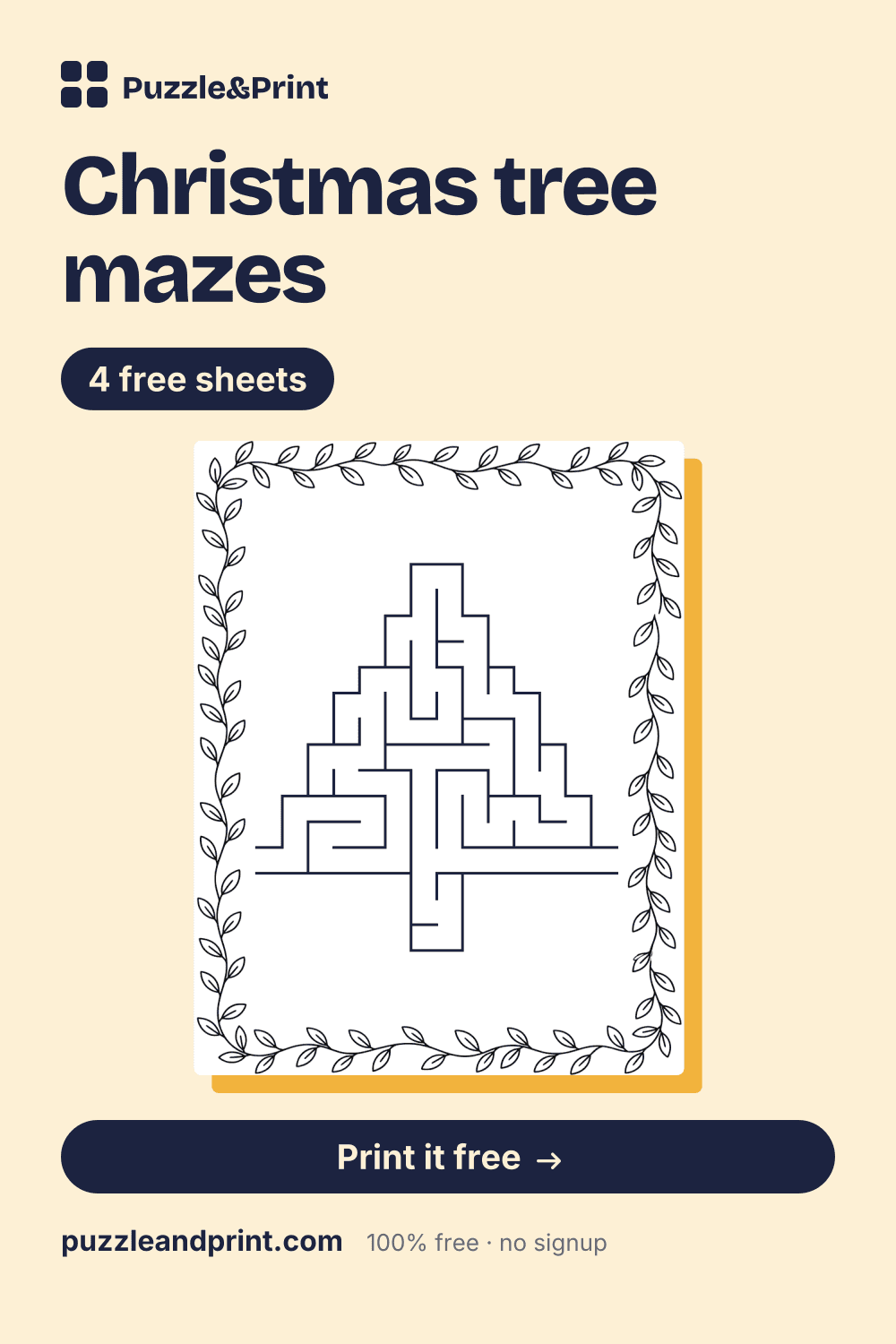
Christmas Tree Maze
Created for free at puzzleandprint.com
Four Christmas tree mazes from 16 to 28 squares across, each with the solution on its own page.
Last updated
Save this to PinterestChristmas Tree Maze
Created for free at puzzleandprint.com
Christmas Tree Maze, Solution
Created for free at puzzleandprint.com
Four mazes, each a different size. Every one is a two-page PDF, the maze, then the solution on its own page.
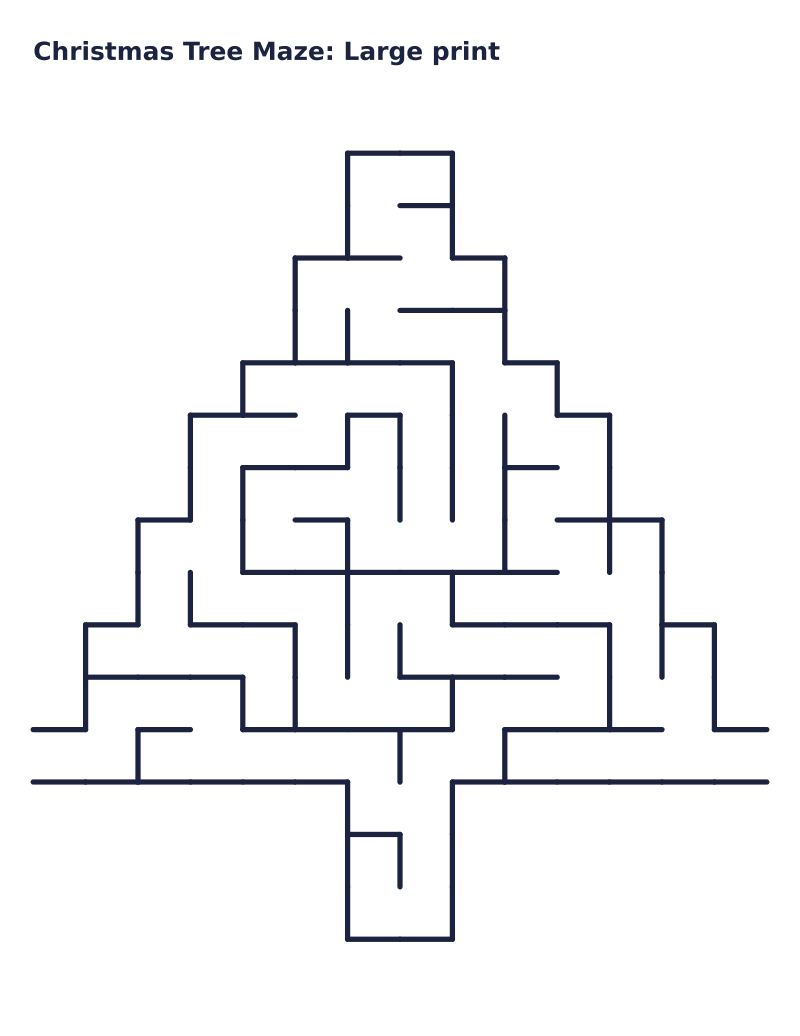 Christmas tree maze, large print16 × 16 grid · EasyDownload PDF ↓
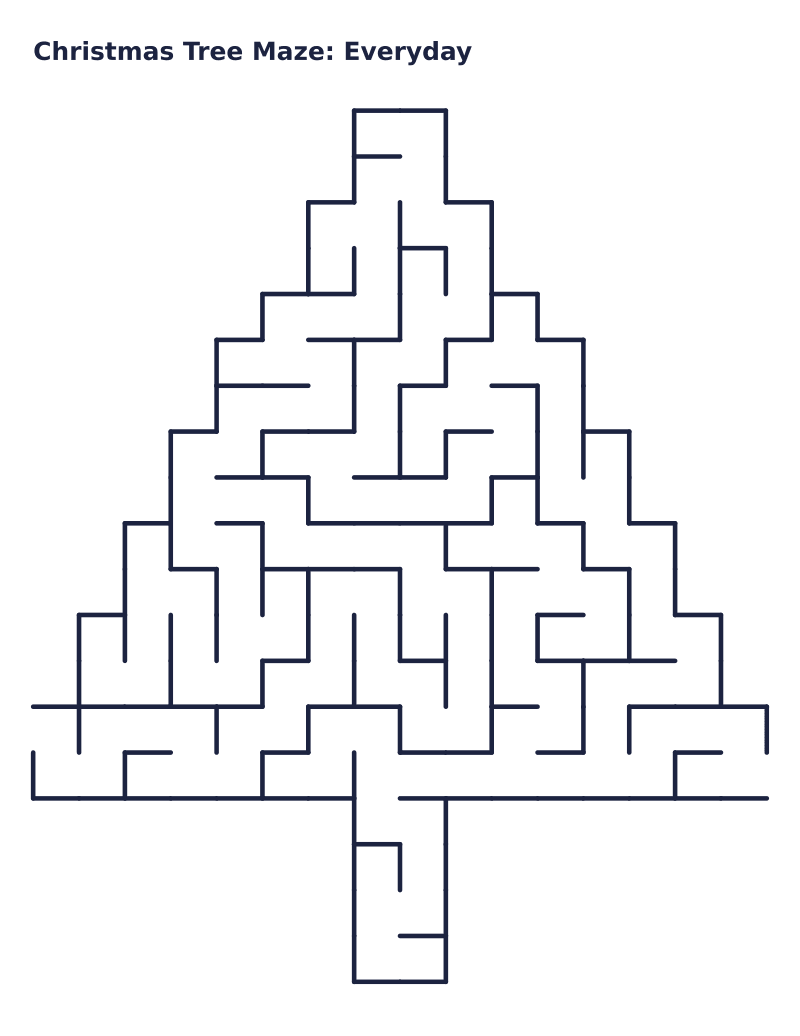 Christmas tree maze, everyday20 × 20 grid · MediumDownload PDF ↓
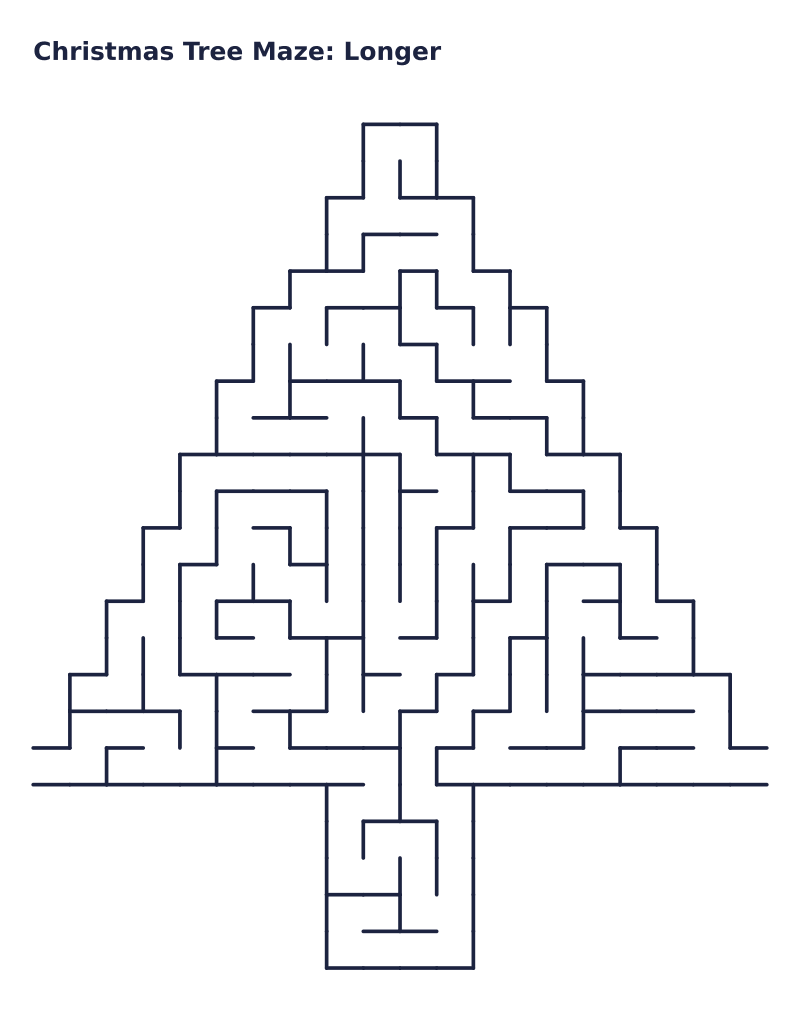 Christmas tree maze, longer24 × 24 grid · MediumDownload PDF ↓
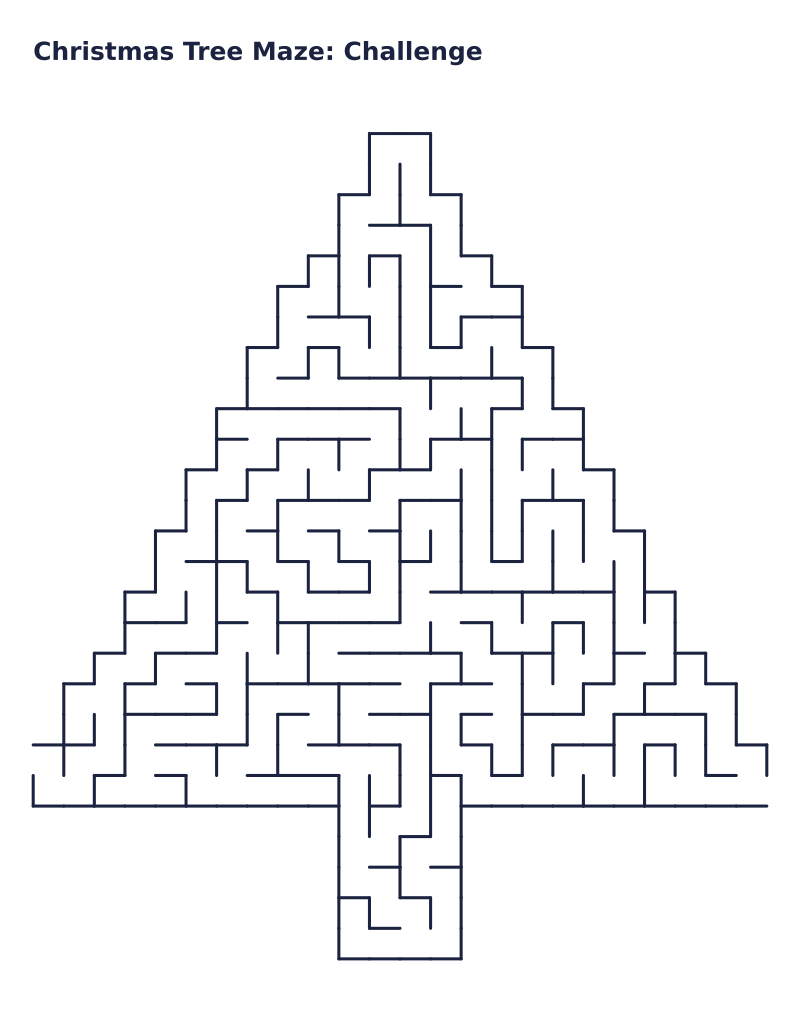 Christmas tree maze, challenge28 × 28 grid · HardDownload PDF ↓
Every sheet here is free to print as often as you like. If one saved you time, the tip jar is on Ko-fi.
A triangle over a trunk keeps a little over a third of its grid, from 36.5 to 39 percent on these four sheets, so the Everyday tree on its 20 by 20 grid has 146 squares to explore and the Challenge on its 28 by 28 grid has 306. The way in and the way out sit at the left and right ends of the widest rows of branches, at the foot of the tree, so every climb the route makes toward the narrow top is one it has to come back down.
The tree is one clean triangle rather than the tiered branches a drawing would use, and that is a printing decision. A notch has to be two or three squares deep before it reads as a branch, and a notch that deep on paper reads as a ragged edge instead. The single taper looks more like a tree in the hand, which is the opposite of how it looks on a screen.
The moment for it is the last week or two before winter break, not the days before Christmas: that is when the lessons have finished, the room is restless and there is time that needs filling. It prints black and white on ordinary paper, so a class set costs what any other sheet costs.
Once it is solved, the tree is also something to color. The route fills only part of the outline, leaving 40 squares it never touches on the Large print tree, 61 on the Everyday, 118 on the Longer and 211 on the Challenge, and those dead-end pockets are where the ornaments and tinsel can go.
The Everyday tree suits most of a class: its route is 85 squares long through corridors about 9 mm wide, and no wrong turn on it runs more than 13 squares before it ends. It passes 12 forks, so there is still plenty to decide, but nothing on it is deep enough to lose a child for long, which is what a room of mixed abilities needs. The Large print tree is the gentler option for younger or less confident children, with a 58-square route, squares about 11 mm across and no wrong turn longer than nine squares.
The Longer and Challenge trees are the ones for fast finishers. Their routes are almost the same length, 96 and 95 squares, but each hides a long wrong turn that the smaller trees do not: 46 squares on the Longer and 63 on the Challenge, which has a second of 46 as well. Their squares are about 7.6 mm and 6.5 mm across, so they need a sharp pencil. Printing a stack of Everyday trees with a few of each harder sheet on top is an easy way to cover a whole class without anyone having to come and ask for something different.
Only on the Longer tree does the route really use the trunk: it winds down inside it to within a square of the bottom and back up again. On the Large print tree it drops one row into the top of the trunk, crosses its two squares and climbs straight back out, and on the Everyday and Challenge trees the trunk is a dead end the route never enters. The trunks are not one block either: two squares wide and three tall on the Large print, two by four on the Everyday and four by five on both larger trees, and the Longer route spends 14 of its 96 squares inside its trunk.
The top of the tree behaves differently from sheet to sheet too. On the Everyday tree the route climbs to within one square of the tip, while on the other three it stays lower in the branches and the tip is a pocket to explore. That gives a teacher a hint for two of the sheets that does not give the route away. For a child stuck on the Longer tree, the trunk is the hint: a solver who refuses to go down it can never finish, because the way through runs down there and back. On the Everyday tree the equivalent hint is to head for the top.
A notch deep enough to read as a branch prints as a ragged edge, so the outline is one taper whose sides step out a single square at a time. It runs from two squares wide at the tip to 14 across the bottom row of branches on the Large print sheet, 16 on the Everyday, 20 on the Longer and 24 on the Challenge, and steps that small read as a straight slope on paper.
Send it out in the last week or two before winter break rather than the final days before it. If the plan is one tree a day, the four ready-made sheets cover four days in rising grid size, 16, 20, 24 and 28 squares across, and the New maze button in the maker on this page carves a different tree for every day after that.
Yes. The border picker in the maze maker on this page offers six Christmas frames and opens on Plain until you choose one. A frame takes up some of the page, so the maze prints a little smaller inside it, and the solution page always prints without one.
New printables when they go up, mostly seasonal, a few times a year.