Sudoku
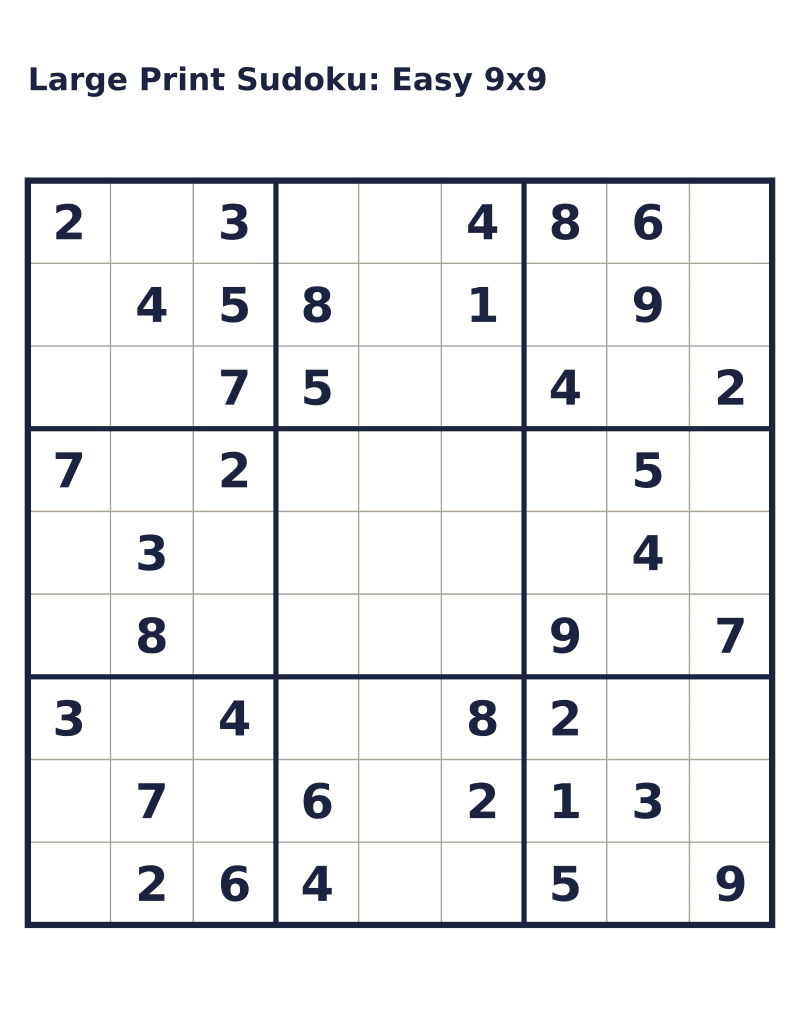
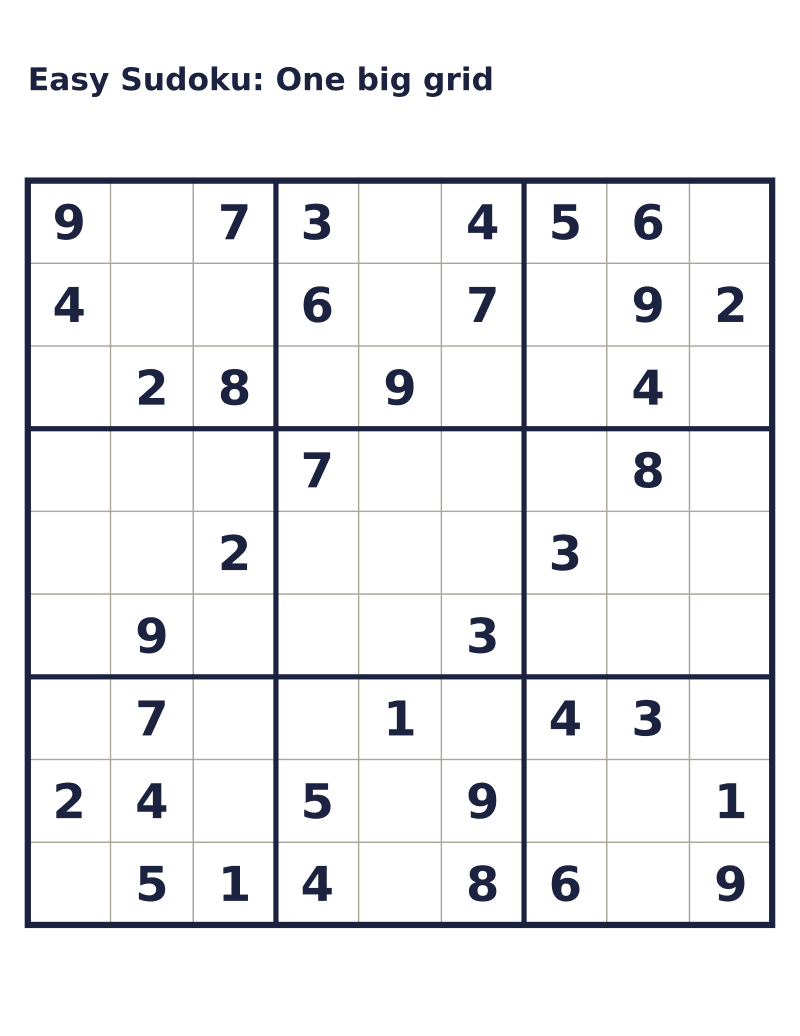
9 × 9 · Easy
Write 1 to 9 once in every row, every column and every 3 by 3 box.
Created for free at puzzleandprint.com
Sudoku from 4x4 to 9x9, graded by the logic each one needs, with the answer key on its own page.
Last updated
Sudoku
9 × 9 · Easy
Write 1 to 9 once in every row, every column and every 3 by 3 box.
Created for free at puzzleandprint.com
Sudoku, Answer Key
9 × 9 · Easy
Created for free at puzzleandprint.com
A holiday or winter word sudoku comes first while in season. The pages behind these hold four sheets apiece, each followed by its answer key.
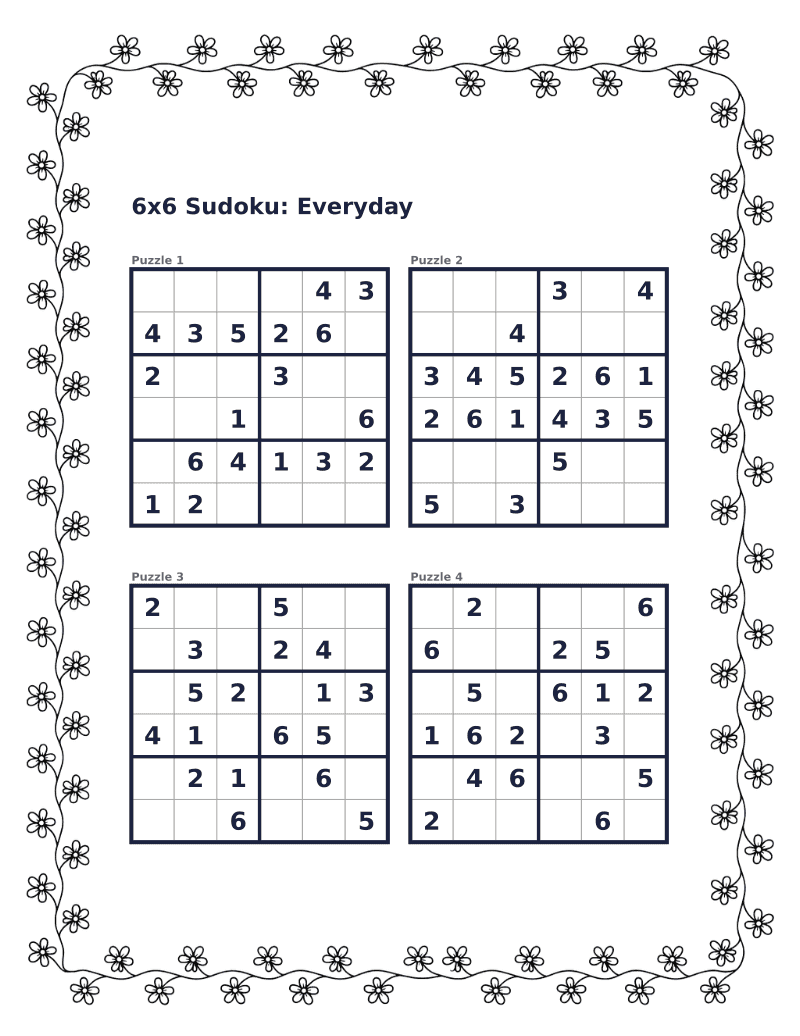
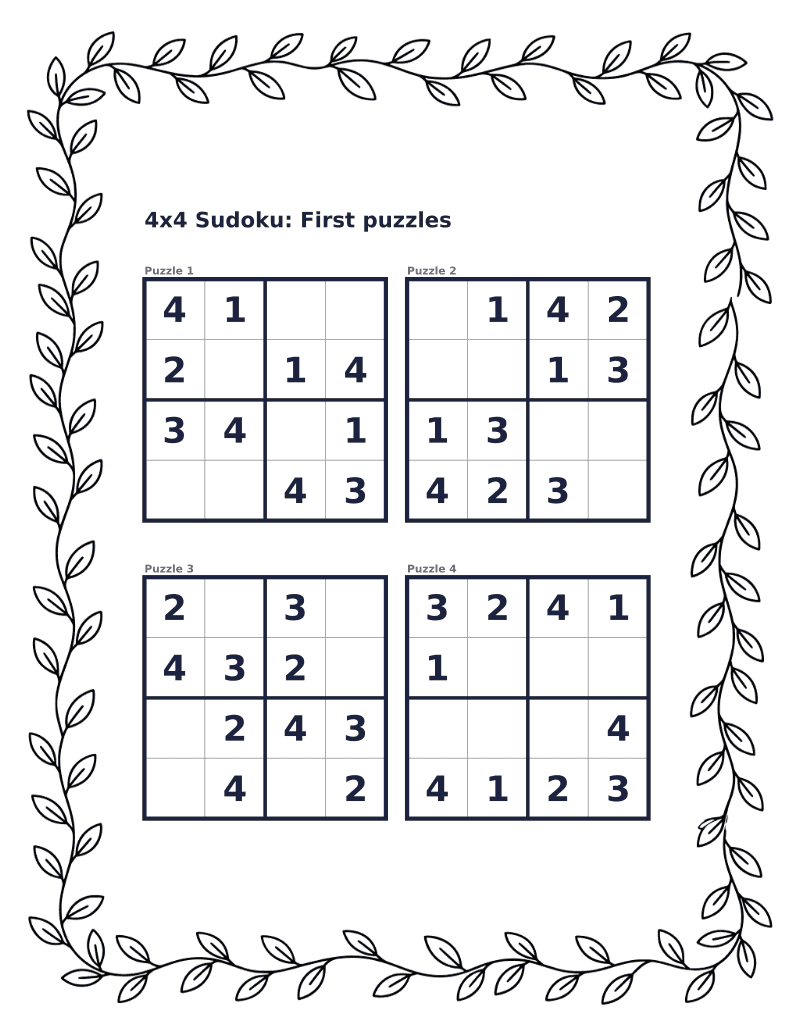
A title, a line for a name and a date, and one sentence of instructions: write 1 to 9 once in every row, every column and every 3 by 3 box, with the range and the box shape changed to match a 4x4 or 6x6 grid, and a second line on a word sudoku saying that one row will spell its word. Under that come one, two, four or six grids, each labeled Puzzle 1, Puzzle 2 and so on when there is more than one, so a key can never be matched to the wrong grid.
The box edges are drawn three to four times heavier than the lines between squares, in near black, and the square lines in gray. That contrast is what lets a solver see the boxes without counting squares, and it is the first thing a cheap printer loses, which is why the thin lines are gray rather than hairline.
The answer key is the same page again with every square filled. The printed clues stay bold and the answers are set lighter and gray, so whoever is grading can tell at a glance which squares were given and which were worked out. Like every key on this site it prints without a border.
Each puzzle is solved by a program that works the way a person does, one deduction at a time, trying the simplest kind first and never guessing. The level printed on the sheet is the simplest set of deductions that finishes the grid.
Easy falls to naked singles alone: at every step there is a square where only one number can go. Medium needs at least one hidden single, where a number has only one place left in a row, column or box although that square could still hold other numbers. Hard needs at least one of three elimination moves (a naked pair, a pointing pair or a box-line reduction) and never anything beyond them, so no hard puzzle here asks for guessing, X-wings or chains.
When a fresh grid comes out easier than the level asked for, it is thrown away and another is made, so the label is measured rather than hoped for. In a run of 1,000 hard puzzles, 854 used a naked pair, 377 a pointing pair and 75 a box-line reduction, and the average puzzle needed 2.3 of those moves, with the most demanding one needing 10.
Counting the printed numbers is the usual shortcut, and it is a poor one. In samples of 1,000 from this maker, medium puzzles had 28 to 33 clues and hard puzzles had 23 to 33, so the two ranges overlap almost entirely. One of the ready-made hard sheets carries a letters puzzle with 34 clues that still needs a naked pair, while many medium grids start with only 28.
What makes a puzzle hard is where the clues sit, not how many there are. That is also why the maker keeps a floor under the easy level: easy 9x9 puzzles here always have 36 or 37 clues, so a first attempt is not made needlessly daunting by a sparse page that happens to be easy.
A sudoku with two solutions is broken in a way nobody notices until it is graded: the child has a correct grid and the key has a different correct grid. Every puzzle here is checked by a second, independent program that tries every possibility and stops counting at two. Only a puzzle it finds exactly one solution for is ever shown or printed.
The clues are also placed in matching pairs, each one mirrored by a clue in the opposite position when the grid is turned upside down, which is how printed sudoku has traditionally looked. It makes no difference to the logic and a lopsided grid looks like a mistake.
The small grids are built differently from the 9x9. Every level can be finished with single squares alone, which is the most a young child can reasonably be asked for, and the level is set by how many squares start filled: 10, 8 or 6 of the 16 on a 4x4, and 22, 18 or 14 of the 36 on a 6x6.
The 4x4 uses four boxes of two by two. The 6x6 uses six boxes that are two squares tall and three wide, the layout printed 6x6 puzzles usually follow, so the grid has two boxes across and three down. A child who has finished a few 6x6 grids has used every idea an easy 9x9 needs.
Switch Fill with to letters and the grid uses A to D, A to F or A to I in place of the numbers. Nothing else changes: the same puzzle, the same single solution, the same level. It suits a solver who reads numbers as arithmetic and freezes, and it is a change of scenery for anyone who has done a stack of numbered ones.
The third choice, A word, writes the grid in the letters of a word four, six or nine letters long with no letter repeated, picked from the theme lists or typed in, and arranges the answer so one row spells it. That is the puzzle also sold as word sudoku or wordoku, and the answer key shades the row with the word. The word sudoku page below has four holiday sheets ready to print, from SPIDER at Halloween to LOVE for Valentine’s Day.
Each puzzle is made in your browser by a background process, so the page stays responsive while a hard grid is worked out. Nothing you choose is sent anywhere, and Download PDF and Print this sheet both use the puzzles already on your screen.
Each page has four ready-made sheets to print, plus the maker above opened on that size, level or word.
Yes. Each puzzle is solved twice before it is shown: once by the step-by-step solver that sets its level, and once by a search that tries every possibility and stops at two. A grid is kept only when that search finds exactly one solution, so the answer key is the only correct answer.
Easy can be finished by repeatedly finding a square where only one number fits. Medium also needs hidden singles, a number with only one possible square in a row, column or box. Hard needs at least one naked pair, pointing pair or box-line reduction, and never a guess.
Yes, at every size: A to D on a 4x4, A to F on a 6x6 and A to I on a 9x9. Choose letters under Fill with before printing. The puzzle and its answer key both switch, and the level and single solution stay exactly as they were.
Yes. Choose A word under Fill with, then Type my own word. It needs exactly as many letters as the grid is wide, so four, six or nine, with no letter used twice, and the maker says what is wrong with a word that does not fit. One row of the answer spells it. The word stays on your device and never goes into the page address.
One, two, four or six. One fills the page for large print, two are stacked for bigger grids, four sit in a square and six run two across and three down. On plain paper six 9x9 grids print with squares of about a quarter of an inch, still big enough to write in. A 9x9 word sudoku stops at four, because its instructions take a second line and a theme word brings its theme’s frames, and six in the narrowest of those would leave squares too small to write a letter in.
Yes, on the page after the puzzles and laid out the same way, with the printed clues bold and the worked-out answers lighter. It can be switched off under Answer key, and with several versions each page of puzzles is followed by its own key, numbered to match.
No. There is no sign-up, no email and no limit on how many sheets you make. Every puzzle is generated on your own device, and nothing about what you print is sent to us.
New printables when they go up, mostly seasonal, a few times a year.