Hex Paper
Created for free at puzzleandprint.com
Created for free at puzzleandprint.com
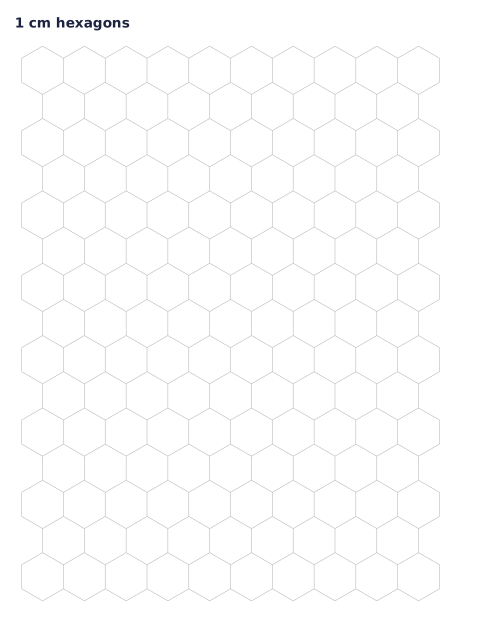
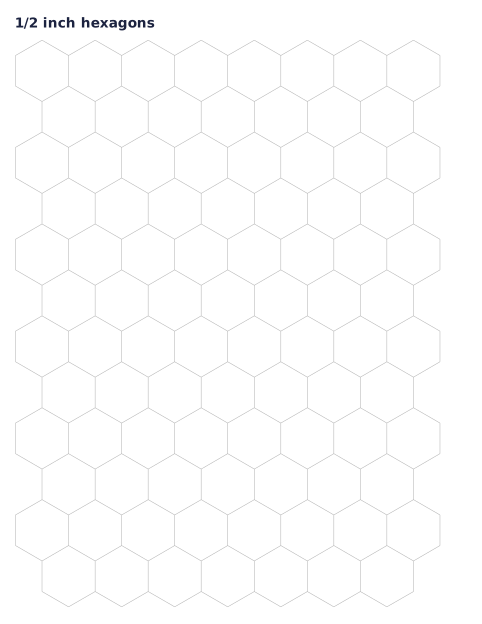
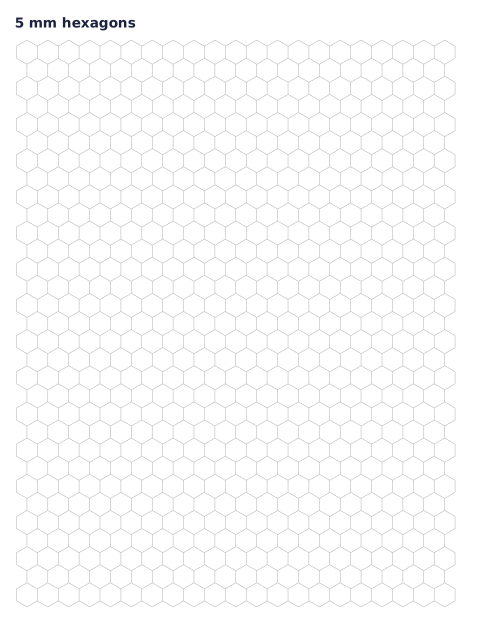
Ruled sheets at the standard sizes, each one a single page. The measurement is printed at the foot, so a reprint can be checked against a ruler.
Hexagons tile the plane without leaving gaps, and unlike squares every neighbour is the same distance away: there are no awkward diagonals that count as one step but measure one and a half. That is why wargames and tabletop campaigns have drawn their maps on hexes since the sixties, and why hex paper is worth having in a drawer if you build worlds on paper.
The other half of the audience is chemistry. A benzene ring is a hexagon, and so is nearly every ring in an organic structure, so drawing on hex paper turns a fiddly freehand sketch into something that just follows the lines. The sheets here have a vertex at the top of each hexagon, which is the orientation rings are conventionally drawn in.
Sizing is given twice, because hex paper is quoted both ways. The number in the name is the length of one side of a hexagon; the second figure is the distance straight across it, which is what you want if you are planning how many fit on a map. A 1 cm hex is 1.73 cm across.
Only whole hexagons are printed, no half shapes sliced off at the margin, because a partial hex is neither drawable nor tidy. Free to print as often as you like, with nothing on the page but the grid.
Because every neighbour is the same distance away. On a square grid a diagonal step counts as one move but measures about one and a half, and that awkwardness is what wargames have been avoiding by drawing on hexes since the sixties.
One centimetre along a side, and 1.73 cm straight across. Both figures get quoted in the wild, so the number in the name here is the side length. The width is the one you want when working out how many fit across a map.
Yes. Print as many sheets as you like, for yourself, a class or a workplace. There is no sign-up, no watermark and no limit.
Almost always because the printer scaled it. Choose 100% or "actual size" rather than "fit to page" in the print dialog. If it still does not match, measure ten squares of the book and divide by ten, the book may not be the size you think it is.
Exactly 6.35 mm. Paper sold as 6 mm is a different thing, and over the width of a page the two are about 5 mm apart, which is enough to notice.
The gap between lines. Wide ruled is 8.7 mm and is what primary schools generally use, college ruled is 7.1 mm, and narrow ruled is 6.35 mm. All three are here.
The sheets are US Letter. A4 is slightly narrower and taller, so printing at 100% will simply crop a little from the right and leave a gap at the foot, the spacing itself stays correct, which is the part that matters.
Drawing three-dimensional objects without constructing perspective. It suits technical sketching, product design and any maths topic involving volume or nets, because every edge of a cube follows a line already on the page.
New printables when they go up, mostly seasonal, a few times a year.