Hundreds Chart
1 to 100
Created for free at puzzleandprint.com
The 1 to 100 chart ready to print, the 120 chart, any hundred after it, and missing-number charts with plain answer keys.
Last updated
Make your own chartEach is a PDF on US Letter. The filled charts are a single page; the blank chart has its answer key on the page after it, and so does each of the four charts in the 100th day set.
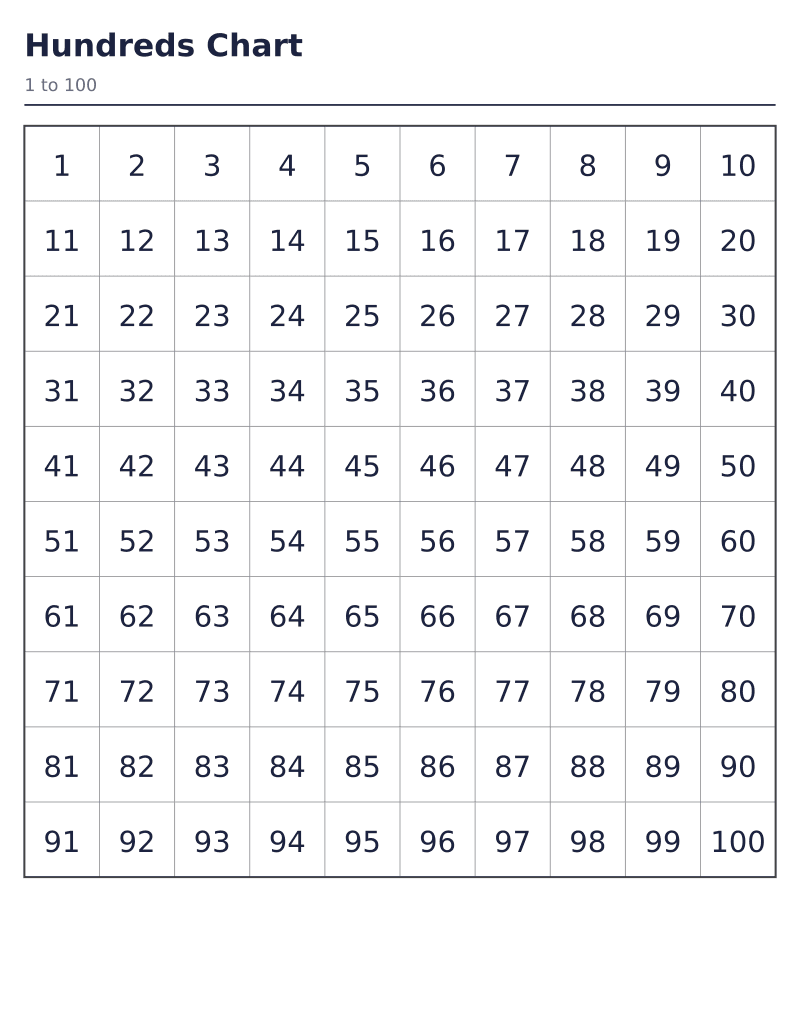 Hundreds chart 1 to 100100 numbers · 18.2 mm squaresDownload PDF ↓
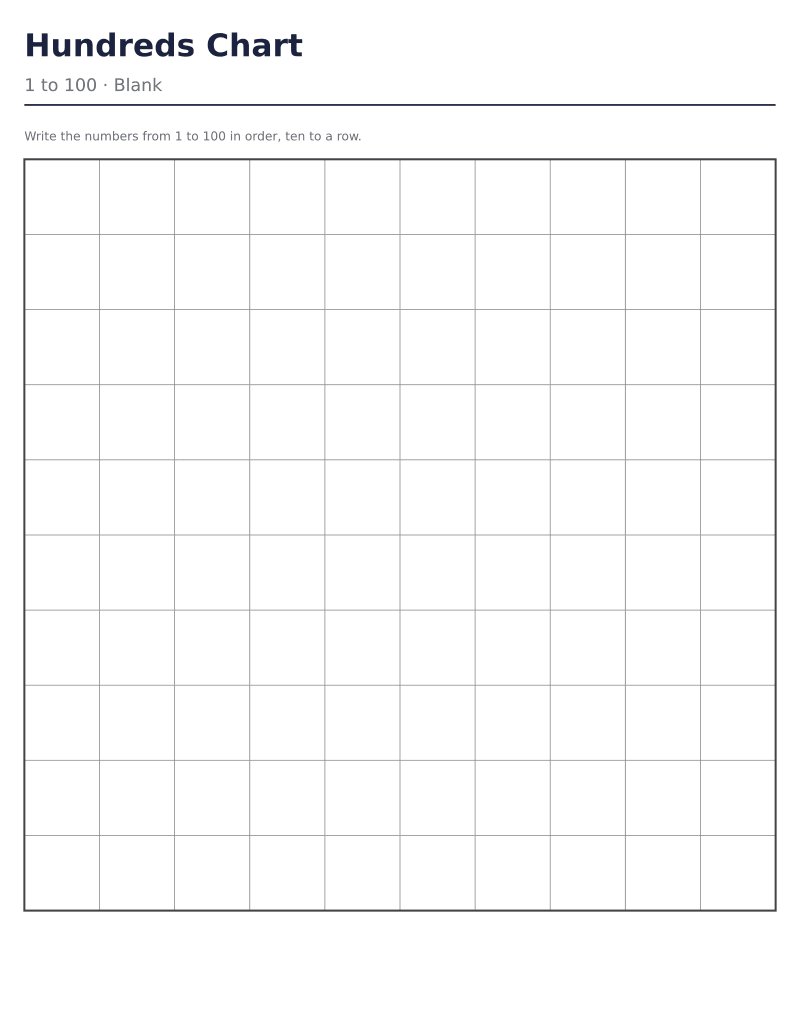 Blank hundreds chartEvery square empty · answer keyDownload PDF ↓
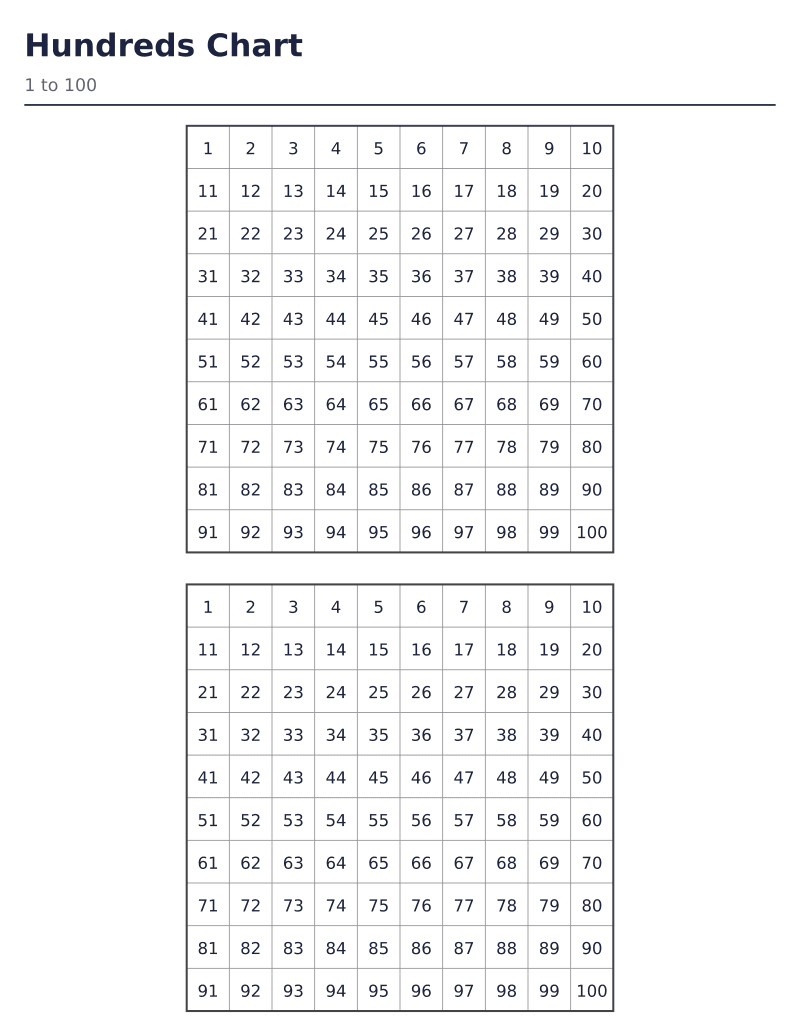 Hundreds chart two per pageTwo filled charts, to cut apartDownload PDF ↓
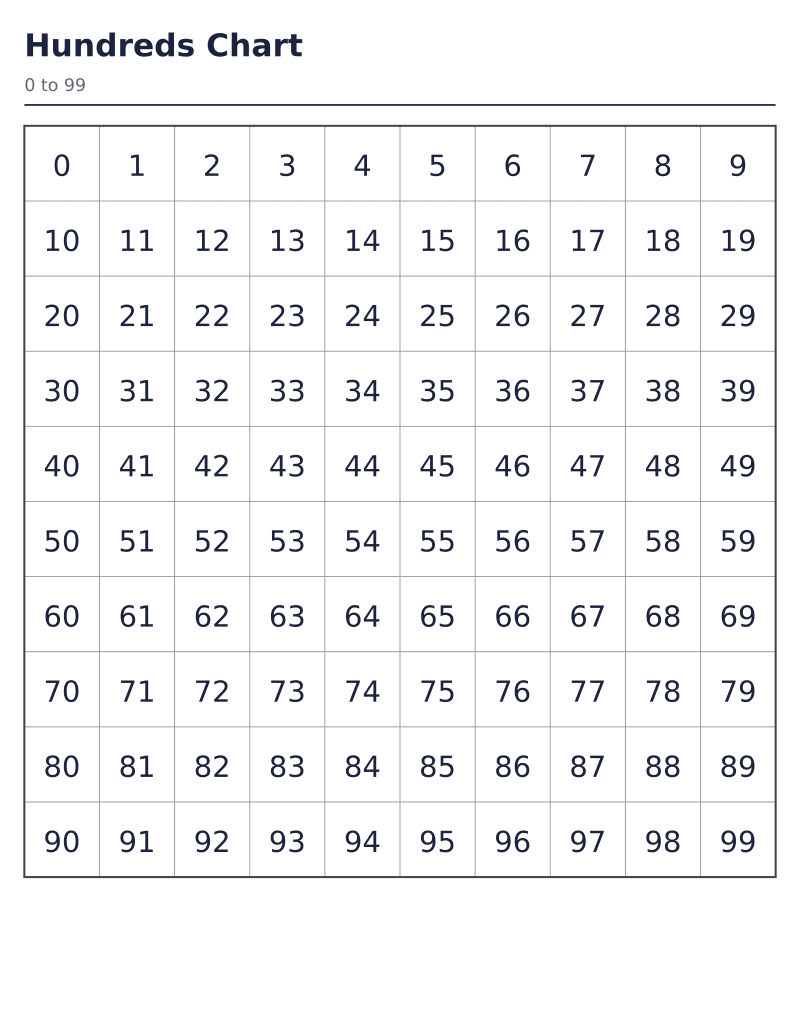 Number chart 0 to 99One tens digit to a rowDownload PDF ↓
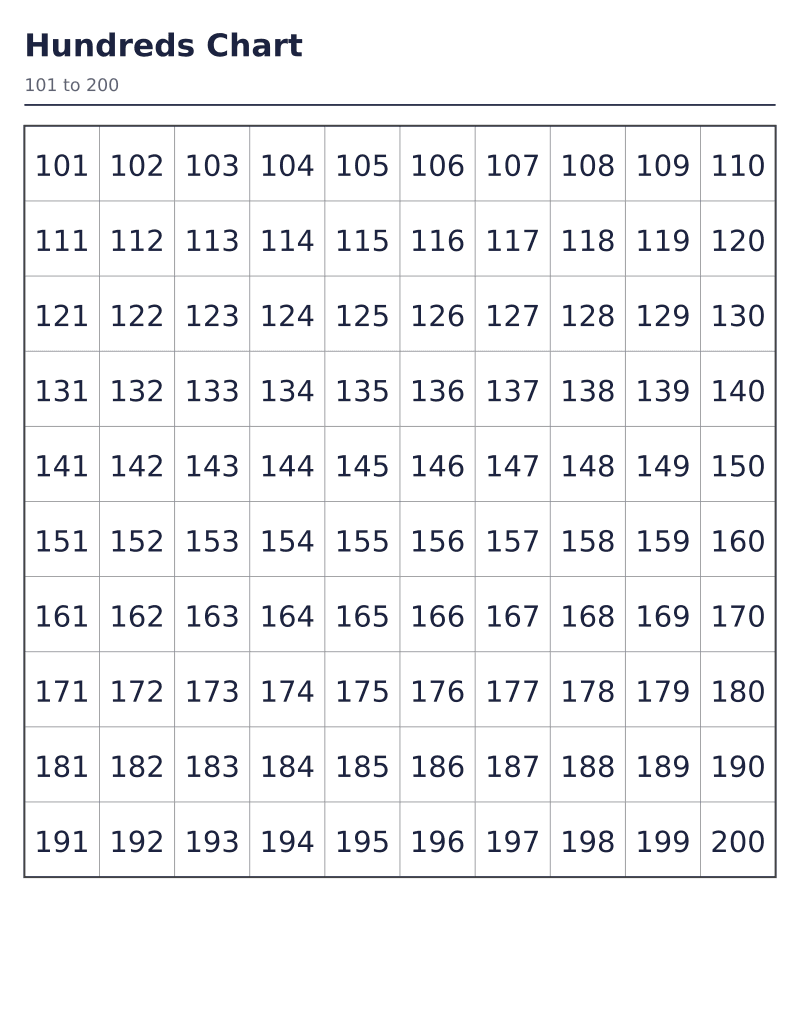 Number chart 101 to 200The second hundredDownload PDF ↓
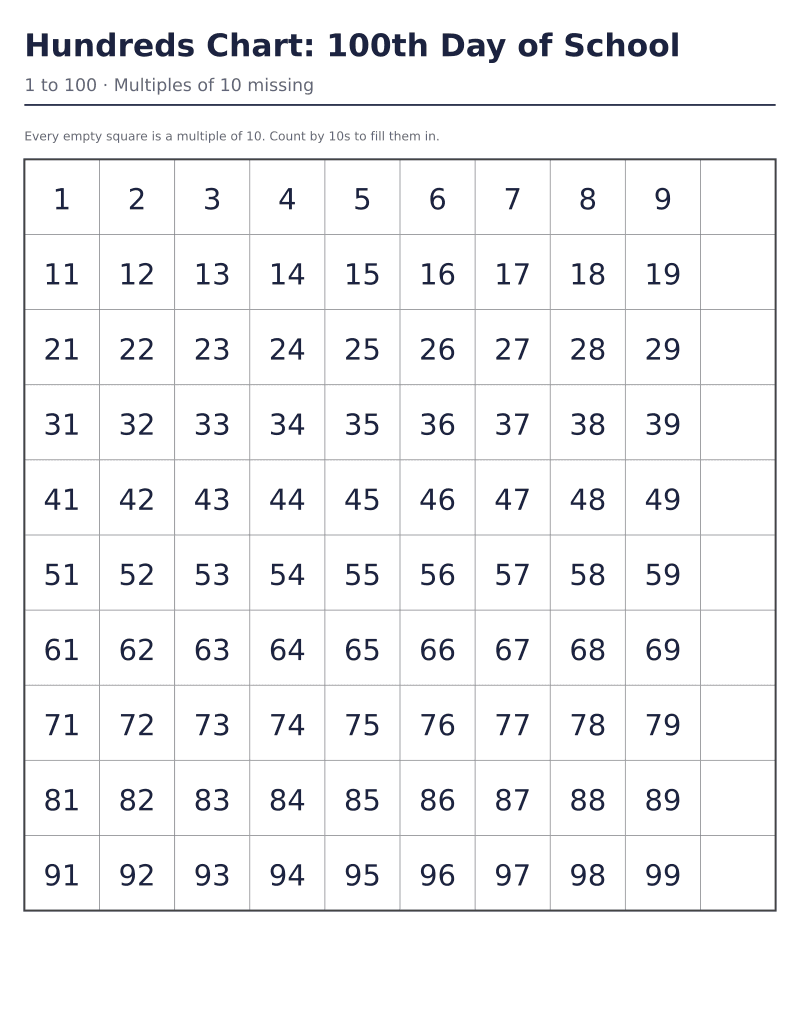 100th day of school hundreds chartCount to 100 by 10s, 5s, 2s and 1s · 4 charts, each with its keyDownload PDF ↓
Every sheet here is free to print as often as you like. If one saved you time, the tip jar is on Ko-fi.
Hundreds Chart
1 to 100
Created for free at puzzleandprint.com
The filled chart is ten rows of ten squares on one US Letter page, 1 in the top left corner and 100 in the bottom right, each number in near black in a square 18.2 mm across, so the whole grid is 182 mm wide and as tall. The grid lines are gray and the outline is heavier. There is no color and no decoration, so the chart reads the same from a black and white photocopier as from the printer.
Two charts to a page shrinks the squares to 10.8 mm, the charts stacked one above the other so the page can be cut in two for a desk or a folder, and four to a page sets them two by two at 8.7 mm. A chart that starts somewhere else is drawn the same way: the 0 to 99 version puts 0 in the corner, and the 101 to 200 chart and every hundred after it, up to 901 to 1000, carry on the count.
On a 1 to 100 chart each column holds numbers ending in the same digit, so moving down one square adds ten and moving up takes ten away, while moving right adds one. The diagonal from the top left corner runs 1, 12, 23 and on to 100, adding eleven at each step. Those moves are the reason the chart is used at all: adding 23 to 45 is two squares down and three to the right, landing on 68.
The 0 to 99 version shifts everything by one, so every number on a row shares its tens digit, 30 to 39 on the fourth row, which some teachers prefer for place value. On the 1 to 100 chart the tens digit changes at the end of each row instead, where 30 closes the third row. Shading the multiples of a number shows skip counting as a shape: the multiples of 10 fill the last column, the 5s fill two columns, the 2s make stripes in five of the ten columns, and the 9s step down and to the left, one column at a time, from 9 to 81.
A missing-number chart prints some of the numbers and leaves the rest of the squares empty. Random gaps come in three amounts, a quarter, half or three quarters of the squares, spread so that every row has its share, within one, and the first square is never left out, so the starting number is always on the sheet. Or the gaps can be the multiples of a number from 2 to 10, which turns the chart into a skip counting sheet.
Every missing-number and blank chart has its answer key on the next page: the chart with every number written in, the answers in a lighter gray than the printed ones. Up to five versions go in one download, each different and each followed by its key, and on a page of two or four random charts every chart is different and labeled, so a key can only be matched to the chart it belongs to.
For a classroom wall or a desk reference, the filled 1 to 100 chart. For first grade, where the Common Core asks children to count to 120, the 120 chart, which adds two rows: 101 to 110 and 111 to 120. For children moving on to three-digit numbers, the 101 to 200 chart shows that the second hundred follows exactly the same pattern as the first.
For practice, a missing-numbers chart with a quarter of the squares empty, then half, then three quarters as the count becomes secure. The blank chart, with every square empty and nothing printed but the grid, is the last step: writing the numbers from 1 to 100 in order, ten to a row, which is the instruction printed above it.
Many kindergarten, first grade and second grade classes mark the 100th day of school by counting to 100 together, and in most US schools the day falls between late January and the middle of February, depending on when the year began and how many days off came before it. A hundreds chart is the one sheet that holds the whole count, ten rows of ten ending on 100, so the counting planned for the day can be done on one.
The 100th day set among the ready-made charts at the top of this page counts to 100 four ways in one PDF. The first chart leaves out the 10 multiples of 10, the whole last column; the second the 20 multiples of 5, the fifth and tenth columns; the third the 50 even numbers, every other column; and the fourth is the blank chart, all 100 squares to fill in order. Each chart is headed Hundreds Chart: 100th Day of School and followed by its answer key, eight pages in all, so the odd pages go to the class and the even pages are kept for checking. The steps run 10, 20, 50 and 100 numbers to write, and a class can stop at whichever chart suits it.
Two more ideas need only the filled 1 to 100 chart. Its squares are 18.2 mm across, room for a dried bean, a button or a piece of cereal, so 100 small things can be counted out one to a square, a full row for every ten. Cutting a second copy along its grid lines into five or six large pieces makes a puzzle, put back together by matching the numbers across each cut: whatever sits under 47 has to be 57.
Many classes also count the days of school on a hundreds chart from the first day, writing in one number each morning, so the last square fills on the hundredth day. The blank chart serves for that, and the maker above prints it with a title of up to 40 characters, such as the class name, on the chart and on its answer key.
| Activity | What to print | Where it is |
|---|---|---|
| Counting to 100 by 10s, 5s, 2s and 1s | The 100th day set: four charts, each followed by its key | The ready-made charts on this page |
| Counting out 100 small things | The filled 1 to 100 chart, one thing to a square | The ready-made charts on this page |
| Counting the days of school | The blank chart, one number written in each morning | The ready-made charts on this page |
| Filling gaps anywhere in the count | A quarter, half or three quarters of the numbers missing, or a Monday to Friday set of five charts | Hundreds chart with missing numbers |
| Counting on past 100 | The 120 chart, with 101 to 120 in the same columns as 1 to 20 | 120 chart |
| Joining 100 dots | A heart, star, diamond or egg in 100 dots, 1 to 100 in standard print, or counting by 10s in 10 dots | Connect the dots maker |
| Writing 100 in a place value chart | The blank hundreds, tens and ones chart, where 100 is the first number with a digit in every column | Blank place value chart |
Each page has its own ready-made charts to print, plus the maker above opened on that chart.
Yes, every chart on this page and every one the maker makes, printed as many times as you like for home or a whole school. There is no sign-up, no email to give and no watermark on the chart.
Either is right, and the maker does both. The 1 to 100 chart is the common one and ends neatly on 100; the 0 to 99 chart puts every number with the same tens digit on one row, so 40 to 49 sit together, which suits place value lessons. Use whichever your textbook uses, so the patterns children learn match the chart in their book.
Yes. The first number can be 101, 201 and so on up to 901, so the charts run 101 to 200, 201 to 300 and up to 901 to 1000, or to 1020 on a 120 chart. The squares and the layout stay the same; only the numbers change.
One chart to a page gives squares 18.2 mm across on a grid 182 mm wide, which also fits A4 paper at 100%. Two to a page makes them 10.8 mm and four to a page 8.7 mm. A two-to-a-page chart with numbers missing is a little smaller, 9.4 mm, because the name line and the instructions take some of the page.
So the chart always shows where the count begins. On a 1 to 100 chart that hardly matters, but on a 301 to 400 chart a missing first square leaves the child guessing where to start, which is not what the sheet is practicing. Every other square can be left out, and the gaps are still counted against all of the squares, so a quarter missing is 25 of 100.
Yes, it is designed to. The numbers are near black, the grid is gray, and the only fill is a light gray behind any multiples you choose to shade, so there is no color to lose on a black and white printer or a photocopier.
By counting to 100 on it in more than one way. The ready-made 100th day set is one free PDF of four hundreds charts, each followed by its answer key: the 10 multiples of 10 left empty for counting by tens, the 20 multiples of 5 for counting by fives, the 50 even numbers for counting by twos, and a blank chart for writing every number from 1 to 100. A filled chart, with squares 18.2 mm across, also works as a mat for counting out 100 small objects, one to a square and ten to a row.
New printables when they go up, mostly seasonal, a few times a year.