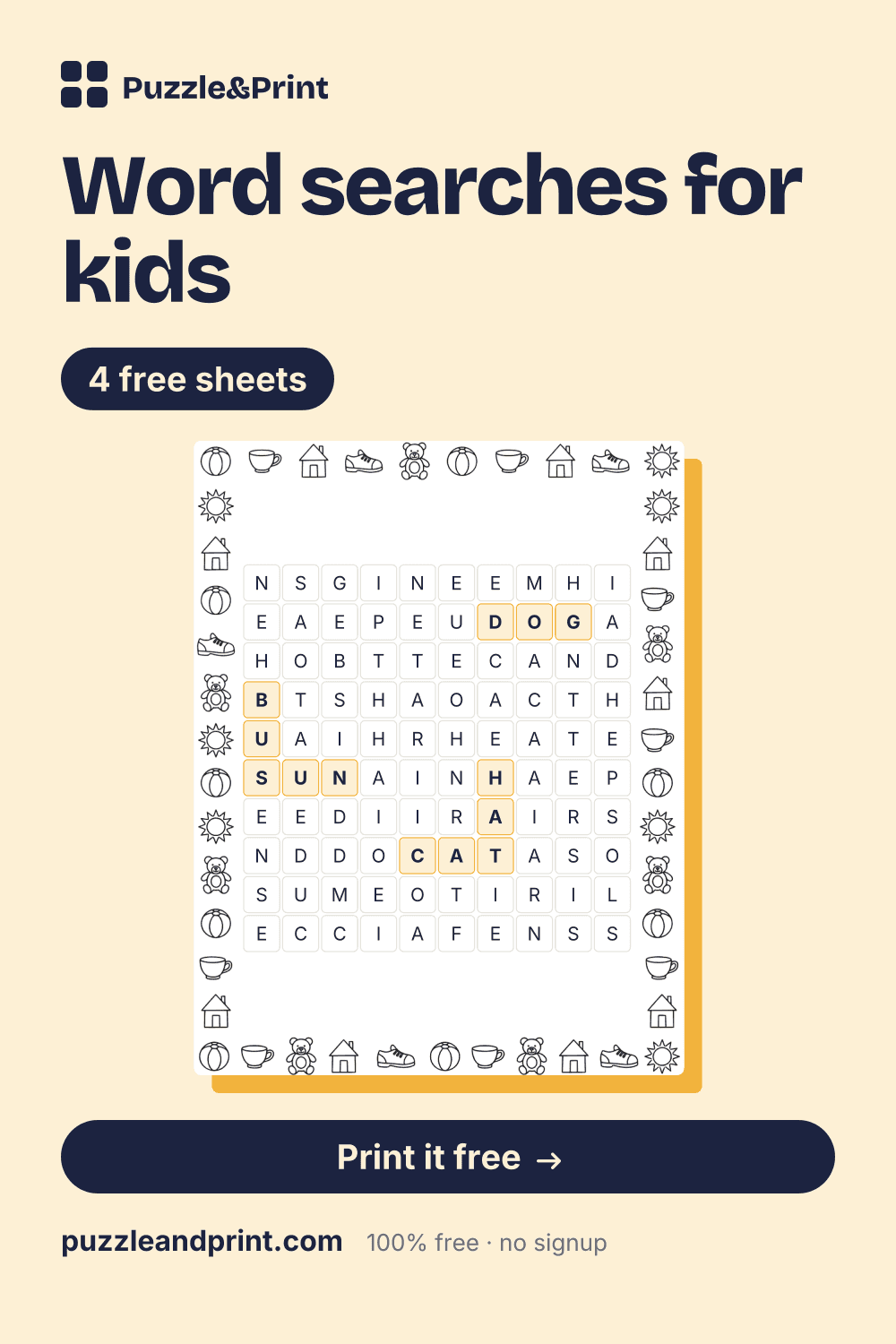
First words for kids Word Search
- DOOR
- SUN
- BEAR
- DUCK
- DOG
- NEST
- LION
- SNOW
Created for free at puzzleandprint.com
Four free printable word searches for kids, with short words, big letters and the answer key on its own page.
Last updated
Save this to PinterestFirst words for kids Word Search
Created for free at puzzleandprint.com
First words for kids Word Search, Answer Key
Created for free at puzzleandprint.com
Four sheets, each with a different job. Every one is a two-page PDF, the puzzle, then the answer key on its own page.
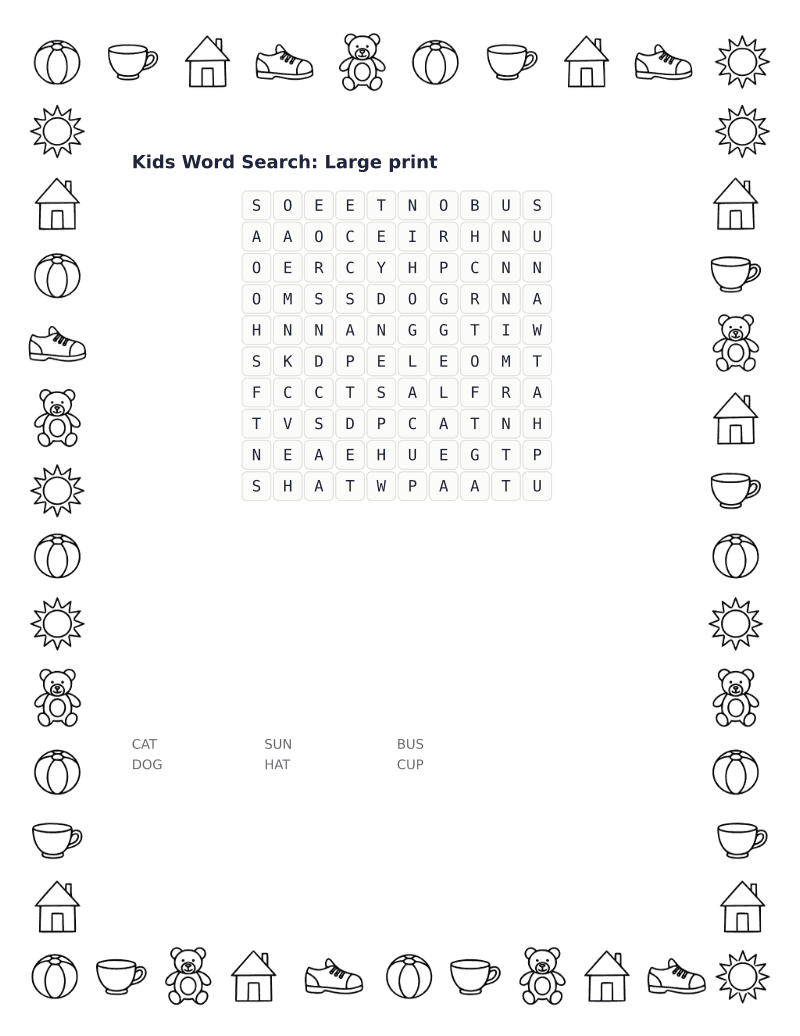 Kids word search, large print10 × 10 · 6 words · Easy, across and down onlyDownload PDF ↓
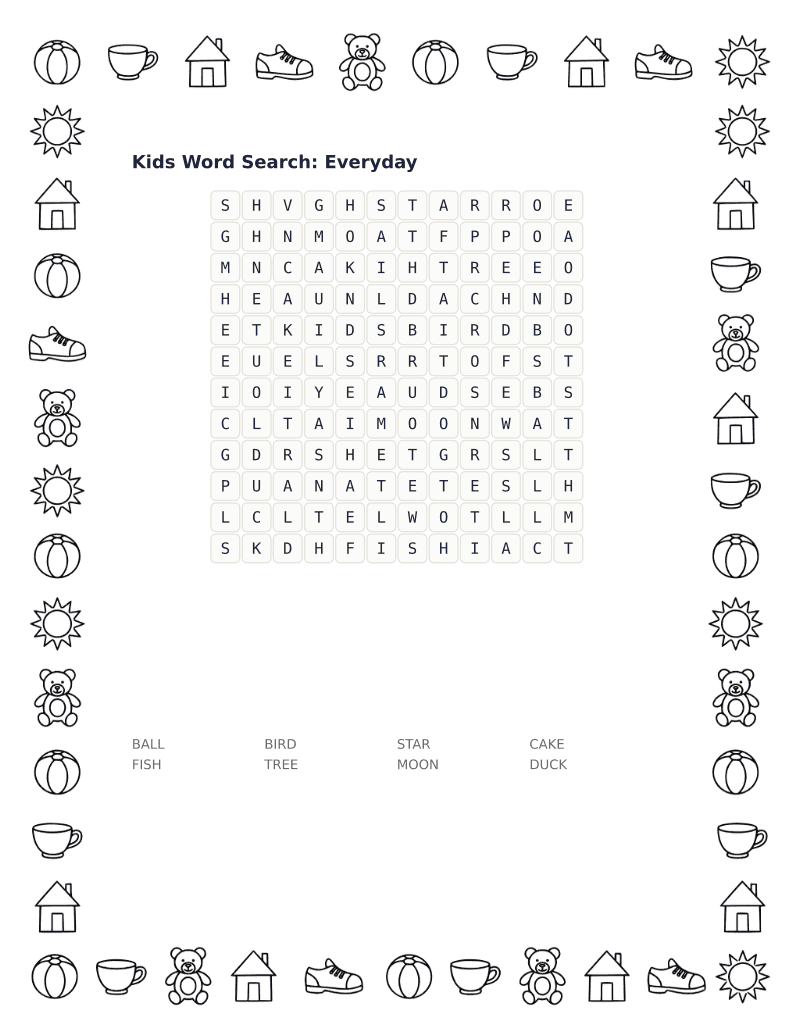 Kids word search, everyday12 × 12 · 8 words · Easy, across and down onlyDownload PDF ↓
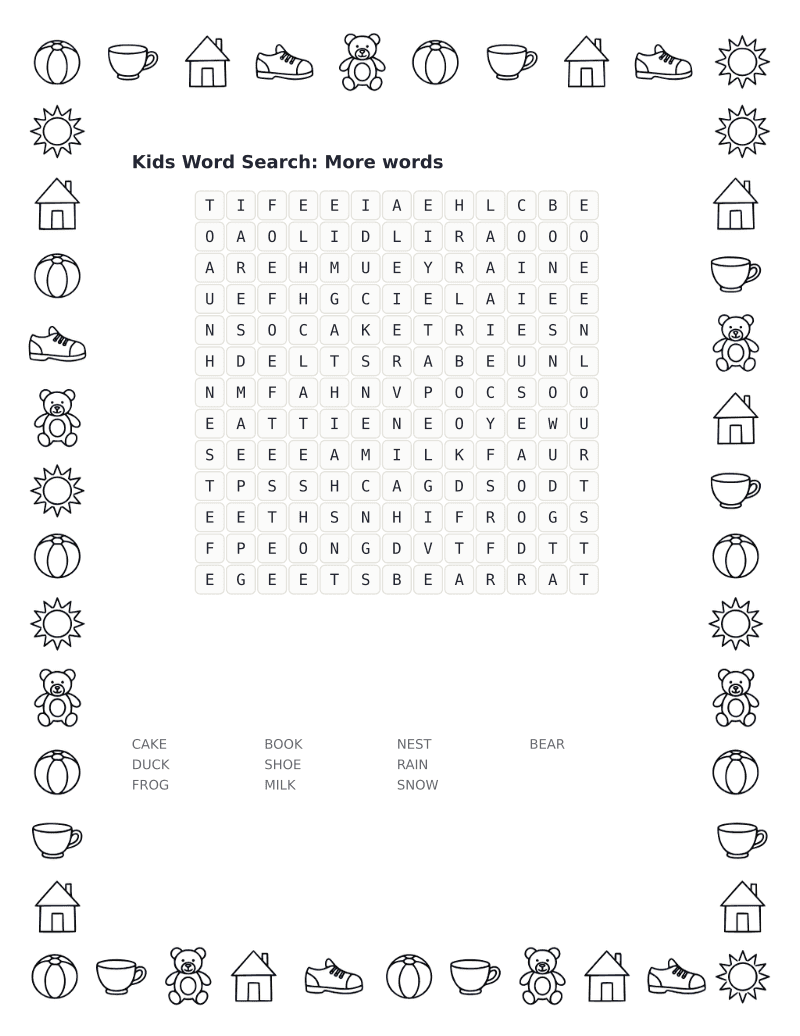 Kids word search, more words13 × 13 · 10 words · Easy, across and down onlyDownload PDF ↓
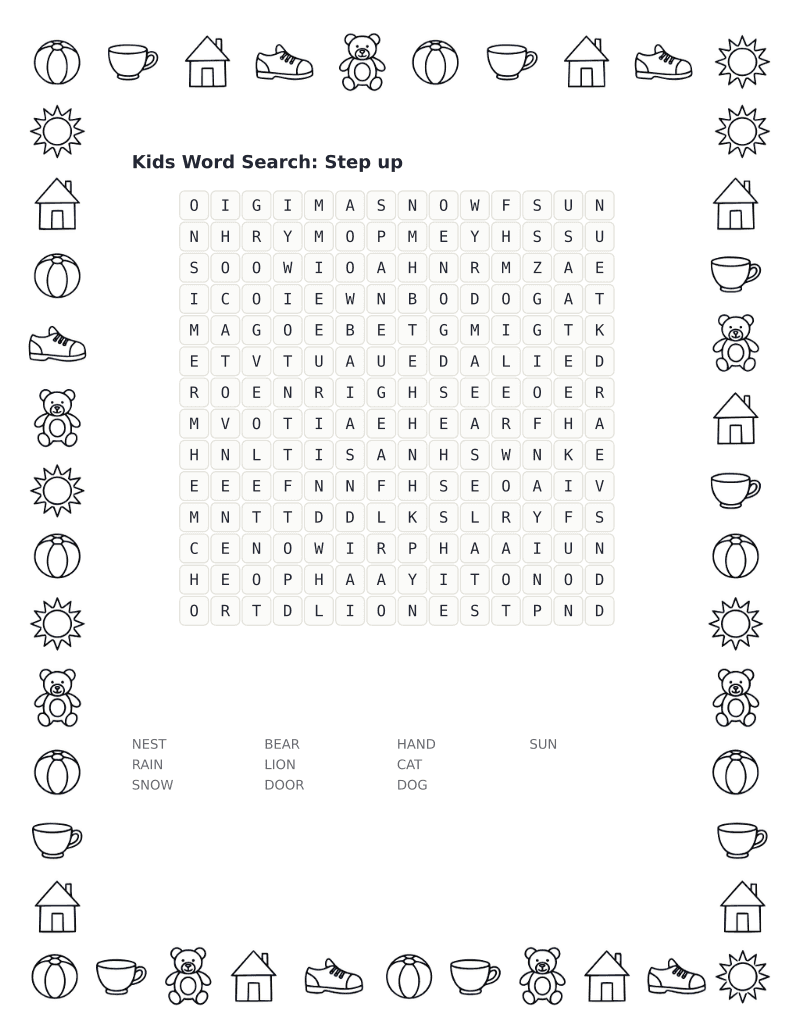 Kids word search, step up14 × 14 · 10 words · Medium, adds diagonalsDownload PDF ↓
Every sheet here is free to print as often as you like. If one saved you time, the tip jar is on Ko-fi.
A word search is often the first puzzle a child can finish without help, and that matters more than the puzzle itself. Finding a word means reading it one letter at a time and holding it in mind while your eye tracks along a row, which is exactly the skill that early reading needs practice at, dressed up as something more fun than a worksheet.
The ready-made sheets use short, familiar words and grids of ten to fourteen squares, which keeps the letters large enough for small hands to follow with a finger. Most run across and down only. A finger is a perfectly good tool here; so is a highlighter, and children who lose their place are usually helped more by a highlighter than by a smaller grid.
If a child is finding it hard, go back to the large-print sheet, where six three-letter words sit in a ten by ten grid with a lot of white space and a real sense of finishing something. Once they are confident, move up a size before adding difficulty, since diagonals wait until Step up.
Every sheet here is free to print as many times as you like, for one child or a whole class. The maker on this page opens with CAT, DOG, SUN, HAT, BUS, CUP, BALL and FISH in a twelve by twelve grid, across and down only, so you can swap in a child’s own spelling words and keep the rest.
The kids word search starts with words that can be sounded out one letter at a time and moves on to the first common letter pairs. CAT, DOG, SUN, HAT, BUS and CUP, the six words on the large-print sheet, need nothing more than single sounds, which is why a child who has only just started phonics can finish it. The other nineteen words on the list are all four letters long, and most of them bring in a pair of letters making one sound: the SH in FISH and SHOE, the CK in DUCK, the AI in RAIN, the EE in TREE and the OW in SNOW. STAR and BIRD show what an R does to the vowel in front of it.
MOON, BOOK and DOOR are worth reading aloud side by side, because the same OO makes three different sounds in them: long in MOON, short in BOOK, and different again in DOOR. They sit on three different sheets (Everyday, More words and Step up), so a child meets them one at a time, and comparing them once all three have been found turns the finished puzzles into a short phonics lesson. CAKE is the only word on the list with a split vowel, where the E at the end changes the sound of the A. LION is the one to watch for a child who sounds out carefully, since its I and O belong to different beats of the word.
Move up one sheet at a time, because the grid grows by one or two squares at each step and only the last sheet adds diagonals. The large-print sheet is ten squares with six words. Everyday is twelve squares with eight words, none of them from the large-print sheet, and More words is thirteen squares with ten; CAKE and DUCK appear on both of those. Step up is fourteen squares with ten words, and four of them, NEST, RAIN, SNOW and BEAR, were also on More words. Step up then brings back CAT, DOG and SUN from the very first sheet. Between them the four sheets use all twenty-five words on the list, and none is longer than four letters, so the difficulty grows through grid size and direction rather than through harder spelling.
Step up is the only kids sheet with diagonal words, and all four of its diagonals slope the same way. RAIN, BEAR, DOOR and HAND each run from top right down to bottom left, so the letters are read in a direction that runs against the left to right tracking a young reader has just learned. The other six words on that sheet run across or down, as on the earlier sheets. Before handing it over, trace one diagonal together with a finger, starting from the first letter at the top. Once one has been found, point out that the other three slope exactly the same way, which turns the new direction from a surprise into a pattern.
Four to seven or so, though reading is the better guide than age. A child who can read three-letter words such as CAT and SUN can finish the large-print sheet. Everyday and More words move on to four-letter words such as BALL, MILK and FROG, and Step up suits a reader who can also follow a word sloping down a diagonal.
Cut the word list before you change anything else. The maker on this page goes down to a ten by ten grid and takes any word of three letters or more, so five or six words the child already knows from their reading make a sheet they can finish. A child who finishes quickly and asks for another has had a much better time than one who grinds through a full page.
Capitals, both in the grid and in the word list printed underneath it. A child who has mostly met lower-case letters is therefore matching shapes that may still be new, so writing each large-print word in lower case beside its capital version before starting (cat next to CAT, bus next to BUS) makes a useful two-minute warm-up.
New printables when they go up, mostly seasonal, a few times a year.