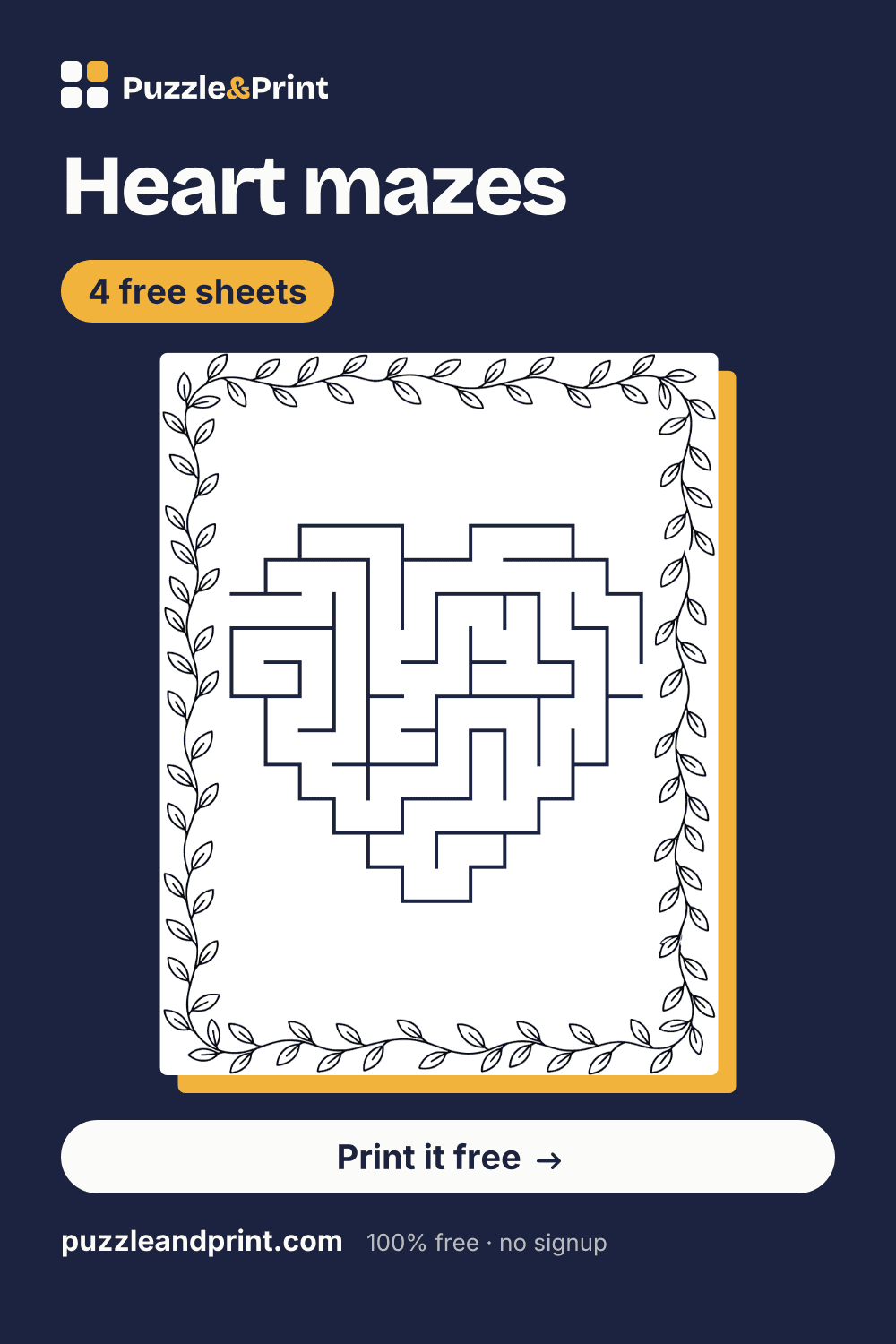
Heart Maze
Created for free at puzzleandprint.com
Heart Maze
Created for free at puzzleandprint.com
Heart Maze, Solution
Created for free at puzzleandprint.com
Four mazes, each a different size. Every one is a two-page PDF, the maze, then the solution on its own page.
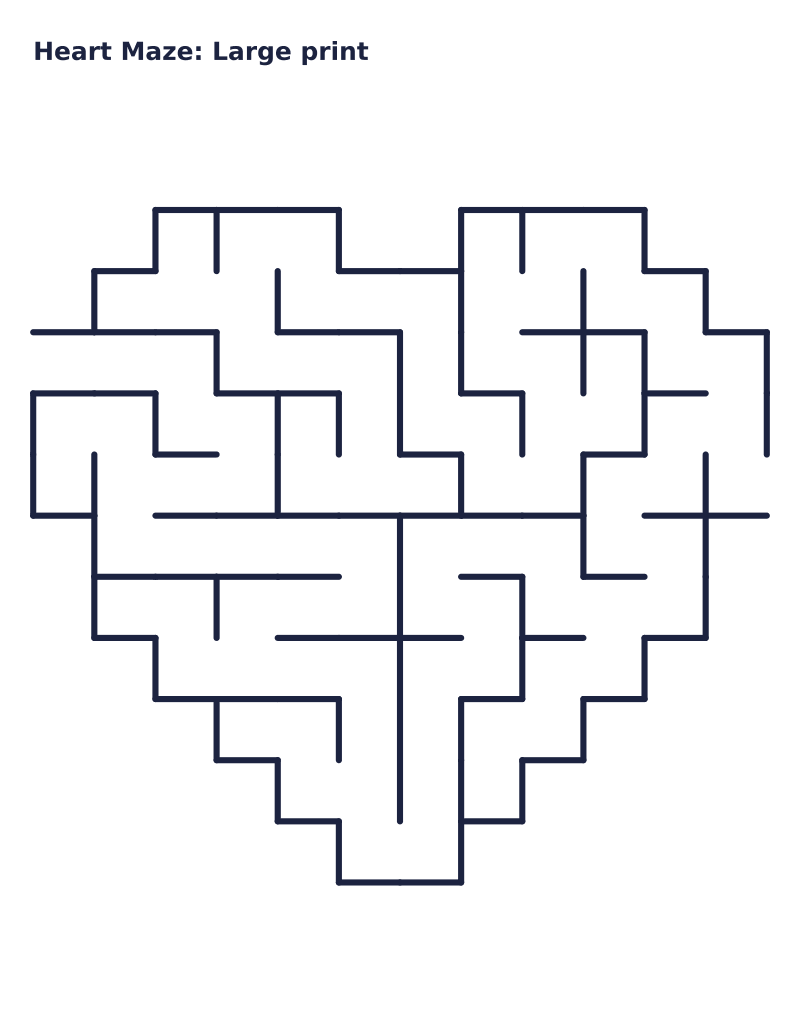 Heart maze, large print16 × 16 grid · EasyDownload PDF ↓
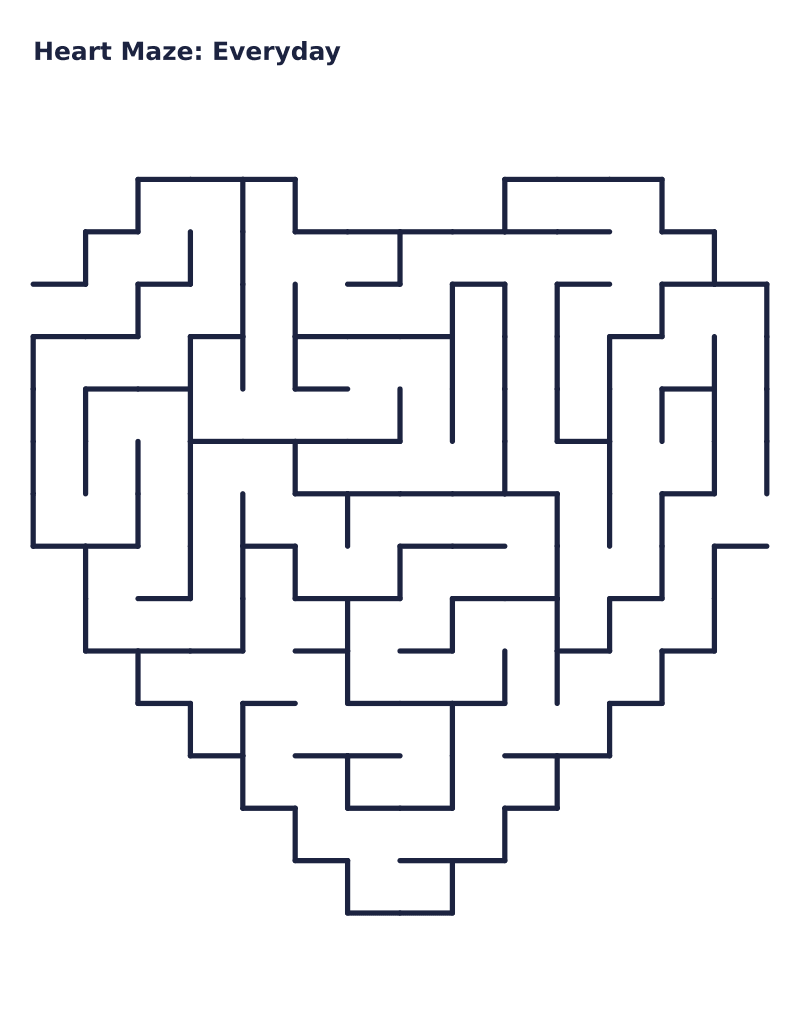 Heart maze, everyday20 × 20 grid · MediumDownload PDF ↓
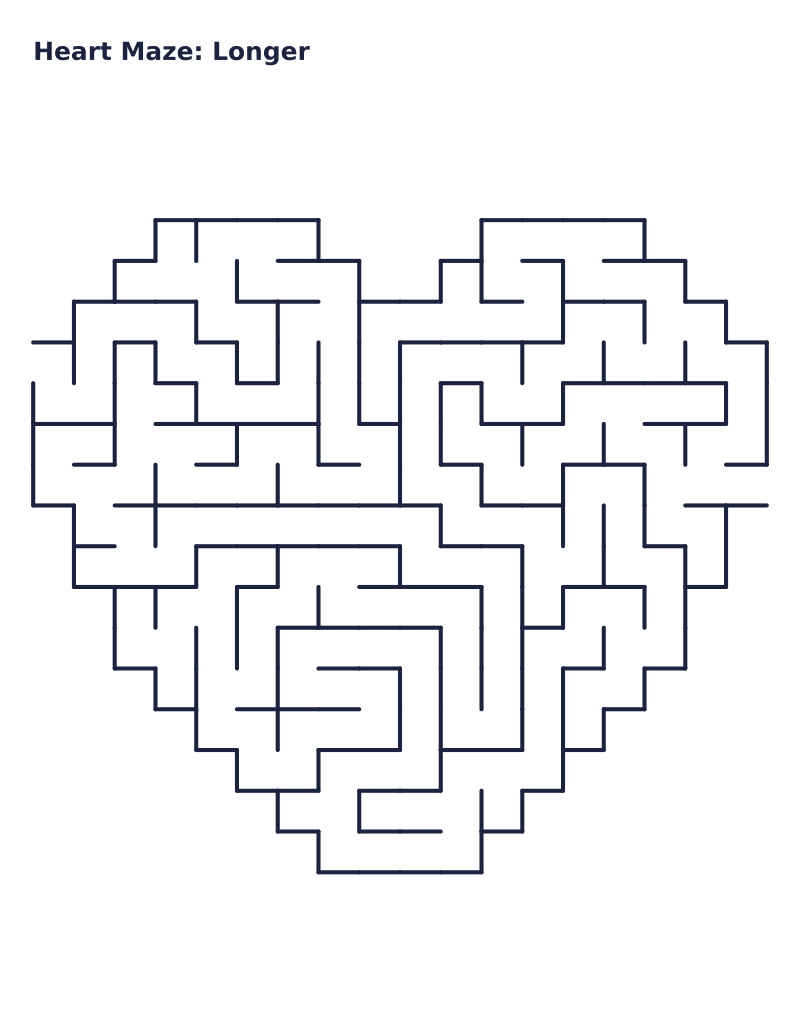 Heart maze, longer24 × 24 grid · MediumDownload PDF ↓
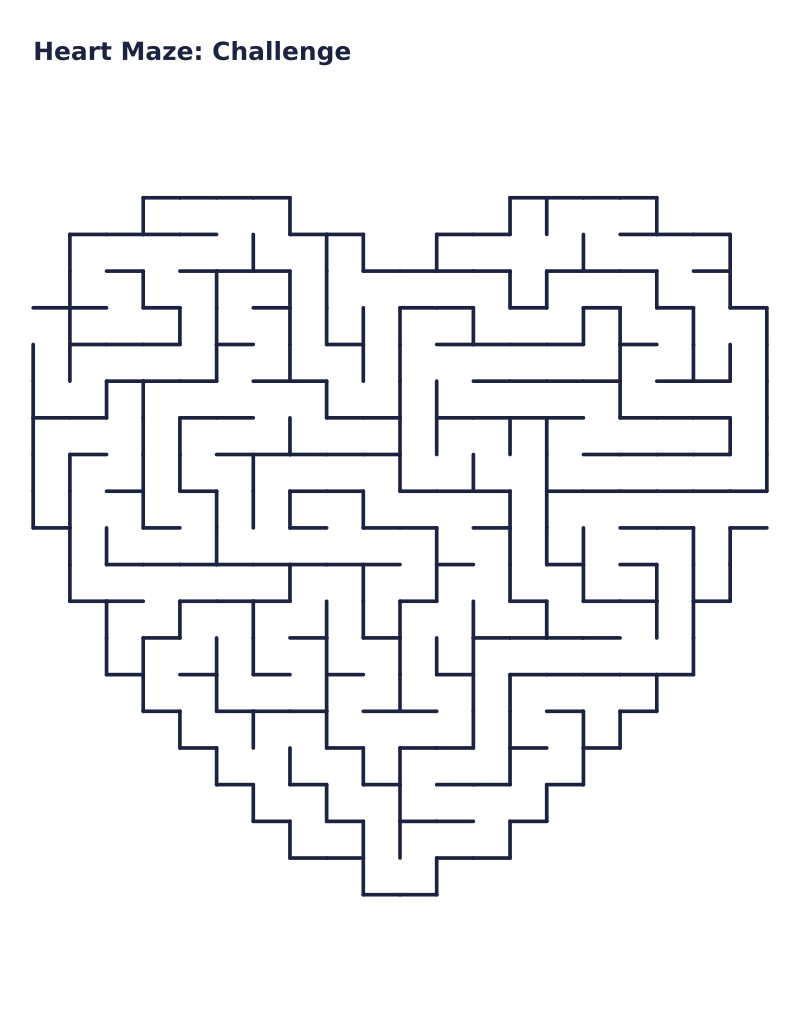 Heart maze, challenge28 × 28 grid · HardDownload PDF ↓
Every sheet here is free to print as often as you like. If one saved you time, the tip jar is on Ko-fi.
A heart maze is a plain maze with the corners taken off, and that turns out to matter more than it sounds. A square maze gives no clue where you are; a shaped one does, because the outline tells you how far you have come. Children who lose their place in a rectangle often do not in a heart.
The outline costs squares. A heart keeps roughly a third of the grid it is cut from, so these sheets start at sixteen squares rather than twelve, a sixteen-square heart is about as much puzzle as a ten-square rectangle. The route still runs left to right, entering at the widest point on one side and leaving at the other.
The obvious use is February, and it does the job, a class set of these is a Valentine activity that involves no glitter and no glue. But a heart is not only a Valentine shape, and these work as a get-well card insert, a Mother's Day sheet, or simply a maze that looks like something.
Each heart has exactly one route and no loops, and its solution prints as the second page of the same PDF. The dead ends grow with the grid: 10 on the Large print, 18 on the Everyday, 24 on the Longer and 33 on the Challenge.
For a child still learning pencil control, the Large print heart is better, because its squares print about 11 mm across against about 9 mm on the Everyday sheet. The heart sits in a grid of 16 squares each way and keeps 92 of them. Its route is 42 squares with five forks, and four of those forks lead into dead ends of five squares or fewer. The fifth sits one square before the way out, where a turn climbs into the right-hand lobe and opens a 36-square branch that fills both lobes of the heart, its longest dead end 29 squares in, so a child who is nearly finished can still be sent on a detour.
For a child who can manage narrower corridors but gives up after wrong turns, the Everyday heart is the gentler puzzle. The first 49 squares of its 58-square route contain no fork at all: they form one long corridor that winds from the way in across the heart, and the only decision comes eight squares before the way out. The wrong branch there runs 14 squares before it stops. That makes the Everyday heart close to a pure pencil-control exercise, a long line to keep between two walls with almost nothing to work out, which suits a child who enjoys drawing more than puzzling.
The Challenge heart is harder because of one wrong turn: a single side branch runs 98 squares before it dead-ends, longer than the 87-square route through the maze itself. It opens 76 squares along the route, and everything below the route's lowest point, all the way down to the tip of the heart, belongs to it. The Longer heart is the opposite kind of puzzle. Its route is the longest of the four at 135 squares and passes 14 forks, but no wrong turn on it runs more than 15 squares, so it asks for patience rather than luck.
Both sheets need a pencil rather than a crayon, with squares of about 7.6 mm on the Longer and 6.5 mm on the Challenge. For a Valentine's class set that means the Longer heart for children who like a long route and the Challenge for those who enjoy being caught out, since the route on the Challenge is quick once that one turn is avoided. There is also a useful hint for a child who is stuck on the Challenge, and it gives nothing else away: the route never enters the bottom six rows of the heart, so anyone drawing down into the narrow point has taken the wrong turn.
Because a heart throws away nearly two thirds of the square it is cut from. Every heart sheet here keeps 36 percent of its grid, from 92 squares on the sixteen-square Large print to 282 on the twenty-eight-square Challenge, so starting at sixteen still gives the smallest sheet a 42-square route with five branches off it.
It starts on the left edge of the heart and finishes on the right edge, never down at the point. The way in is the highest square of the heart’s leftmost column and the way out the lowest square of its rightmost column, so on every ready-made sheet the exit sits lower than the entrance: two rows lower on the Large print, four on the Everyday, three on the Longer and five on the Challenge.
No. Sixteen is the smallest heart it will carve, so choosing Easy on this page gives a sixteen-square heart rather than the usual twelve. Below that the outline is unreliable: at fourteen squares the dip between the two lobes disappears altogether and the shape reads more like a shield, and at twelve the heart keeps only 48 squares.
New printables when they go up, mostly seasonal, a few times a year.