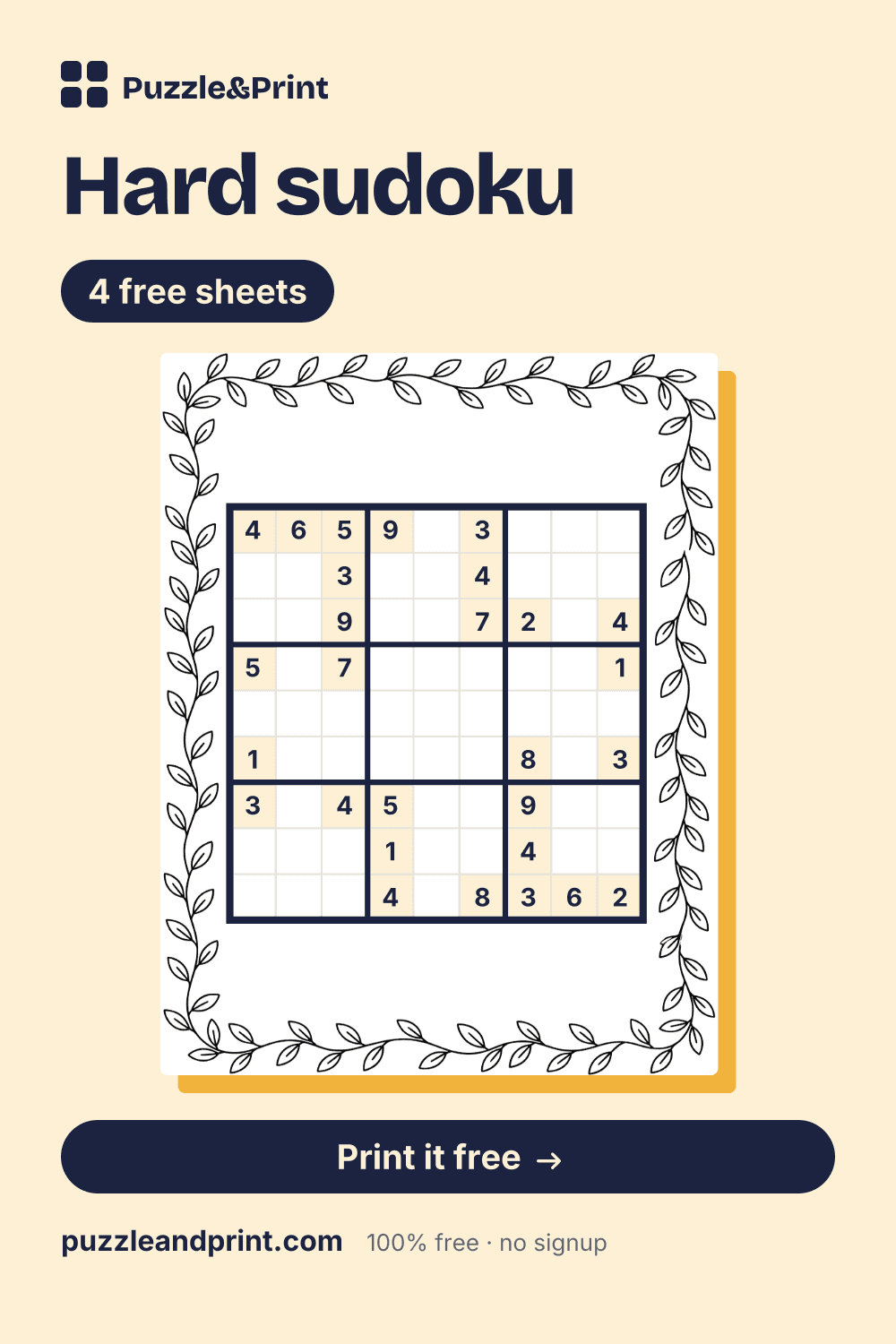
Sudoku
9 × 9 · Hard
Write 1 to 9 once in every row, every column and every 3 by 3 box.
Created for free at puzzleandprint.com
Nine by nine, and each one needs a pair or a pointing move somewhere.
Last updated
Save this to PinterestSudoku
9 × 9 · Hard
Write 1 to 9 once in every row, every column and every 3 by 3 box.
Created for free at puzzleandprint.com
Sudoku, Answer Key
9 × 9 · Hard
Created for free at puzzleandprint.com
Four sheets, each a two-page PDF: the puzzles, then the answer key on its own page.
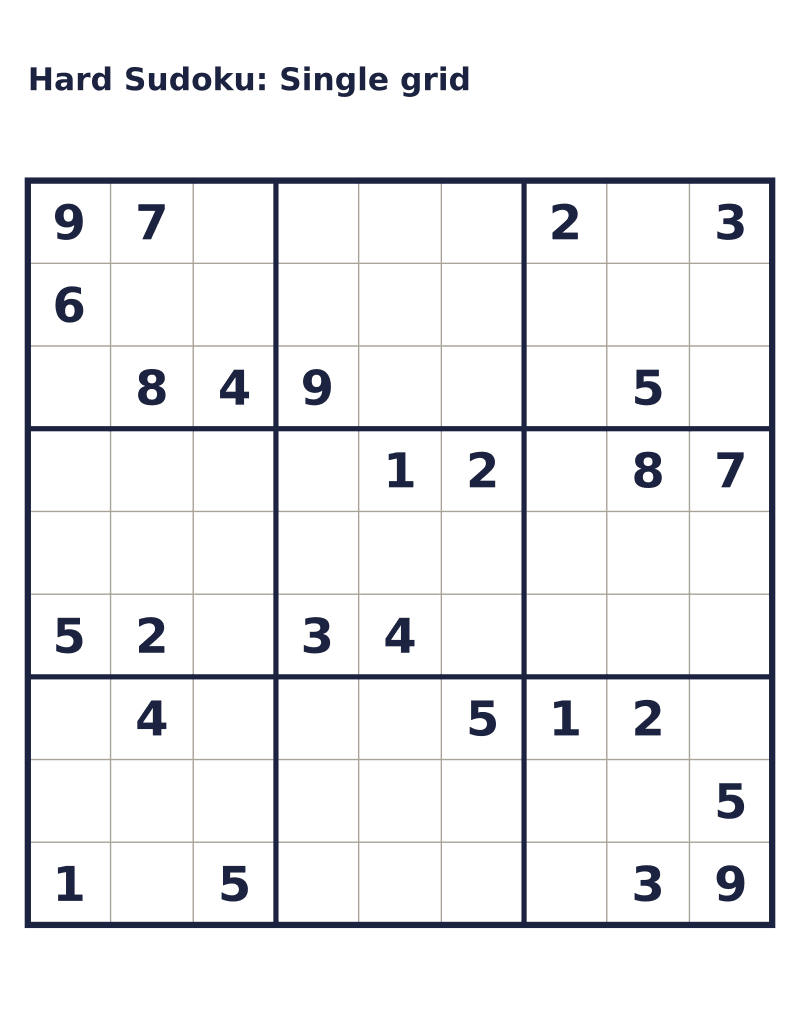 Hard sudoku, single grid9 × 9 · Hard · 1 puzzleDownload PDF ↓
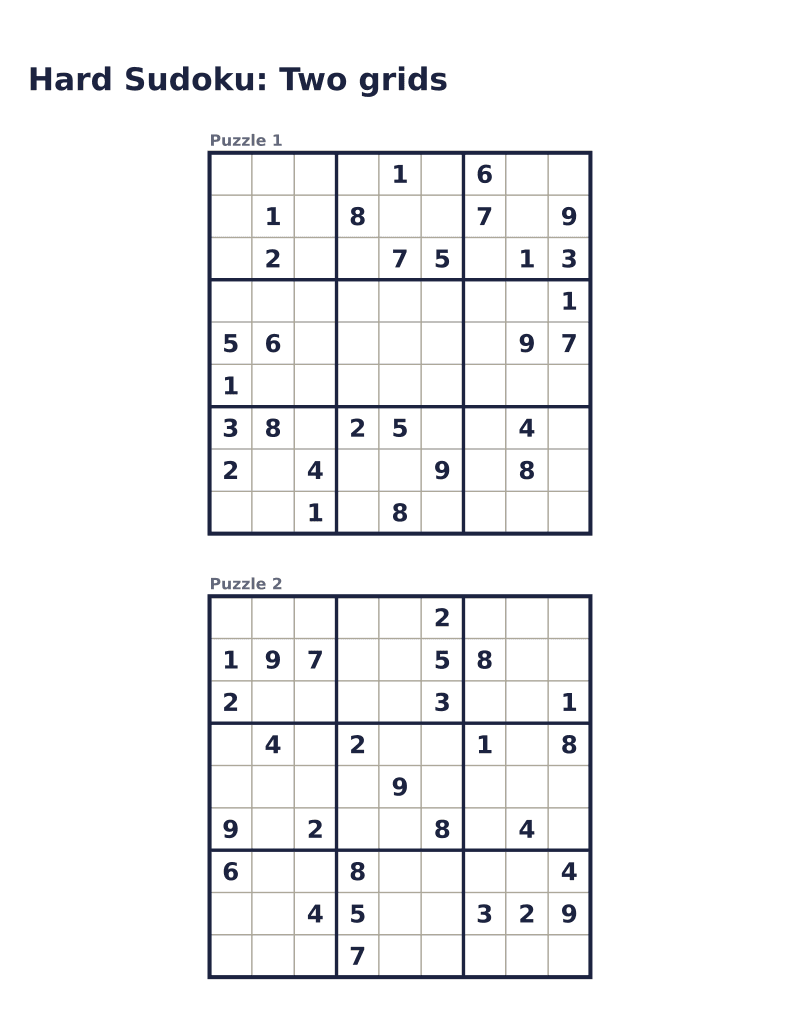 Hard sudoku, two grids9 × 9 · Hard · 2 puzzlesDownload PDF ↓
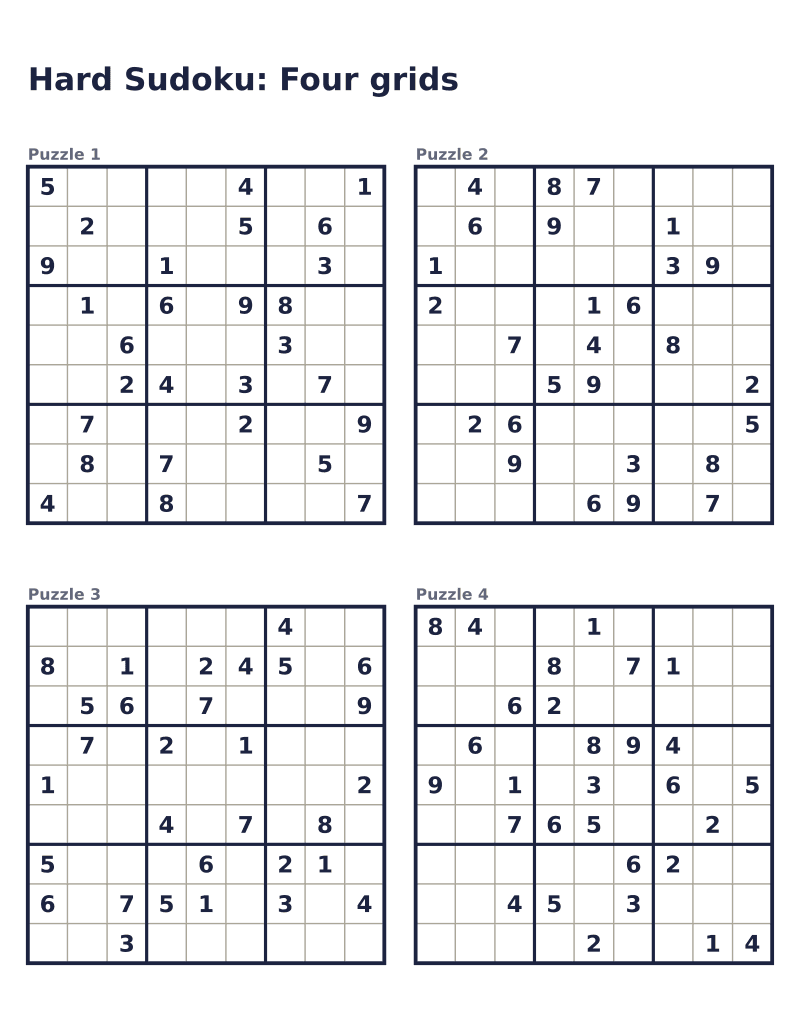 Hard sudoku, four grids9 × 9 · Hard · 4 puzzlesDownload PDF ↓
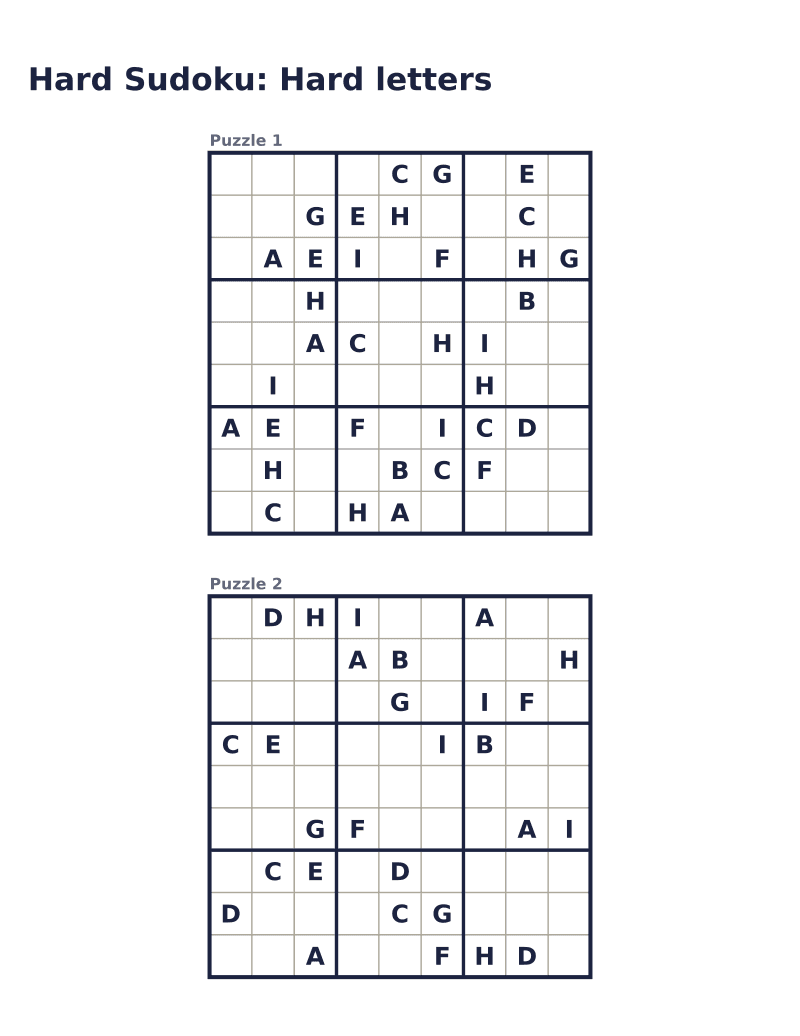 Hard sudoku, hard letters9 × 9 · Hard · letters · 2 puzzlesDownload PDF ↓
Every sheet here is free to print as often as you like. If one saved you time, the tip jar is on Ko-fi.
Hard on this page has a definite meaning. Each puzzle reaches a point where neither kind of single will place another number, and the only way on is to rule numbers out: with a naked pair, a pointing pair or a box-line reduction. Every one needs at least one of those moves and none needs anything more, so there is no guessing, no trial and error and no X-wing.
That makes these the hardest puzzles that stay friendly to pencil and paper, and the sticking point is usually short. Solving each one the easiest way available at every step, the grader here used one naked pair in the whole of the single grid sheet, and one in each puzzle on the two grids sheet. The four grids sheet is the most varied: its first puzzle took a naked pair and five pointing pairs, its second two naked pairs, its third two pointing pairs and two box-line reductions, and its fourth a single naked pair.
Clue counts run from 26 to 34 across the four sheets, and they say little about which puzzle is harder. The hard letters sheet, which uses A to I, has one grid with 34 clues that still took a naked pair and another with 28 that took two.
Hard puzzles are the slowest kind for the maker to produce, because a grid that comes out easier than hard is thrown away and another tried. Even so, a new page of one or two appears in well under a second on a typical laptop, worked out in the background so the page stays usable.
A naked pair is two squares in the same row, column or box that can each hold only the same two numbers, so those two numbers can be crossed out of every other square in that row, column or box. A pointing pair is a number that, inside one box, can only go in a single row or column, so it can be ruled out of the rest of that row or column outside the box. A box-line reduction is the reverse: a number that, inside one row or column, can only go in a single box, so it can be ruled out of the rest of that box.
Across the nine puzzles on this page’s four sheets, the grader used a naked pair in eight, a pointing pair in two and a box-line reduction in one, the third puzzle on the four grids sheet, which used both of the last two. None of these moves places a number by itself. Each one clears a candidate so that a single appears again, and then the solve runs on as before.
Pairs are far easier to see once the possible numbers are written down, so hard puzzles are where pencil marks start to earn their place: small numbers in the corner of a square listing what it could still be. That needs room. The single grid sheet prints its puzzle with squares about 0.8 of an inch across, enough for several small figures and the final answer.
The two grids sheet has squares just over 0.4 of an inch and the four grids sheet just under, which suits a solver who keeps notes only for the few squares that matter. The answer key for each sheet is on its second page, and because every puzzle has exactly one solution, a square that disagrees with the key is always a mistake rather than an alternative answer.
No. Every hard puzzle here was finished by a solver that never guesses and uses nothing beyond naked pairs, pointing pairs and box-line reductions on top of singles. If a solve stalls, one of those three moves is available somewhere; trial and error is never required.
Usually not, and on purpose. Puzzles sold as expert or diabolical tend to need techniques beyond these, such as X-wings and chains. Hard here stops at pairs and pointing, so it is a real step up from medium while staying solvable with a pencil and some patience.
New printables when they go up, mostly seasonal, a few times a year.