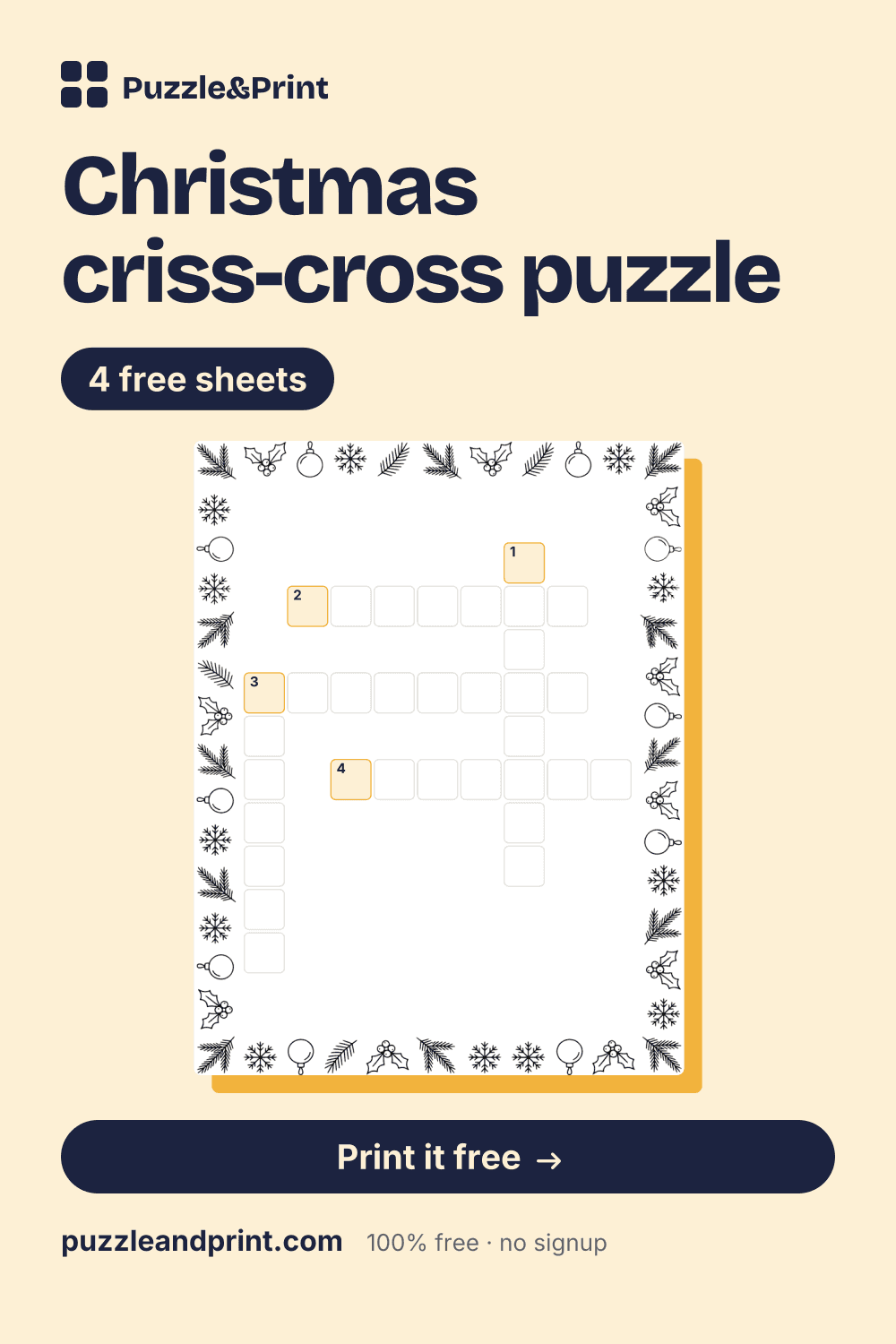
Christmas Criss-Cross
- CANDLE
- CHESTNUT
- FEAST
- FIREPLACE
- GARLAND
- GINGER
- HOLLY
- PARCEL
- REINDEER
- SLEIGH
- SPRUCE
- WREATH
Created for free at puzzleandprint.com
Interlock your own list, or take one of four ready-made festive grids.
Save this to PinterestCreated for free at puzzleandprint.com
Created for free at puzzleandprint.com
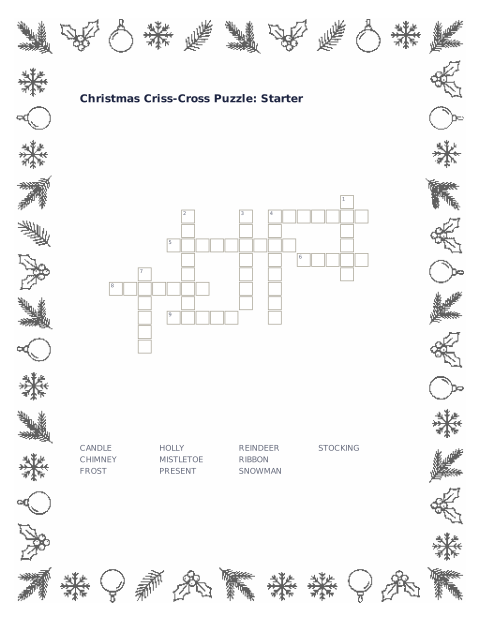
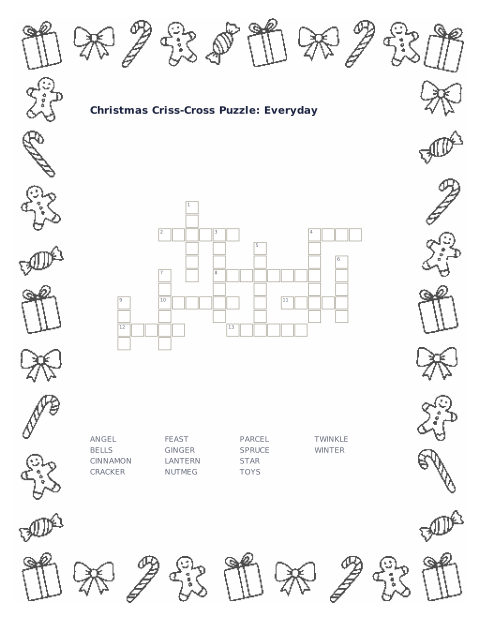
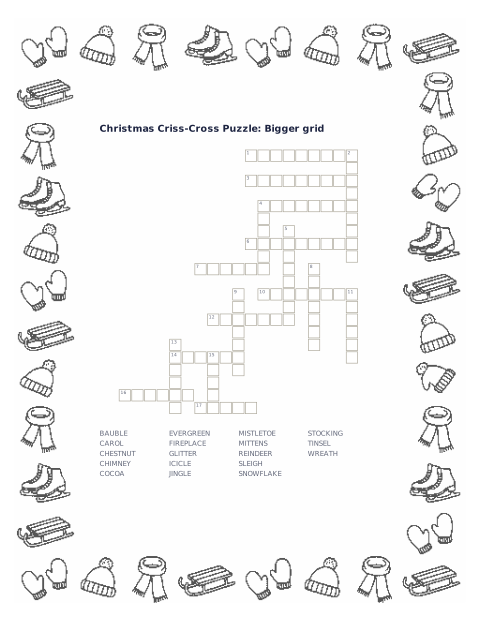
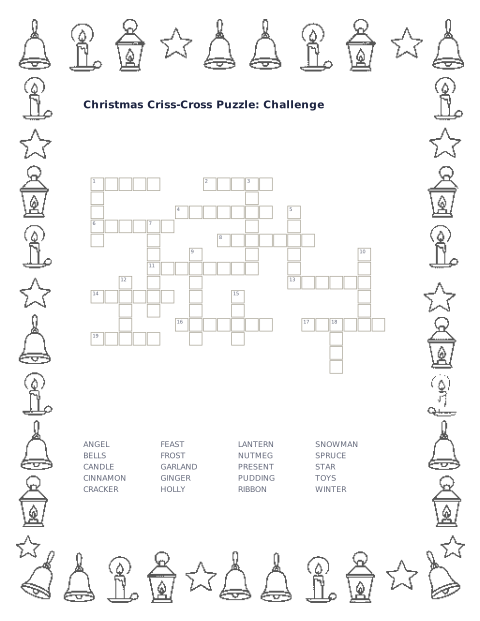
Four grids from ten words to twenty. Every one is a two-page PDF, the puzzle, then the answer key on its own page.
A criss-cross is the version of a crossword that works in a classroom, because the words are printed underneath the grid and there are no clues to write or to understand. Nobody is stuck because they have not heard of something. The whole puzzle is a question of where each word fits, and that turns out to be the part children will actually argue about.
Christmas vocabulary suits it unusually well. The interlock needs words of different lengths sharing letters, and this list gives you MISTLETOE and SNOW in the same set, which is exactly the mix that produces a grid with long spines and short crossings rather than a dense block. POINSETTIA and CANDLE crossing at an L is the kind of thing a solver spots once and then looks for everywhere.
It asks more than the word search does. Finding CAROL in a grid of letters means recognising a shape you can already see; writing it into six squares means producing the spelling from memory, one letter at a time, in a place where a wrong letter stops the next word fitting. The puzzle checks itself, which is why a child will correct their own spelling here without being told to.
The four sheets run from ten words to twenty. Print the starter for the last week of term when nobody is concentrating, and the challenge for a child who finishes everything early and needs something that takes longer than four minutes. If you want the words from your own carol or class list instead, the maker on this page will interlock them and print the key separately.
A search asks you to recognise a word you can already see; a criss-cross asks you to produce its spelling one letter at a time. Finding CAROL is a shape-matching job. Writing it into five squares where the second letter is already fixed by another word is a spelling job, which is why children correct themselves on this sheet without being told to.
No, it is the whole design. The word list under the grid is the clue, so nobody is locked out for not knowing something, and the puzzle becomes a question of where each word fits rather than what each word is. That is what makes it work in a class where reading ages vary by four years.
It shared no usable letter with anything already placed, so there was nowhere to interlock it. Unlike a word search, a criss-cross cannot put a word somewhere on its own. Press New puzzle to rearrange everything, or swap the word for one with more vowels in it.
No, and that is the point of this rather than a crossword. The solver gets the full word list and works out where each one goes, so a puzzle takes about as long to make as a word search does.
They mark where a word begins, numbered left to right and top to bottom the way a crossword is. Where an across word and a down word start in the same square, they share one number.
Ten to fourteen makes a comfortable grid for most lists. Fewer than that and the puzzle is over quickly; past about sixteen the grid starts to sprawl and the squares get small on a printed page.
Always, and it prints on its own page so you can hand out the puzzle without it. The key is the same grid with every letter filled in.
No. There is no sign-up, no email, and no watermark on the printed sheet. The grid is worked out in your browser, so your word list never reaches us.
New printables when they go up, mostly seasonal, a few times a year.