Primary Writing Paper
Created for free at puzzleandprint.com
Headline, dashed midline and baseline, at the line heights schools use.
Last updated
Save this to PinterestPrimary Writing Paper
Created for free at puzzleandprint.com
Ruled sheets at the standard sizes, each one a single page. The measurement is printed at the foot, so a reprint can be checked against a ruler.
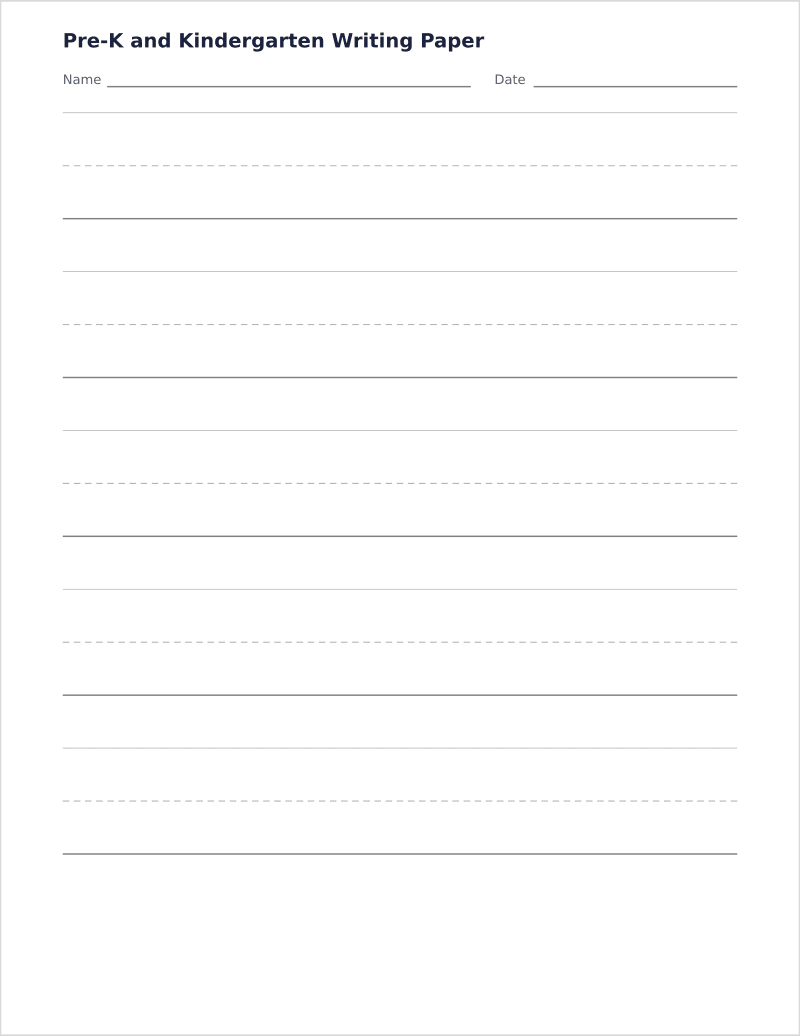 Pre-K and kindergarten writing paper1 1/8 inch lines · 5 to a pageDownload PDF ↓
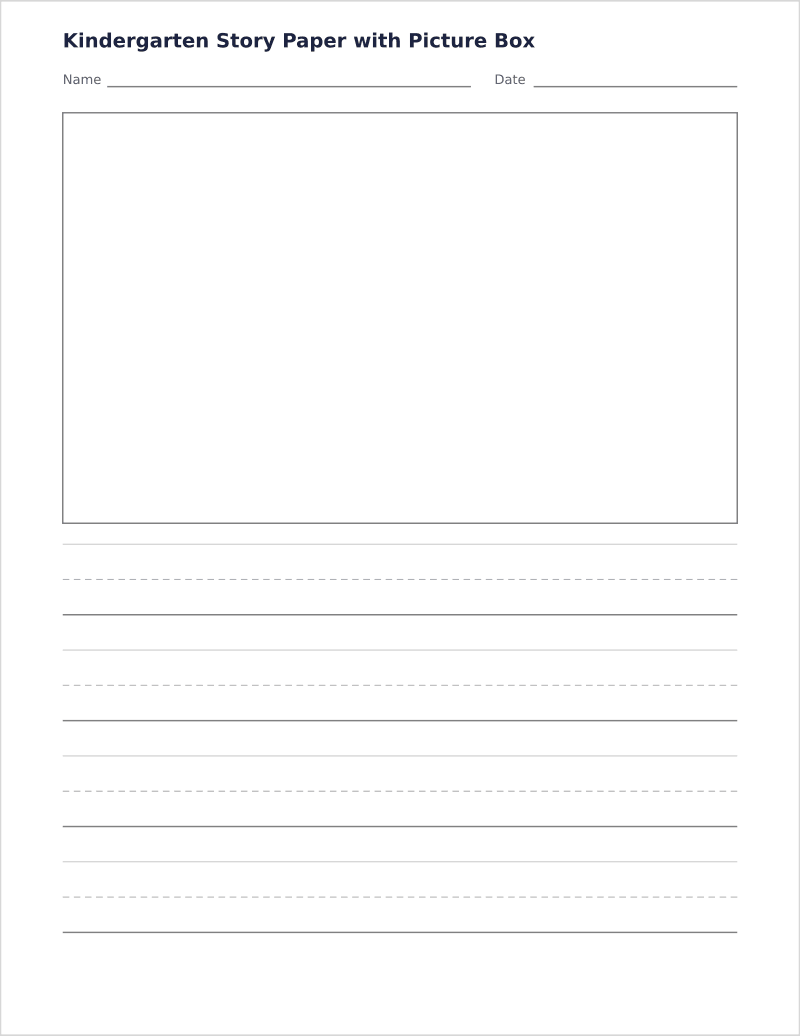 Kindergarten story paper with picture box3/4 inch lines · 4 to a page · picture boxDownload PDF ↓
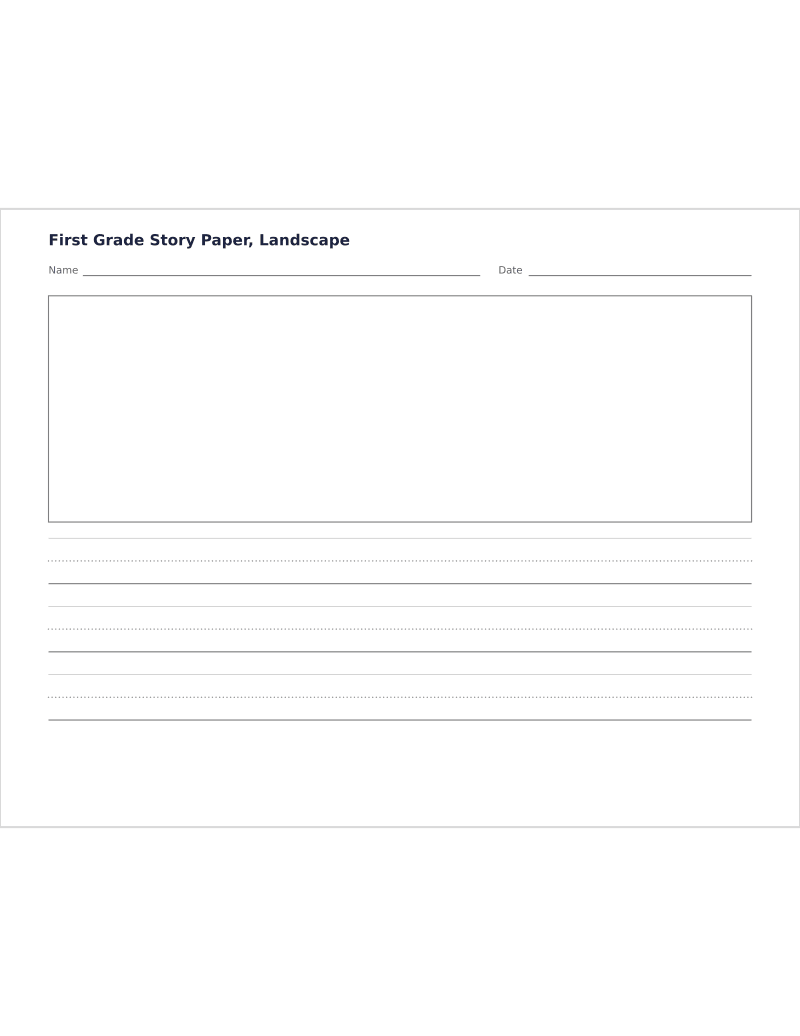 First grade story paper, landscape5/8 inch lines · 3 to a page · picture box · landscapeDownload PDF ↓
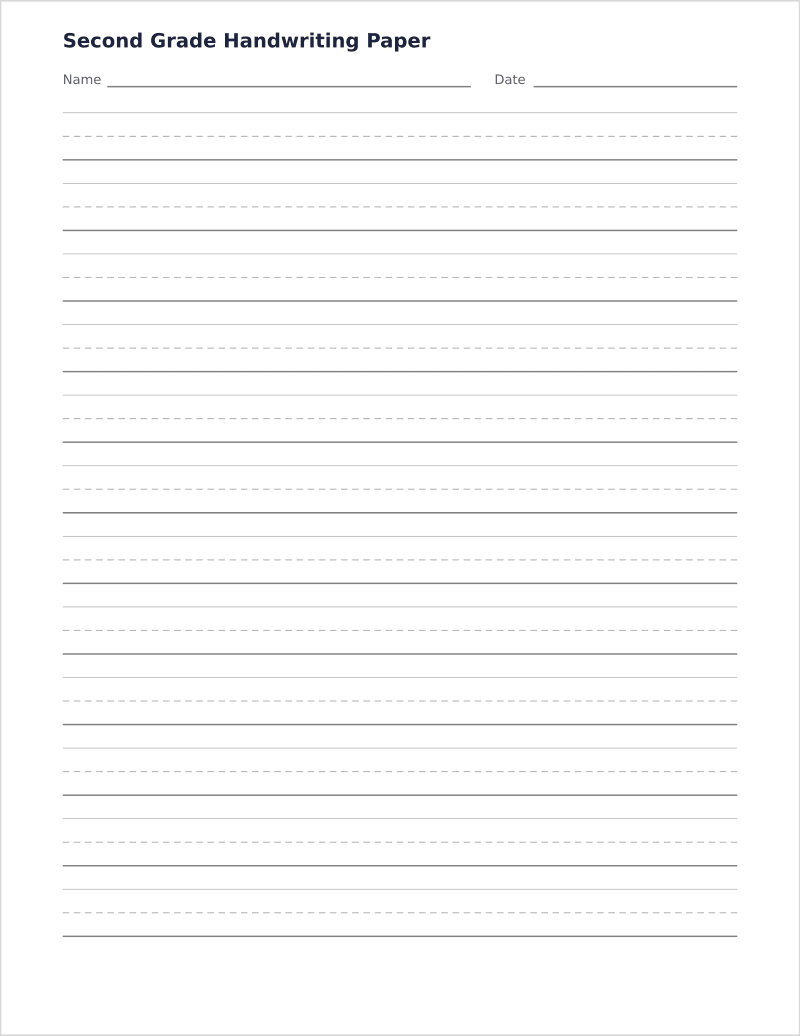 Second grade handwriting paper1/2 inch lines · 12 to a pageDownload PDF ↓
Every sheet here is free to print as often as you like. If one saved you time, the tip jar is on Ko-fi.
Primary writing paper is the three-line ruling children learn to print on: a solid headline at the top, a dashed midline through the middle and a heavier baseline for every letter to sit on, with a band of blank paper below each line for the tails of g, j, p, q and y. Capitals and tall letters such as b and l reach the headline, and short letters such as a, n and o stop at the midline.
The line heights are the ones handwriting paper is sold in for the Zaner-Bloser program, the ball-and-stick print many American schools teach: 1 1/8 inch for pre-K and the start of kindergarten, 3/4 inch for kindergarten, 5/8 inch for first grade, 1/2 inch for second grade and 3/8 inch for third and fourth. The figure is the distance from headline to baseline. At every size the midline sits exactly halfway, and the skip space below each line is half a line deep, so a descender drawn to the bottom of it just touches the next headline.
The four ready-made sheets differ by grade and by layout. The pre-K and kindergarten sheet has five 1 1/8 inch writing lines under a Name and Date line. The kindergarten story paper puts a picture box across the top half of the page, 7.17 inches wide and 4.36 tall, with four 3/4 inch lines below it. The first grade story paper turns the page sideways, with a picture box 9.67 inches wide over three 5/8 inch lines and a dotted midline, and the second grade sheet holds twelve 1/2 inch lines.
The maker on this page offers all five line heights, with the midline dashed or dotted, skip space between lines or none, a picture box over the top third or top half, as many lines as fit or fewer, the Name and Date line on or off, and the page upright or sideways. Nothing else is printed: no title, no watermark, and only a small note of the line height at the foot, so a reprint can be matched to a ruler.
On an upright page with the Name and Date line at the top, the five sizes fit 5 writing lines at 1 1/8 inch, 8 at 3/4 inch, 9 at 5/8 inch, 12 at 1/2 inch and 16 at 3/8 inch, each with its skip space below it. Leaving the Name and Date line off gains a line at 5/8 inch and at 3/8 inch and nothing at the other three, because the spare paper there is less than one more line needs.
A picture box over the top half leaves 2, 4, 4, 6 and 8 lines in the same order, and one over the top third leaves 3, 5, 6, 8 and 10. Turned sideways, the page is shorter and the lines longer: with the Name and Date line it holds 3, 5, 7, 8 and 11 lines, and with a picture box over the top half 1, 2, 3, 4 and 5. Lines always start at the top, under the name line or the picture, and any spare paper is left at the foot of the page, where it does not split one story in two.
Skip space is the band of blank paper under each baseline, half a line deep, and it is how primary paper is sold for the early grades. It gives the tails of g, j, p, q and y somewhere to go and keeps each line of writing visibly separate from the next, which matters most while a child is still finding the baseline at all.
Turning it off gives continuous ruling, where every baseline is also the headline of the line below, so the page holds about half as many lines again: 12 at 3/4 inch instead of 8, and 18 at 1/2 inch instead of 12. Tails then cross into the top half of the next line, which older writers manage easily, so continuous ruling suits second and third grade practice, and copying out spelling words or numbers, which have few tails to collide.
Usually 3/4 inch from headline to baseline, the kindergarten size in Zaner-Bloser paper, which fits eight writing lines on a page here with the Name and Date line. Children just starting to form letters, in pre-K or the first weeks of kindergarten, often do better on 1 1/8 inch, which fits five. First grade moves down to 5/8 inch.
Only in how it is drawn. Both mark the same line, exactly halfway between the headline and the baseline. The dashes print in the same light gray as the headline, and the dots a shade darker, because a row of small dots carries less ink than a line; either way the midline reads as a guide, lighter than the baseline every letter sits on. Which to choose is a matter of what a class is used to. The maker offers both, and the ready-made first grade landscape sheet uses dotted.
Yes. Choose Landscape under Page in the maker and the PDF page itself is turned, so the printer feeds Letter paper as usual and prints across the long side. The ready-made first grade story paper is landscape: a picture box 9.67 inches wide over three 5/8 inch writing lines.
New printables when they go up, mostly seasonal, a few times a year.