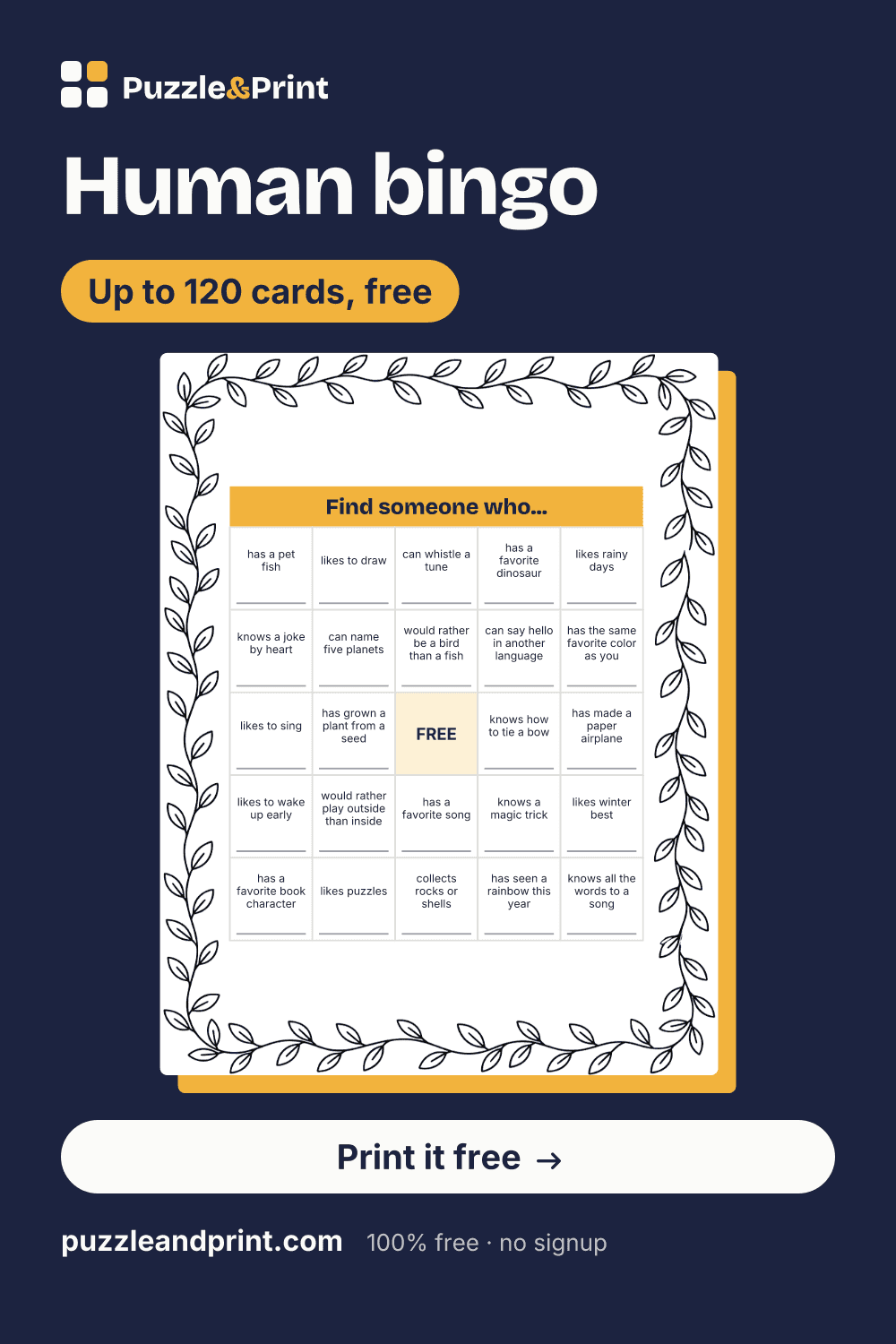
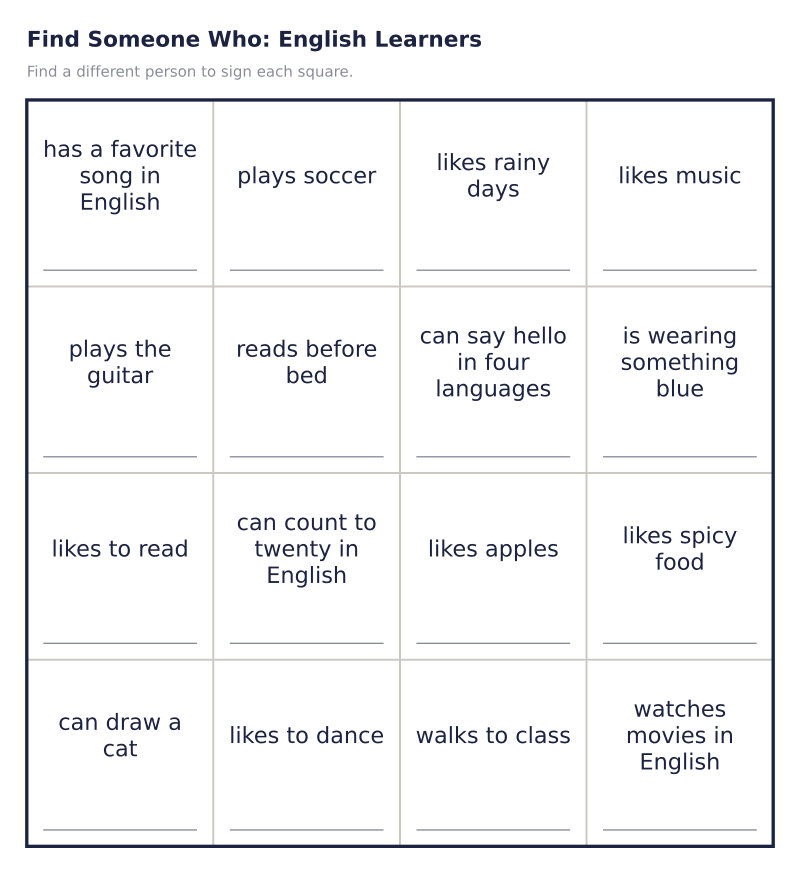
Human bingo is bingo without a caller. It also goes by find someone who and get to know you bingo, and the game is the same under every name: each square holds a short phrase, such as "has a pet fish" or "can whistle a tune", and players move around the room asking until they find someone it is true of. That person writes their name on the line under the phrase. The usual rule is one square per person, so the only way to fill a card is to talk to a lot of people.
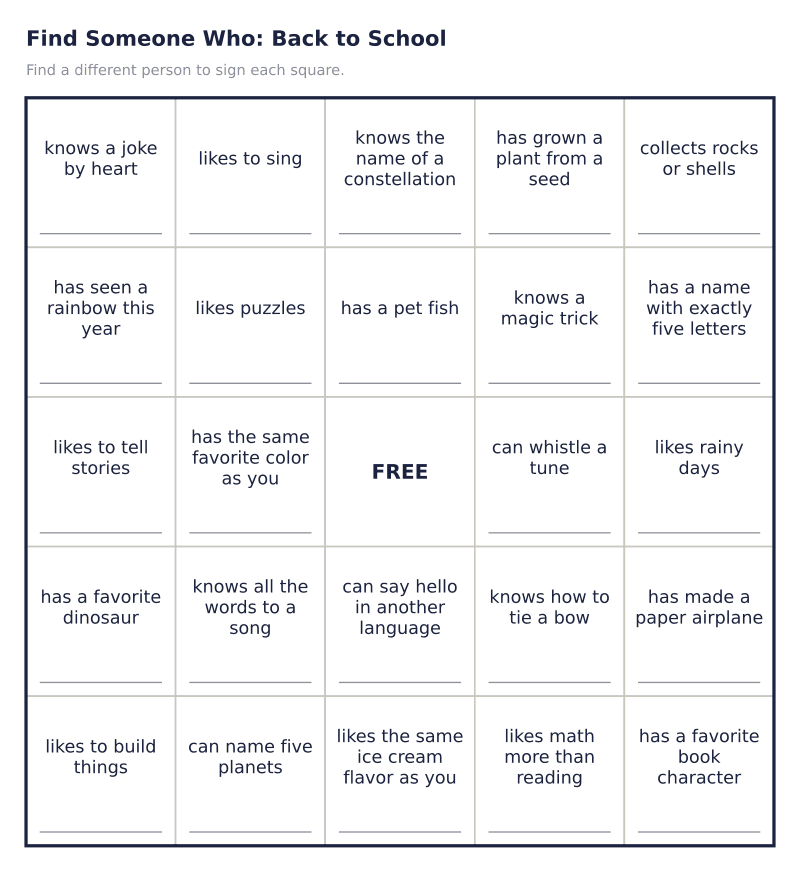
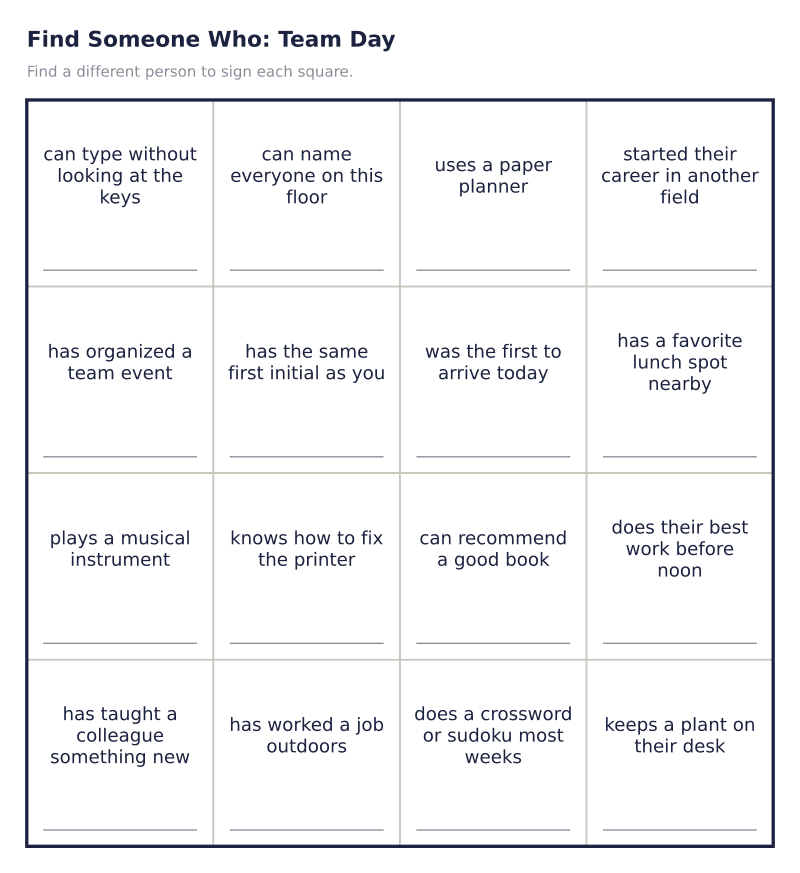
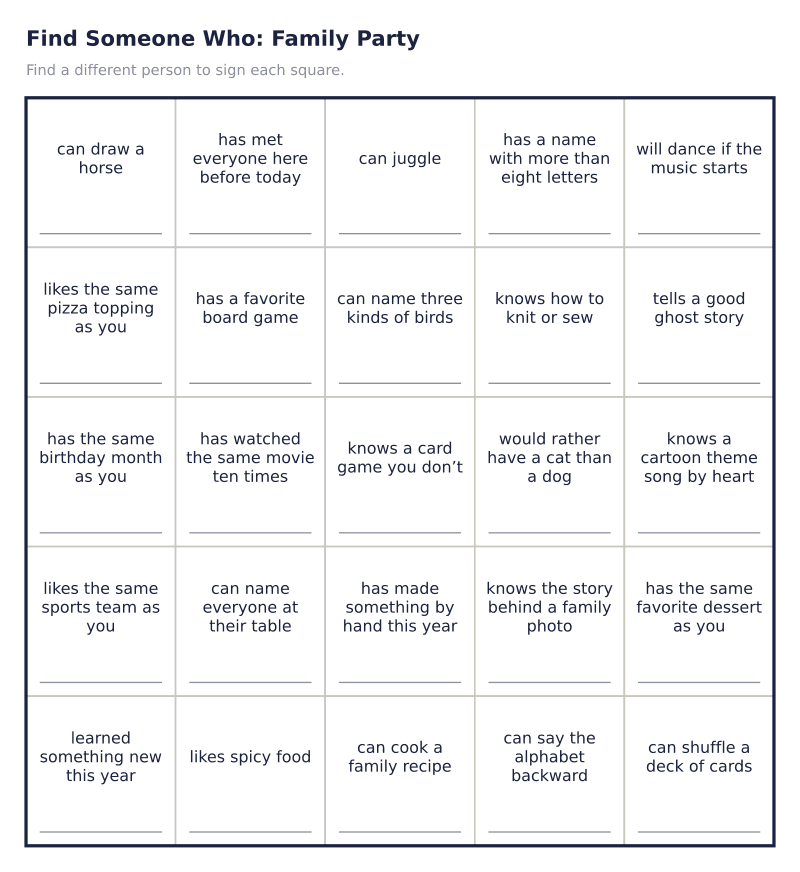
The four ready-made sets are written for four different rooms. Back to school is thirty 5 × 5 cards with a free center, drawn from 32 prompts. Team day is twenty 4 × 4 cards from 28 prompts written for a workplace. The family reunion or party set is thirty 5 × 5 cards with no free square, so all 25 squares hold a prompt, drawn from 33. English learners is twenty-four 4 × 4 cards from 26 short prompts in everyday English. Every set has more prompts than a card has squares, so each card holds its own selection in its own order, and no two cards in a set are the same.
Every prompt is something a person can be asked in front of a room and can answer either way without minding: what they like, small things they can do, a harmless fact such as a birthday month. None of them touches health or bodies, religion, politics, money, or who is in somebody’s family, and none is the kind of question a child could be teased for answering. The team day prompts keep to what colleagues already talk about at work: the job, the desk, the tea, and books, music and hobbies.
To make your own, use the maker at the top of the page, which opens on Find someone who: pick a set or write your own prompts, one to a line, up to 40 characters each. Cards come in 5 × 5, 4 × 4 or 3 × 3, and a 5 × 5 can keep its free middle or give it to one more prompt. Whatever you type stays in your browser; nothing is uploaded.
How to run a game of human bingo
Hand everyone a card and a pencil, explain that each square needs a different person, and set a time limit before anyone moves. Players ask one question at a time, "Do you like rainy days?", and on a yes they hand over the card so the other person can write their name on the line under that square. Each person signs any one card only once, so a room of twelve can never fill a 5 × 5 card between them; with fewer people than squares, allow two signatures each or play to a line.
Decide what wins before the first question. A line across, down or corner to corner is the short game and suits a room with other things to do; a full card is the long one and gets everyone talking to everyone. When somebody says they are finished, check the card by reading two or three squares aloud and asking the people named to put a hand up. It settles a dispute quickly, and it works as a second round of introductions for the whole room.
Using the English learners cards for question practice
Each prompt in the English learners set is written to turn into a question a beginner can ask: "has a pet" becomes "Do you have a pet?", "can draw a cat" becomes "Can you draw a cat?", and "likes spicy food" becomes "Do you like spicy food?". Model the change from statement to question with two or three squares before the class starts, because the do and does question is the part most learners need to practice. Answers can stay short, "Yes, I do" or "No, I can’t", which keeps the room moving.
When the time is up, the cards turn into a speaking exercise of their own. Students report back in the third person, "Ana plays the guitar", "Tom speaks three languages", which practices the s on the verb that the prompts already show. The set has 26 prompts, so each 4 × 4 card leaves out ten of them and holds its sixteen in an order of its own.
Writing find someone who prompts of your own
A good prompt is true of some people in the room and not all of them. "Likes pizza" fills itself at once and "can speak seven languages" will probably never be signed; "would rather be a bird than a fish" lands in between, and earns a reason as well as a name. Start each prompt with a verb, because the card prints "Find someone who" above it, and keep it to 40 characters, which is what three lines of a 5 × 5 square hold. The maker drops a "Find someone who" typed at the start of a line, and list bullets and numbers too, so a list pasted from a document works as it is.
The test of whether a prompt is safe is simple: would anyone in the room mind saying no to it in front of everyone? Questions about family, money, health, bodies, religion and politics all fail it for somebody, which is why none of the ready-made sets asks them. Tastes, small skills and the morning so far pass it every time.