Name Writing Practice
Trace the name, then write it on the empty lines. Start at each big dot.
Created for free at puzzleandprint.com
Type a name, or paste a whole class list, and print it in dotted letters on primary writing lines.
Last updated
Name Writing Practice
Trace the name, then write it on the empty lines. Start at each big dot.
Created for free at puzzleandprint.com
Two sets from the alphabet page and two from the numbers page, each linked to the page it comes from.
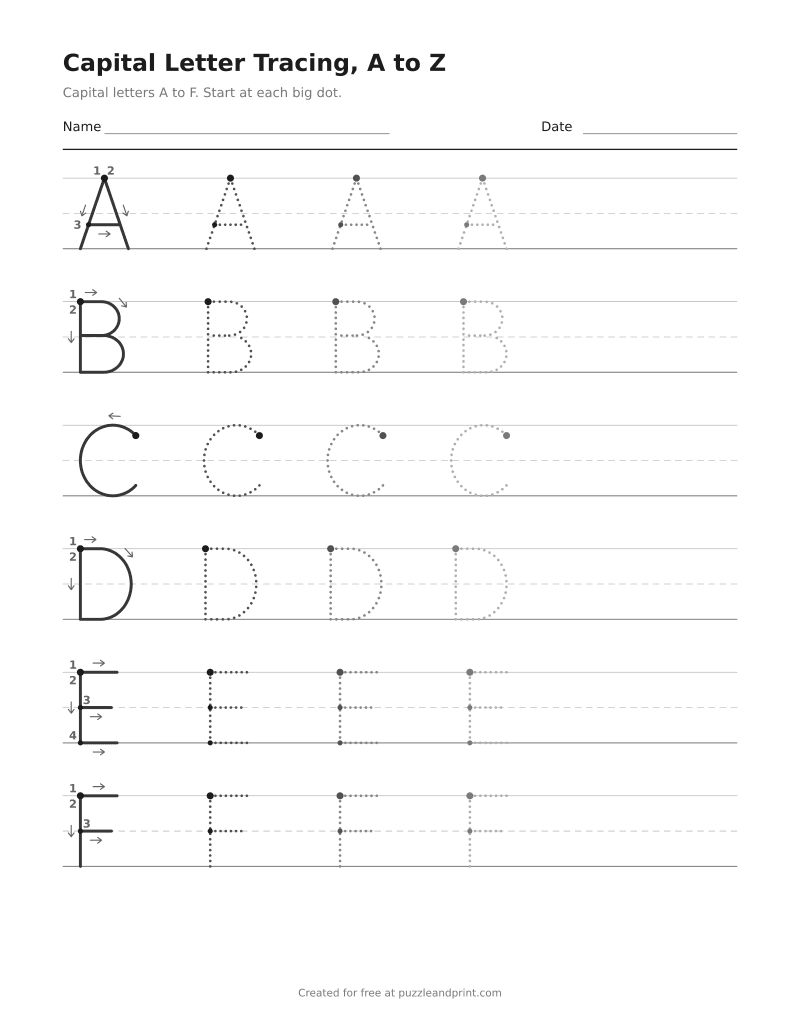 Capital letter tracing worksheet, A to Z5 pages · 3/4 inch lines · dottedAll 4 on its page →
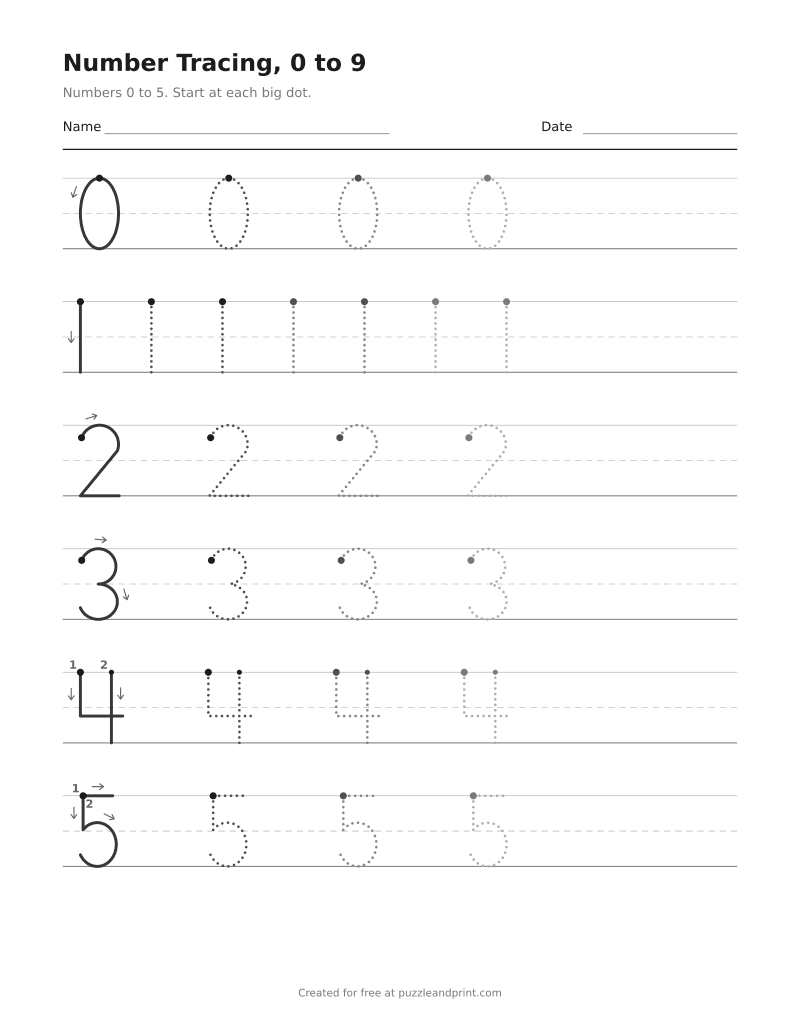 Number tracing worksheet, 0 to 92 pages · 3/4 inch lines · dottedAll 4 on its page →
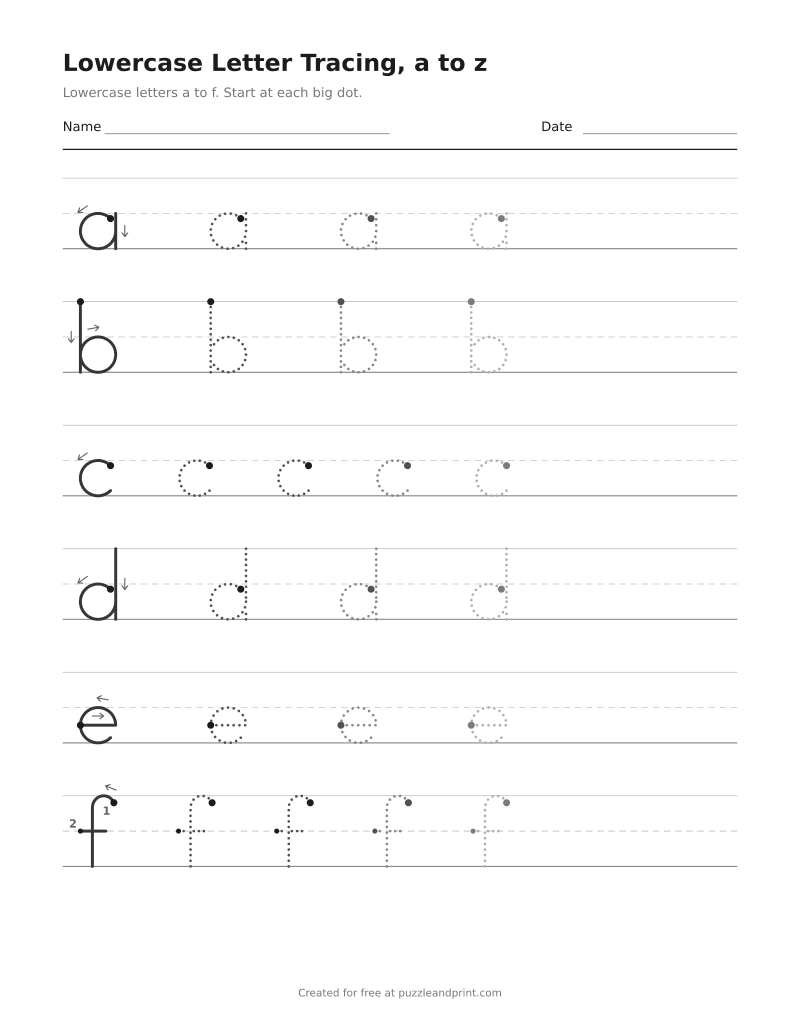 Lowercase letter tracing worksheet, a to z5 pages · 3/4 inch lines · dottedAll 4 on its page →
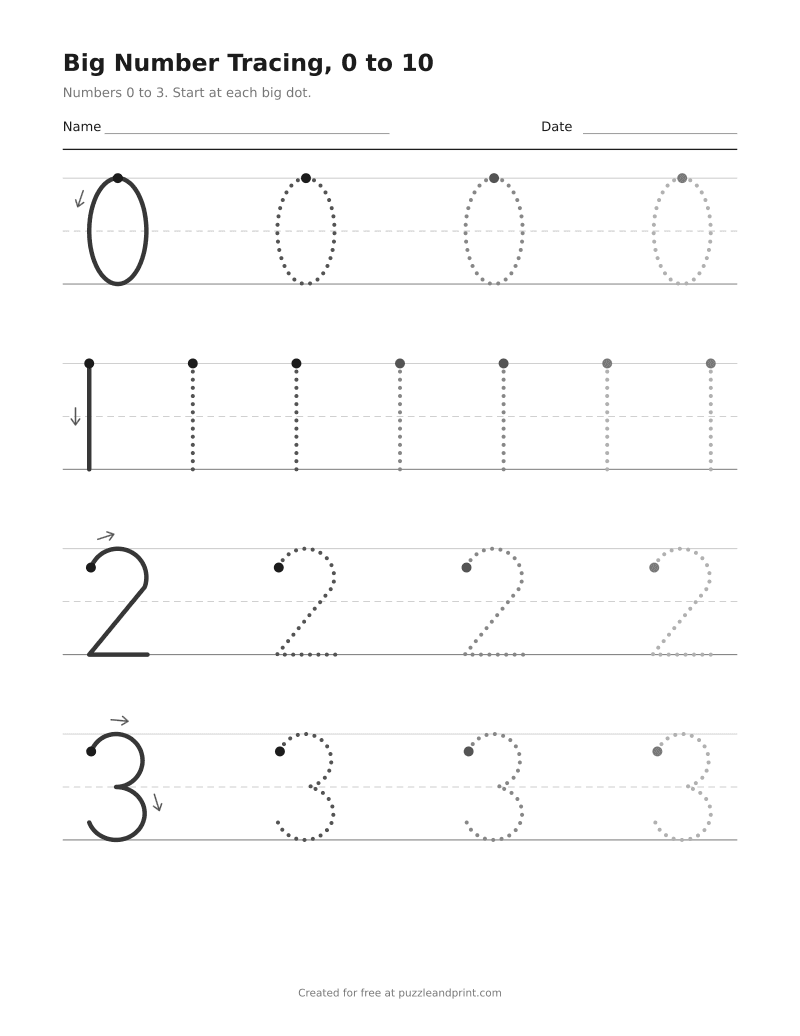 Big number tracing worksheet, 0 to 103 pages · 1 1/8 inch lines · dottedAll 4 on its page →
One US Letter page for each name. The first line opens with the name written out as a solid model, with a big dot where each stroke starts; the copies after it are dotted, or dashed if you prefer, and when there are three or more they fade from dark to light in reading order, so the help thins out as the page goes on. The last lines are left blank, for writing the name without a guide, and the page carries a Name and Date line at the top.
At the kindergarten size of 3/4 inch a page holds six writing lines: four with the name to trace, as many copies to a line as fit, and two left blank. Choose no blank lines for more tracing, or more of them for more independent writing, and switch the solid model, the fading and the stroke arrows on or off.
The letters are not a font. Each one is drawn for this site as the strokes a child makes, in the upright ball-and-stick print of the Zaner-Bloser program: a single-story a and g, a full-height t crossed on the midline, a q whose tail curves forward so it is never a backward g. Every stroke has a start dot, on every copy, not only on the model.
With arrows switched on, the model also shows which way each stroke goes and, on letters made in more than one stroke, the order. Arrows are offered at 5/8 inch and larger; at the smaller sizes they crowd the letters. The alphabet and number pages, linked below, use the same letters one at a time, and the lines and shapes pages give the strokes and shapes a child traces before letters, with the same dots, start dots and arrows. The cutting practice page is for the same age with scissors instead of a pencil: thick dashed lines and shapes to cut out, at least an inch apart, with a small pair of scissors where each cut starts.
Each copy of a name has to fit on one writing line, and the line height sets how much fits. At 3/4 inch, Christopher fits on a line with room to spare, but not at 1 1/8 inch, where a line holds about six capital letters. A first and last name together, such as Isabella Rodriguez, needs 1/2 inch or smaller. If a name is too wide, the maker says so and suggests a smaller size or the first name alone.
Names can use the letters A to Z and a to z, the numbers 0 to 9, spaces, hyphens, apostrophes and periods, so Anne-Marie, O'Neil and J.R. all work. Accented letters such as é or ñ have no drawing yet; the maker lists any it cannot trace rather than leaving a gap in the name.
Choose Class list and paste the names, one to a line, from a spreadsheet or a roster. Each name gets a page of its own, in the order pasted, all in one PDF, up to 40 names. The settings apply to every page, so one class set prints at one size with one layout.
The names never leave your computer. The sheets are built in the browser, and the names are not put into the page address or sent anywhere. Nothing is kept once the page is closed unless you check Remember my lists on this device and save the list, which keeps it in this browser until you press Forget everything; on a computer other people use, press it before you leave. Otherwise only the PDF you download holds them.
Each page has four ready-made sets, plus the maker above opened on that page's letters, numbers, lines or shapes, or on cutting practice.
Yes. Make as many sheets as you like, including a whole class set in one download, with no sign-up, no account and no watermark on the printed page.
Capital and lowercase letters, the numbers 0 to 9, spaces, hyphens, apostrophes (straight or curly) and periods. Letters with accents, such as é and ñ, are not drawn yet, so a name that has them shows a message listing them instead of a sheet.
No. There is no openly licensed dotted font in the upright ball-and-stick print American kindergartens use, so each letter is drawn here as the strokes a child makes, which is also what lets every stroke have its own start dot and arrow.
No. The sheets are made in your browser. A name or class list is never put into the page address and never sent to this site or anyone else. It is gone when the page is closed, unless you save a class list with Remember my lists on this device, which keeps it in your own browser until you forget it; otherwise only the PDF you download keeps it.
The largest, 1 1/8 inch from headline to baseline, which is the size handwriting paper is sold in for pre-K and early kindergarten. Kindergarten usually moves to 3/4 inch, first grade to 5/8 inch and second grade to 1/2 inch. The same five sizes are on the blank primary writing paper page, for writing without anything to trace.
So the help fades as the child goes: the first copies are dark and easy to follow, the next ones lighter, and the last ones faint, leading into the blank lines. Turn fading off in the maker and every dotted or dashed copy prints in the same dark gray.
New printables when they go up, mostly seasonal, a few times a year.