Christmas Bingo, card 1
TINSELMITTENSWINTERSTOCKINGMISTLETOELANTERNHOLLYPRESENTTWINKLEBELLSCINNAMONCANDLEFREEGARLANDANGELORNAMENTICICLEPACKAGEWREATHGINGERNUTMEGCHESTNUTEVERGREENTOYSSNOWMAN
Created for free at puzzleandprint.com
Ready-made sets of 8, 16 and 30 Christmas bingo cards, every card different, plus a 12-card 3 by 3 quick game.
Last updated
Save this to PinterestChristmas Bingo, card 1
Created for free at puzzleandprint.com
Christmas Bingo, call list
Check off each word as you call it. 40 words in play.
Created for free at puzzleandprint.com
Four sets sized for different groups. Every card within a set is different, and each prints on a page of its own after the call list.
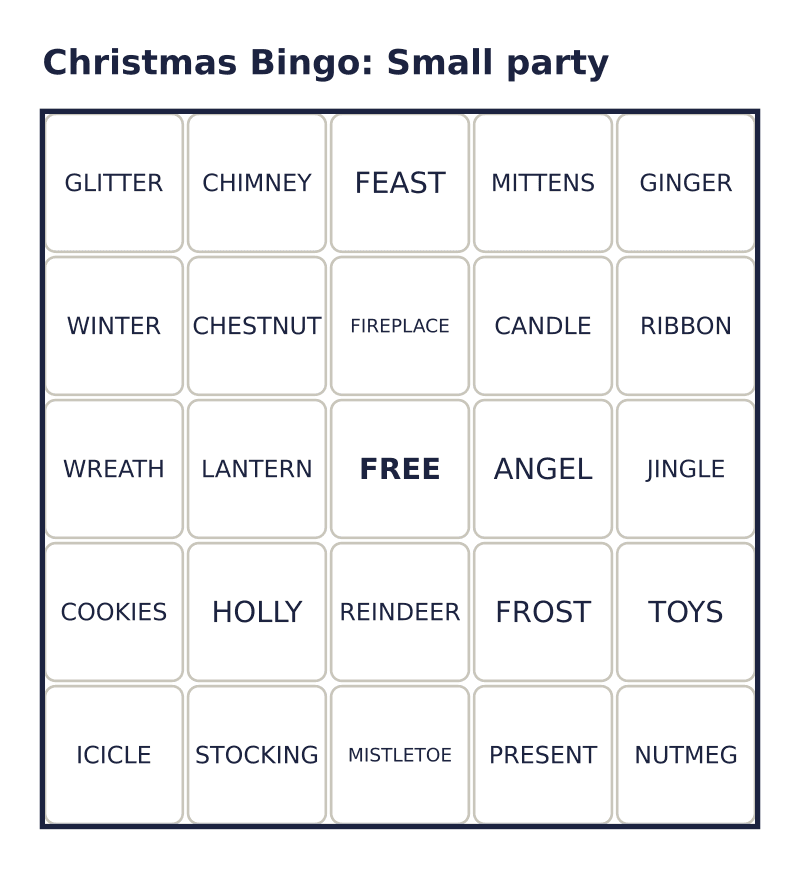 Christmas bingo, small party8 cards · 5 × 5Download PDF ↓
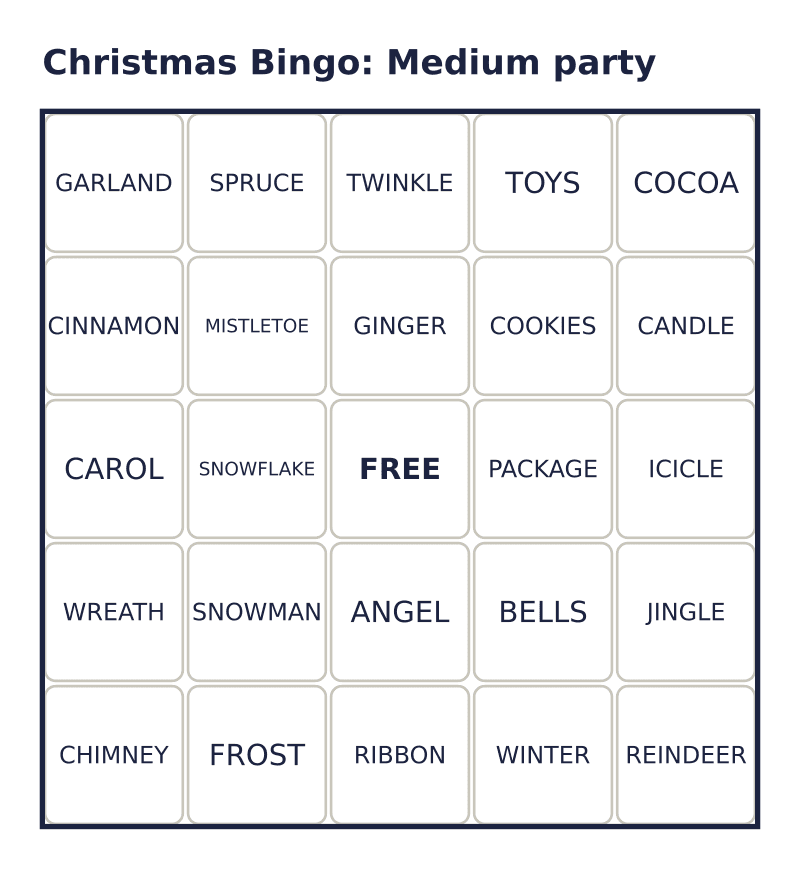 Christmas bingo, medium party16 cards · 5 × 5Download PDF ↓
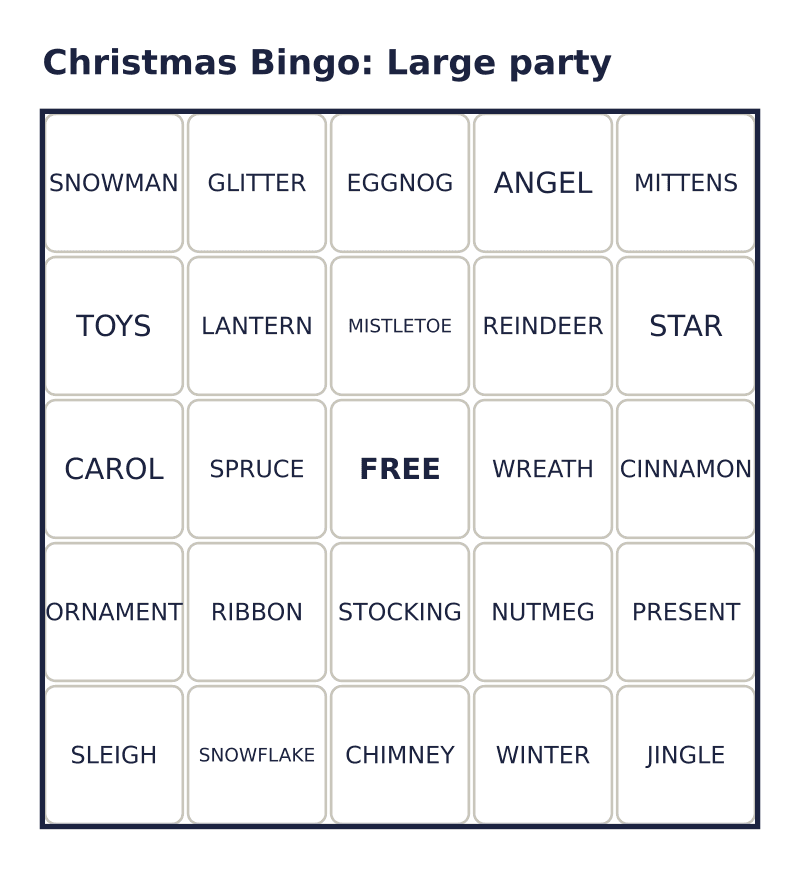 Christmas bingo, large party30 cards · 5 × 5Download PDF ↓
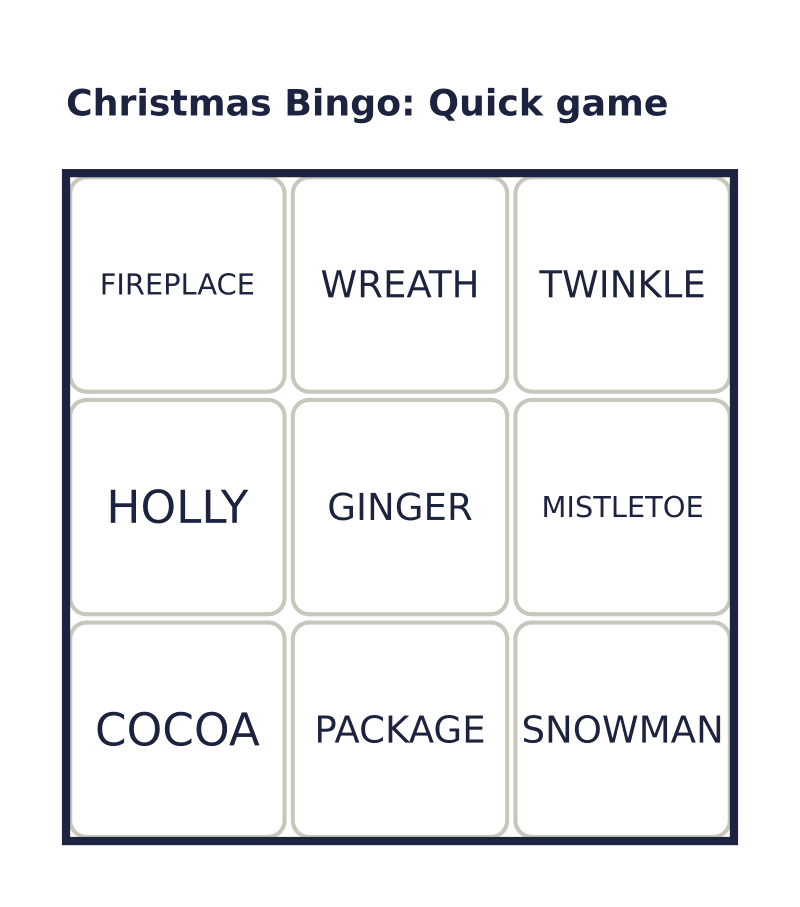 Christmas bingo, quick game12 cards · 3 × 3Download PDF ↓
Every sheet here is free to print as often as you like. If one saved you time, the tip jar is on Ko-fi.
Christmas bingo earns its place on the last afternoon before winter break and on the afternoon of the day itself, which are the two moments in the year when a room contains more people than things to do. It needs no setup beyond printing, and it works with a group that has nothing else in common.
The ready-made sets share one 40-word call list, from TINSEL and SLEIGH through MISTLETOE and CHESTNUT to COCOA, dealt into sets of eight, sixteen and thirty 5 × 5 cards. Thirty is a full class; eight is a family. No two cards in a set have the same layout, but shared wins still happen: with the thirty-card set about one game in six ends with two or more cards completing a line on the same call, so settle beforehand what a tie wins.
For small children with dinner on the way, the twelve-card 3 × 3 quick game holds nine words a card in place of twenty-four. The list mixes short words such as STAR, TOYS and COCOA with long ones like FIREPLACE and EVERGREEN, so pointing to the word on the call list as you read it out lets a child who cannot yet read match it by its shape.
For a family game, the version people remember is the one built from your own words: the cousins’ names, the dog, the dish that turns up every year, whatever your Christmas actually contains. The maker above the ready-made sets takes the list and prints each card on a page of its own. Give it single words of three letters or more, because it keeps only the letters of each entry: HOT COCOA would print as HOTCOCOA, so COCOA on its own reads better.
A game of Christmas bingo played to one line usually ends after about 15 calls with the eight-card set, 13 with sixteen cards and 12 with thirty, out of the 40 words on the call list. Those averages come from playing the actual cards in each set through thousands of random call orders, and single games vary a good deal: with thirty cards, roughly nine games in ten end somewhere between the eighth and the fifteenth call. Every 5 × 5 card holds 24 of the 40 words around a free square in the center, so playing on to a full card is a much longer game. The first card fills after about 37 calls, which is close to the whole list.
The quick game is twelve 3 × 3 cards of nine words each, with no free square, and a line there comes after about nine calls. Two words on its call list, GLITTER and JINGLE, are on none of the twelve cards, so cross them off before you start. Each set downloads as the call list followed by one card per page: nine sheets of paper for the small party, seventeen for the medium, thirty-one for the large and thirteen for the quick game. At a steady call every ten seconds, a twelve-call game takes two minutes, so several rounds fit comfortably between courses.
The Christmas bingo words easiest to confuse are the ones that share an opening sound or opening letters, such as GINGER and JINGLE, or SNOWMAN and SNOWFLAKE. GINGER and JINGLE both begin with a j sound but not with the same letter, so a young player who hears the call and looks for a J will pass straight over GINGER. CINNAMON, ICICLE, SPRUCE and FIREPLACE all have a C that sounds like an S, and CINNAMON matters most because its soft C comes first: the sound sends a child looking among SLEIGH, SNOWMAN and STAR. Adding the first letter to the call, "cinnamon, with a C", costs a second and settles it.
SNOWMAN and SNOWFLAKE share their first four letters, and CHIMNEY and CHESTNUT their first two, so a child who reads only the start of a word can mark the wrong square. For older players the same list makes a harder round if the caller gives a clue in place of the word: "left out on a plate for Santa" for COOKIES, "frozen and hanging from the gutter" for ICICLE, "prickly leaves and red berries" for HOLLY. The three spices, GINGER, CINNAMON and NUTMEG, need the most careful clues, because the caller is describing a taste rather than something you can point at.
Yes, because all four sets deal from the same 40-word call list, so what you choose is how many cards to print. Print the smallest set that covers everyone: a class of 25 takes the thirty-card set and a family of ten the sixteen, and cards left in the pile do no harm because only cards in play can win. Keep the 3 × 3 quick game for a round of its own, though: played alongside the sixteen-card set, its twelve small cards reach a line first in about four games in five.
Neither. A pencil works for marking, and most rooms play for the sake of winning. If you want counters without buying any, chocolate coins and raisins both survive being passed around a table, and the winner gets to eat theirs.
Yes, if the cards were marked in pencil, but call the words in a different order the second time. Reading the call list from the top again replays the first game call for call, with the same card winning on the same word. Start from the bottom instead, or cut the list into strips and draw them from a bowl.
New printables when they go up, mostly seasonal, a few times a year.