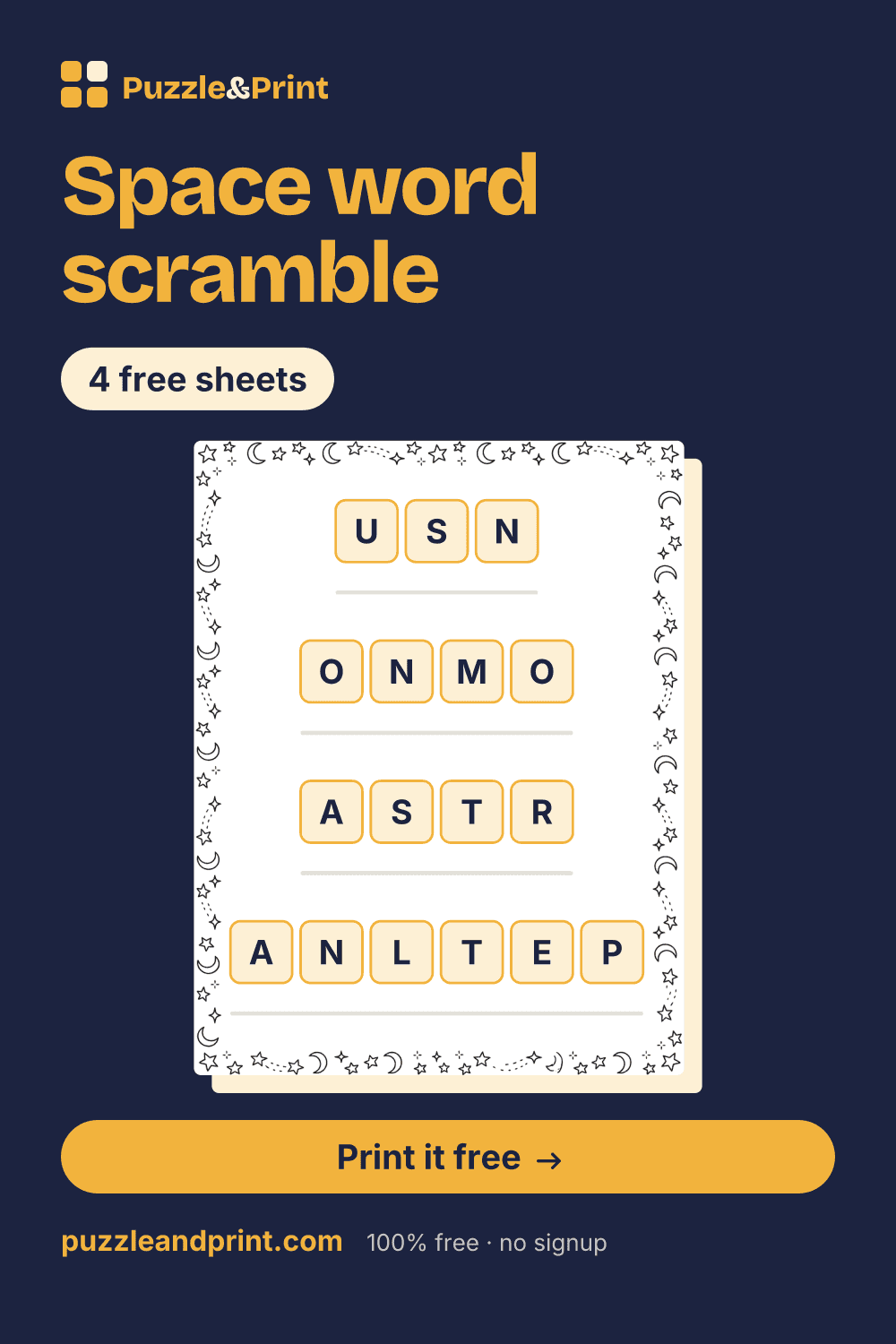
Space Word Scramble
- ORBTI
- RVGATYI
- SNU
- NTPEAL
- QASUAR
- HEULTTS
- RAKCIOL
- AERTCR
- ESVUNROAP
- ALPUCES
- ALKMYWYI
- MOSSCO
Created for free at puzzleandprint.com
Jumble your own list, or take one of four ready-made space sheets.
Last updated
Save this to PinterestSpace Word Scramble
Created for free at puzzleandprint.com
Space Word Scramble, Answer Key
Created for free at puzzleandprint.com
Four sheets at different lengths and difficulties. Every one is a two-page PDF, the worksheet, then the answer key on its own page.
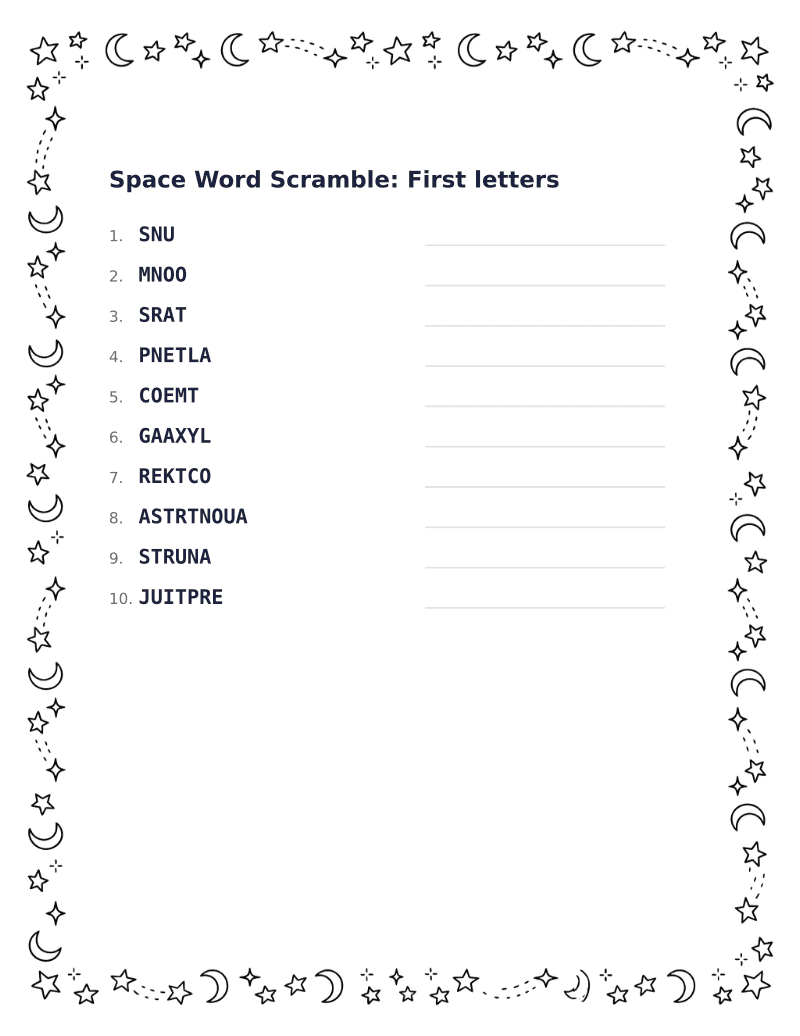 Space word scramble, first letters10 words · Easy, first letter stays putDownload PDF ↓
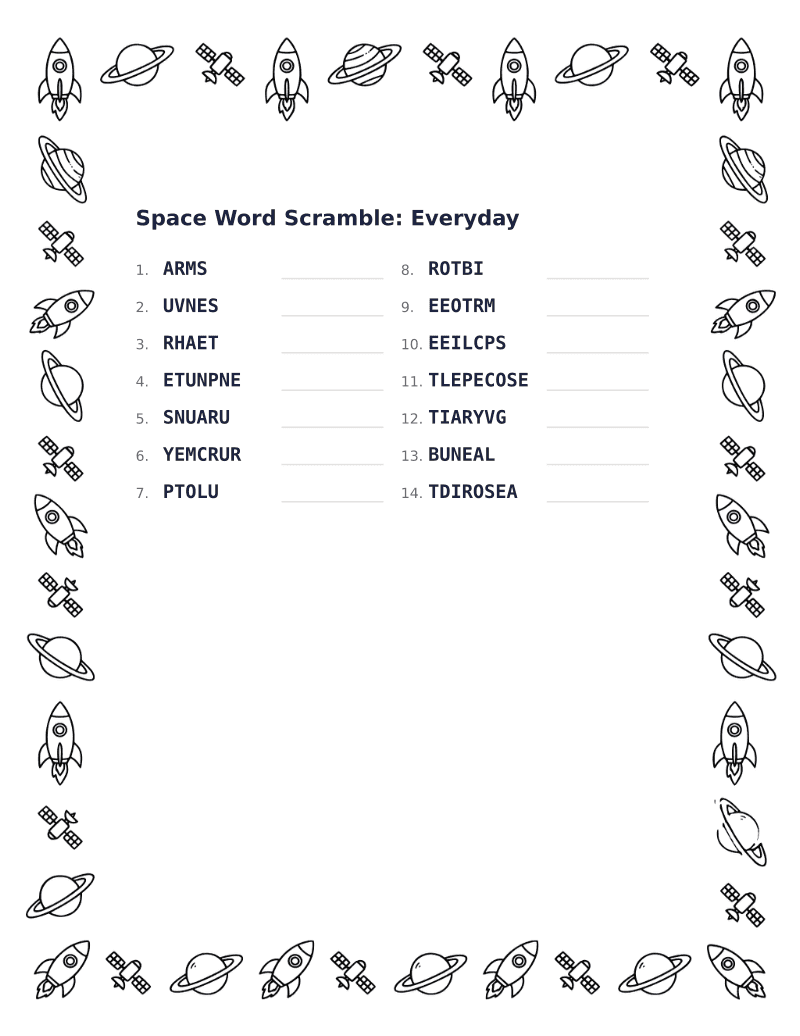 Space word scramble, everyday14 words · Medium, every letter movesDownload PDF ↓
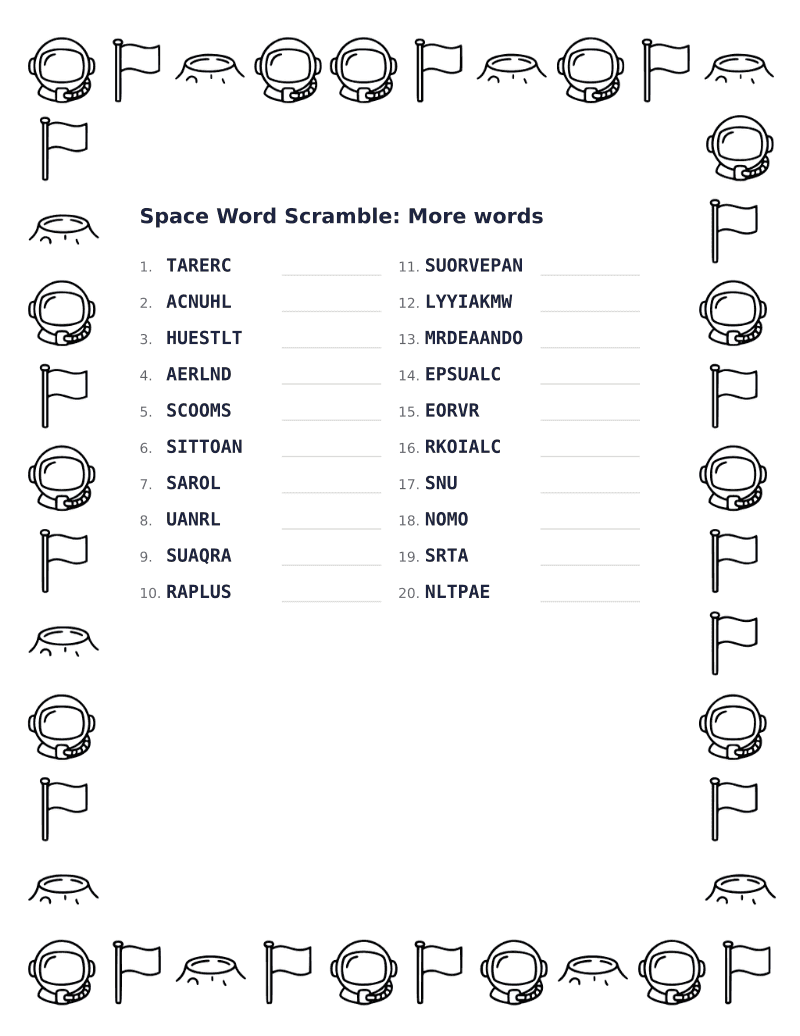 Space word scramble, more words20 words · Medium, every letter movesDownload PDF ↓
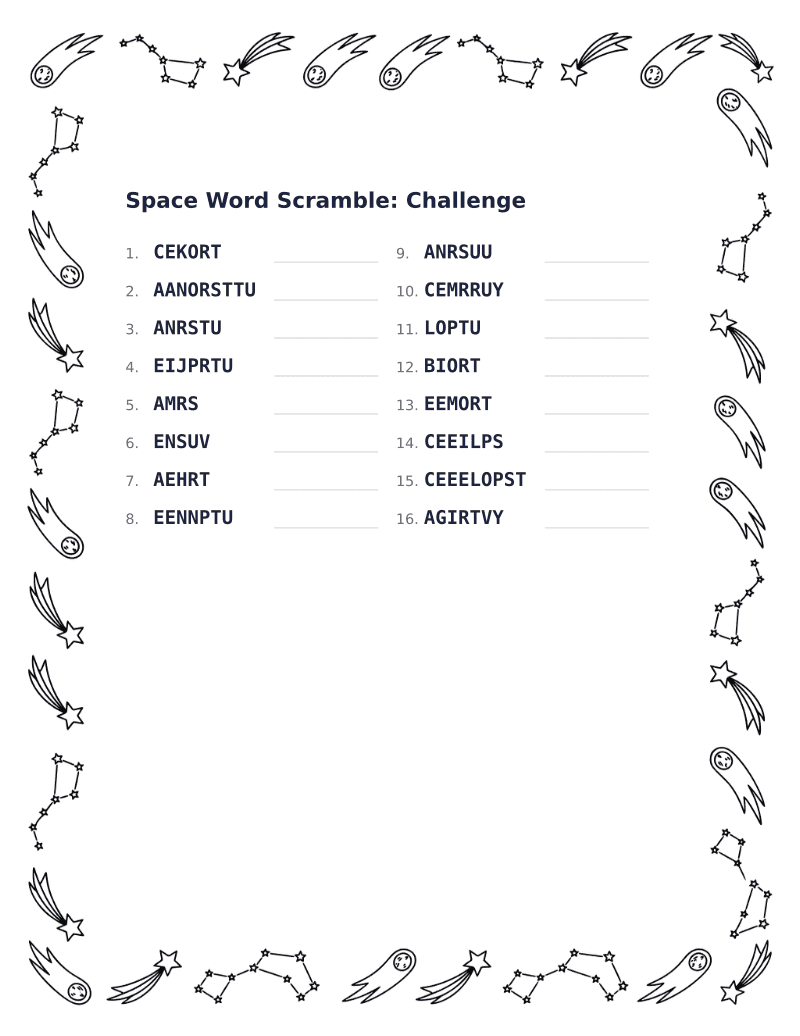 Space word scramble, challenge16 words · Hard, letters in alphabetical orderDownload PDF ↓
Every sheet here is free to print as often as you like. If one saved you time, the tip jar is on Ko-fi.
Space vocabulary is long, technical and satisfying to write out, which makes it unusually good scramble material. TELESCOPE, ASTEROID and GRAVITY are words children meet in reading and on screen far more often than they ever write, so a scramble is frequently the first time they have had to spell one.
The planet names do something useful too. A child who knows the order of the planets has a way into the puzzle that has nothing to do with letters, they can work through the list mentally and check each against the jumble, which is a genuinely different solving strategy from the letter-shuffling one.
The four sheets go from a first-letter version to an alphabetical challenge. The harder sheets suit a class that has been doing a space unit, where the vocabulary is fresh and the puzzle becomes review rather than guesswork.
If you are running a themed unit, the maker takes your own list (the terms actually in your lesson plans, rather than the generic set), and prints the answer key on its own page.
ASTRONAUT, TELESCOPE and ASTEROID are easier to unjumble in parts, because each is built from Greek pieces a child can learn and then spot inside the jumble. ASTRONAUT is astro, star, plus naut, sailor; TELESCOPE is tele, far, plus scope, to look; and ASTEROID, on the everyday sheet, shares the star root and means star-like. A child who knows the astro chunk can pull A, S, T, R and O out of a nine-letter jumble and is left with four letters to arrange. ASTRONAUT is on the first-letters sheet, where it keeps its A, and on the challenge sheet as "aanorsttu"; TELESCOPE is on Everyday and again on the challenge sheet, where it becomes "ceeelopst".
On the more-words sheet the parts are plainer. AIRLOCK is air and lock, two words a child can already spell. SUPERNOVA is super plus nova, Latin for new, because a star that suddenly brightened was once taken for a new one. SOLAR and LUNAR are the adjectives for SUN and MOON, from the Latin sol and luna, which links them to words a child may already know, such as solar panels or a lunar eclipse. Teaching the parts before the sheet goes out takes a couple of minutes and pays off twice, since the same roots turn up again in the reading for any space topic.
The space challenge sheet has all eight: MERCURY, VENUS, EARTH, MARS, JUPITER, SATURN, URANUS and NEPTUNE are among its sixteen words, along with PLUTO, which has been classed as a dwarf planet since 2006. That leaves seven words that are not planets, ROCKET, ASTRONAUT, ORBIT, METEOR, ECLIPSE, TELESCOPE and GRAVITY. A child who works through the planets in order from the Sun can solve eight of its sixteen lines, nine with PLUTO, before facing a single unfamiliar jumble, which makes the hardest sheet on the page less daunting than its alphabetical letters suggest. The everyday sheet holds six of the planets plus PLUTO, and SATURN and JUPITER are on the first-letters sheet.
Three jumbles on the challenge sheet can be read two ways. Sorted, EARTH becomes "aehrt", which also spells heart; MARS becomes "amrs", which also spells arms and rams; and METEOR becomes "eemort", which also spells remote. On a space sheet the space word is the answer the key gives, but a child who writes heart has read the letters correctly and deserves to hear so. MARS also comes out as "arms" on the everyday sheet, a jumble that happens to be a real word, so it is worth telling a class before they start that every line hides a space word, even when the jumble already looks like a finished one.
No, they are among the easiest, because each jumble can be tested against eight names a child already knows. The harder ones are short words with no list behind them: NEBULA, which is only on the everyday sheet, as "buneal", and ORBIT, which is "rotbi" there and "biort" on the challenge sheet. NEPTUNE has seven letters but goes quickly once a child spots the two Ns in "eennptu".
At the end rather than the start, because a scramble only works once a child half knows the spelling. As the unit draws to a close, begin with the first-letters sheet, since all ten of its words keep their first letter and it opens with SUN, MOON and STAR, then save the challenge sheet, with its letters in alphabetical order, for the final lesson. A word search is the better way to introduce new terms.
Because the list stores it without the space, so the more-words sheet jumbles all eight letters together and the answer key spells it MILKYWAY. In ordinary writing it is two words with capitals, the Milky Way, which is worth pointing out when the sheet is graded so the one-word version does not stick.
New printables when they go up, mostly seasonal, a few times a year.