Christmas Word Scramble
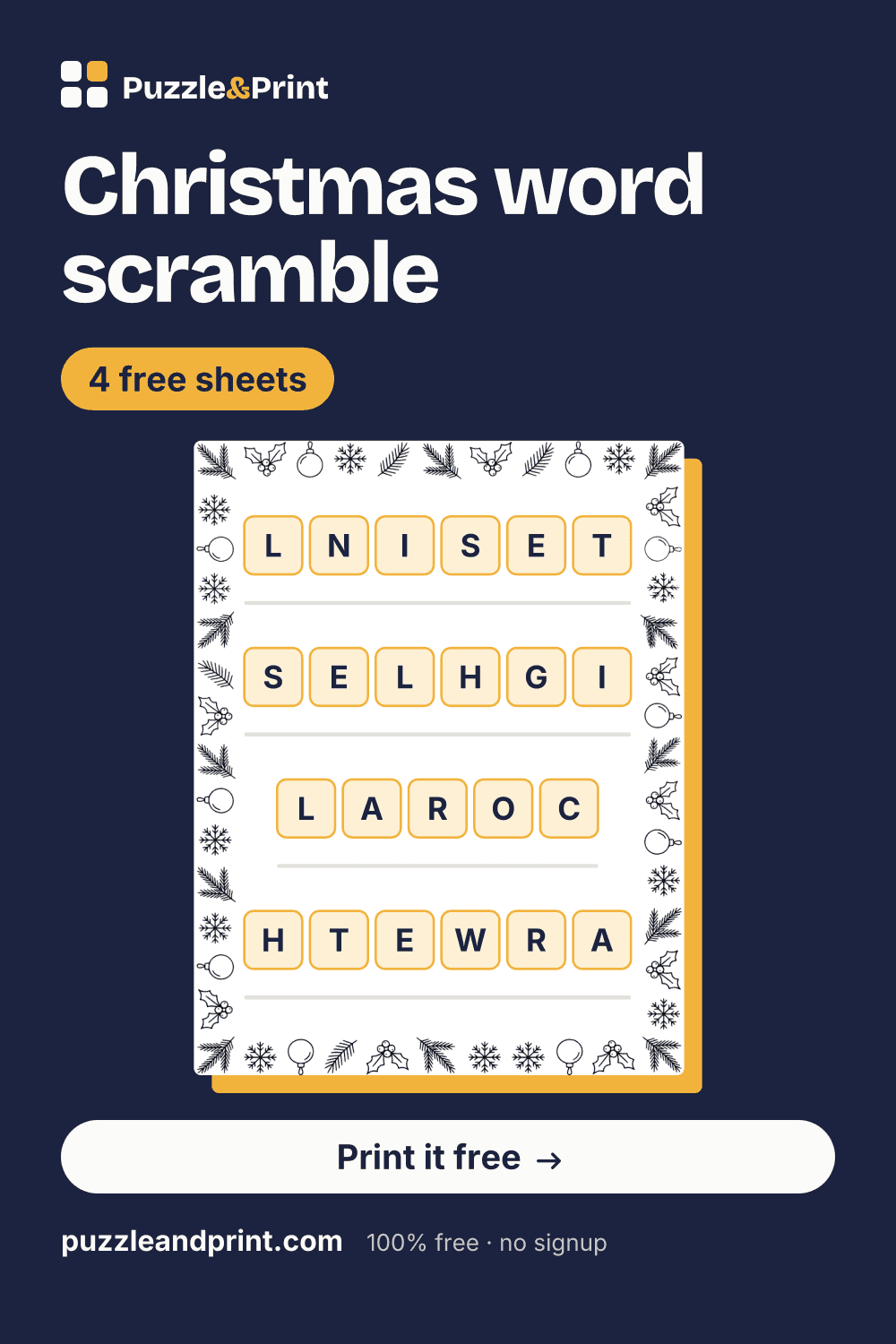
- EICCLI
- STNMIET
- LTENARN
- ILTESN
- ETTGLRI
- COCAO
- EREINRED
- LIKTNWE
- YOST
- COOKSIE
- CDELNA
- MWNSNAO
Created for free at puzzleandprint.com
Jumble your own list, or take one of four ready-made festive sheets.
Last updated
Save this to PinterestChristmas Word Scramble
Created for free at puzzleandprint.com
Christmas Word Scramble, Answer Key
Created for free at puzzleandprint.com
Four sheets at different lengths and difficulties. Every one is a two-page PDF, the worksheet, then the answer key on its own page.
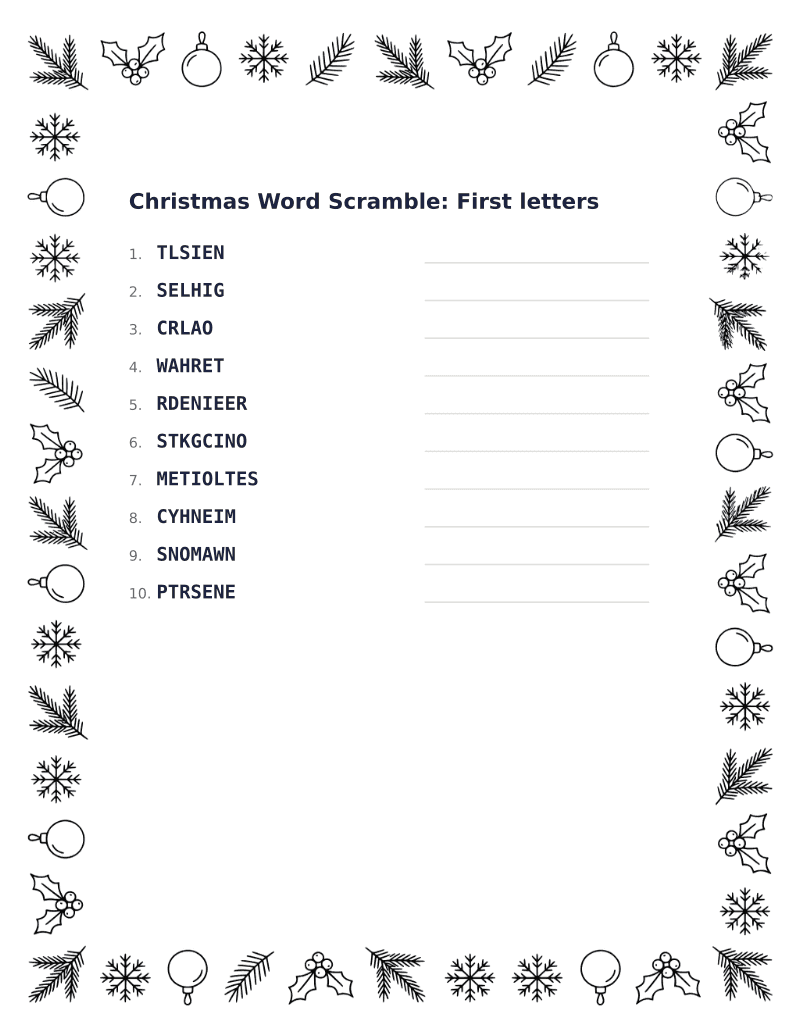 Christmas word scramble, first letters10 words · Easy, first letter stays putDownload PDF ↓
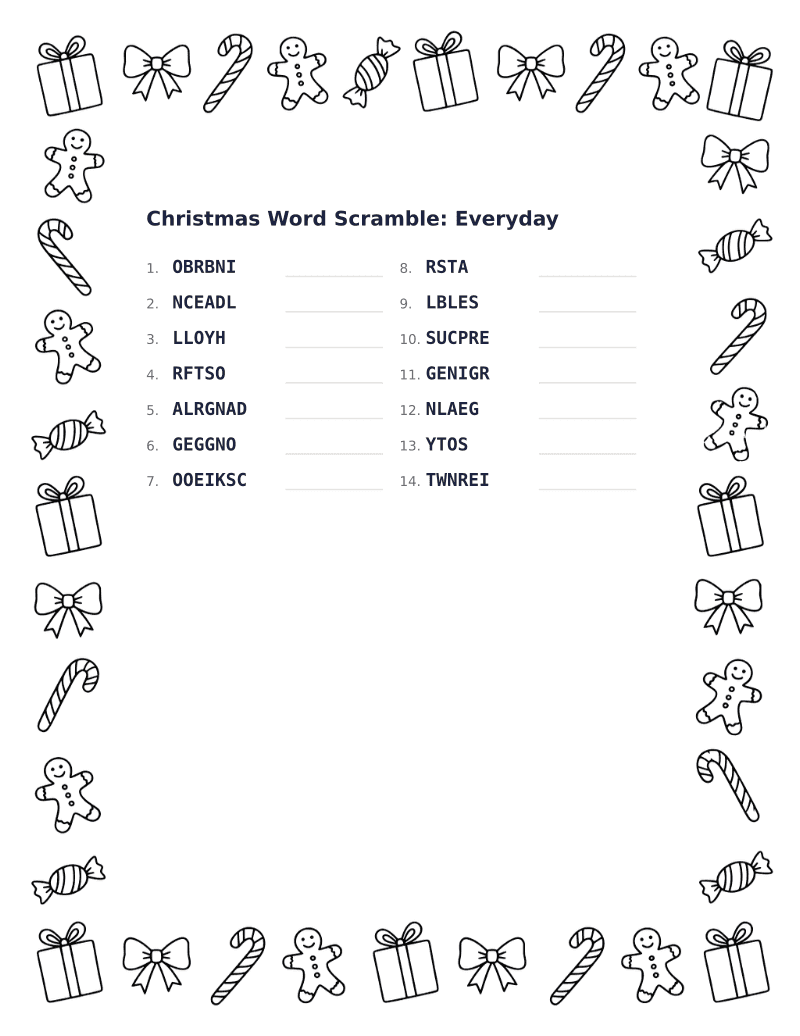 Christmas word scramble, everyday14 words · Medium, every letter movesDownload PDF ↓
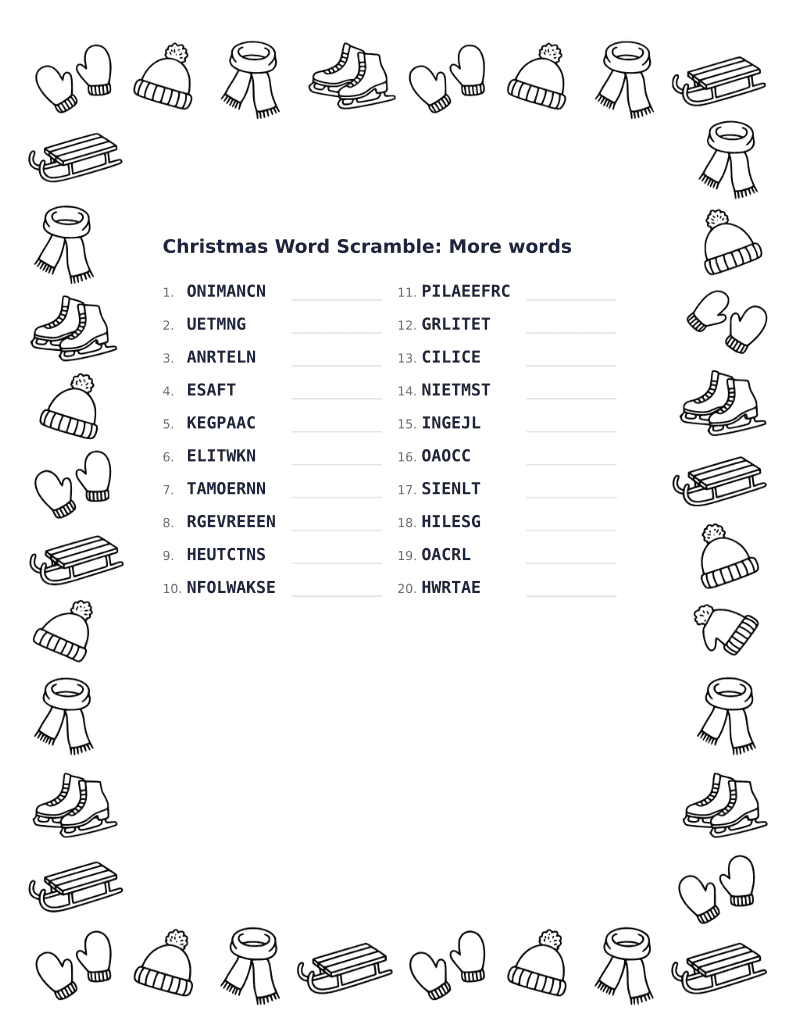 Christmas word scramble, more words20 words · Medium, every letter movesDownload PDF ↓
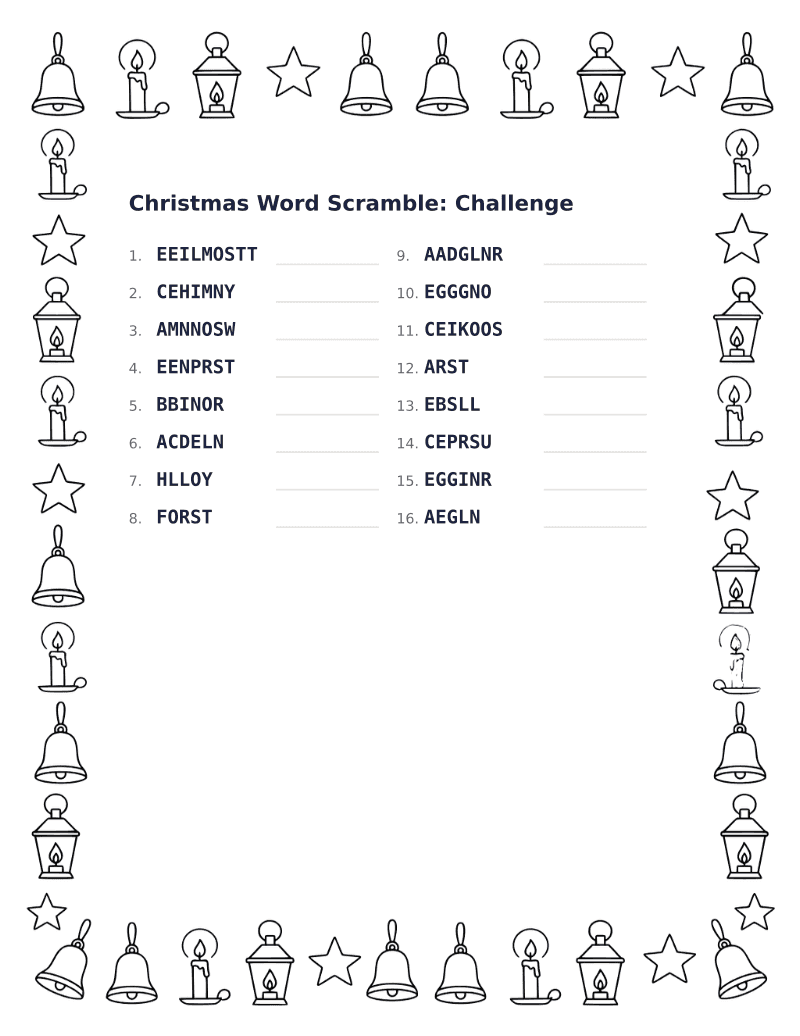 Christmas word scramble, challenge16 words · Hard, letters in alphabetical orderDownload PDF ↓
Every sheet here is free to print as often as you like. If one saved you time, the tip jar is on Ko-fi.
A Christmas word scramble is the puzzle that works when a room has stopped concentrating. It needs no explanation, it can be done alone or in pairs, and it holds a class for the ten minutes between one thing finishing and the next thing starting, which is most of the last week before winter break.
The vocabulary is unusually good for this particular puzzle. Words like WREATH, TINSEL and MISTLETOE are long, have awkward letter clusters, and are spelled in ways children rarely write out. Unjumbling one means holding its letters in mind and testing them against a spelling you half know, which is precisely the practice that moves a word from recognized to written.
The four sheets step up. First letters keeps the opening letter of each word in place, which is what makes a scramble solvable for a five- or six-year-old. Everyday and More words shuffle the whole word, but a shuffle often leaves a letter where it was: 26 of their 34 jumbles keep at least one, and FEAST comes out as "esaft" with its A and T unmoved. Challenge sorts the letters alphabetically, which sounds gentler and is often harder: SNOWMAN becomes "amnnosw", with no letter left where the word has it.
The forty words cover decorations, food, weather and presents, from TINSEL and ORNAMENT to NUTMEG, FROST and PACKAGE, along with CAROL, SLEIGH and REINDEER, and nothing here is a brand name. If you want a sheet from your own list (a carol title, the names of everyone at the table) the maker on this page will jumble it and print the answer key on its own page.
BELLS is the one word on the Christmas challenge sheet that is not printed in alphabetical order, because its letters already are: B, E, L, L and S run in alphabetical order exactly as the word is spelled, so sorting them would print the answer. The sheet shuffles it instead, as "ebsll", and sorts the other fifteen. A child who notices that one jumble breaks the pattern has worked out how the sheet is built, which is a useful thing to know before tackling MISTLETOE, printed as "eeilmostt", with its two Es and two Ts sitting side by side and nothing else to hold on to.
Sorting does not make every word equally hard, and the challenge sheet is best started at its short end. FROST sorts to "forst", a single swap away from the answer, and STAR becomes "arst"; HOLLY turns into "hlloy", which at least keeps the double L together. The long words give nothing away at all: GARLAND is "aadglnr" and SNOWMAN is "amnnosw", and each has to be rebuilt from knowing the theme rather than from the shape of the letters. Solving the four- and five-letter words first means every answer found shortens the list of Christmas words left to try against the longer jumbles.
The Christmas everyday and challenge sheets share twelve words, from RIBBON to ANGEL, and that overlap is the most useful thing to know when planning the last week before winter break. On Everyday the twelve are shuffled at random; on the challenge sheet the same twelve are sorted alphabetically. Printing Everyday early in the week and the challenge sheet at the end therefore gives a second, harder pass over spellings the class has already met once, which is a fair test of whether they stuck. The challenge sheet's other four words, MISTLETOE, CHIMNEY, SNOWMAN and PRESENT, come from the first-letters sheet, so nothing on it is entirely new.
Between them the four sheets use all forty words on the Christmas list, and twenty of the forty appear twice. The more-words sheet is the longest at twenty jumbles, and sixteen of them appear on no other sheet, from CINNAMON and NUTMEG through ORNAMENT and EVERGREEN to SNOWFLAKE, ICICLE and COCOA. It ends with TINSEL, SLEIGH, CAROL and WREATH, the first four words of the first-letters sheet, jumbled in full this time with no first letter to lean on. A child who has already done the first-letters sheet will recognize those four, which makes a gentle finish to the longest page of the set.
Because sorting can strip a word of the clues a shuffle leaves behind. On the Everyday sheet SPRUCE comes out as "sucpre", starting with its own S and ending with its own E, and GINGER as "genigr", with its first G, its N and its R still in place. On the challenge sheet the same two words are sorted to "ceprsu" and "egginr": SPRUCE keeps not a single letter where the word has it, and GINGER keeps only its final R.
Spelling rather than reading, because the solver has to produce every letter of the word in order instead of recognizing it on sight. The Christmas list is full of spellings that catch children out when they write them: the double letters in HOLLY, RIBBON, COOKIES and GLITTER, the silent T in MISTLETOE and CHESTNUT, and the -le ending of ICICLE, TWINKLE and JINGLE.
Yes, several can. TINSEL on the more-words sheet uses the same letters as silent and listen, CAROL can also be read as coral, ANGEL can be angle, and STAR can be rats or arts. The answer key gives the Christmas word, so a child who writes one of the others has unscrambled the letters correctly and should be told so.
New printables when they go up, mostly seasonal, a few times a year.