Animals Word Scramble
- ONYEKM
- FOWL
- DEORALP
- GATO
- EMLUR
- OALKA
- EFAGIFR
- UMOES
- GHHEODGE
- OIRLLGA
- BCTABO
- IGRTE
Created for free at puzzleandprint.com
Jumble your own list, or take one of four ready-made animal sheets.
Last updated
Save this to PinterestAnimals Word Scramble
Created for free at puzzleandprint.com
Animals Word Scramble, Answer Key
Created for free at puzzleandprint.com
Four sheets at different lengths and difficulties. Every one is a two-page PDF, the worksheet, then the answer key on its own page.
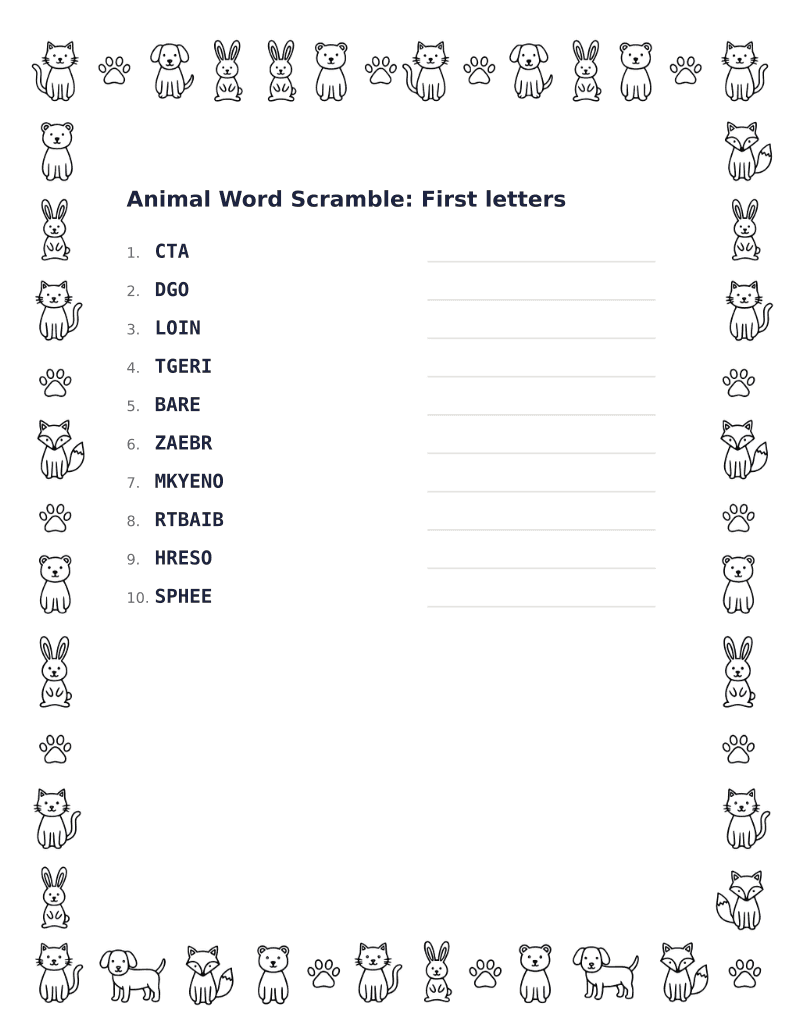 Animal word scramble, first letters10 words · Easy, first letter stays putDownload PDF ↓
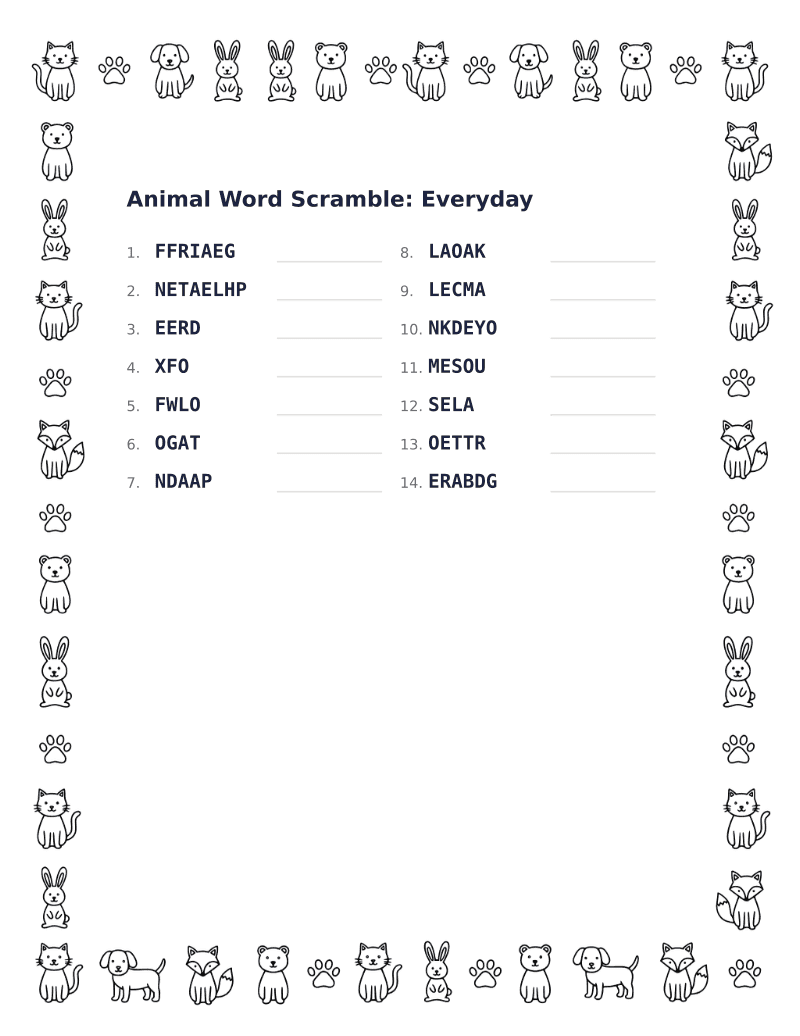 Animal word scramble, everyday14 words · Medium, every letter movesDownload PDF ↓
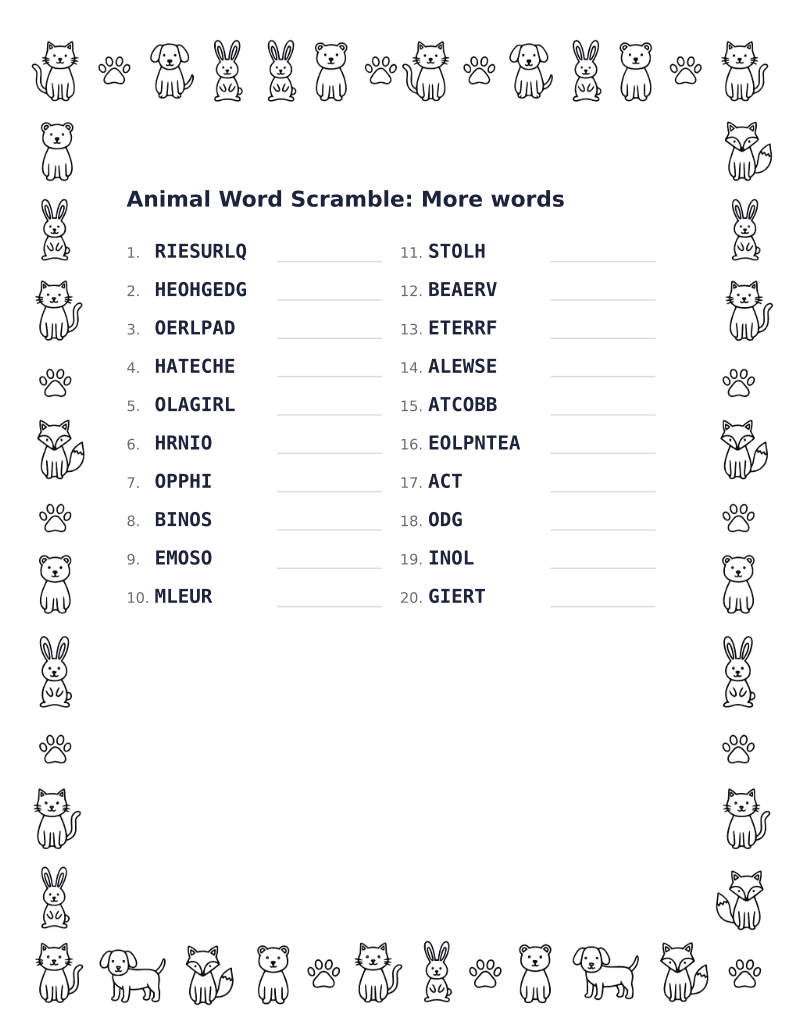 Animal word scramble, more words20 words · Medium, every letter movesDownload PDF ↓
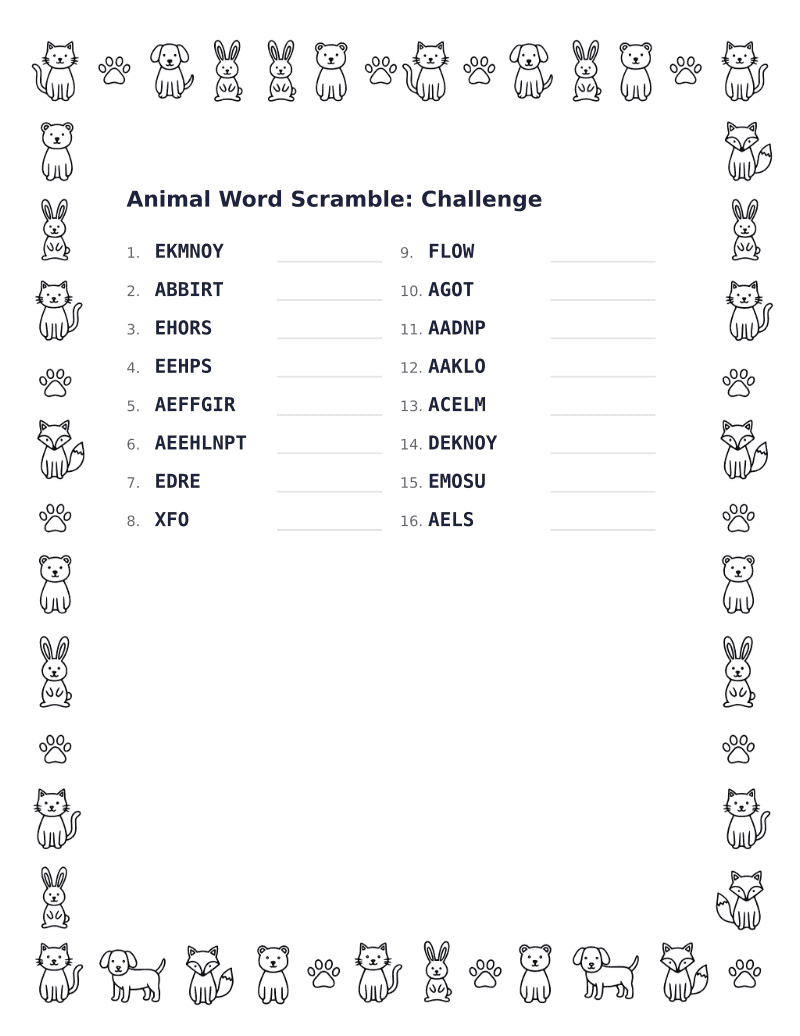 Animal word scramble, challenge16 words · Hard, letters in alphabetical orderDownload PDF ↓
Every sheet here is free to print as often as you like. If one saved you time, the tip jar is on Ko-fi.
Animal names are the first vocabulary most children can spell without being taught, which makes them the right subject for a first scramble. A child who cannot yet unjumble an abstract word will often get TIGER on sight, and that early success is what makes the rest of the sheet worth attempting.
The list runs from three-letter animals such as CAT, DOG and FOX to eight-letter ones such as ELEPHANT, HEDGEHOG and SQUIRREL, and no sheet sorts them by length. More words opens on SQUIRREL and HEDGEHOG and closes on CAT, DOG, LION and TIGER, and Everyday puts FOX two lines below ELEPHANT, so a child who stalls on a long word has a short one close by to keep going with.
The first-letter sheet is the one to start with for four to six year olds. Keeping the opening letter turns the question from "what could these letters spell" into "what animal begins with Z", which is answerable. The alphabetical challenge at the other end is a genuine puzzle for an adult.
All 40 animals on the list appear across the four sheets, and 20 of them appear twice: CAT, DOG, LION and TIGER keep their first letter on the easy sheet and lose it on More words, MONKEY, RABBIT, HORSE and SHEEP move from the easy sheet to the alphabetical Challenge, and twelve Everyday animals from GIRAFFE to SEAL come back on the Challenge sheet too. A word a child stalled on the first time gets a second attempt on a harder sheet.
Four jumbles on the animal sheets happen to be real words, and they are the ones most likely to confuse a child: LION is printed as "loin" and BEAR as "bare" on the first-letters sheet, CAT appears as "act" on More words, and WOLF sorts into "flow" on the challenge sheet. A child who reads "bare" may write bare on the line and move on, believing the word was never scrambled. Saying before the sheet starts that every line hides an animal, even when the jumble is itself a word, heads that off. The answer key gives the animal each time, so these four are also the ones most likely to need a quick conversation when grading.
Used deliberately, the same four make a short lesson on anagrams, words built from exactly the same letters. BEAR and bare share a sound as well as their letters, so they are a homophone pair too, while LION and loin do not even sound alike. Once the class has the idea, the list has more pairs to find: HORSE rearranges into shore, SEAL into sale, DEER into reed and GOAT into toga. Giving a clue for each ("an animal whose letters also spell the edge of the sea") turns the answer key into a five-minute extension that needs no extra printing. TIGER, RABBIT and MONKEY have no such partner, so the search also shows that most words do not.
Look for letters that travel in pairs, because the long animal names give themselves away through them. In SQUIRREL, on the more-words sheet, there is a Q, and in English a Q is almost always followed by U, so the QU can be placed as one block before anything else. In ELEPHANT, on the everyday and challenge sheets, the PH makes the f sound, which matters because a child sounding the word out will look for an F that is not there. CHEETAH has two Hs, one in the CH at the front and one at the very end, and SHEEP starts with SH, so in either jumble the first H to place is the one straight after the C or the S.
Doubled letters are the other clue. GIRAFFE has FF, RABBIT has BB, HIPPO has PP, OTTER has TT and SQUIRREL has RR, and in every one of them the pair sits together in the answer, so two matching letters in a jumble can usually be treated as one block. The rule is not perfect. KOALA and PANDA each have two As that are not side by side, and HEDGEHOG has two Hs and two Gs spread through the whole word, so for those three the block trick does not help. KOALA and PANDA are on the everyday sheet and HEDGEHOG is on More words, which is worth knowing before a child asks why the trick stopped working.
The First letters sheet suits a five-year-old, because every animal on it keeps its opening letter. It is also the only one of the four with no word longer than six letters, from CAT and DOG up to MONKEY and RABBIT, and its ten animals all begin with different letters, so a child who guesses from the first letter is never torn between two animals on the same sheet.
No, the scramble is a different exercise even though both use the same 40-animal list: a search asks a child to spot a spelling, a scramble asks them to produce it. The scramble also goes further down the list. LEMUR, SLOTH, BEAVER, FERRET, WEASEL, BOBCAT and ANTELOPE are on no animal word-search sheet, and all seven are on the More words scramble.
Because both already are: F, O, X and D, E, E, R run in alphabetical order, so sorting them would print the answer. The challenge sheet shuffles those two instead, as "xfo" and "edre", and every other word on it is sorted.
New printables when they go up, mostly seasonal, a few times a year.