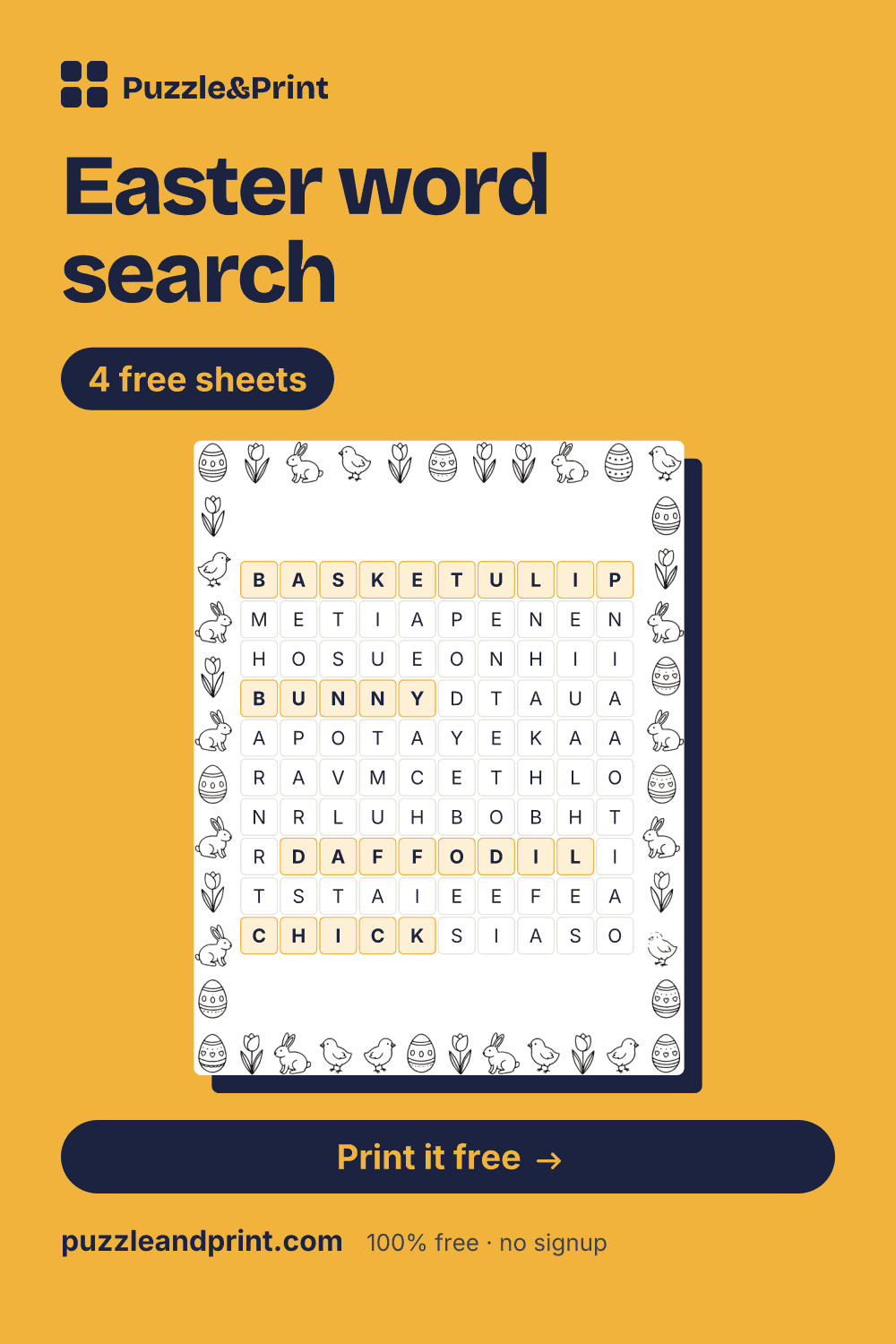
Easter Word Search
- SPECKLED
- JELLYBEAN
- LAMB
- CARROT
- NEST
- HIDDEN
- SUNDAY
- PAINTED
- GARDEN
- PETALS
- BUNNY
- RENEWAL
Created for free at puzzleandprint.com
Eggs, spring flowers and everything that hatches.
Last updated
Save this to PinterestEaster Word Search
Created for free at puzzleandprint.com
Easter Word Search, Answer Key
Created for free at puzzleandprint.com
Four sheets, each with a different job. Every one is a two-page PDF, the puzzle, then the answer key on its own page.
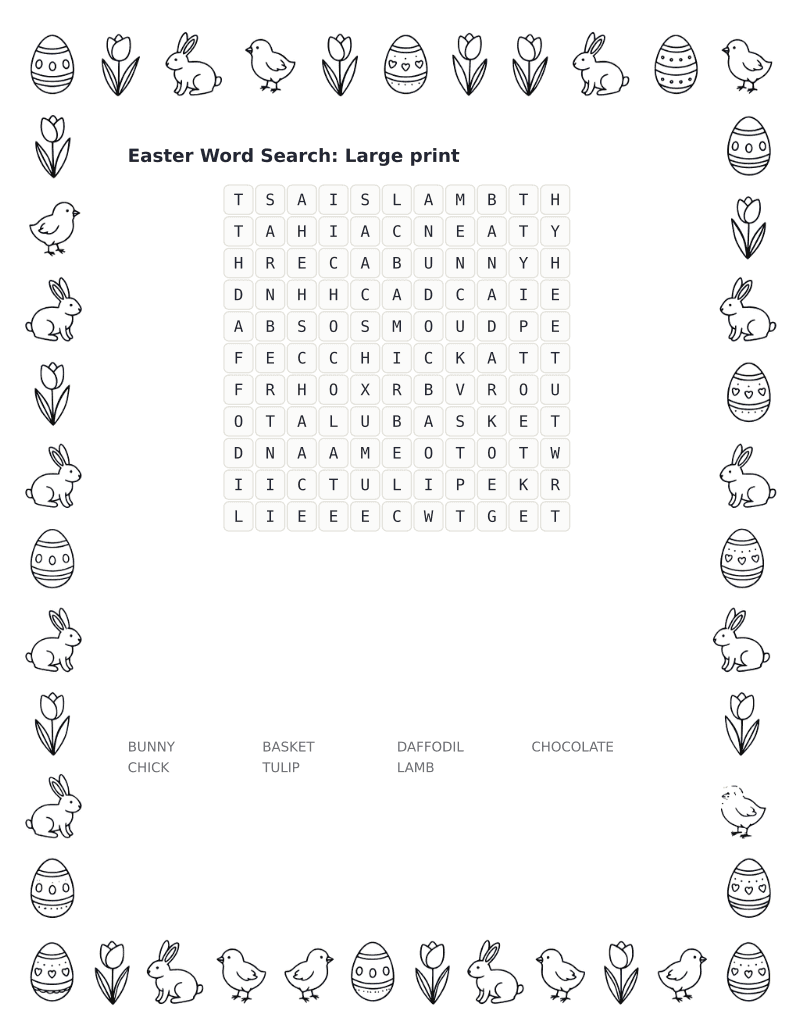 Easter word search, large print11 × 11 · 7 words · EasyDownload PDF ↓
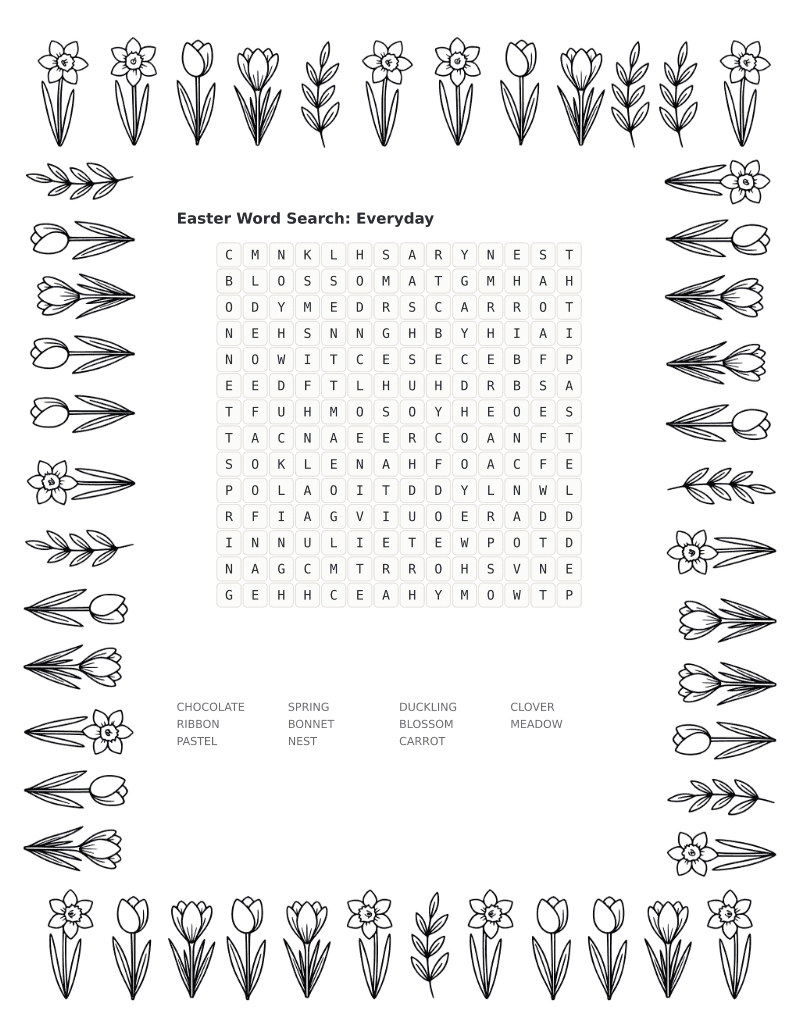 Easter word search, everyday14 × 14 · 11 words · MediumDownload PDF ↓
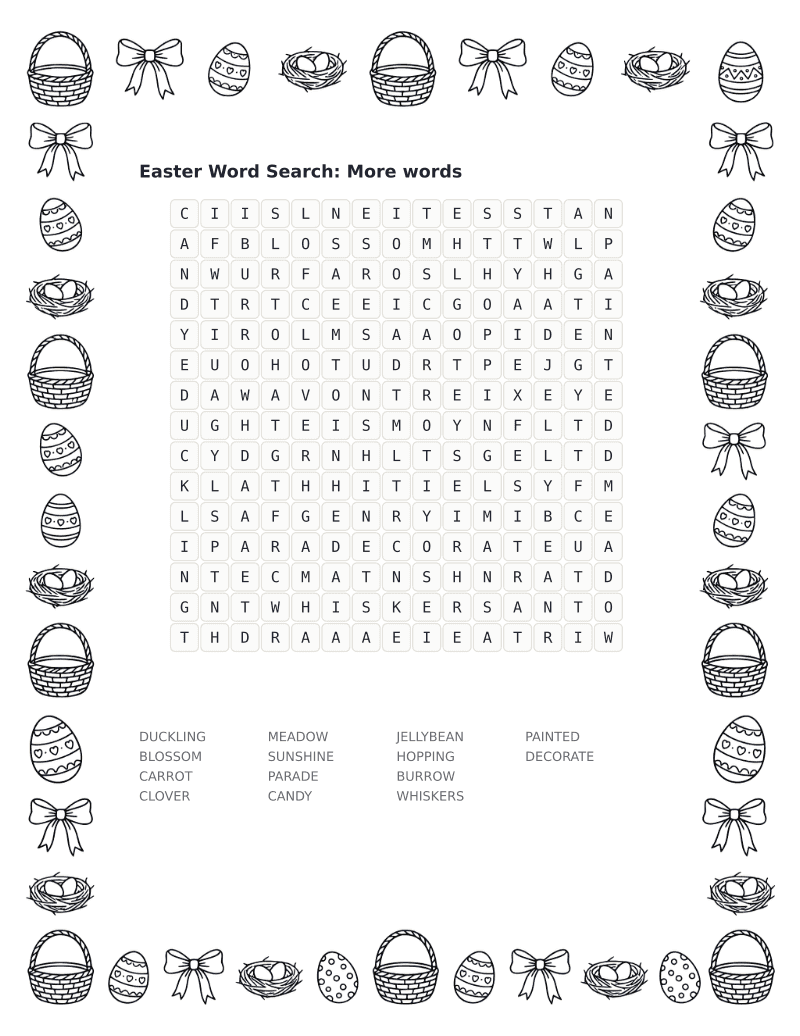 Easter word search, more words15 × 15 · 14 words · MediumDownload PDF ↓
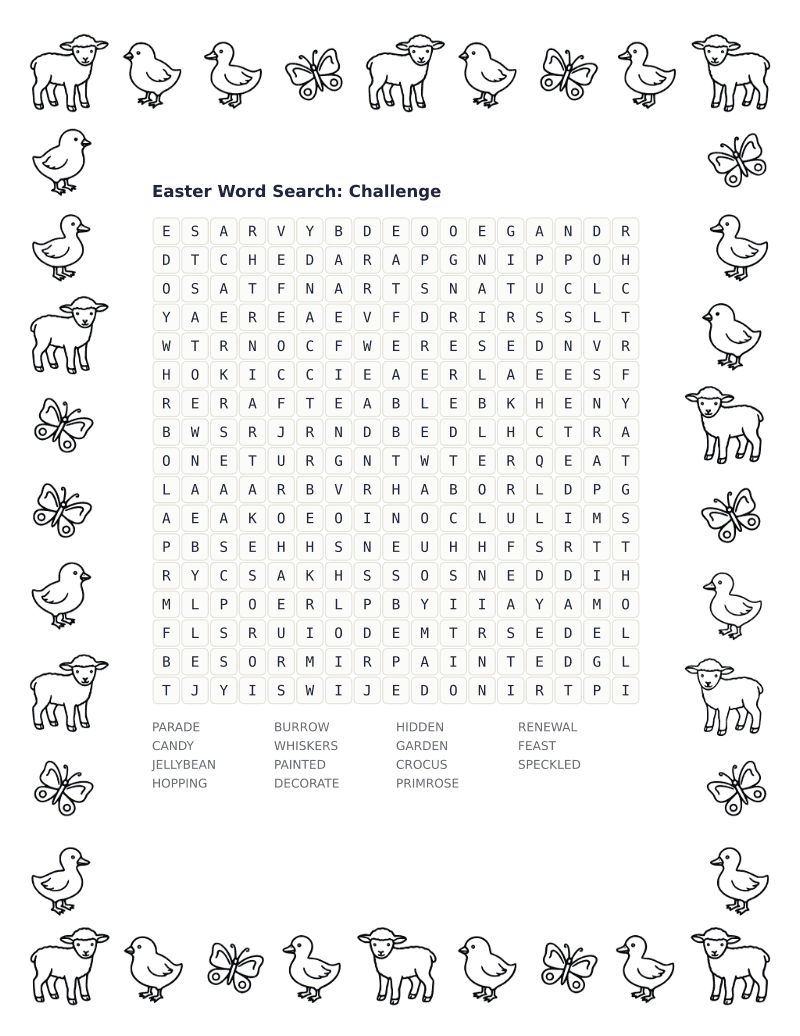 Easter word search, challenge17 × 17 · 15 words · HardDownload PDF ↓
Every sheet here is free to print as often as you like. If one saved you time, the tip jar is on Ko-fi.
Easter vocabulary is unusually kind to early readers, because so much of it is short and concrete. Bunny, chick, lamb and tulip, all four on the large-print sheet, are words a five-year-old can find without help, which makes this one of the few seasonal lists that works at the largest print size.
The spring half of the list does more teaching than the holiday half. Crocus, primrose and blossom are plant names most children only meet if someone points them out, and a puzzle is a low-effort way to put them in front of a class before a walk.
For a mixed classroom, the list stays on the secular side of the holiday. Nothing here assumes a particular observance, which means it can go home with everyone rather than being set aside.
It pairs well with anything involving decorating. Children who have just painted an egg have a use for speckled, painted and pastel, and the words land better attached to a thing they made.
Eleven of the forty Easter words have a double letter: BUNNY, DAFFODIL, RIBBON, BONNET, BLOSSOM, CARROT, JELLYBEAN, HOPPING, BURROW, HIDDEN and FLUFFY. That makes the list unusually good spelling practice, because a doubled letter is exactly where spelling mistakes tend to happen. CARROT has a double R and a single T, and the usual mistake is to double the wrong one. DAFFODIL doubles its F and nothing else. HOPPING shows the rule most children are taught early on, that a short vowel followed by a single consonant doubles that consonant before ing, so hop becomes HOPPING, and HIDDEN follows the same pattern from hid.
Doubled letters also help in the puzzle itself, because a pair of identical letters side by side stands out from a grid more than a single one does. On the challenge Easter sheet, where fifteen words can run backwards and diagonally across seventeen squares, JELLYBEAN, HOPPING, BURROW and HIDDEN all carry a pair and make a sensible place to start. PARADE, GARDEN, CROCUS and FEAST have nothing doubled to catch the eye, so they are the ones to leave until last. PRIMROSE, also on that sheet, is worth a sentence: it is not a rose, and its name comes from the Latin for first rose, because it flowers so early in spring.
BONNET, PARADE, RIBBON, DECORATE, PAINTED and PASTEL are the Easter words that go with a bonnet parade, and PARADE, PAINTED and DECORATE are among the fifteen words on the challenge sheet, where words can also run backwards. An Easter bonnet parade, where children decorate a hat and walk it through the hallways or around the playground, is a long-standing spring tradition in many British schools, and these are the words a child needs to describe what they made. BONNET, RIBBON and PASTEL are on the everyday sheet; PARADE, PAINTED and DECORATE come on the more words sheet, so printing both gives the whole set, and the finished sheets make a word bank for a label to go beside each bonnet.
The other Easter sheets follow the season rather than the parade. Large print is the familiar half of the holiday, seven words from BUNNY to CHOCOLATE on an eleven-square grid where every word runs across or down, and CHOCOLATE, at nine letters, takes up all but two squares of whichever row or column it runs along. The everyday and more words sheets move outdoors with NEST, BLOSSOM, CLOVER, MEADOW and SUNSHINE, and bring in BURROW, WHISKERS and HOPPING for the rabbit. The challenge sheet ends in the garden with GARDEN and CROCUS, and adds SPECKLED and HIDDEN, two words that belong to the egg hunt more than to anything else on the list.
No. The list is spring, animals and chocolate: BUNNY, CHICK, BASKET, TULIP, DAFFODIL, LAMB and CHOCOLATE open it, and RENEWAL and SUNDAY are as close as it comes. SUNDAY is on none of the four ready-made sheets, and RENEWAL appears only on the challenge sheet, so the large-print, everyday and more words sheets carry neither.
It slots in well as the thing to do while the eggs are being hidden, which is the gap every egg hunt has. Print the large-print sheet for the youngest and the challenge sheet for whoever is too old to be hunting.
In the week or two before spring break, since that is when the classroom use comes and Easter often falls in or close to spring break. Easter Sunday moves from year to year, falling between March 22 and April 25 in the Western calendar, so check the date against your school calendar rather than assuming the same week as last year.
New printables when they go up, mostly seasonal, a few times a year.