Easter Word Scramble
- CKHCI
- DTAIENP
- DFADOFLI
- ERDPAA
- BUYNN
- RCATOR
- WROUBR
- RAELNWE
- DOMAWE
- BLLJEANYE
- SRCCUO
- EOBNTN
Created for free at puzzleandprint.com
Four Easter word scrambles, 60 jumbles in all, from BUNNY and CHICK with their first letters kept in place to JELLYBEAN with its letters sorted, each with its answer key on its own page.
Last updated
Save this to PinterestEaster Word Scramble
Created for free at puzzleandprint.com
Easter Word Scramble, Answer Key
Created for free at puzzleandprint.com
Four sheets at different lengths and difficulties. Every one is a two-page PDF, the worksheet, then the answer key on its own page.
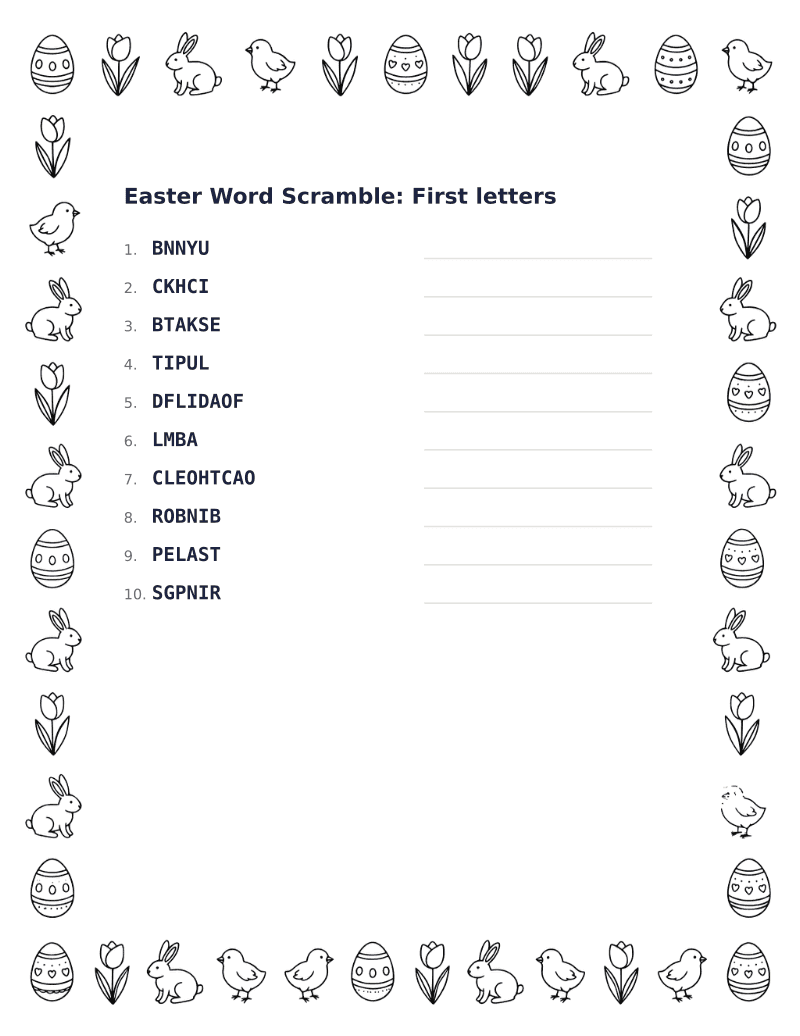 Easter word scramble, first letters10 words · Easy, first letter stays putDownload PDF ↓
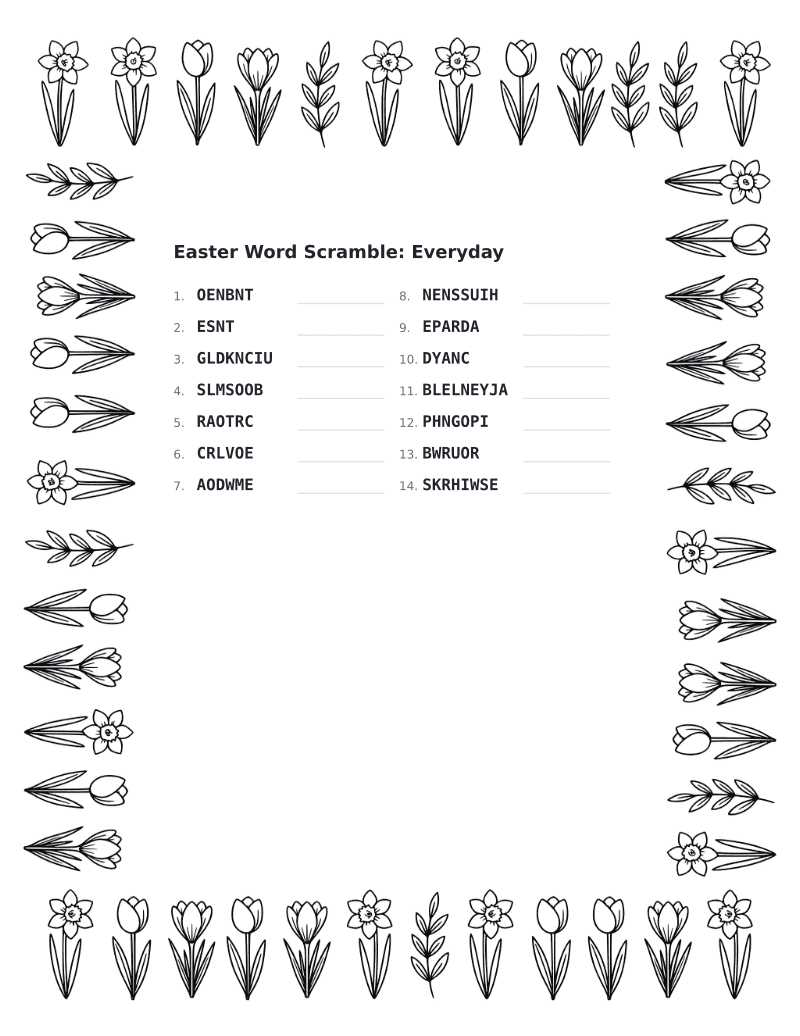 Easter word scramble, everyday14 words · Medium, every letter movesDownload PDF ↓
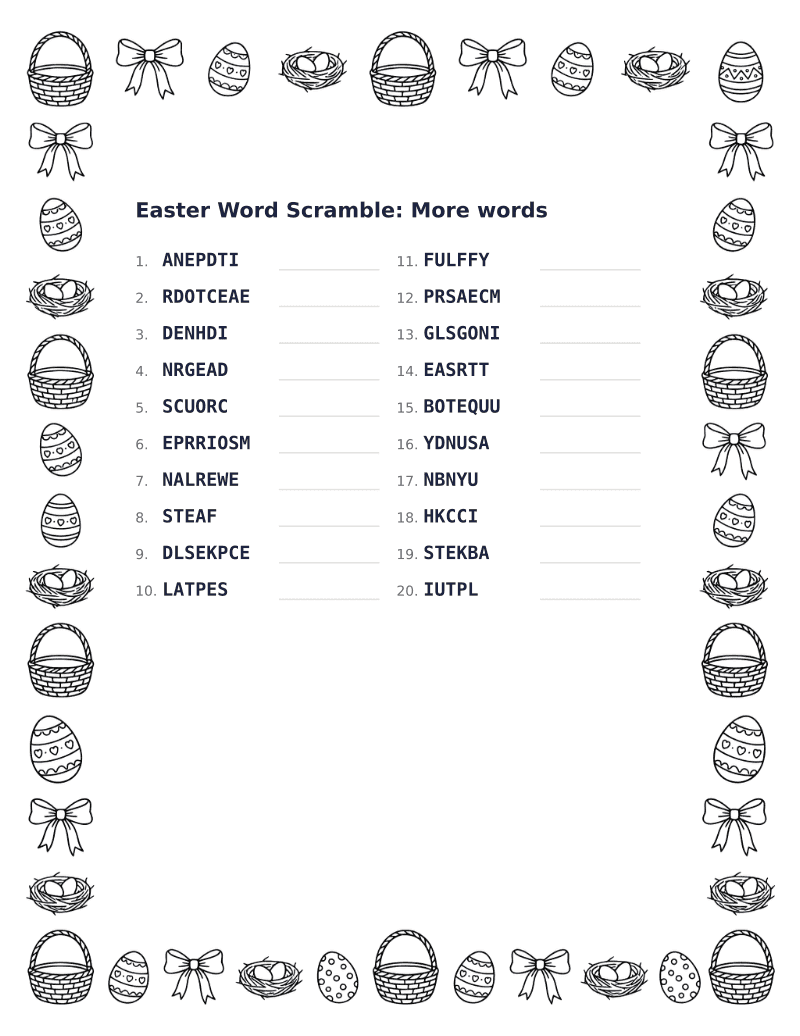 Easter word scramble, more words20 words · Medium, every letter movesDownload PDF ↓
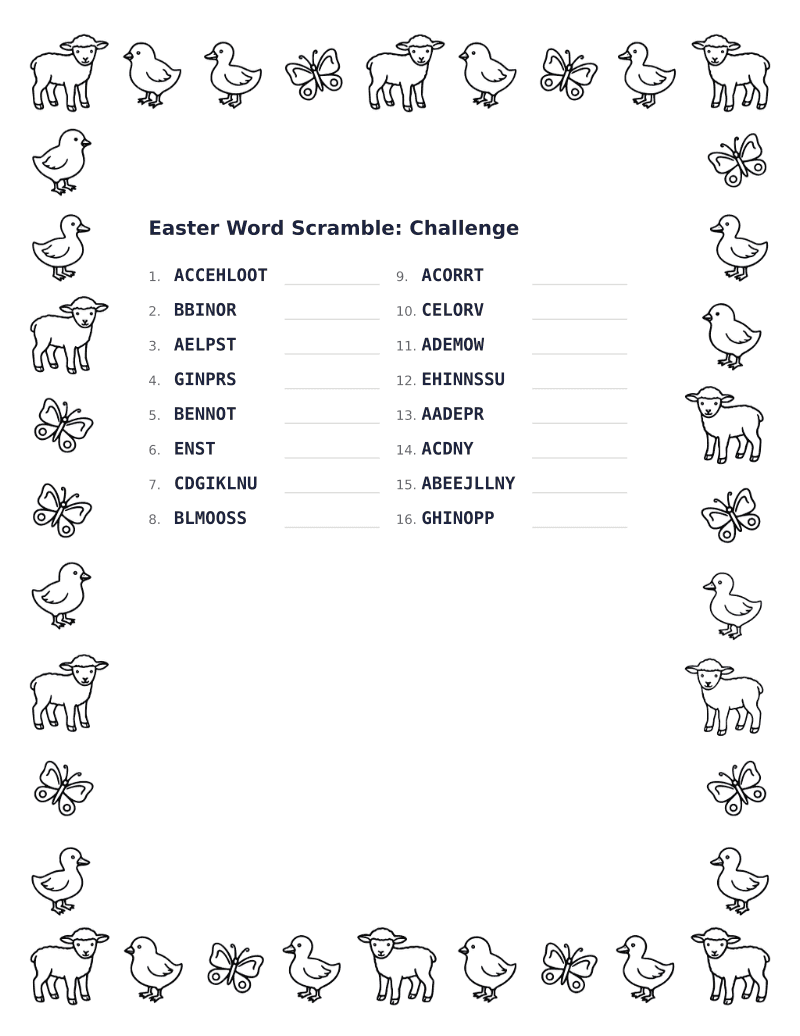 Easter word scramble, challenge16 words · Hard, letters in alphabetical orderDownload PDF ↓
Every sheet here is free to print as often as you like. If one saved you time, the tip jar is on Ko-fi.
Easter moves, to March 28 in 2027 and April 16 in 2028, and the weeks before it are when a classroom or a family table wants something spring-shaped to do. A word scramble needs a pencil and no explanation, it can be passed between two people, and it suits the quiet half hour before an egg hunt while somebody else is out hiding the eggs.
The forty words keep to the season and the hunt. There are the young animals (BUNNY, CHICK, LAMB, DUCKLING and GOSLING), the spring flowers (TULIP, DAFFODIL, CROCUS and PRIMROSE), the hunt itself (BASKET, HIDDEN, PAINTED, SPECKLED and DECORATE) and the sweets (CHOCOLATE, JELLYBEAN, CANDY and TREATS). None of them is a religious term; for a church group, the maker on this page will jumble the words from your own lesson instead, up to 24 of them.
The first-letters sheet is not all short words. It opens with BUNNY and CHICK but also holds CHOCOLATE and DAFFODIL, two of the longest words on the list, and keeping the first letter is what puts them within reach of a young reader: "cleohtcao" is a lot of letters, but a C at the front and chocolate already in mind is usually enough. Two of its words begin with B and two with C, so on those four the first letter narrows the choice without settling it.
The other three sheets shuffle the whole word, and the last one sorts it. Everyday has fourteen words, from BONNET to WHISKERS, More words has twenty, from PAINTED to TULIP, and Challenge prints sixteen in alphabetical order, CHOCOLATE as "accehloot" and DUCKLING as "cdgiklnu". Between them the four sheets use all forty words on the Easter list, and twenty of them twice.
PASTEL and PETALS are made of exactly the same six letters, and both are on the Easter list. PETALS is on the more-words sheet as "latpes". PASTEL is on the first-letters sheet as "pelast" and on the challenge sheet as "aelpst", which is also what PETALS looks like sorted, and what plates, staple and palest would look like too. The answer key says PASTEL, but a child who writes petals there has unjumbled the letters perfectly and has even stayed on the theme.
Five more Easter words hide a second word. GARDEN, on the more-words sheet as "nrgead", is also danger; NEST, on the everyday and challenge sheets, is sent, nets and tens; LAMB is balm; FEAST is feats and fates; and TREATS is taster. None of those second words is a spring word, so they are easy to rule out once a child knows every line hides something from Easter, and the pairs make a short extension for a class that finishes early: give the second word as the clue and ask which Easter word it is hiding in.
Nine of the sixteen words on the Easter challenge sheet have a letter twice, and sorting puts every pair side by side: RIBBON becomes "bbinor", HOPPING "ghinopp" and CARROT "acorrt". In those three the pair sits together in the word as well, so a doubled letter in the jumble can go into the answer as one block. BONNET works the same way with its NN, and so do BLOSSOM and JELLYBEAN for one of their two pairs, the SS and the LL.
It is not true of every pair, and the exceptions are the slow lines. SUNSHINE sorts to "ehinnssu", with its Ns together and its Ss together, but in the word both pairs are split; PARADE ("aadepr") keeps its two As apart with an R, and CHOCOLATE ("accehloot") has its two Cs and its two Os apart. BONNET is the friendliest line on the page: sorting only swaps its O and E, so "bennot" already has the B, both Ns and the T where the word needs them.
Every word on the Easter challenge sheet has been on an earlier sheet. CHOCOLATE, RIBBON, PASTEL and SPRING come from the first-letters sheet and the other twelve, from BONNET to HOPPING, from the everyday sheet, which leaves only BURROW and WHISKERS behind. That makes the alphabetical sheet a fair end-of-week check: the letters give nothing away, but every answer is a word the class has already unjumbled once.
The more-words sheet is where the new vocabulary is. Sixteen of its twenty words are on no other Easter sheet, and they lean toward the garden and the egg hunt: PAINTED, DECORATE, HIDDEN and SPECKLED for the eggs, CROCUS, PRIMROSE and PETALS for the flowers, and GOSLING and SCAMPER for the animals. Printed on its own, it is a second Easter sheet for a child who has done the first-letters one and wants words they have not met yet.
Because the shuffle happened to swap only its L and U, so "fulffy" has four of its six letters exactly where the word has them. A random shuffle lands that close now and then. The rest of that sheet is much less kind: PAINTED, HIDDEN, GARDEN, CROCUS, RENEWAL, FEAST and SCAMPER keep no letter in place at all.
They are on the first-letters sheet with their opening letters kept, and they come back as the last four lines of the more-words sheet shuffled in full, as "nbnyu", "hkcci", "stekba" and "iutpl". A child who has done the first sheet reaches the end of the longest one with four answers half known, which is a gentle way to finish twenty jumbles.
Because the list stores every entry as letters only, so jelly bean is jumbled as a single nine-letter word, "blelneyja" on the everyday sheet and "abeejllny" on the challenge sheet. Dictionaries usually print it as two words, which is worth mentioning when the sheet is graded. A child who spots JELLY among the letters has found the quickest way in, since BEAN is all that is left.
New printables when they go up, mostly seasonal, a few times a year.