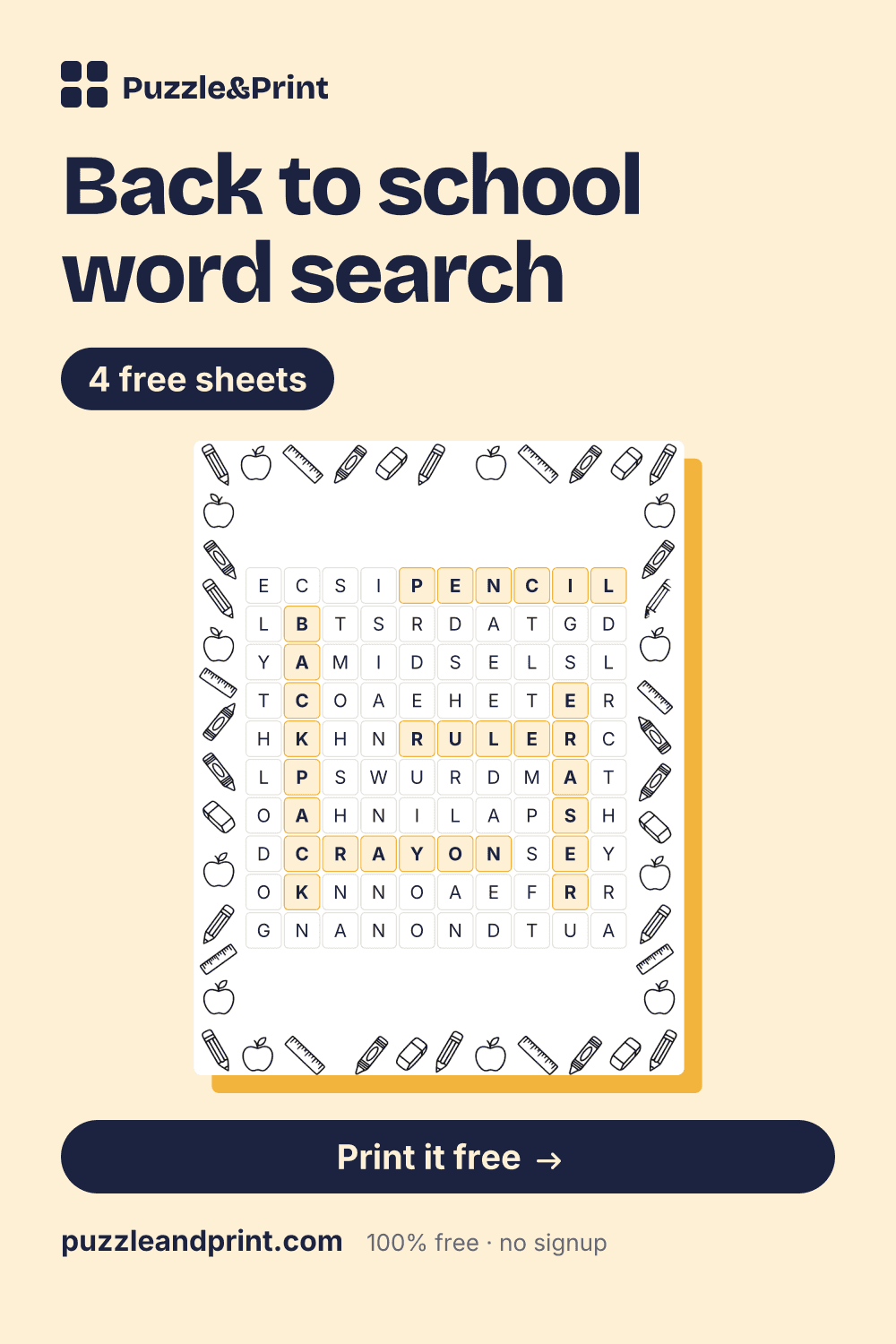
Back to school Word Search
- SCISSORS
- CALENDAR
- HOMEWORK
- LIBRARY
- RECESS
- PENCIL
- CAFETERIA
- COMPASS
- STAPLER
- DESK
- FOLDER
- SCHEDULE
Created for free at puzzleandprint.com
Created for free at puzzleandprint.com
Created for free at puzzleandprint.com
Four sheets, each with a different job. Every one is a two-page PDF, the puzzle, then the answer key on its own page.
September vocabulary earns its place because children need it immediately. Sharpener, binder, schedule and locker are words that appear on the first day and get used every day after, and a child who can read them navigates the week more easily.
It is a settling activity as much as a teaching one. The first days back are long on administration and short on things for early finishers to do, and a sheet built from the room around them is easier to hand out than one that needs explaining.
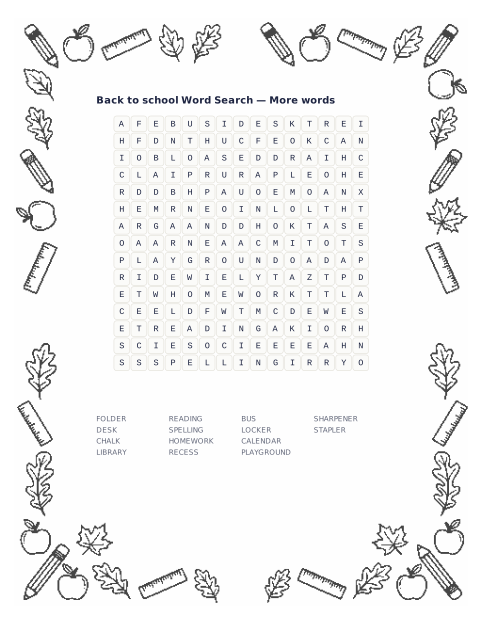
The list mixes what is on the desk with what happens in the day (recess, assembly, library, cafeteria), so it works as a walkthrough of the timetable for a child starting somewhere new. Reading the words before meeting the places takes some of the edge off.
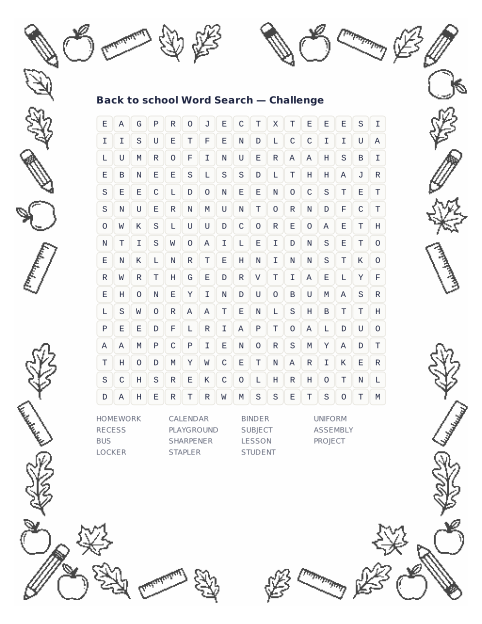
For a home-education setting the same list works as a September reset. Print the large-print version for the start of the year and keep the challenge sheet for whoever finishes everything early, which is a problem this week reliably produces.
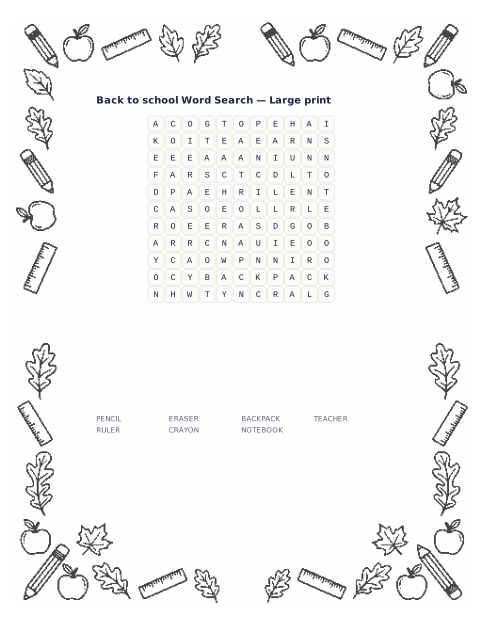
Before term rather than after it. The words are the ones a child is about to need, PENCIL, RULER, ERASER, CRAYON, BACKPACK, NOTEBOOK and TEACHER, and meeting them in the last week of the holidays takes some of the strangeness out of the first week of school.
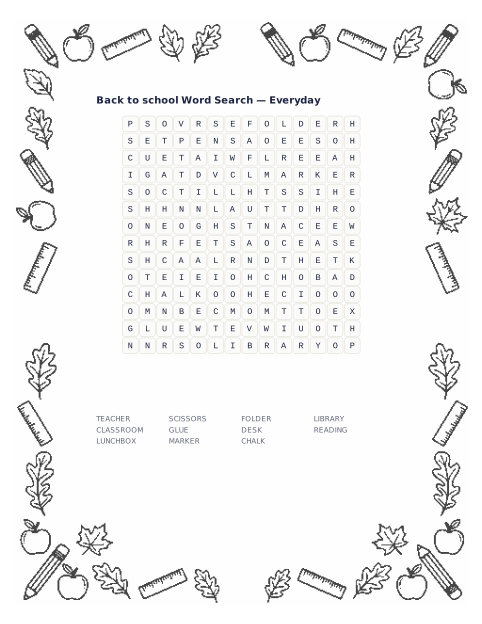
It is a reliable first-morning activity, because it needs no prior knowledge and can be done alone at a desk while other children are still arriving. CLASSROOM, LOCKER, ASSEMBLY and CAFETERIA also name the places a new child is about to have to find.
Up to twenty-five. Ten to fifteen is comfortable for most grids. If you add more than the grid can hold, the tool tells you which words did not fit rather than silently leaving them out.
Either it is longer than the grid is wide, or the grid filled up before it could be placed. Try the next size up, remove a word, or press New puzzle for a different arrangement, a word that fails one layout often places fine in the next.
Yes. Set difficulty to Easy so words only run left to right and top to bottom, and use a 10 by 10 grid with five to eight short words. That combination is manageable for most children who can read the words on the list.
Always, and it prints on its own page so you can hand out the puzzle without it. Each answer is marked directly on a copy of the grid.
No. There is no sign-up, no email, and no watermark on the printed sheet. Puzzles are built in your browser, so your word list never reaches us.
Yes, use them with your class, your family, your club, or your care home, and print as many copies as you need. The one thing we ask is that you do not resell the sheets themselves.
New printables when they go up, mostly seasonal, a few times a year.