Transportation Word Search
- BARGE
- BIKE
- AMBULANCE
- HOVERCRAFT
- YACHT
- MINIBUS
- CAMPER
- KAYAK
- BULLDOZER
- CANOE
- PLANE
- TAXI
Created for free at puzzleandprint.com
Transportation by road, rail, sea and air.
Last updated
Save this to PinterestTransportation Word Search
Created for free at puzzleandprint.com
Transportation Word Search, Answer Key
Created for free at puzzleandprint.com
Four sheets, each with a different job. Every one is a two-page PDF, the puzzle, then the answer key on its own page.
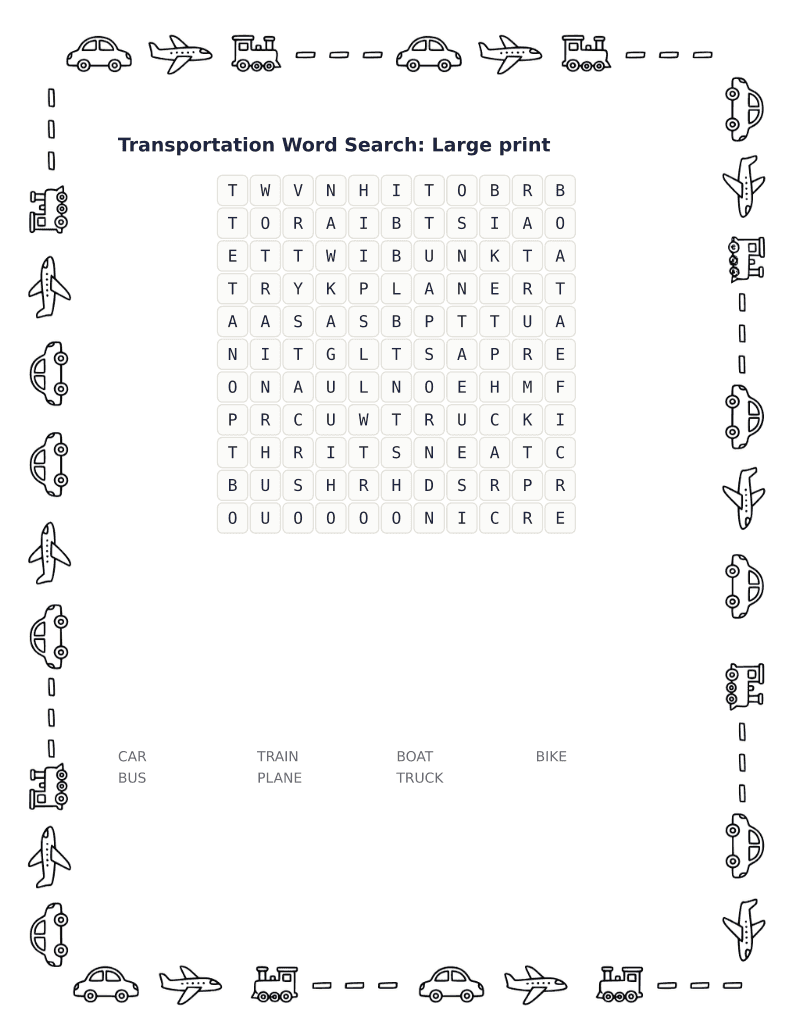 Transportation word search, large print11 × 11 · 7 words · EasyDownload PDF ↓
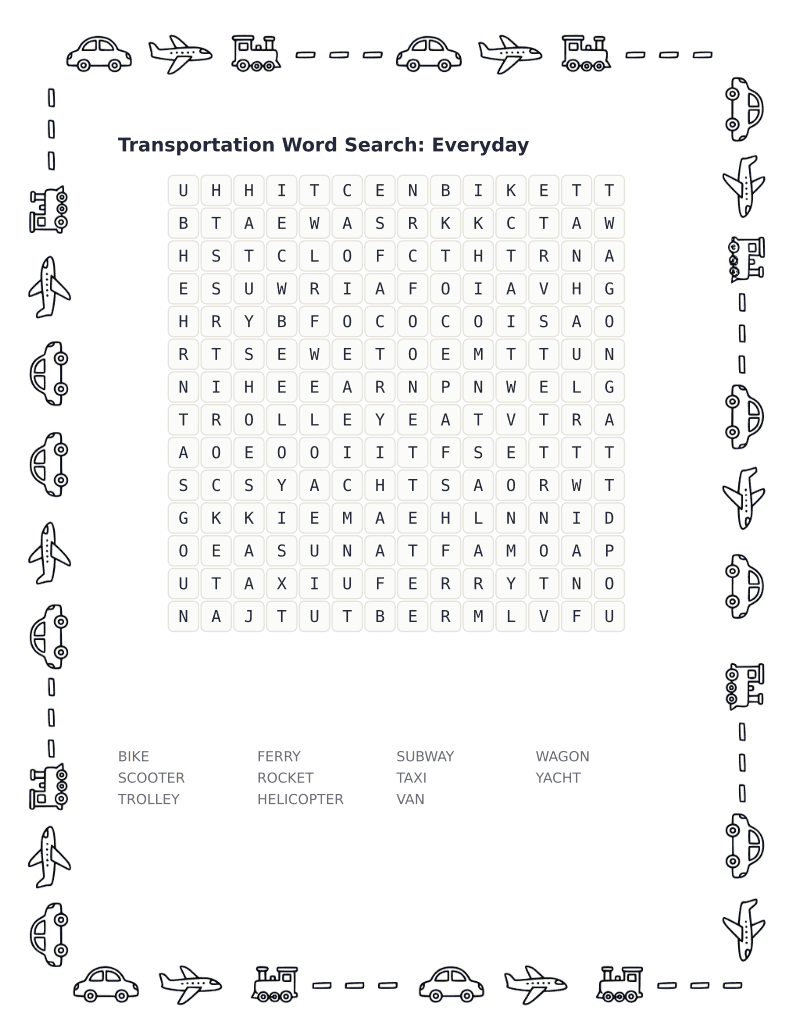 Transportation word search, everyday14 × 14 · 11 words · MediumDownload PDF ↓
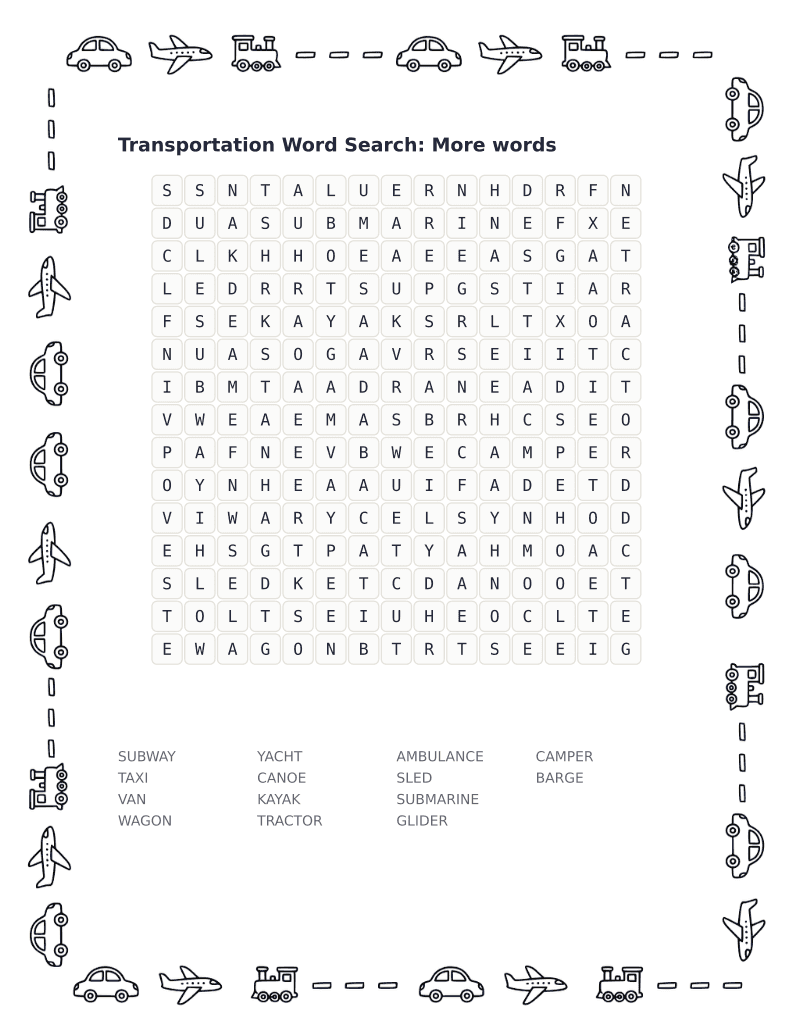 Transportation word search, more words15 × 15 · 14 words · MediumDownload PDF ↓
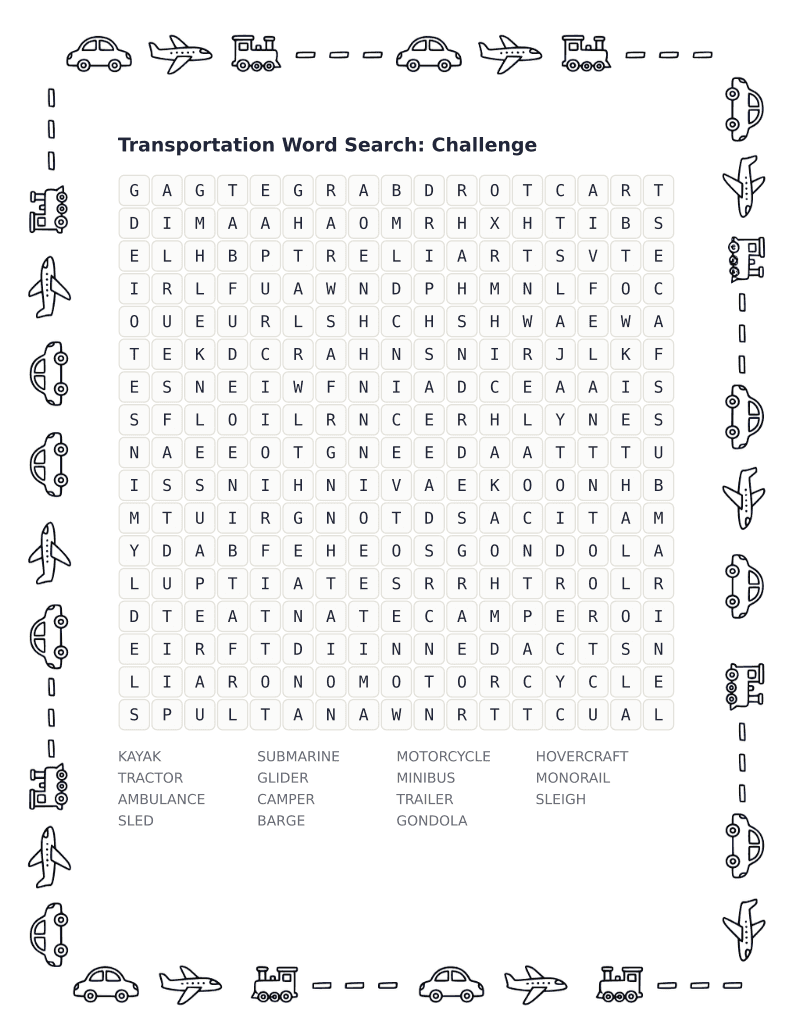 Transportation word search, challenge17 × 17 · 15 words · HardDownload PDF ↓
Every sheet here is free to print as often as you like. If one saved you time, the tip jar is on Ko-fi.
Vehicles are reliably popular with younger children and the words are mostly short, so this places well in a small grid. It is a good first theme for a child who has not done a word search before.
The list spans all four ways of traveling, so the finished sheet supports an easy sorting question: which of these go on water? That extends a two-minute activity into something more.
Seven of the forty words, CHARIOT, RICKSHAW, FORKLIFT, BULLDOZER, AIRSHIP, JETSKI and TANDEM, are on none of the four ready-made sheets, so they are the ones to type into the maker above for a fifth sheet.
This one travels. A sheet built from what you might pass on the way is a better distraction than a generic list, and takes a minute to put together before you leave.
Several of the vehicles on the transportation list arrived in English from other languages, and their spellings still show it: KAYAK comes from an Inuit word, YACHT from Dutch, GONDOLA from the Italian of Venice, RICKSHAW from Japanese, and CANOE from a Caribbean language by way of Spanish. YACHT is the hardest of them to spell, with a ch that makes no sound at all, and it sits on the everyday and more-words sheets. KAYAK is the neatest: it reads the same backwards, so on the challenge sheet, where words can run in reverse, it looks exactly the same whichever way it was placed.
CAMPER came the long way around: camp reached English through French from the Latin campus, an open field, and English added the er, so the word names a person who camps as well as the vehicle they sleep in. CHARIOT and SLEIGH belong mostly to stories, and SLEIGH carries the same silent gh as eight and weigh. On the challenge sheet, GONDOLA and HOVERCRAFT make an unlikely pair, one rowed along canals for centuries and the other riding on a cushion of air, and asking a child which of the two is older is a good question to finish on.
The front of a transportation word often says what kind of vehicle it is: sub means under, mono means one and mini means small, so a SUBMARINE goes under the sea, a SUBWAY runs under the ground, a MONORAIL runs on a single rail and a MINIBUS is a small BUS. Teaching those three prefixes from this list gives a child a way into words they have never met. SUBMARINE and SUBWAY share the more-words sheet, and MINIBUS and MONORAIL are both on the challenge sheet, so either sheet can carry a short lesson on how English builds a long word from a short one.
Five more vehicles are plain compounds that come apart into words a child already knows: MOTORCYCLE, HOVERCRAFT, AIRSHIP, FORKLIFT and JETSKI. One of the short words on the large-print sheet also turns up inside a longer one on the list, BUS in MINIBUS, and the two never share a sheet, since MINIBUS waits until the challenge sheet, so a child cannot mistake the three letters inside the longer word for a BUS of its own. Spotting the small word inside the big one is a good habit for a reader, even when it is a nuisance in a word search.
The large-print sheet, which uses CAR, BUS, TRAIN, PLANE, BOAT, TRUCK and BIKE. Nearly all of it can be spotted through the window as well as on the page, which buys considerably more than the ten minutes the puzzle takes.
HELICOPTER, HOVERCRAFT and MOTORCYCLE, at ten letters, are the longest words on the list, followed by AMBULANCE, SUBMARINE and BULLDOZER at nine. None of them is on the 11-square large-print sheet; HELICOPTER is on the 14-square everyday sheet, AMBULANCE and SUBMARINE are on the more-words and challenge sheets, HOVERCRAFT and MOTORCYCLE appear only on the 17-square challenge sheet, and BULLDOZER is on none of the four.
Yes: on a list of vehicles SUBWAY carries its American meaning, an underground railway. In Britain a subway is more often a foot tunnel under a busy road, and the London railway is the Underground or the Tube, so a British class may need the word explained. SUBWAY is on the everyday and more-words sheets.
New printables when they go up, mostly seasonal, a few times a year.