Jobs and careers Word Search
- VET
- DRIVER
- FLORIST
- POLICE
- JUDGE
- PLUMBER
- CARPENTER
- OPTICIAN
- DOCTOR
- CHEF
- LIBRARIAN
- BUILDER
Created for free at puzzleandprint.com
Jobs and careers Word Search
Created for free at puzzleandprint.com
Jobs and careers Word Search, Answer Key
Created for free at puzzleandprint.com
Four sheets, each with a different job. Every one is a two-page PDF, the puzzle, then the answer key on its own page.
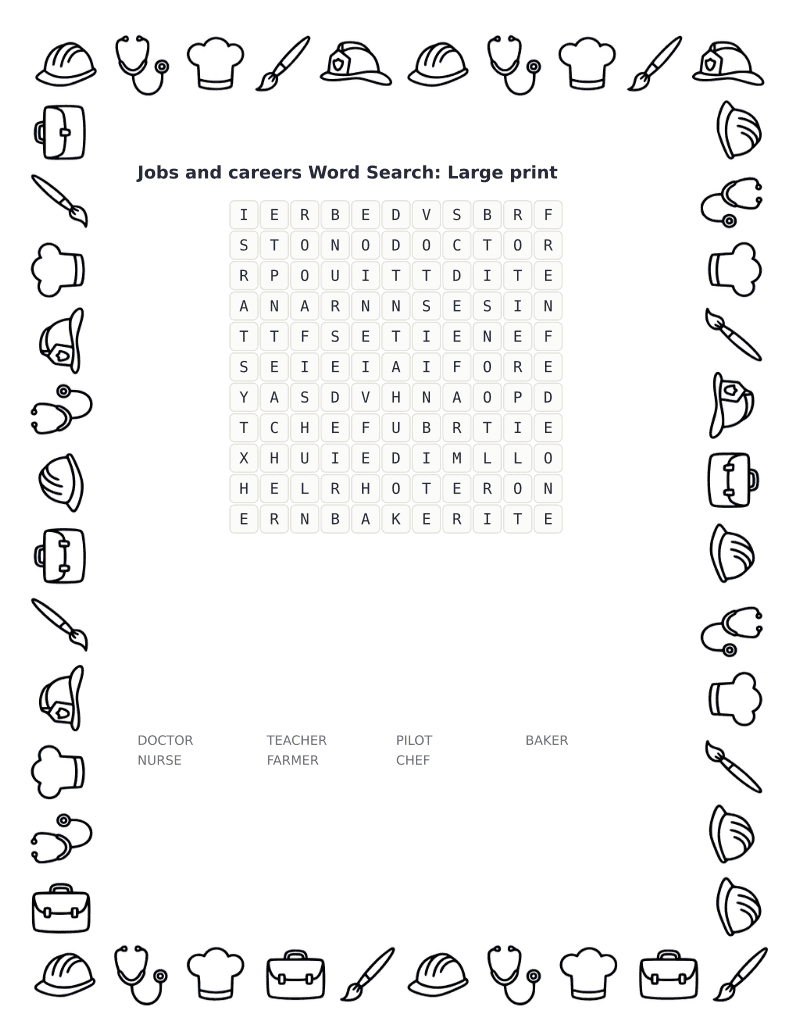 Jobs and careers word search, large print11 × 11 · 7 words · EasyDownload PDF ↓
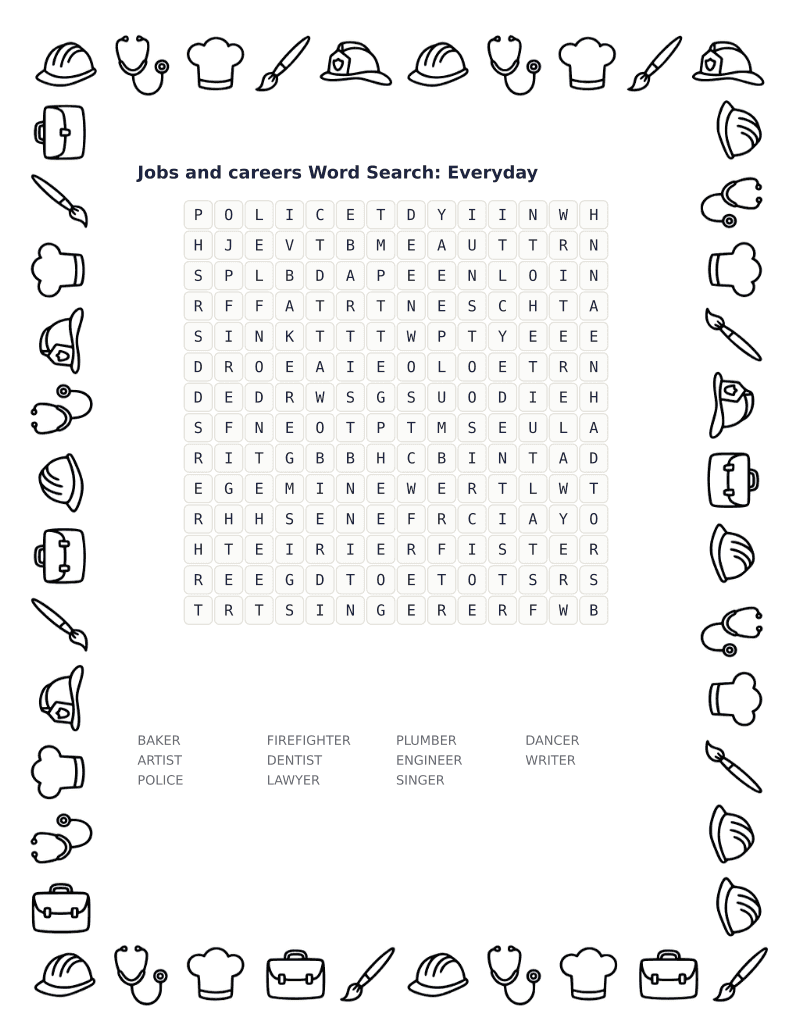 Jobs and careers word search, everyday14 × 14 · 11 words · MediumDownload PDF ↓
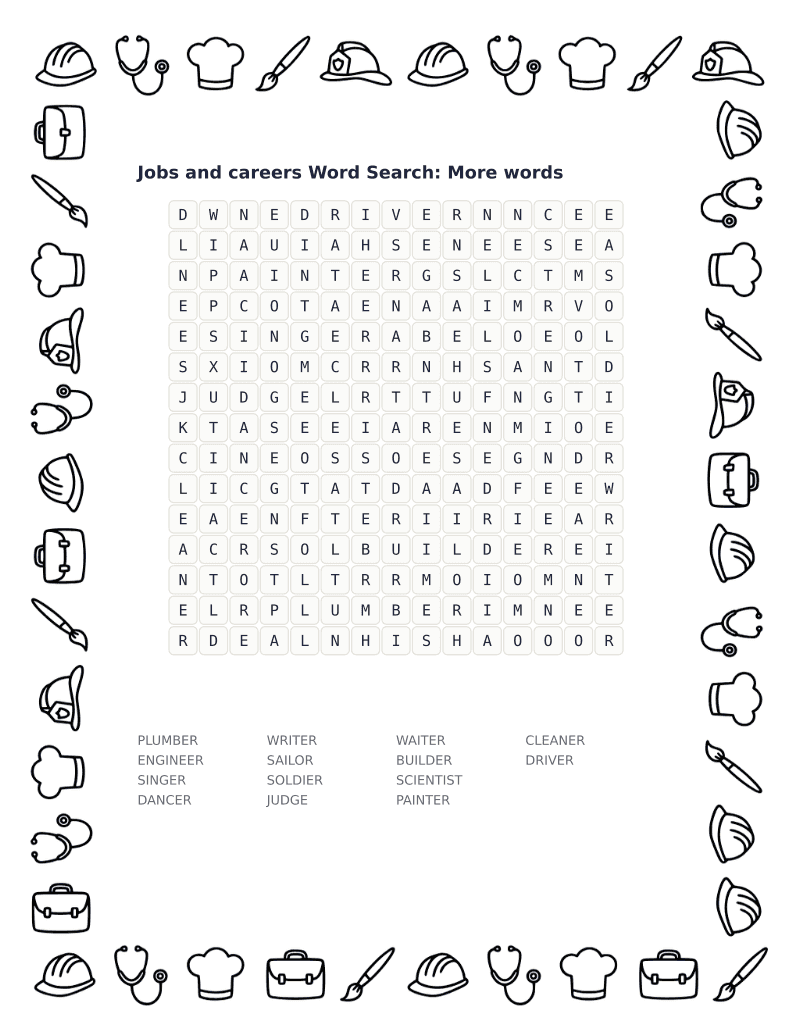 Jobs and careers word search, more words15 × 15 · 14 words · MediumDownload PDF ↓
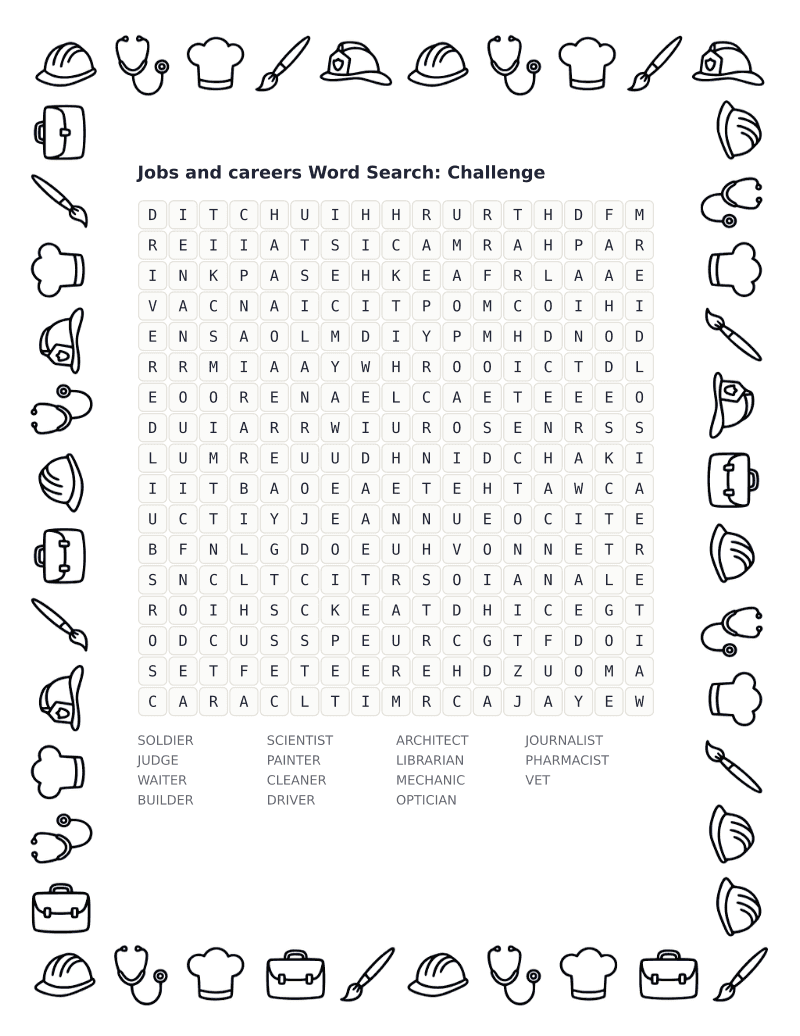 Jobs and careers word search, challenge17 × 17 · 15 words · HardDownload PDF ↓
Every sheet here is free to print as often as you like. If one saved you time, the tip jar is on Ko-fi.
The list opens with the jobs most children meet first, DOCTOR, NURSE and TEACHER, and most of the less familiar titles come further down. A job a child can already name makes for an easier puzzle, and one they cannot name makes for a better conversation afterwards.
It is a natural prompt for the obvious follow-up question, which is the real value: find the word, then say what that person actually does all day.
The four ready-made sheets take the list in order and overlap where they meet: BAKER is on both of the first two, PLUMBER to WRITER on the everyday and more-words sheets, and SOLDIER to DRIVER on the last two, so moving up a level brings back a few words already found, now hidden in a bigger grid.
The longest job is FIREFIGHTER at eleven letters, then JOURNALIST and PHARMACIST at ten, and ARCHITECT, LIBRARIAN, SCIENTIST and CARPENTER at nine. The large-print sheet uses none of them, its longest word being TEACHER at seven, which suits its 11 by 11 grid; the maker opens at fourteen squares, which gives the long ones room.
Twenty-one of the forty jobs end in er because the usual way English names a worker is to add er to what they do, and eleven of them are an everyday verb with that ending on the back: TEACHER, FARMER, BAKER, SINGER, DANCER, WRITER, WAITER, BUILDER, PAINTER, CLEANER and DRIVER. A child who can read bake, paint and drive can usually read the job as well, which makes these the easiest words on the sheets to decode. The rest of the er group is less obliging. PLUMBER has a B nobody says, SOLDIER and BUTCHER have no verb inside them at all, and ENGINEER ends in eer rather than plain er.
The remaining nineteen show the other endings English uses for a person. Six end in ist (ARTIST, DENTIST, SCIENTIST, JOURNALIST, PHARMACIST and FLORIST), two end in ian (LIBRARIAN and OPTICIAN), and three end in or (DOCTOR, SAILOR and TAILOR), where SAILOR and TAILOR both sound as though they ought to end in er. The last eight fit no pattern at all: NURSE, PILOT, CHEF, POLICE, JUDGE, ARCHITECT, MECHANIC and VET. Sorting the found words into those five groups takes ten minutes, needs no grading, and leaves a child with a better guess at the ending next time a new job turns up.
The large-print jobs sheet fits a community helpers unit best, because its seven words are DOCTOR, NURSE, TEACHER, FARMER, PILOT, CHEF and BAKER, jobs a young child can picture someone doing. None is longer than seven letters and every one runs across or down, so the reading is the whole task. The everyday sheet then adds POLICE and FIREFIGHTER, followed by DENTIST and PLUMBER, the people a family turns to when something has gone wrong. POLICE is the one word on the list that names a service rather than a person, so it is worth asking a child what the person who does the job is called.
Seven jobs never reach a printed sheet. FLORIST, BUTCHER, TAILOR, JEWELER, POTTER, GARDENER and CARPENTER sit at the end of the forty, past the last word the challenge sheet uses, and between them they are the traditional trades: people who make, grow or sell one kind of thing. The maker at the top of the page draws its words from all forty, so pressing New puzzle there can bring them in, or the seven can be typed as a list of their own. For a unit on local trades and the people who practice them, those seven make the better sheet.
For the youngest end of one. The least familiar jobs on the list, OPTICIAN, ARCHITECT, PHARMACIST and JOURNALIST, are all on the challenge sheet, and finding a word is a low-pressure way to be introduced to a job nobody in the family does.
Because it names the job whoever does it. Fireman is still the word many young children arrive with, and noticing the difference is a fair conversation to have. If your class uses another word, the maker above takes your own list and will place it just as happily.
Yes: switch the maker at the top of the page from the theme to your own words and type them in, up to twenty-five, each at least three letters long. Two-word titles lose their space, so lunch lady prints as one run of letters, and single words such as custodian or receptionist read more clearly.
New printables when they go up, mostly seasonal, a few times a year.