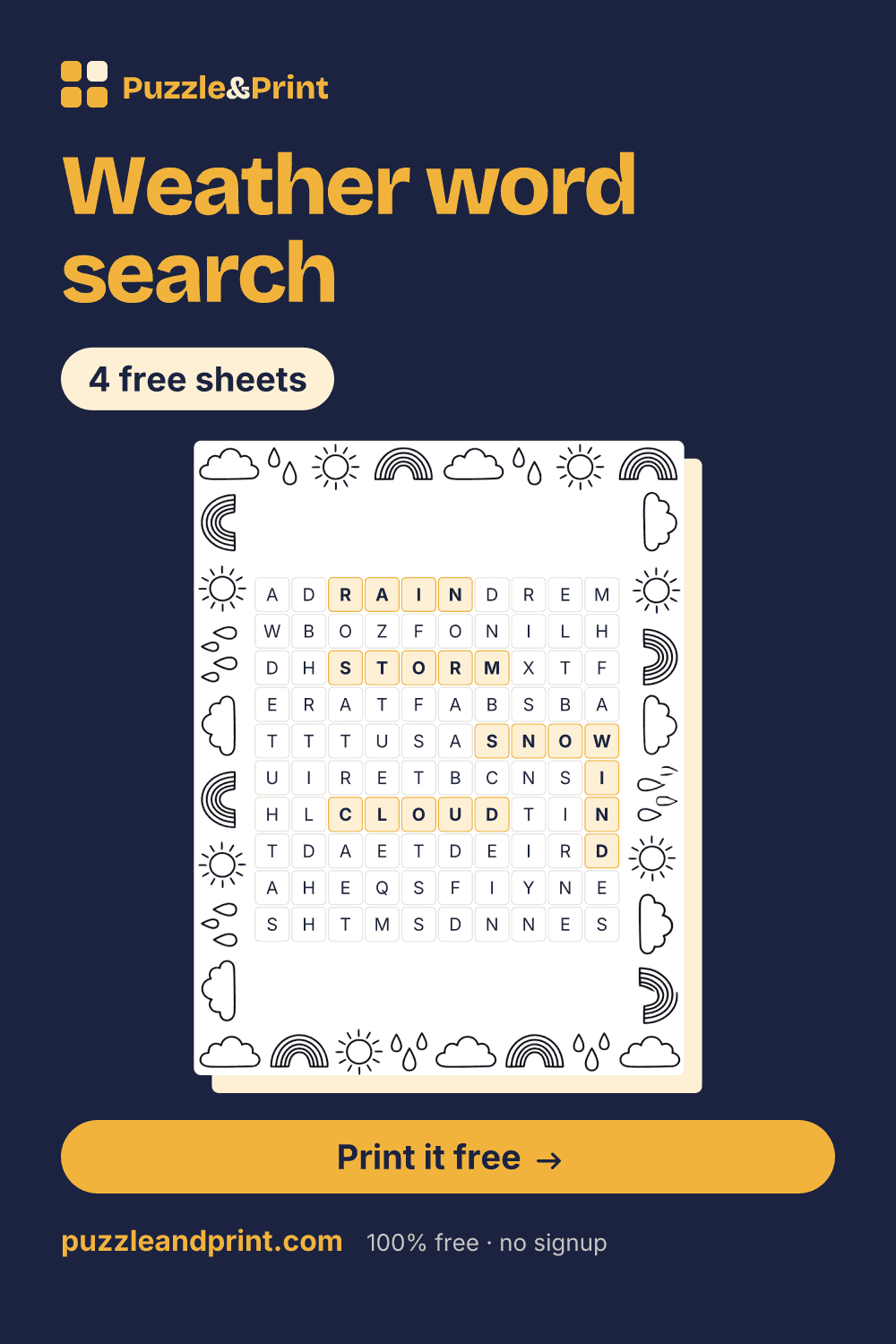
Weather Word Search
- HURRICANE
- SLEET
- SNOW
- THAW
- STORM
- SUNBEAM
- LIGHTNING
- SHOWER
- RAIN
- MONSOON
- GALE
- WIND
Created for free at puzzleandprint.com
Weather Word Search
Created for free at puzzleandprint.com
Weather Word Search, Answer Key
Created for free at puzzleandprint.com
Four sheets, each with a different job. Every one is a two-page PDF, the puzzle, then the answer key on its own page.
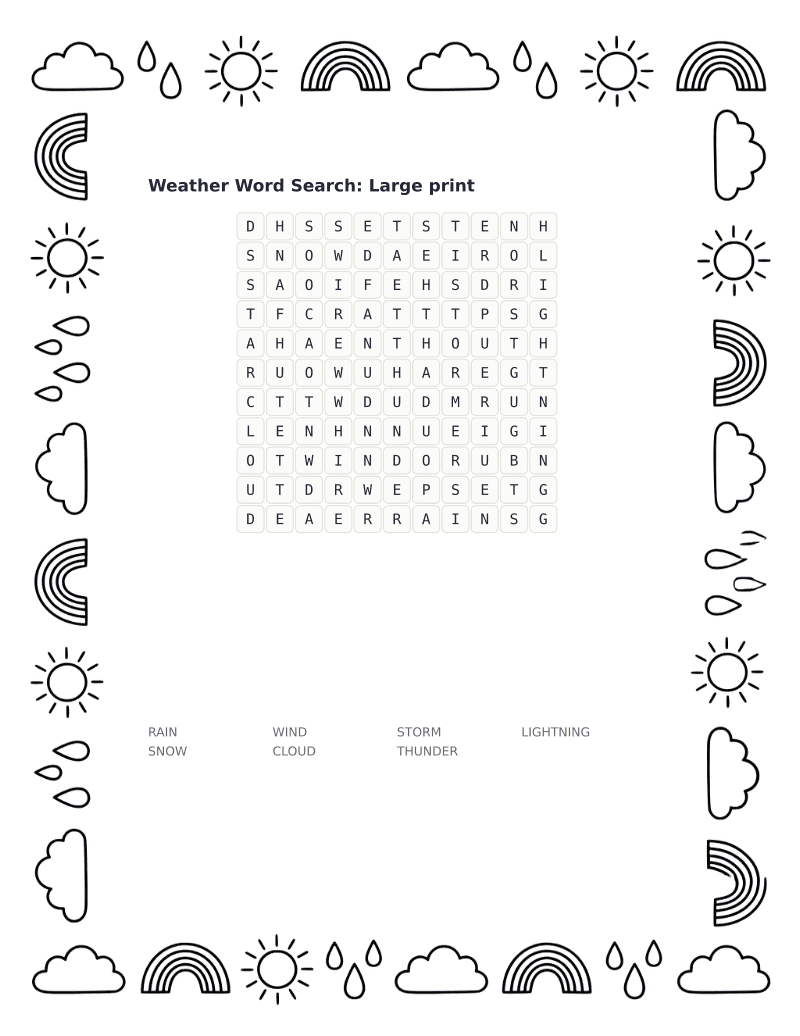 Weather word search, large print11 × 11 · 7 words · EasyDownload PDF ↓
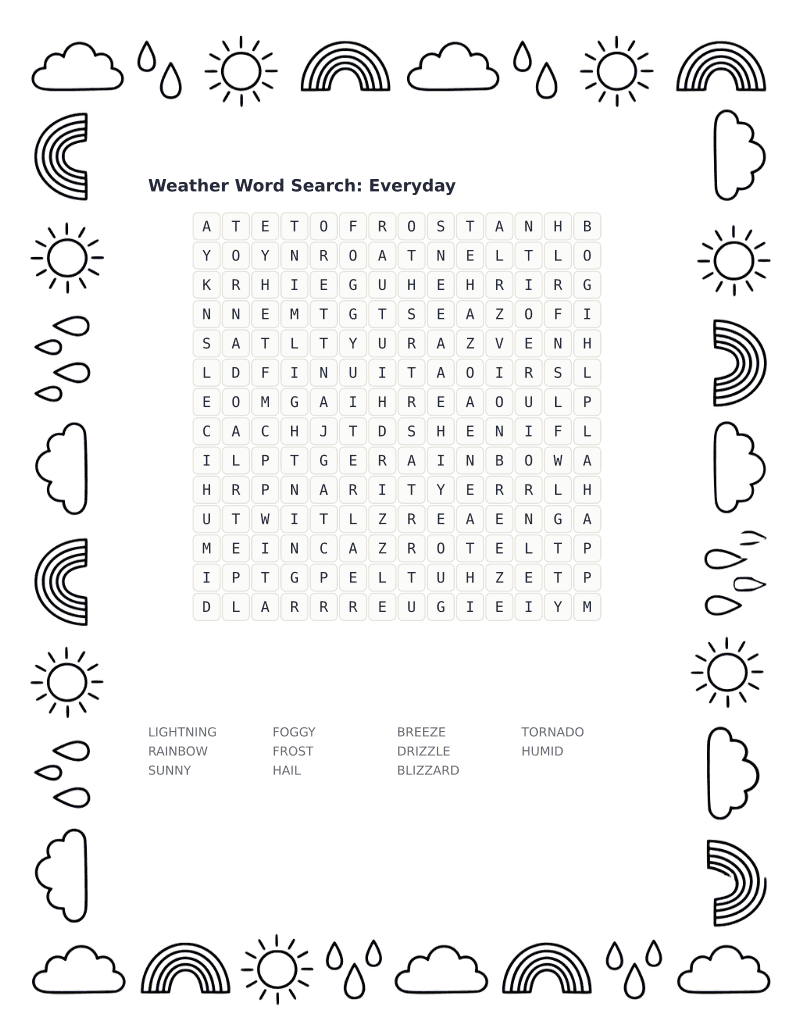 Weather word search, everyday14 × 14 · 11 words · MediumDownload PDF ↓
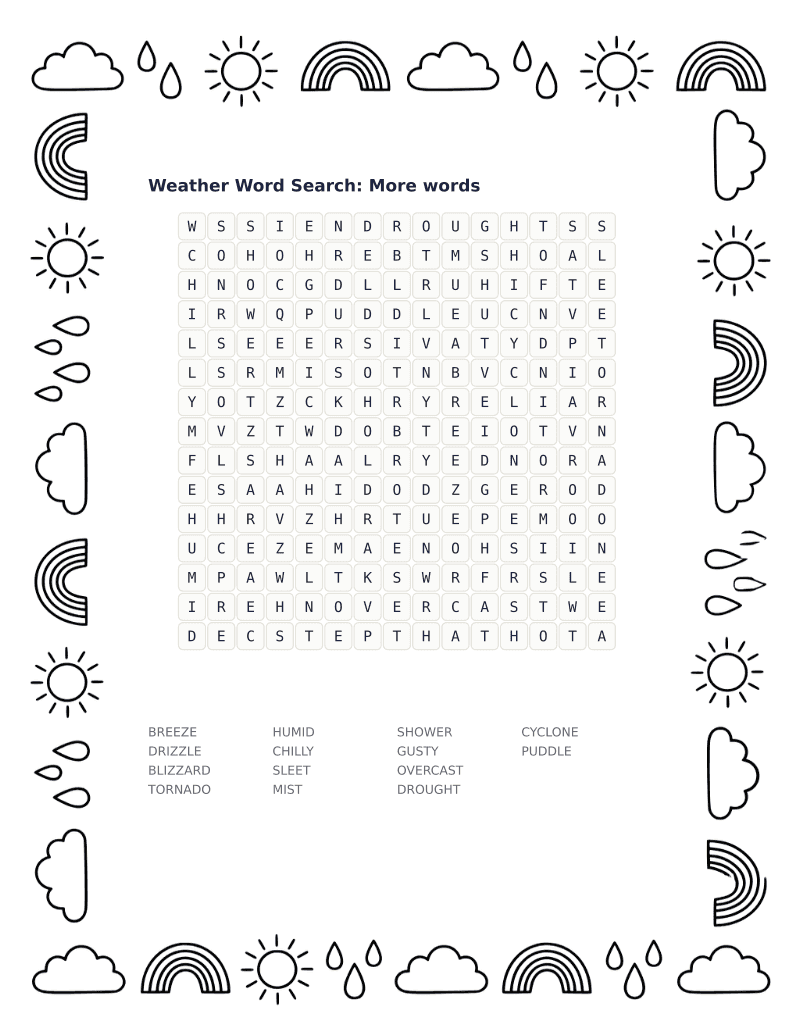 Weather word search, more words15 × 15 · 14 words · MediumDownload PDF ↓
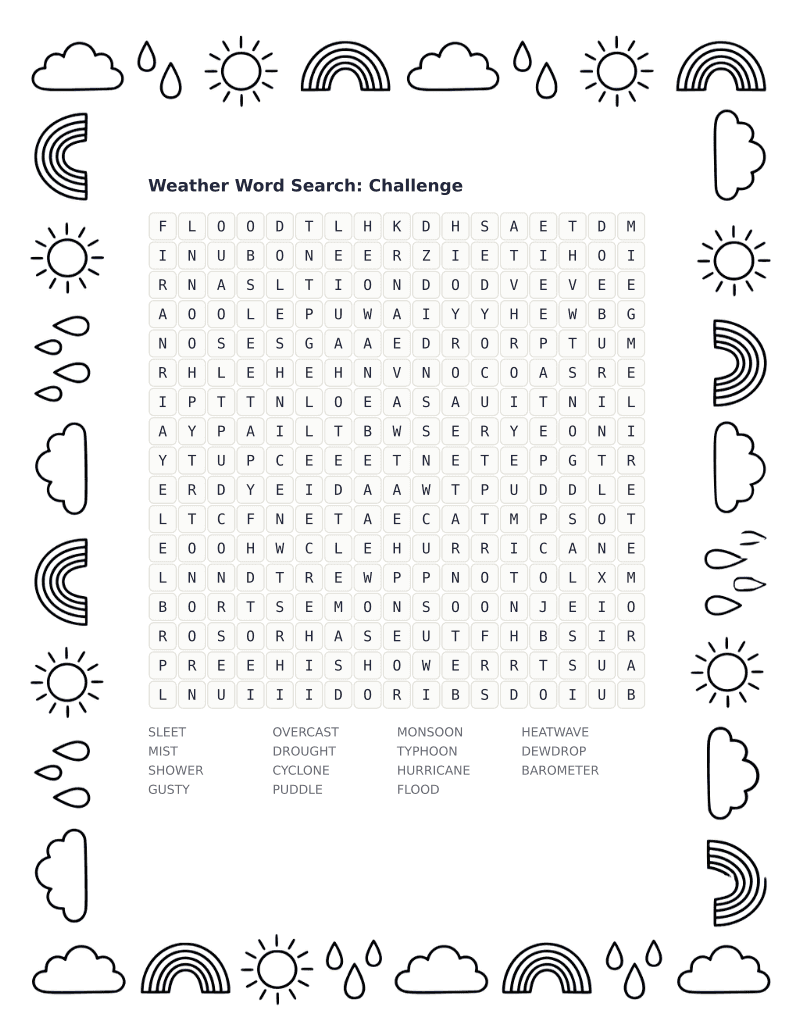 Weather word search, challenge17 × 17 · 15 words · HardDownload PDF ↓
Every sheet here is free to print as often as you like. If one saved you time, the tip jar is on Ko-fi.
Weather words are useful because they are immediately checkable against the window, which is rare in vocabulary work. A child can find "drizzle" and then tell you whether it is happening.
The list runs from the everyday to the dramatic, so it stretches across ages. For younger children, cut it to the short familiar ones; for older, the blizzard-and-cyclone end has more to chew on.
The four sheets work down the list in order, overlapping as they go: large print takes the first seven words, everyday runs LIGHTNING to HUMID, more words repeats five of those on its way to PUDDLE, and the challenge runs SLEET to BAROMETER.
A running weather chart pairs with this almost automatically: find the words on Monday, then mark off which ones actually turned up by Friday.
A HURRICANE, a TYPHOON and a CYCLONE are the same kind of storm, a huge spinning system that forms over warm sea, and the name changes with the ocean: hurricane in the Atlantic and the north-east Pacific, typhoon in the north-west Pacific, and cyclone in the Indian Ocean and the South Pacific. All three are on the challenge sheet, so a child who finds them can be told they have found one storm three times. A TORNADO is a different thing, a narrow spinning funnel that reaches down from a thunderstorm, usually over land and far smaller. TORNADO is on the everyday and more-words sheets.
MONSOON, also on the challenge sheet, is not a storm at all but a seasonal change in the wind that brings months of heavy rain to parts of Asia and elsewhere. DROUGHT and FLOOD, a pair of opposites, are both on that sheet, and so is HEATWAVE, which makes the challenge sheet the one to print for a geography lesson on extreme weather. BAROMETER, the instrument that measures air pressure, looks like the odd one out, but falling pressure is one of the signs that a storm is coming, so it belongs among the storms more than it first appears to.
LIGHTNING, the flash in a thunderstorm, is spelled without the e that lightening has, because lightening is a different word that means making something lighter. The two sound almost the same, so the spelling has to be learned by eye rather than by ear, and LIGHTNING appears on both the large-print and everyday sheets, which gives a child two chances to see it written correctly. DROUGHT is the other trap on the list: its ough says ow, as in now, and nothing else on the forty is spelled that way. DRIZZLE and BLIZZARD each carry a double Z, and HURRICANE a double R.
Seven of the forty are two words joined together: RAINBOW, OVERCAST, HEATWAVE, DEWDROP, FORECAST, SUNBEAM and DOWNPOUR. OVERCAST and FORECAST share their ending, a neat way to show that cast can mean more than throwing. RAINBOW is on the everyday sheet, OVERCAST on the more-words and challenge sheets, and HEATWAVE and DEWDROP on the challenge sheet, while FORECAST, SUNBEAM and DOWNPOUR are on the list but on none of the printed four. Pulling each compound apart into its two halves shows a child that a long word is often two short ones, which is a habit worth more than the puzzle.
Yes, though the chart words are split across two sheets: SUNNY and FOGGY are on the everyday sheet, while CHILLY, GUSTY and OVERCAST are on the more-words sheet. To get all five on one page, type them into the maker on this page with RAIN, SNOW and WIND, and print a single sheet that matches the classroom chart.
Because the differences are the interesting part: DRIZZLE, SHOWER and DOWNPOUR are rain at three strengths, light to heavy, and SLEET is rain and snow falling together. DRIZZLE, SHOWER and SLEET are all on the more-words sheet, but DOWNPOUR is on none of the four, so add it in the maker on this page to put the three strengths in order.
The large-print sheet suits children from about five, with seven words, RAIN, SNOW, WIND, CLOUD, STORM, THUNDER and LIGHTNING, running only across and down. The everyday and more-words sheets suit most of an elementary class, and the challenge sheet, where words can also run backwards and upwards, is better kept for children of nine or ten and for adults.
New printables when they go up, mostly seasonal, a few times a year.